What worked for me, was when I changed my mentality to treat weight loss and keeping weight off as part of my identity and not as a goal I have to work hard towards to. My identity is that I want a healthy life. It is something that I will do for the rest of my life, so falling off the wagon every now and then is not much of a problem, it's normal, I'm human!
Did I overeat one or two days? No regrets. I don't have a goal that now moved further. It is what it is. Today is a new day and I'll do what I normally do. Did I hit a plateau? Well, what can I do? My identity still says I should eat sensibly. I stayed off processed foods this week? Check. Did I consume excess sugar or soda? No. Ate my greens? Yip! So, my lifestyle is healthy no matter what the scale says. Did I go out with friends and overindulged? Hey, that's a healthy lifestyle too! Just don't do it very often.
Sure, I can give more practical advice and do think that OP is way too early to announce victory after just one month, but it's a journey, you have to experience some things on your own.
I'll just comment on calorie counting. Once upon a time I used to count calories to single digit accuracy. It's not needed. Keep a rough track of your macros as some people say (protein and carbs are aroung 4KCal/gram, fat is around 9KCal/gram) and you will be fine.
ZERO cheating. Not a single beer. Not a single extra bite. Managed this for 3 months, losing 15 kg. Then occasional cheating for 6 months, losing 0 kg... Then managed once more for 3 months, lost another 15 kg. This is the hard part, I managed by introducing the following habits:
Same "default" meal every day. Chicken with broccoli, day in day out. It's not the best nutrition advice, but not having to think what to buy and what to cook is a huge factor.
Drinking a lot of water. 3 litres a day. I'd basically put two 1.5 liter bottles of water on my desk and made sure to drink all of it. Simple, effective.
Mindset shift. Told myself "I don't eat sweets" and "I don't drink alcohol" - sounds stupid, but very efficient to have preprogrammed reaction when facing a temptation.
I've lost about the same amount but have since regained about 12kg and have been sitting about 7kg more than I would like for some time.
I've been asked what I did to lose weight but I really don't have a good answer for it. At a couple points in my life I've decided to take dieting very seriously. "ZERO cheating" works when you are serious. Other times I've started "seriously" and the eventual work party, birthday, vacation, etc throws me off and I lose motivation.
I wish I could tell someone what I did to make the mindset change necessary to diet seriously, but I can't figure it out myself.
I am in the same situation: Roughly at a time where I moved to a new house I decided to loose weight (133kg). In 2.5 years I lost 40kg, for 6 months I stayed in a plateau, then in the next year I regained 20. Since two years my weight is more or less stable.
Today I am, like you, not sure why I loose so much weight, why I had a plateau, then why my weight went up again.
On the 'default meal' thing, I actually find I become essentially physically unable to eat the same meal for more than a week. For important psychological reasons, I suggest changing up any 'default' meal on a weekly basis. If that's too much effort then, well, your chances of success are poor anyway.
Yes, exactly! Zero cheating and accurate measurements seem to be paramount. I'm glad for some of the others posters who could take a more lax approach and only eyeball stuff or vaguely count macro, but that didn't work for me at all.
It is indeed true that calorific deficit and accurate measurements is the best way to predictable weight loss.
But can you eat chicken and brocoli for the rest of your life? Can you do zero cheating and accurate measurements for ever? Is losing 15 kgrs in 3 months healthy? It is very easy to take the weight back and then some. There is a reason we have the term yo-yo dieting. :(
Food is sustainance, but also is enjoyment. Following a more lax approach where you ease into a better diet and keep enjoying food is a more sustainable long-term approach. Lose 15kgrs in one year instead of 3 months and magical things will happen.
After 3 months of hard dieting you will probably reach for a chocolate during a crave. After 12 months of moderate dieting, you will reach for an apple and you will enjoy it as much as a chocolate. Reprogramming ourselves takes time.
Can you eat chicken + broccoli for the rest of your life? No you can't. But it teaches you to ditch all crap from your fridge and find good unprocessed stuff. Boy, who doesn't love a piece of steak with just grilled veggies, or a good roasted fish with just a nice salad? Why fill yourself with potatoes, rice, etc. if you can have good meat.
Is losing 15 kgrs in 3 months healthy? It's healthier than staying fat..
breakfast: slice of rye bread with low-fat curd
1st snack: an apple
lunch: chicken breast + broccoli
2nd snack: an apple
dinner: chicken breast + broccoli
Of course I did sometimes eat something different. But having the default always readily available was paramount.
Btw broccoli is amazing - you cook it for exactly 3 and half minutes and you have half a kilo of warm healthy veggies that fills you for hours. I haven't found anything else that comes even close to broccoli "efficiency".
The problem with these types of posts is that while there's a grain of truth in there (burn more calories than you take in), we're still not able to easily determine a number of key pieces of information that would allow us to really understand how to be successful:
1) How many calories do you need at your target weight?
2) What is your basal metabolic rate?
3) As you cut out calories and lose weight, how much is your basal metabolic rate changing?
The problem is that for people who are predisposed to store excess energy as fat rather than burning it off, as we cut back on our calories, our body reacts by becoming more efficient to try to avoid emptying out our fat stores.
This means that for some people losing a pound a week could require cutting out anywhere from 500-1000 calories per day. --So when people suggest cutting out 500 calories per day, and you either don't see any loss or you see a much lower loss than the pound per week, that can be even more demoralizing than trying to cut out 1000 calories per day if you knew that would allow you to average that pound a week of loss.
That's mostly wrong. Everyone is predisposed to store excess energy as fat. Cutting back calories doesn't cause a significant increase in metabolic efficiency (unless you're really suffering from starvation which wouldn't apply to anyone on a regular calorie restriction diet). The reason that weight loss tends to slow down for most people on diets is that it simply takes less energy to maintain a lower body mass. So to sustain the same rate of weight loss they would have to keep decreasing calorie intake.
Resting metabolic rate tests are widely available for about $75. You just sit in a chair for a few minutes while a machine measures your exhalations. This is worth doing occasionally if you can afford it to establish an accurate baseline. A lot of people blame their failure to lose weight on a "slow metabolism" which is almost never correct: metabolic rates for individuals with a given height, weight, and sex differ by only a few percent.
The various studies done also show that most people regain the weight back 6 months to a year down the line. Right now the only thing we can be sure of is that weight loss only works for the minority in the long term and the only way to be slim is to always be that way.
We did at least work out why processed foods appeared to be more calories, turns out we spend about 20% more energy digesting food that isn't highly processed. Which also goes to show that calories in calories out is far over simplified when people are suggesting deficits that could easily be less than 20% of daily intake.
It is a chemical process and a very complex one at that and right now food science is basically garbage tier with very little in the way of good studies, most of the better end is on mice and rats.
Yes, keeping weight off over the long haul is extremely difficult, and only gets harder the more weight you lose. I know that for myself, beyond having to try and watch what I'm eating, I also have to stay much more active than the average person because I know that I have a slow metabolism - my body wants to hang on to every bit of energy it can.
I think there is proper research going on when it comes to food science, and weight loss, but finding the good studies among the junk is difficult. We do know that there are some drugs and supplements that have moderate effects, but mostly by acting as an appetite suppressant.
It is highly unlikely that you really have a "slow metabolism". Outside of a few rare medical conditions, metabolic rates only vary by a few percent for a given height, weight, and sex. It's more likely that you're underestimating calorie consumption. I recommend getting a resting metabolic rate test to accurately quantify your baseline.
Well, to give another point of view: I think it is pretty much understood, what is healthy and what is not and also what leads to weight loss and what doesn't.
People not sticking with it is really an added point to the reality that calories in/out is a very poor model for losing weight, even if it is completely correct at a physical level.
It depends. Do you see losing weight as a purely physical phenomenon, or do you see it as one that's heavily influenced by psychology and other such factors? The actual physical act of losing weight i.e. reducing one's mass needs to be distinguished, in my opinion, from all the factors that actually go into that. If it turns out that in response to hunger that your brain secretes a hormone that makes you much more hungry than the average, the psychological aspect of losing weight has been compromised, even while the physical laws stay the same.
Of course psychology comes into play. I'd know, that's what kept me from making progress with this for years. But that does not subtract from the fact that to lose weight you need to consume less calories.
> If it turns out that in response to hunger that your brain secretes a hormone that makes you much more hungry than the average, the psychological aspect of losing weight has been compromised, even while the physical laws stay the same.
I don't agree. You lose weight by eating less calories. If you need to manage your implementation of that technique because you have some condition that deviates from the norm, sure, that's something you have to deal with.
To return to my exercise analogy, I have a medical condition that makes exercise difficult. So I have to work around my unique limitation. But I don't go around saying that doing cardio and working out is not the correct way of getting fit.
My point isn't that 'cardio and working out' are not how one gets fit, it's that achieving 'fitness' is more than 'cardio and working out'. The words are overloaded, and I think your very last sentence illustrates that well. I also tossed up between physiological and psychological, but reasoned for my purposes they were similar enough to get the point across - i.e. that despite the physical laws being simple, the actual process is not.
I don’t know why people subscribe to arbitrary numbers on the internet vs just experimenting. If you want to lose weight, you eat less and burn more and that is it. Not losing enough weight? Don’t quit. Just run more and eat even less. Or run even more and maintain your diet.
There is no human that won’t shed weight like water off a roof if given energy expenditure coupled with restricted intake. And its easy to overwhelm yourself with energy expenditure if you wanted to still eat like a pig: start running up and down bleachers until you are on the verge of puking and watch the pounds fly off.
The reason why so many people are overweight is because they spend their life sitting in bed, sitting at work, sitting in their car, burning tens of calories. Then they try cutting out a 300 cal muffin from their daily intake and wonder why it takes 6 months to lose 5 lbs. You need activity, especially if you don’t have activity in your life. It’s who we are as animals. Early humans would walk game down until it was exhausted and sitting down no longer able to even stand. Then our ancestors would calmly walk up to the delirious antelope on the verge of death and poke it with a stick or beat it with a rock. Today, no one bothers making time to burn those calories, and that’s ultimately why people get fat. Modern suburban living has coddled us from physical activity, such as walking.
>Most studies suggested that for most people, the amount of calories consumed determines your weight. Hormonal factor exist, but they're either negligible or for a very, very, VERY small part of the population. You're likely not it.
And the correlary: "Tons of people will nevertheless protest that that's it their case even when it isn't". It's the "It's not my program, it's a compiler bug" of dieting...
Calorie counting doesn't work for me, I'm just not disciplined enough. I learned a shortcut, which might not work for others: I try to go a bit hungry. If I'm hungry, I'm in calorie deficit. I might even get a bit cold. Turns out I can just listen to the hunger feeling and know whether I'm currently losing or gaining weight. But walking past a bakery, inhaling the smell of fresh bread... Can't say I'm always able to resist.
Some other simplifications:
- I don't keep food at home anymore. Only rice and some bland tasting astronaut food which I can only tolerate when hungry enough.
- I love sugar, and I'm cheating my brain by drinking cola zero. I've gotten so used to it by now that I actually really like the taste and it feels like getting a sugar fix.
- No fixed meals: Only eating when actually hungry, not because it is time.
That's actually not true. When your stomach has been empty for two hours, it begins contracting to sweep remaining food into the intestines. This rumbling is called 'borborygmus'. Cells in the stomach and intestine produce ghrelin, a hormone that triggers feelings of hunger.
Src: https://www.sciencefocus.com/the-human-body/what-happens-in-...
So, the body isn't so clever to recognize how much fat you've stored before sending 'hunger' signals.
Upon reflection, you're probably partially correct too. There are other factors apart from the level of food in the stomach, and I'm not knowledgeable enough to make definitive statements. For example, the amount of fibre you ingest has an effect on how long you feel stuffed.
Being disciplined is the only way to lose weight. All these magic techniques and whatnot are just shortcuts to cheat you into being more disciplined. And what works here is different for everyone.
I agree. I guess I just wanted to say that calorie counting was a kind of discipline I could not muster (like many), and that there might be simpler strategies which could work out for you. Still requires discipline.
For me intermittent fasting, eating lots of fiber, cooking instead of eating out and avoiding sugar at all costs. You know just treat food with the same respect that you would give to medicine: it can heal you or make you ill.
And it's horrible for your body. It's still releasing insulin, but there's no sugar to meet it. So you're driving toward metabolic syndrome without putting on the pounds.
> And for exercise it would be just as simple. I would do weight training 3x a week, ala Starting Strength, because it's the only form of exercise I actually enjoy doing. That's it. Beyond that would just be whatever recreational activities we did with friends over weekends.
Weight training can be very helpful for weight loss in a way that is distinct from cardio exercise. Everyone's body is different though -- for some people cardio is all they need. See the book Cardio Sucks by Michael Matthews for a defense of weight training over cardio though.
And doing something that is fun -- something that you enjoy doing, is key. This applies to both diet and exercise and pretty much everything in life that you want to sustain.
I went from 82kg down to 67kg and have kept it off for 4 years.
I'm happier, more mentally stable, and more free in my thoughts.
I agree with the main argument you make - measure what you eat, and decrease it, but not too rapidly, and stick with it.
I agree with your main food recommendation of keeping it natural: "only vegetables, fruit, lean meats, eggs, all seasoned with herbs and salt only - not sauces and very little oils."
Regular big salad lunches keep you feeling full. Learn how to wash and store a whole lettuce and make salad dressing in bulk. With those staples in your fridge, you'll be able to whip up a tasty salad with little preparation time and little effort.
However, I urge caution with this recommendation, which is against your main recommendation and in my experience is not helpful: "Diet drinks and fat free yogurt are fine for those sweet-tooth cravings."
Fat free yogurt is full of sugar and should be strongly avoided. Sugar is the biggest threat to weight loss because the calories from sugar go straight to fat, and the sudden increase in high glycemic index input triggers an insulin response, which makes you feel like a yo-yo merry-go-round of energy/despair.
Diet drinks should also be avoided. Whilst they don't contain sugar, the artificial sweeteners are so unnaturally sweet they will cause your brain to habitually crave sweet things. If you stick to water and natural foods you will lose these cravings after a few weeks and you won't need to revisit them.
Kudos for keeping it off that long, that's incredible.
WRT the diet drinks, I know they're bad. I found I can get some pretty bad migraines if I drink them too often. I try to keep it for once or twice on the weekends though, as a small treat. But I'll try cutting them out completely and see what happens.
Thanks! It is actually no effort, because the change to fresh foods away from processed foods and sugars makes me feel constantly sated, instead of cycling between hungry and full.
>Sugar is the biggest threat to weight loss because the calories from sugar go straight to fat, and the sudden increase in high glycemic index input triggers an insulin response, which makes you feel like a yo-yo merry-go-round of energy/despair.
I've had problems with fatigue/low energy for a while now - I always crash in the afternoon around 2pm, roughly three hours after eating my first meal of the day. After doing some research I decided to cut out sugar and flour in the morning, and the results have been dramatic. My problems with energy and fatigue were getting so bad that I was starting to think I had a chronic illness - nope, just crashing from insulin every day!
AFAIK it's just fructose in the absence of fiber that mostly goes into fat by default. Glucose is mostly stored as glycogen in muscle and liver, but excess glucose is also stored as fat. I fully agree with you wrt sweet foods, they don't make you satient. In general, avoid everything that has High Fructose Corn Syrup in it. It's one of the biggest contributors to the obesity epidemic of the US.
For eating large amounts of lettuce, I found small amount of grated parmigiano reggiano on top makes it incredibly enjoyable.
I had a similar result, although without having to go to quite the same lengths on calorie counting - all I had to do was fix lunch.
There was a time when I had a flat stomach etc., but it was in my twenties when I rowing 3-5 times a week. You need plenty of calories to sustain that and I never got out of the habit. That combined with 20 year old metabolism and a free canteen at work meant that in addition to a big dinner, I was having a full hot lunch with dessert. This habit of a big lunch (although maybe not with dessert) carried on into my thirties and after I stopped rowing.
I'd tried to 'just have less lunch' and proved to be bad at resisting the options in the canteen. I took the opportunity of starting to work from home a couple of years ago to set a habit of having Huel for lunch. It meant that it was a very consistent amount of food and I just cheat by having a larger portion. I didn't have any problem with patience as long as I saw the weight continuing to trend down, which it did from 95Kg to the low eighties.
While I still have Huel sometimes, I've stopped using it consistently as I'm pretty sure I was experiencing the testosterone depressing effect of all the flax seed. A year of it reset my expectations over lunch portions that I can cope without it though.
In terms of variations on weight measurements, I've found that weighing myself first thing in the morning, after shower and visit to the toilet (but before breakfast) reduced the noise significantly to the extent it was rarely more than +/1 1kg
Several years ago I dropped 25-30 pounds in 3 months without exercise. I drastically dropped my carbs and increased my fat in take and Saturdays were my cheat days. This was bad for my cardio but I really trimmed up and it required a tremendous amount of discipline.
I have found that long distance running also resulted in some weight loss. After 3 months of running on a treadmill I gradually increased my distance until I was running an 8 minute mile pace for 50 minutes, which is about a 10K. This was much healthier than dieting. Even though it required extensive time and effort it felt like less discipline than dieting and I wasn't so limited on what I could eat. The exercise allowed me to trim up, but I only lost a little bit of weight. The running resulted in a low resting pulse rate of about 42bpm.
I've done basically the same thing a couple times over the last 10 years. First time I lost 40 pounds or so over a period of 6 months. After a few years, my weight slowly started to rise up a bit, so I had another period of caloric restriction. I lost 25 pounds over two months.
I think the most important part is simply counting your calories. You can't manage what you can't measure. You'd be surprised just how quickly you can get to your daily caloric limit with a few snacks and one large meal.
Now days I don't stress too much about my eating. I still try to keep a caloric balance, but I also know exactly how to lose the weight again if it starts to go up too much.
I'm 58 and I've lost over 30 lbs (180 - 149) in the last 5 months. I've used basically the same technique you describe. I've tracked every calorie and learned how to prepare mostly plant-based (raw, whole food) meals. However, I exercised more than you describe. I like to walk so I've been walking 25-40 miles/week. When I walk I can eat more and stay within my calorie deficit goal It became a virtuous motivational feedback loop for me. The other benefit of the exercise is that I haven't seen any indication of muscle or strength loss while losing the fat.
I have a simple system that works for ME. Basically I eat once a day. I have a full lunch and that's it for the day. I do not fell hungry,specially in the morning where for some reason I just can't eat.
I did the inverse - just stopped having lunch - and that works for me. I also don't feel hungry.
For me, lunch was usually some low quality food grabbed in a hurry, and so it was the easiest meal to cut out. But the main reason to cut lunch was that I always got sleepy mid afternoon, and falling asleep in meetings isn't really acceptable. Not having lunch makes my afternoons much more effective, which is great as I'm not really a morning person.
The OP description matches my experience fairly accurately - I lost ~9 kg in 4 months (yay!) using essentially the same routine.
Prior to this, I've done IF (18:6) for 18 months without any visible weight loss simply because I was ingesting the same amount of food just in a shorter interval.
It really started working when, in addition to the IF (which I kept for other benefits), I started restricting my calorie intake - not counting calories, but simply setting a reasonable portion size and sticking to it, only reducing slightly after 7-10 days of lack of progress.
Other things that helped me greatly:
-don't sit at the eating table while being (really) hungry!
I have a snack (fresh fruits, vegetables, various nuts) 1 hour before the actual meal, such that when sat at the table I am in control, and can stop eating easily.
-prepare your food, place it on a plate, take a picture and send it to a friend before starting to eat!
I used to start eating as I was preparing the food, and it becomes hard to keep track of how much you ingested. Plus, when you take a picture to send it to someone else, you look at it with different eyes, and it jumps out at you: Hey,this is a lot of food!)
I've had amazing results with myfitnesspal (free). The only discipline you need is to enter the calories and keep under the daily calories it tells you.
It's so scientific, linear and predictable that it makes you wonder why people bother with all these weight loss shenanigans when weight loss is as simple as calories in vs calories out (at least that's how it was in my case)
I use intermittent fasting approach. 16/8h natural rhythm. I'm not only loosing weight, but I also feel great. Anger caused by hunger is not longer an issue, it just completely disappeared. My body response to temperatures is way more balanced. I stopped being sick periodically. Every day I feel amazed, how such a simple change can improve life quality.
I’ve made a SaaS app that essentially automated what the author is describing. In most circles it’s referred to as “flexible eating”.
My wife struggled with keeping weight off and counting macros has been the only effective way to do it, but it’s insanely exhausting, especially with kids who you need to feed too. We worked from a spreadsheet for about a year until I automated everything and now we (and others!) get automated meal plans once a week with genuine, easy recipes that hit your calorie requirement. It’s like EatThisMuch but specifically for Australians and generates much more realistic meal plans. Of course, nothing is ever perfect for everyone, but it’s a great foundation.
My tip is be comfortable with eating MORE sometimes. Going out for dinner with mates? It’s fine, as long as it’s not a regular thing. Movies with popcorn and coke? That’s okay too! “Flexible eating” works well when it becomes a lifestyle, not just an 8 week plan.
So the "secret" is to take diet seriously? Not to dismiss his great achievements, but when I did read that he had tried every diet under the sun, I would have expected that calorie counting would have been part of it.
Caloric restriction worked great pre-1980's. If you could stick to 'simple foods', like the author advocates, it still works.
The reason why so many people dismiss it is that from the 1980's onward food was starting to get designed for overeating, and labeling requirements were starting to be gamed so the calories listed on these designed foods (and that includes nearly everything today) no longer have as high straightforward correlation with the 'calories' measured in 'simple' foods of old.
It goes back a lot further than that. The moment we started tinning food and making long life carbohydrates the equation completely changed. They take so much less energy to digest than their counterparts but its even deeper. Have a read into the difference in flour making over the past century and how industrial processes and wheat variants have gone hand in hand to remove all the fiber from bread. We have been adjusting our food to increase calory density and reduce the cost of digestion for thousands of years but it really accelerated in the past 120.
A Kilo Calory is the energy extracted in burning it, our body doesn't burn fuel it chemically converts it into different substances, the processes are so different since one conserves mass and the other does not. It is a terrible measure given plant fibre burns well and produces lots of energy and hence has lots of calories but plant fibre generally goes right through us since we can't digest a lot of it. The entire thing is a bit rotten from a science point of view. Reducing how much we eat sort of works, for some people, changing to more natural foods works for others, changing to fats and protein exclusively for others etc etc. Few studies show the majority of people loosing fat long term. All this to me points to the fact we don't have this figured out at all yet.
It has more to do with the glycemic index of the food, that is now satient it is. 300kcal of rye bread (low GI) keeps your blood sugar much more even much longer than 300kcal candy bar (high GI). Both are "processed foods" but one is much more healthy than the other. Whole foods like fruits, vegetables etc. have almost always low GI: https://www.health.harvard.edu/diseases-and-conditions/glyce...
I agree, 1 month is nothing in the weight management game. I lost about half my body weight (>150lbs) years ago and have been up and down in a 40lb range around there ever since. It's a constant fight against the parts of your mind that are concerned about starving to death and/or are addicted to food. It doesn't take much for them to start winning either, some extra stress and a slightly more relaxed approach to eating will sneak up on you.
I think that the reason OP is excited is not the weight loss per se, but because of the realisation that it happened in a way that feels sustainable long term.
For me, the key thing has been to find sustainable exercise. I don't enjoy running so that's not sustainable.
Walking, or indoor exercise bike works for me, together with not keeping myself feeling full all day. Learning to live with a mild occasional feeling of "I'm a little hungry and I could eat something" without eating immediately is not that hard.
What initially worked for me was the 5:2 "diet". Eat for 5 days fast for 2, and i followed it for a couple of years, and in the first 3 months i lost 15kg. After that things kinda "flattened" out, i still stuck to it, but eventually i caved.
With 5:2 i would be miserable on fast days. The lack of food didn't bother me, but concentration, feeling cold, and trying to fit into a world that eats dinner at nights eventually got too much.
These days i'm more or less doing the sunrise-sunset routine, which seems more natural to me. I've never been a big breakfast person, and for most of my life i've skipped breakfast. The only thing i've added is skipping lunch, which is also easy in the "work from home" world we currently live in.
My family and i also have different rituals in the morning, so we're usually not up at the same time anyway. So i eat a normal size dinner with the family in the evening, and my "social life" is mostly intact while at the same time cutting calories by 1/4 or more.
The thing is, when you're used to "overeating" you're hungry all the time. Stuffing less food in your stomach causes it to shrink, meaning you'll feel full earlier, so contrary to what many people believe, you don't just consume a full days worth of calories in the evening (assuming you're not eating at McDonalds, which makes it very easy to consume 2500 kcal in one sitting).
In the end, calories is all that matters in weight loss. The less you eat the skinnier you get. There are healthy and unhealthy ways of doing calorie restriction, but if you eat less than your body consumes, you lose weight.
Edit: I should add that another thing i changed was that i'm not "religious" about it. If somebody invites me out for dinner, or the family just gathers for dinner during the weekend, i eat.
> First principles suggested I stop faffing around with diets that operate on clever narratives, assumptions and "magic" rules, and just look at what the science said. And the science was pretty consistent - calories matter above all else.
I don't believe 'the science' is consistent about this at all.
Tim Ferris cites lots of science when writing 'The Four Hour Body' a decade ago, and decades before that Atkins had a fair amount of science to back up similar observations & claims -- not all calories are equal.
Eschewing carbohydrates (a word that doesn't appear in TFA) and filling up on proteins (appears once in relation to a supplement) and fats (appears only twice - once referring to being fat as a child, the other as an adjective for yogurt) will get you most of the way 'there', if 'there' is gentle weight loss / management that's easier to maintain than calorie counting.
From my experience, progress is a good motivator to keep pushing it. When you start on low carb or something like Keto, you’ll get progress for sure. If you want more progress beyond that, you will simply not be able to deny that a calorie is a calorie. You have to reduce calories, period.
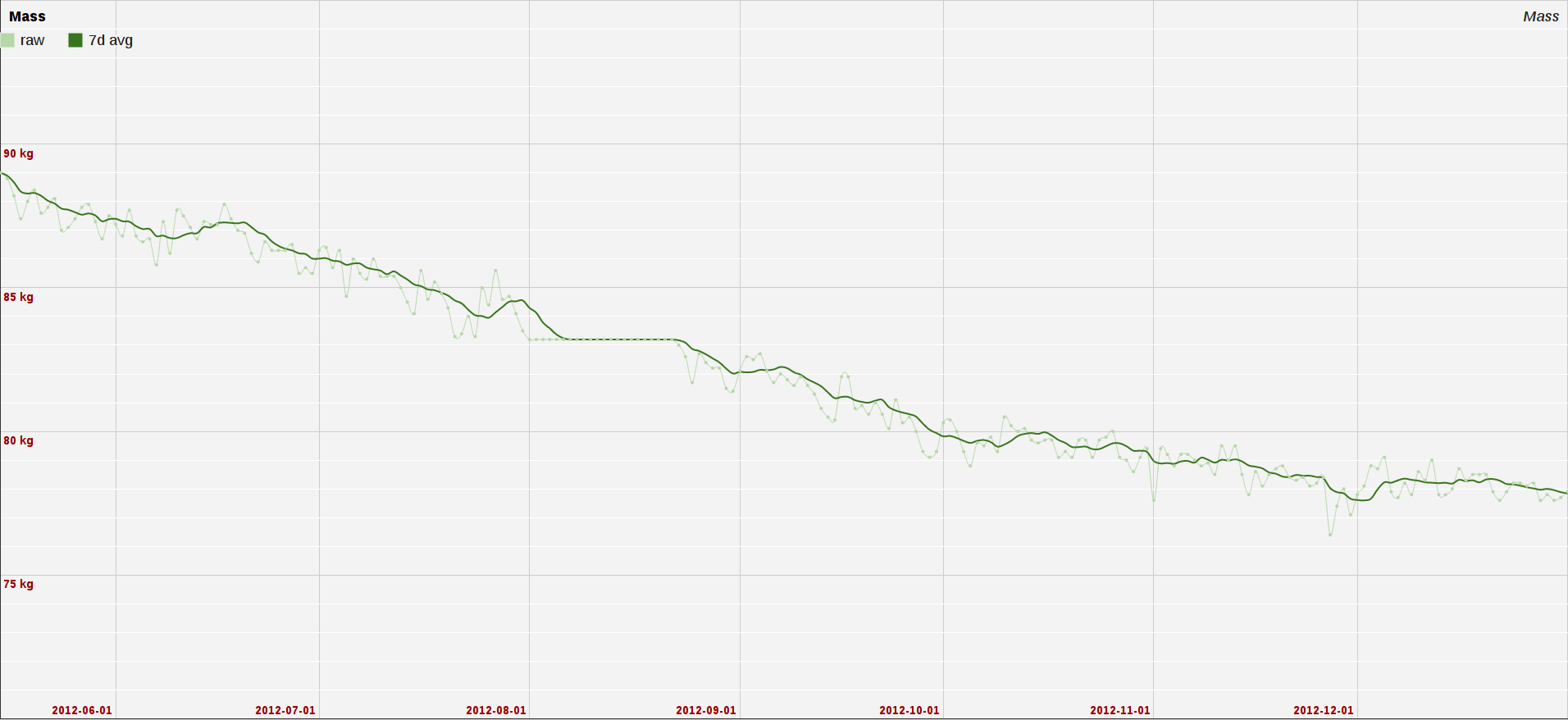
In 2012 I followed the Four Hour Body approach - eat enough to never feel hungry after a meal, reduce carbs (beans & pulses, mainly) so it's not keto, drink more, avoid 'white things' (rice, flour, sugar), bump up your meal size to compensate for the absence of carbs, have one cheat day a week to keep you sane (eat as much as you like or whatever you like for lunch & dinner on that one day). Jot down everything you eat - it helps motivate you to not eat poorly.
Measure everything - well, as much as you can. I used some Omron body composition scales - probably not hugely accurate in the absolute, but more than sufficiently accurate in the relative.
So I have a google spreadsheet that over the space of 18 months has daily weigh-in data, and very detailed descriptions of everything I ate each day. (It was quite the adventure, though I'd be unlikely do it again.)
I reiterate -- this graph shows changes in my mass during a period where I was never calorie-counting, never felt hungry, wasn't in keto, and felt the approach could be sustained long-term without threatening sanity. My modest amount of exercise - the occasional bicycle ride - did not change during this period.
I did the slow carb diet too when the book came out, didn't work for me. Made me sick and lethargic. And I didn't lose any weight. To each his own, I guess
Irrelevant. You can eat nothing but twinkies and still lose weight as long as you maintain a caloric deficit. Certain foods are going to make that easier and healthier, but that's orthogonal to the actual weight loss.
My point is that not all calories are equal as far as the consumer is concerned.
As others have noted, eating RDI (or just under) with only carbs - eg the twinkies diet - would be tiring and soul-destroying, likely very difficult to sustain.
Eating the same amount (calories) of proteins and fats would keep you much happier and healthier.
Eating a lot more (calories) of proteins and fats, and avoiding as many carbs as possible, and you're probably lose weight without having to track & maintain a 'caloric deficit' state.
You can but you will be hungry and it will be very difficult. You want to avoid carbs and sugar because carbs get turned into sugar and they spike your sugar levels, causing your pancreas to produce insulin to tell your body to store the excess sugar in your fat cells. Then when the excess sugar is all stored, you get the crash and you're hungry again. This is why people want to snack between meals.
Instead, avoid carbs and eat proteins and healthy fats. You won't get the sugar spike and crash, and will last hours without getting hungry. It is easy to eat only twice a day this way.
Exactly. And to add, it may be easier to achieve a caloric deficit with some foods than with others. When I am on a ketogenic diet, I always eat to satiation but still manage to lose bodyfat.
I'll tell you a simple trick that works for me and should work for most people who can afford this (considering possible health concerns): Don't eat anything after 4PM, basically skip the 3rd meal of the day. Go for a 5-7km walk every other day. Just make sure to have all the necessary vitamins and minerals throughout the day.
I've lost about 13kg since December. Most of it before our winter hit then I plateaued now that spring/summer is back I expect it'll start dropping again.
3 major changes for me:
1) Every (or most days) day I get up and on my bike. I dont set a limit, its just enough that I get on it. What I've found is that over a fairly short amount of time I started riding longer and further just because I was enjoying it. I now add in a stop at an outdoor gym for some sit-ups and push ups etc.
2) I skip breakfast every day. Call it Intermittent Fasting or Calorie Restriction... It matters not.
3) I no longer drink sweetened drinks. black coffee, black tea, water... that's about it.
They're not world changing things but they all seem to add up and work. I think they shouldn't be too difficult to keep up indefinitely.
Nobody wants to calculate everything from scratch again and again. Thus I wrote a program that does 99% of heavy lifting. It contains a database of ingredients I commonly use and their nutritional values. I have a set of recipes that I tend to make mostly the same way, the only thing that differs is the relative amount of ingredients that go into the sauce for example. I measure those when I meal prep, and then I only need to weigh the ~homogenic components of each portion. The program does everything else including macro tracking, daily weight loss estimates etc. This is extremely sustainable and it removes all of the guess work. So far it's been scarily accurate which in turn has kept motivation high.
With practice you do get better at understanding the cost of the food you are processing. To me, using technical tools is very expensive in this process. It helps to begin with, but as soon as I have aquired necessary knowledge tech just gets in the way unless it is fully automated.
My 'trick' is to use a smaller plate than everyone else and resist the temptation to pile it high. I'm not losing weight quickly but keeping it down and dropping slowly without any stress.
I did some calorie counting at the beginning but dropped it once I had convinced myself that I was indeed eating fewer calories.
One other thing I do is to delay breakfast until after I have done my morning walk. Experience tells me that my appetite will be sharpened by the exercise so I will be tempted to eat again. So getting dressed and walking straight out of the house for an hour of brisk walking saves me that temptation or perhaps puts it to good use.
Sounds about right. Calories in, calories out. I have $7 digital scale that I measure food with. With consistency you eventually get to the point where you can eyeball 50g of rice, 125g of chicken, roughly a 250 calorie meal. There’s zero tricks to it, just measure and aim for 1500-1800 calories a day.
Oh, and it’s going to suck, because it’s hard. I did 180 to 138 in 5ish months. Started with the Keto until I realized it’s just a trick to reduce calories, so eventually just cut the Keto framework out so I could eat some bread/rice.
Keto I found also seems to trick you into feeling less hungry even with reduced caloric intake.
A lot of dietary advice treats the sensation of hunger as some taboo thing to be avoided at all cost. But the body will fight HARD to maintain current balances and hunger is a clear signal that you’ve ingested less calories recently than your norm.
We’re so used to never going hungry that the sensation feels like a serious anomaly, but hunger is not harmful unless it goes on for a protracted period (at least days), it’s just unpleasant.
I’m not advocating for starvation, but I think successful dieting that doesn’t rely on some trickery necessarily involves enduring the sensation of hunger until the body adjusts to a new baseline.
Fronting up in advice to dieters and normalising the idea that it’s ok to feel hungry when adjusting your diet downwards would be hugely beneficial to people’s success in weight management I think.
This part doesn't get emphasized enough. People start down this road and at first it looks like losing weight is easy because they shed a few pounds right away, but most of it is water so they hit a wall and things get hard and they think they must be doing something wrong. They're not: it just sucks and there's no way out of that, not that it stops people from trying to sell them an easy way.
The only thing you need to know to successfully lose weight is that you need to consume less calories than your body requires to maintain its current weight. That's it.
I’m afraid this is BS. It’s from the “how to make a million dollars and pay no taxes” school of self improvement. Sure, to lose weight you have to consume fewer calories than you need to maintain your current weight. Understanding that tautology is not the part that people find difficult.
Maybe change it to The only thing you need to know to successfully lose weight is that you’ll need discipline and commitment then :)
There are myriads of factors that prevent people from being able to reach and maintain a “healthy” weight long term, otherwise fixing the obesity crisis would be as simple as handing out an index card to everyone. Most diets ultimately fail (including calorie counting), and we still don’t completely understand why: https://www.scientificamerican.com/article/unexpected-clues-...
An autonomic process should not require one ounce of discipline and commitment, otherwise something has gone far wrong systemically.
I mean, when I buy a sandwich, I don't know how many calories it contain. Not even roughly. When having dinner, I don't know how many grams of potatoes are in my plate or how much meat is on my plate. Do you guys weigh it?
I certainly don't know how much "a serving" is, and I do suspect that if my idea of a serving size was normal, I wouldn't need weight loss in the first place.
If you're already not buying sandwiches and eating chicken breast, steak, broccoli and watermelon, do you really need to weigh your food anymore? (Only half tongue in cheek)
https://www.weightwatchers.com works really well. I thought it was just a brand of frozen food, but it's not. You get a set number of "points" each day, which more or less equate to calories. It makes counting calories much, much easier. Worth a look.
You need to wait 12-24 months before you can consider your diet a success.
A caloric deficit doesn't work long term, as over time your metabolism slows down to match the caloric intake.
"The key to long-lasting weight control is to control the main hormone responsible, which is insulin. Controlling insulin requires a change in our diet, which is composed of two factors — how high the insulin levels are after meals, and how long they persist. This boils down to two simple factors:
What we eat — which determines how high insulin spikes; and
When we eat — which determines how persistent insulin is."
The best resource for weight loss via fasting is Dr. Jason Fung
Thank you for this comment. I don't have weight problems, but I like to know how the body works in general. I can't believe I didn't know about the relation between insulin and weight. Indeed, people with type 1 diabetes tend to experience weight loss even if they eat normally, vice versa for people with type 2 diabetes.
I'm in my 40's. When I was in my late 20's I noticed that I'd started to put on some pudge. I'm 186cm tall and had been used to being very skinny and able to eat as much junk as I wanted. I'd been a long distance runner in school, generally active, but had slowed that down after getting a programming job. I weighed myself for the first time in years and I was 90kg. Not "fat" but not comfortable for me. I lost 20kg over about five or six months and have kept it off for about the last 15 years. I've gone up and down by a few kgs, but never went above 75kg again. I literally weigh almost exactly 70kg today.
The advice I give is generally close to what you've found. I didn't track calories or anything, but I weighed myself every single day, tracked it in a spreadsheet and consciously adjusted what I ate and how much I ate based on my average over the last week or so. Basically, if my weight was on track, I'd eat what I felt like and not worry about it. If it was trending up, I'd consciously make an effort to eat "less" than I wanted to; smaller portions, skip a meal, drink water instead of beer, etc. The further off track I was or the longer it was taking me to get back on track, the harder I'd have to correct. It involved the same shift in mindset, that I wasn't just losing weight, but achieving and maintaining a certain range was just part of who I was.
Like I said, I didn't track calories and still don't, but I did take a very data-driven approach where the results of my recent past actions determined my future actions. Basically, our bodies are bad at accurately signalling whether you have eaten enough or too much. Most of us, if we just eat when we feel hungry and eat what we think is a good amount, will get it wrong most of the time. We need to bring in external data to that feedback loop.
At some level, "calories in calories out" is right and it doesn't matter that much what you eat. If you are adjusting the quantity based on results, it will work. But of course, eating well really does make it easier. Eating more whole plant-based food and balancing your macros tends to make you feel fuller so you aren't fighting your own sense of hunger as much and keeps you healthier and feeling healthier and more energetic. It's hard to maintain the willpower over long periods if you are eating junk and your body isn't being nourished properly. You might lose weight but you can still ruin your health.
I'm also skeptical of calorie counting because there does seem to be some truth to "not all calories are the same". "Calories in calories out" works based on what your body actually digests and metabolizes. I'm not convinced that the calories in the food you eat match what your body actually gets out of that food, whether that's consistent across different people or even for the same person over time. Eg, I wouldn't be surprised if personal gut biome plays a large role here.
Similarly, exercise isn't strictly necessary, but helps in so many ways. I'd mostly recommend keeping it minimal until you are well into the "maintain" phase. I think a really common failure is when people get really into exercise, push it too far, then burn themselves out (or injure themselves) and crash out of the whole thing. Find physical activity that you enjoy and can do on a regular basis and don't overdo it.
The big thing that I feel is hard to get across to others sometimes is that there is a huge difference between "simple" and "easy". Losing weight and keeping it off with that approach is extremely "simple". But it's far from "easy". I've been doing it for fifteen years and it's something that I still have to work hard at basically every single day. I'm only maintaining my weight so it's not a huge sacrifice every day, but it's not easy to keep that level of effort up over a long period of time in the face of whatever other ups and downs you might have in your life. I get a bit hurt and frustrated when others downplay my efforts because I "look thin" so they believe it must be easy for me. (then they usually ignore whatever advice I give them in favor of the latest fad diet that their overweight friends are recommending because clearly their overweight friends must know more about diet and weight loss than me).
Been doing similar research on same topic over the past few months, and I can say strict calorie counting is definitely the easiest way: It's incredibly easy to accidentally exceed maintenance calories which will kill the progress.
Some slightly more advanced advice:
* Figure out your Basal Metabolic Rate or BMR. That's the number of calories you burn by lying on couch.
* Count your calories for food and exercise.
* Make sure you're on 10-30% calorie deficit, aim for 1-1.5% total body weight loss / week.
To make maintaining the diet easier, immediately cut out all products with added sugars. The sugar crashes and cravings will ease in a week or so. After that you'll notice you don't need to eat nearly as often, and as you decrease portion size you'll find your stomach shrinks and you'll feel full even with much smaller portions. Leave cheat days to once every two months or so.
Make sure the food is high in protein (about 1.5 grams / pound of body mass). The problem is, if you're not paying extra for 100% whey isolate supplement, you're probably getting too much sugar with the supplement so getting enough protein means you'll need to add some cardio (which in turn benefits from the protein and improves overall health). Make sure you always consume at least 20% of daily calories from fat to not hurt A/D/E/K vitamin intake. If you're obese, the calories from fat should be closer to 35% due to weakened insulin response of the body.
For the carbs you need and take, make sure it's always from products that have low glycemic index (rye bread, whole wheat pasta (Rummo is fantastic) etc). If you need to consume something that's sweet, eat it as part of a larger meal to reduce likelyhood of taking seconds etc., and to prevent blood sugar spikes that lead to blood sugar crashes that lead to binge eating.
If you're doing cardio, remember to increase distance only 10% / week to avoid over training which will slow the diet down. Stick to the 10% rule even if you think you can do more. It's as important as counting every calorie.
Also, if you're doing weights, consuming creatine etc. your body weight might increase despite fat loss, so to track body composition change the scale won't do. Body fat calipers are cheap and easy to use: there's sites that use e.g. Jackson-Pollock 7 to calculate body fat percentage https://www.free-online-calculator-use.com/skin-fold-test.ht...
Monthly progress photos also help, although if your body fat is very high the change won't be visible at first, but the speed of change is exponential.
I agree.
IF helped, though, by reducing the time window where I need to preocuppy myself with food/eating topics.
Basically outside of my eating interval I don't think/worry about food at all, I can focus on something else.
IF does require some getting used to, though.
Decreasing portion size tends to make your stomach smaller which will reduce the amount of false sensation of hunger felt when the stomach empties itself. Smaller portions more evenly distributed might be beneficial. The change should be gradual.


Did I overeat one or two days? No regrets. I don't have a goal that now moved further. It is what it is. Today is a new day and I'll do what I normally do. Did I hit a plateau? Well, what can I do? My identity still says I should eat sensibly. I stayed off processed foods this week? Check. Did I consume excess sugar or soda? No. Ate my greens? Yip! So, my lifestyle is healthy no matter what the scale says. Did I go out with friends and overindulged? Hey, that's a healthy lifestyle too! Just don't do it very often.
Sure, I can give more practical advice and do think that OP is way too early to announce victory after just one month, but it's a journey, you have to experience some things on your own.
I'll just comment on calorie counting. Once upon a time I used to count calories to single digit accuracy. It's not needed. Keep a rough track of your macros as some people say (protein and carbs are aroung 4KCal/gram, fat is around 9KCal/gram) and you will be fine.