I used to make posts like this. I'm starting to feel like these words will merge in the next 100 years, and either form will be correct for all usages.
This kind of errata in our language doesn't help us do anything and it just causes confusion and frustration.
Agreed. English is already just a mash up, I could care less about grammar so long as what you are trying to say is getting across to me. Certain areas require a comma or period otherwise can be read wrong but I have never had a problem with their, your, its, or any other such words confusing me into not understanding what the writer is trying to say...
While I'm hardly a perfect English speaker, I have to admit those errors bother me. It's like talking to someone who is picking his nose - the content may be there, but still in a distracting and irritating form.
I'm going to delete this post in 30 minutes, but man, I'm just screaming to say... it is so peculiar that he consistently kept making that mistake (along with a bunch of other ones). It looks like the guy is a graduate from Stanford's business school... and is the co-founder of Pricenomics. What the heck.
Edit: heh, I guess I won't delete it now (to preserve continuity of extant conversation). Sorry.
  It looks like the guy is a graduate from
  Stanford's business school... and is the
  co-founder of Pricenomics. What the heck.
I used to make that mistake - or what I assume was the mistake, which now seems to have been corrected.
Many guides to using apostrophes [1,2,3,4] say they can be used for contractions (the dog's outside) and to indicate possession (the dog's ball) - Why shouldn't something possessed by "it" use a possessive apostrophe?
Some people tried to correct my using of "it's" to indicate possession by explaining "Apostrophes are used for contractions like it is" which was unconvincing as obviously they can be used to indicate possession.
It wasn't until I got to college that someone gave me a satisfactory explanation: It/Its belongs to the same class of words as he/his, her/hers, your/yours, who/whose which do not follow normal apostrophe usage rules as the rules are descriptive, not prescriptive and nothing obliges the language and its users to be consistent.
I hadn't heard that grouping, which actually makes a lot of sense.
A teacher taught me a simpler rule: "It's" normally has an apostrophe, while most words don't. So instead of adding a apostrophe to show possession, we remove it.
Basically we're toggling the apostrophe state. Or..."it's" always results in a NOT output when compared to other outputs.
Well, I think it probably wouldn't be a stretch to say that strong communication abilities correlate to business acumen. If I'm going to be reading a piece of writing that keeps on getting these basic things wrong I'm going to get distracted in a bad way.
> I'm starting to feel like these words will merge in the next 100 years, and either form will be correct for all usages.
Interesting thought since, prior to the 19th century, "its" frequently was spelled "it's".
I have long considered it one of the abominations of the English language that a contraction ("it is" -> "it's") is given precedence over a pronoun with what is clearly a saxon genitive. Contractions should always take the lowest possible precedence in cases of collisions as far as I am concerned.
I don't agree. Having specific words in these cases reduces the cognitive load associated with reading - a simple find-and-retrieve in your brain for what the word means, rather than a context-sensitive compare with the last sentence or next few words to determine which form of its/it's is being used.


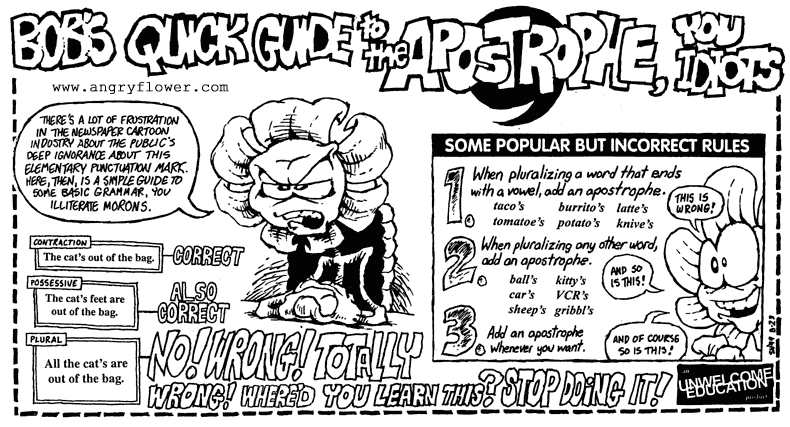
This kind of errata in our language doesn't help us do anything and it just causes confusion and frustration.