It appears to me like the linked explanation is also subtly wrong, in a different way:
“This is why a flat surface like a sail is able to cause lift – here the distance on each side is the same but it is slightly curved when it is rigged and so it acts as an aerofoil. In other words, it’s the curvature that creates lift, not the distance.”
But like you say flat plates can generate lift at positive AoA, no curvature (camber) required. Can you confirm this is correct? Kinda going crazy because I'd very much expect a Cambridge aerodynamicist to get this 100% right.
Yes, it is wrong. The curvature of the sail lowers the leading angle of attack which promotes attachment, i.e. reduces the risk of stalling at high angles of attack, but it is not responsible for lift in the sense you mean.
It could be argued that preventing a stall makes it responsible for lift in an AoA regime where the wing would otherwise be stalled -- hence "responsible for lift" -- but that would be far fetched.
More likely the author wanted to give an intuition for the cuvature of the airflow. This is produced not by the shape of the airfoil but the induced circulation around the airfoil, which makes air travel faster on the side of the far surface of an airfoil, creating the pressure differential.
Sorry, I know nothing about this topic, but this is how it was explained to me every time it's come up throughout my life. Could you explain a bit more?
I've always been under the impression that flat-plate airfoils can't generate lift without a positive angle-of-attack - where lift is generated through the separate mechanism of the air pushing against an angled plane? But a modern airfoil can, because of this effect.
And that if you flip them upside down, a flat plate is more efficient and requires less angle-of-attack than the standard airfoil shape because now the lift advantage is working to generate a downforce.
I just tried to search Google, but I'm finding all sorts of conflicting answers, with only a vague consensus that the AI-provided answer above is, in fact, correct. The shape of the wing causes pressure differences that generate lift in conjunction with multiple other effects that also generate lift by pushing or redirecting air downward.
The core part, which is incorrect and misleading, is 'the air needs to take an equal time to transit the top and bottom of the wing'. From that you can derive the correct statement that 'the air traveling across the top of the wing is moving faster', but you've not correctly explained why that is the case. And in fact, it's completely wrong that the transit time is equal: the videos from the page something linked above show that usually the air above the top takes less time than the bottom, and it's probably interesting to work out why that's the case!
(Also, once you've got the 'moving faster' you can then tell a mostly correct story through bernuolli's principle to get to lower pressure on the top and thus lift, but you're also going to confuse people if you say this is the one true story and any other explaination, like one that talks about momentum, or e.g. the curvature of the airflow causing the pressure gradient instead is wrong, because these are all simply multiple paths through the same underlying set of interactions which are not so easy to fundamentally seperate into cause and effect. But 'equal transit time' appears in none of the correct paths as an axiom, nor a necessary result, and there's basically no reason to use it in an explanation, because there's simpler correct stories if you want to dumb it down for people)
>Air over the top has to travel farther in the same amount of time
There is no requirement for air to travel any where. Let alone in any amount of time. So this part of the AI's response is completely wrong. "Same amount of time" as what? Air going underneath the wing? With an angle of attack the air under the wing is being deflected down, not magically meeting up with the air above the wing.
But this just sounds like a simplified layman explanation, the same way most of the ways we talk about electricity are completely wrong in terms of how electricity actually works.
If you look at airflow over an asymmetric airfoil [1], the air does move faster over the top. Sure, it doesn't arrive "at the same time" (it goes much faster than that) or fully describe why these effects are happening, but that's why it's a simplification for lay people. Wikipedia says [2]:
> Although the two simple Bernoulli-based explanations above are incorrect, there is nothing incorrect about Bernoulli's principle or the fact that the air goes faster on the top of the wing, and Bernoulli's principle can be used correctly as part of a more complicated explanation of lift.
But from what I can tell, the root of the answer is right. The shape of a wing causes pressure zones to form above and below the wing, generating extra lift (on top of deflection). From NASA's page [3]:
> {The upper flow is faster and from Bernoulli's equation the pressure is lower. The difference in pressure across the airfoil produces the lift.} As we have seen in Experiment #1, this part of the theory is correct. In fact, this theory is very appealing because many parts of the theory are correct.
That isn't to defend the AI response, it should know better given how many resources there are on this answer being misleading.
And so I don't leave without a satisfying conclusion, the better layman explanation should be (paraphrasing from the Smithsonian page [4]):
> The shape of the wing pushes air up, creating a leading edge with narrow flow. This small high pressure region is followed by the decline to the wider-flow trailing edge, which creates a low pressure region that sucks the air on the leading edge backward. In the process, the air above the wing rapidly accelerates and the air flowing above the top of the wing as a whole forms of a lower pressure region than the air below. Thus, lift advantage even when horizontal.
Someone please correct that if I've said something wrong.
Shame the person supposedly with a PHD on this didn't explain it at all.
The bottom line is that a curved airfoil will not generate any more lift than a non-curved airfoil (pre-stall) that has its trailing edge at the same angle.
The function of the curvature is to improve the wing's ability to avoid stall at a high angle of attack.
According to NASA, the Air and Space Museum, and Wikipedia: you are wrong. Nor does what you're a saying making any sense to anyone who has seen an airplane fly straight.
Symmetric airfoils do not generate lift without a positive angle of attack. Cambered airfoils do, precisely because the camber itself creates lift via Bernoulli.
I stated "has its trailing edge at the same angle", not "is at the same angle of attack". Angle of attack is defined by the angle of the chord line, not the angle of the trailing edge. Cambered airfoils have their trailing edges at higher angles than the angle of attack.
Again, not an expert, but how does that jive with the existence of reflex cambered airfoils? Positive lift at zero AoA with a negative trailing edge AoA.
And that seems to directly conflict with the models shown by the resources above? They state that cambered wings do have increased airspeed above the wing, which generates lift via pressure differential (thus why the myth is so sticky).
Reflex cambered airfoils generate lift because most of the wing is still pointed downwards.
The crucial thing you need to explain is this: why doesn't extending leading edge droop flaps increase the lift at a pre-stall angle of attack? (See Figure 13 from this NASA study for example: https://ntrs.nasa.gov/citations/19800004771)
Im quite sure the "air on the top has to travel faster to meet the air at the bottom " is false. Why would they have to meet at the same time? What would cause air on the top to accelerate?
I did a little more research and explain it above. The fundamentals are actually right.
The leading edge pressurizes the air by forcing air up, then the trailing edge opens back up, creating a low pressure zone that sucks air in the leading edge back. As a whole, the air atop the wing accelerates to be much faster than the air below, creating a pressure differential above and below the wing and causing lift.
The AI is still wrong on the actual mechanics at play, of course, but I don't see how this is significantly worse than the way we simplify electricity to lay people. The core "air moving faster on the top makes low pressure" is right.
That explanation doesn’t work if the wing is completely flat (with nothing to force the air up), which if you ever made a paper airplane flies just fine. All these explanations miss a very significant thing: air is a fluid where every molecule collides with _billions_ of other molecules every second, and the wing distorts the airflow all around it, with significant effects up to a wingspan away in all directions.
It's both lower pressure above the wing (~20% of lift) and the reaction force from pushing air down (give or take the remaining 80% of lift). The main wrong thing is that the air travels faster because it has to travel farther causing the air to accelerate causing the lower pressure that's double plus wrong. It's a weird old misunderstanding that gets repeated over and over because it's a neat connection to attach to the Bernoulli Principal when it's being explained to children.
a classic example of how LLM's mislead people. They don't know right from wrong, they know what they have been trained on. Even with reasoning capabilities
That's one of my biggest hang ups on the LLMs to AGI hype pipeline, no matter how much training and tweaking we throw at them they still don't seem to be able to not fall back to repeating common misconceptions found in their training data. If they're supposed to be PhD level collaborators I would expect better from them.
Not to say they can't be useful tools but they fall into the same basic traps and issues despite our continues attempts to improve them.
How can you create a pocket of 'lower pressure' without deflecting some of the air away? At the end of the day, if the aircraft is moving up, it needs to be throwing something down to counteract gravity.
Exactly. The speed phenomenon (airflow speeding up due to getting sucked into the lower pressure space above the wing) is certainly there, but it's happening because the wing is shaped to deflect air downwards.
The point isn't about how the low pressure is created just that the low pressure is a separate source of lift from the air being pushed down by the bottom of the wing.
No, what still matters (when explaining why the wing is shaped the way it is) is how the low pressure is created. In this case it's being pulled down by the top of the wing.
Angle of attack is a big part but I think the other thing going on is air “sticks” to the surface of the top of the wing and gets directed downward as it comes off the wing. It also creates a gap as the wing curves down leaving behind lower pressure from that.
The "wrong" answers all have a bit of truth to them, but aren't the whole picture. As with many complex mathematical models, it is difficult to convert the math into English and maintain precisely the correct meaning.
> The "wrong" answers all have a bit of truth to them, but aren't the whole picture. As with many complex mathematical models, it is difficult to convert the math into English and maintain precisely the correct meaning.
Exactly. The comments in this subthread are turning imprecision in language into all-or-nothing judgments of correctness. (Meanwhile, 80% of the comments advance their own incorrect/imprecise explanations of the same thing...)
It's really not. The wing is angled so it pushes the air down. Pushing air down means you are pushing the plane up. A wing can literally be a flat sheet at an angle and it would still fly.
It gets complex if you want to fully model things and make it fly as efficiently as possible, but that isn't really in the scope of the question.
Planes go up because they push air down. Simple as that.
It's both that simple and not. Because it's also true that the wing's shape creates a pressure differential and that's what produce lift. And the pressure differential causes the momentum transfer to the wing, the opposing force to the wing's lift creates the momentum transfer, and pressure difference also causes the change in speed and vice-versa. You can create many correct (and many more incorrect) straightforward stories about the path to lift but in reality cause and effect are not so straightforward and I think it's misleading to go "well this story is the one true simple story".
Sure but it creates a pressure differential by pushing the air down (in most wings). Pressure differentials are an unnecessarily detailed description of what is going on that just confuses people.
You wouldn't explain how swimming works with pressure differentials. You'd just say "you push water backwards and that makes you go fowards". If you start talking about pressure differentials... maybe you're technically correct, but it's a confusing and unnecessarily complex explanation that doesn't give the correct intuitive idea of what is happening.
Sure. If you're going for a basic 'how does it work', then 'pushing air down' is a good starting point, but you'll really struggle with follow-up questions like 'then why are they that shape?' unless you're willing to go into a bit more detail.
How can you create a 'pressure differential' without deflecting some of the air away? At the end of the day, if the aircraft is moving up, it needs to be throwing something down to counteract gravity. If there is some pressure differential that you can observe, that's nice, but you can't get away from momentum conservation.
The pressure differential is created by the leading edge creating a narrow flow region, which opens to a wider flow region at the trailing edge. This pulls the air at the leading edge across the top of the wing, making it much faster than the air below the wing. This, in turn, creates a low pressure zone.
Air molecules travel in all directions, not just down, so with a pressure differential that means the air molecules below the wing are applying a significant force upward, no longer balanced by the equal pressure usually on the top of the wing. Thus, lift through boyancy. Your question is now about the same as "why does wood float in water"?
The "throwing something down" here comes from the air molecules below the wing hitting the wing upward, then bouncing down.
All the energy to do this comes from the plane's forward momentum, consumed by drag and transformed by the complex fluid dynamics of the air.
Any non-zero angle of attack also pushes air down, of course. And the shape of the wing with the "stickiness" of the air means some more air can be thrown down by the shape of the wing's top edge.
You can't, but you also can't get away from a pressure differential. Those things are linked! That's my main point, arguing over which of these explanations is more correct is arguing over what exactly the shape of an object's silhouette is: it depends on what direction you're looking at it from.
That page is arguing against a straw man. Nobody is claiming that the full dynamics of a wing are exactly that of a flat sheet at an angle (with full flow separation etc).
The point is that a flat plane with full flow separations is the minimum necessary physics to explain lift. It would obviously make a terrible wing, and it doesn't explain everything about how real wings are optimised. That's not the point.
In any case, I only said the wing pushes the air down. I didn't say it only uses its bottom surface to push the air down.
Except it isn't "completely wrong". The article the OP links to says it explicitly:
> “What actually causes lift is introducing a shape into the airflow, which curves the streamlines and introduces pressure changes – lower pressure on the upper surface and higher pressure on the lower surface,” clarified Babinsky, from the Department of Engineering. “This is why a flat surface like a sail is able to cause lift – here the distance on each side is the same but it is slightly curved when it is rigged and so it acts as an aerofoil. In other words, it’s the curvature that creates lift, not the distance.”
The meta-point that "it's the curvature that creates the lift, not the distance" is incredibly subtle for a lay audience. So it may be completely wrong for you, but not for 99.9% of the population. The pressure differential is important, and the curvature does create lift, although not via speed differential.
I am far from an AI hypebeast, but this subthread feels like people reaching for a criticism.
the wrongness isn't germane to most people but it is a specific typology of how LLMs get technica lthings wrong that is critically important to progressing them. It gets subtle things wrongby being biased towards lay understandings that introduce vagueness because greater precision isn't useful.
That doesn't matter for lay audieces and doesn't really matter at all until we try and use them for technical things.
The wrongness is germane to someone who is doing their physics homework (the example given here). It's actually difficult for me to imagine a situation where someone would ask ChatGPT 5 for information about this and it not be germane if ChatGPT 5 gave an incorrect explanation.
The predicate for that is you know it is wrong, that wrongness is visible and identifiable. With knowledge that is intuitive but incorrect you multiply risk.
I would still say its completely wrong, given that this explanation makes explicit predictions that are falsifiable, eg, that airplanes could not fly upside down (they can!).
I think its valid to say its wrong even if it reaches the same conclusion.
If I lay out a chain of thought like
Top and bottom are different -> god doesnt like things being diffferent and applies pressure to the bottom of the wing -> pressure underneath is higher than the top -> pressure difference creates lift
Then I think its valid to say thats completely inaccurate, and just happens to share some of the beginning and end
It's the "same amount of time" part that is blatantly wrong. Yes geometry has an effect but there is zero reason to believe leading edge particles, at the same time point, must rejoin at the trailing edge of a wing. This is a misconception at the level of "heavier objects fall faster." It is non-physical.
The video in the Cambridge link shows how the upper surface particles greatly overtake the lower surface flow. They do not rejoin, ever.
Again, you're not wrong, it's just irrelevant for most audiences. The very fact that you have to say this:
> Yes geometry has an effect but there is zero reason to believe leading edge particles, at the same time point, must rejoin at the trailing edge of a wing.
...implicitly concedes that point that this is subtle. If you gave this answer in a PhD qualification exam in Physics, then sure, I think it's fair for someone to say you're wrong. If you gave the answer on a marketing page for a general-purpose chatbot? Meh.
(As an aside, this conversation is interesting to me primarily because it's a perfect example of how scientists go wrong in presenting their work to the world...meeting up with AI criticism on the other side.)
Saw you were a biologist. Would you be ok if I said, "Creationism got life started, but after that, we evolved via random mutations..."? The "equal transit time" is the same as a supernatural force compelling the physical world act in a certain way. It does not exist.
right, the other is that if you remove every incorrect statement from the AI "explanation", the answer it would have given is "airplane wings generate lift because they are shaped to generate lift".
> right, the other is that if you remove every incorrect statement from the AI "explanation", the answer it would have given is "airplane wings generate lift because they are shaped to generate lift".
...only if you omit the parts where it talks about pressure differentials, caused by airspeed differences, create lift?
Both of these points are true. You have to be motivated to ignore them.
But using pressure differentials is also sort of tautological. Lift IS the integral of the pressure on the surface, so saying that the pressure differentials cause lift is... true but unsatisfying. It's what makes the pressure difference appear that's truly interesting.
Funnily enough, as an undergraduate the first explanation for lift that you will receive uses Feynman's "dry water" (the Kutta condition for inviscid fluids). In my opinion, this explanation is also unsatisfying, as it's usually presented as a mere mathematical "convenience" imposed upon the flow to make it behave like real physics.
Some recent papers [1] are shedding light on generalizing the Kutta condition on non-sharp airfoils. In my opinion, the linked papers gives a way more mathematically and intuitively satisfying answer, but of course it requires some previous knowledge, and would be totally inappropriate as an answer by the AI.
Either way I feel that if the AI is a "pocket PhD" (or "pocket industry expert") it should at least give some pointers to the user on what to read next, using both classical and modern findings.
The Kutta condition is insufficient to describe lift in all regimes (e.g. when the trailing edge of the wing isn't that sharp), but fundamentally you do need to fall back to certain 2nd law / boundary condition rules to describe why an airfoil generates lift, as well as when it doesn't (e.g. stall).
There's nothing in the Navier-Stokes equations that forces an airfoil to generate lift - without boundary conditions the flowing air could theoretically wrap back around at the trailing edge, thus resulting in zero lift.
The fact that you have to invoke integrals and the Kutta condition to make your explanation is exactly what is wrong with it.
Is it correct? Yes. Is it intuitive to someone who doesn’t have a background in calculus, physics and fluid dynamics? No.
People here are arguing about a subpoint on a subpoint that would maybe get you a deduction on a first-year physics exam, and acting as if this completely invalidates the response.
How is the Kutta condition ("the fluid gets deflected downwards because the back of the wing is sharp and pointing downwards") less intuitive to someone without a physics background than wrongly invoking the Bernoulli principle?
I would say a wing with two sides of different length is more difficult to understand than one shape with two sides of opposites curvatures but same length


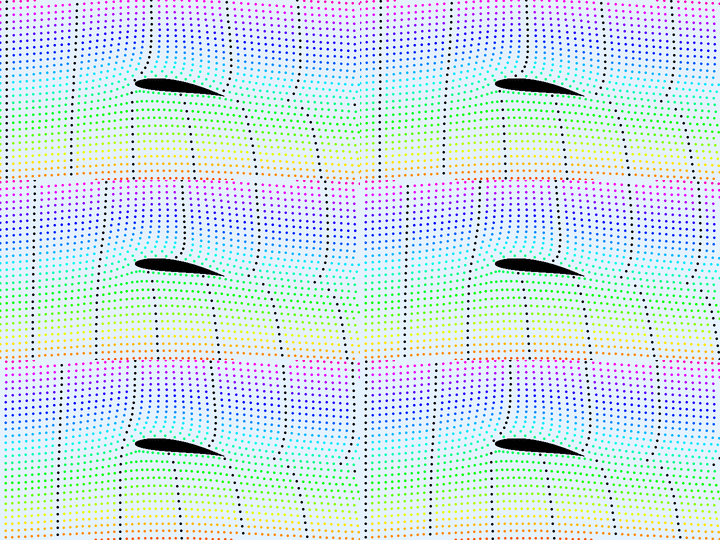
Source: PhD on aircraft design