That’s a fun fact. The US also roughly produces as much renewable electricity as total African production. Total African energy production is projected to grow faster than renewable conversion in the US, though.
If, for example only, this was a significant contributor to global warming and impending doom, does it matter that our first world comforts are to blame? We don't get special exception just because we're used to a certain standard of living.
I desperately hope we don't need to abandon first world comforts. And i really doubt we would need to. However if, for sake of argument, that was the only solution - our answer should be to acknowledge the burden and take action.
This is all for sake of illustration though. Just that your comment seemed to imply because our first world comforts use more energy that it was somehow unfair to question the impact of said comforts.
The only option is to reduce population as what Thanos and Dan Brown addressed in their works. Less human less pollutions and energy consumptions. Anything else is just distractions.
One of the more defeatist comments I've seen in a while. Yes, there's no point chasing efficiency or greener generation, let's just bump off half the population.
But if murder is the only solution, you'd have to murder 10 Nigerians to save the same power consumption as an American; you'd do a lot less murder by focussing your attention.
I feel like you are presuming some argument exists when it is a straightforward statement of fact. It's an interesting comparison, and I'm not sure how it could be described as "unfair."
I hope that in the future, the most advanced nations will be the ones leading the way on energy consumption, maybe because of technology, better regulation, and other factors.
The implied unfairness there becomes a bit more fictional when you consider that an electricity user in Washington state isn't exactly competing with an energy user in Gash-Barka region.
Where such a comparison does become intensely valuable is when the EU says things like "we will do whatever it takes" in relation to energy and food. The implication there is "we will out-bid anyone" and "anyone" happens to be Africa and much of Asia. That's quite a horrendous way of using your currency to export the famine and freezing that you deserve to people who had no say in your bad policy decisions.
From the emissions POV it's not fictional at all, since the marginal electricity use is fossil based. All fossils use is eating at the same global emissions quota we can efford to stave off the worst climate catastrophe.
(Or if in some corner of the US renewables production is reduced before fossil sources when load lightens, that's even a bigger wrong)
That comparison actually showed how small the electricity consumption level is in Africa. The lack of electricity usage is a problem for the lifestyle and health of people living there.
Exactly, it was really more of a truism, there are many manynother things that the developing world consumes more of than Africa, food, education, water, electricity, gas, on and on. It's just not really useful info, it's true, but doesn't really add to the conversation.
It is meaningful to point out. As the poverty rate declines worldwide more and more people will start consuming like Americans do. There aren’t enough resources in the world to sustain that long term unless we start mining asteroids and find a cheap way to send our garbage to the sun.
Wow, you know an awful lot of stuff that doesn't follow from that fact. Can I borrow your magic crystal that lets you read minds to get the intent of the op?
So far tech has enabled us to keep up. Why can't it continue?
We have plenty of sun that hits the desert of the country to power 10x our current energey usage. We have plenty of places to put nukes. Lots of land for wind.
There may be technologies that would enable American energy consumption at global scale. Whether it is realistic is not certain, though.
But in terms of resources it is simply not possible. If every human being consumed as many resources as an average American then the planet would go up in smoke in 6 months. That's not really an opinion, these are the numbers.
When the fact is preceded with the word "Reminder:" it implies an importance and weight to the fact that takes it out of "fun fact" territory and into judgement.
Of course, all things are not equal between the US and Africa, so the comparison isn't worth mentioning.
It's funny that air con is seen as a wasteful luxury, but nobody blinks at a heating bill, even though the average household spends 4x more on heating.
The negative externalities are interesting though: using air con inside makes your outside that much hotter on a hot day, whereas in winter, nobody worries about waste heat leaking out.
Thank you! I find the opinion that AC is somehow a decadent luxury but heating is essential to be a very Northern US/Eurocentric view.
From a pure energy usage perspective, it may make more sense to live in a warm climate that never needs heating versus a cold climate that never needs AC.
Yes, heating consumes a lot of energy. On the other hand, most buildings even in fairly cool climates are absolute sieves when it comes to energy efficiency, mostly because energy has been artificially cheap, historically. It's possible to construct buildings that require very little heating, but of course turning all the existing buildings into Passivhäuser overnight is not really a reasonable proposition.
It's not a wasteful luxury. It's critical. But more attention needs to be paid to overall efficiency. Better home insulation and building materials, and better AC unit placement and better units themselves.
France as a policy to reduce heating energy in households aswell.
It's even seen as a primary mean to reduce energy waste.
People are more and more conscious that you don't need to heat your house at 70F+.
It's ok to live with a sweater on.
> The negative externalities are interesting though
They're not interesting, because they're absolutely negligible. You're moving heat that was outside, back outside. Your house cooled the outside, and you're just undoing this insignificant amount of energy transfer. The only additional heating is from inefficiencies, which aren't so bad these days.
I’m surprised it hasn’t been increasing faster. The US is in the midst of drive to replace heating systems of all kinds with more efficient heat pumps, with massive effort behind it, including restrictions on other kinds of heat, significant tax returns for upgrades of existing systems, etc… and they are lumping heat pumps into the figure.
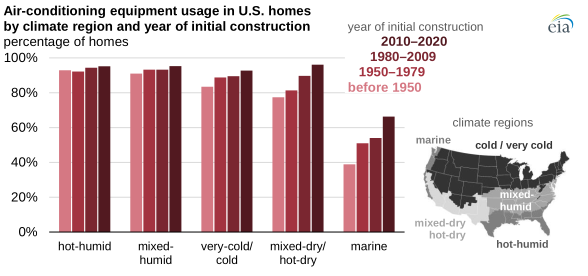
> 88% of U.S. households use air conditioning (AC). Two-thirds of U.S. households use central AC or a central heat pump as their main AC equipment.
The cost of central air has been dropping (it was something like $3k add-on to a furnace replacement) and so rarely do you install or replace a furnace without A/C, and once you have central air, you just set it and forget it. Even a fancy thermostat is going to use more energy than a loud window unit that you turn off whenever possible.
I wonder how this may relate to all the pandemic WFH. Where I live, many residences don't even have AC though it's common in offices. However, if you're home during the hottest part of the day and have to wear something that covers your shoulders for video calls, it becomes a lot more necessary.
The article describes growth from 87% in 2015 to 88% in 2020. If there's an impact from covid it's either tiny or this data was collected too early in 2020 to show it.
I'd have to move way North to be able to sleep OK without AC. Or maybe to a desert area with high elevation, for those nice, cold nights.
Discovering how much better I sleep when the temp is in the 62-66F range has made a big difference. I'd hate to go back to trying to sleep with temps over 68F, certainly. Over 72F and I basically can't sleep. I mean I'm sure I'd acclimate to some degree, but it's not like I was already used to sleeping in colder temps before I tried it, so I'm pretty sure that range is absolutely better for me, regardless of what I'm accustomed to or able to tolerate.
I converted it to celsius and just realized it means you can't sleep if the temperature is above 22C. IMO, that's a reaching the level of a physical handicap: it's a very mild temp.
That is in no way a physical handicap. Sleep quality (in terms of actual rest and recovery) is highly dependent on temperature. The optimal temperature is about 18 °C for most people. This article has an extensive list of references if you want to dig into the research.
The entire world didn't have AC just a few decades ago and most people slept fine.
If in less than a century of introducing a tech your body becomes so dependant to it it impairs a critical body function if you don't have it, yes, it's a handicap.
Actually people often didn't sleep fine at all. Or let's see some evidence that they did because I don't believe you. I know my own grandparents complained about being unable to sleep soundly during the summer when they lived in New York without AC.
Complaining about not sleeping well in the middle of a hot summer is very different from not being able to sleep at all in the middle of spring without an AC.
It's pretty rare for our nighttime lows to be above 72, even in the Summer, and I live in a fairly hot part of the US (though not the South proper). Even when it's in the high 90s or low 100s during the day, which is typically only a few weeks a year, usually it still gets down to 75-78 at night. We're in the high-80s this week and nighttime lows will be as low as 58F.
Spring nighttime temps are more like 35-55.
The main trouble's the damn humidity. A very-humid 72 still feels gross. And maybe I could sleep like a baby on a night when it gets down to 60, but if that's a spring or summer night I'll wake up nasty and covered in sweat unless I've got some serious dehumidification going (that's what happens when I go camping—might be cold enough to sleep well, but unless it's Winter or late Fall the high humidity still has unpleasant effects). Plus you get mildew and mold problems if you let a modern, very-sealed-up (so, efficient for AC) house get very humid too often, so it's better to just dehumidify with the AC even if the outdoor temp matches what I'd like it to be indoors.
Well, another way I can sleep OK in most any condition (short of becoming badly sleep-deprived) is to get a ton of physical activity during the day. Wear myself right the hell out, so I'm dead-tired by sundown. I bet physical activity levels were way, way higher pre-AC, too.
Not sure about this, I'm 110 kg (242 pounds), and I sleep fine with temps up to 30C (86F). Higher than that is less comfortable, but not to the point of not sleeping. It starts to suck above 35.
I think it's more a about if you have lived with AC most of your life or not.
While being fat does mean I get more heat, I have witnessed drastic differences in body temperature adaptation that are independant of the weight of the person. Your ability to change your blood vessels dilatation, produce sweat, and work out your mitochondrias probably plays a big role, and I would imagine they are worse when you are overweight, and better if you lived in Africa or Canada.
It's not your fault, it's your house's. Modern houses are designed to be mechanically ventilated. Older houses were designed to have better thermal mass and better airflow. I have a friend who lives in an 1800s-era "summer home" (designed specifically for the wealthy to live in during the summer). It is quite comfortable during the summer without the AC on.
This is a big part of it. Almost anyone who lived in a large house in the past would have "summer rooms" and "winter rooms" - rooms that were more comfortable during those times.
They'd take more to heat because they often leaked, but they were cooler in the summer also.
Now we heat and cool all the rooms, even on those same older houses.
Yep! And that's part of the reason many places probably shouldn't go back to the old way of doing things. Yes, you use more electricity for AC vs. natural ventilation. However, you gain so much efficiency during the winter with better insulation, and heating power use generally exceeds cooling power use above a certain latitude.
Now, there are some indoor air quality drawbacks associated with mechanical ventilation, but new standards around higher rates of fresh air intake and new technologies like energy recovery ventilators (which now even come in ductless options) are fixing that.
The main thing is to know what you have, what the house was designed for, and keep it maintained. Trying to "add" complete house sealing to an existing house without considering things like ventilation leads to sadness.
I'm in the process of updating my home including whole house sealing. Part of it is an air exchange system that brings in outside air and matches that air to the interior temp and humidity before circulating.
I'm not sure if you're talking about an energy recovery ventilator, but if you're not, you should use one for that. It uses selectively permeable membranes to transfer HVAC exhaust heat and humidity to incoming air. They can recover like 85 to 95% of the energy difference between the air streams. They're pretty cheap now too - totally worth it.
Beware of sealing things that weren't intended to be sealed - for example, a crawlspace may have been designed to be ventilated, and sealing above or around it can lead to rot in the cross-members under the floor.
I tried going without air conditioning this summer, after moving to a new state and town in the spring.
I'm relatively far north in the USA, but even where I am, I found the 85F+ heat waves unbearable for WFH and sleep. I grew up without AC and grew to hate summers as a result. This summer I discovered that I just do not function intellectually above 80F indoors.
It's a bit different if you're outside with a breeze, enjoying nature, hiking, walking, biking, etc. I seem perfectly capable of reading a book or having a stimulating chat in those situations. But even with a fan going, there's a pretty low temperature ceiling for me where I can't work productively. And if it doesn't get below 70F at night, I can't sleep well, which has even more impact on my happiness and productivity.
So I can survive without AC. But I broke and got an AC unit a couple of weeks ago. This heat wave for the past week or so in the northeast convinced me that I was right to do so. I'm just not happy without it.
It's not "nobody needs AC", but the "oh my god I can't live without AC" is mostly fear. If you push yourself into situations where you're uncomfortably hot/code for a while, you'll find your dependance lessened. That's all.
I'm quite happy with my well-air-conditioned apartment, I have no problem with using it, and it's helpful. But I'm also fine with being outside the perfect temperature bubble sometimes.
I spent six weeks last summer working in my place without AC because the AC had broken and for various reasons it couldn't be fixed right away. I can say for certain that I did not become more tolerant of heat and my productivity was extremely low because I was lethargic all the time. I may have become slightly less uncomfortable in the heat but that didn't help with the lethargy.
There is quite a lot of distance between discomfort without AC and dying of the heat. If you're not doing heavy labor all day somewhere hot, living in death valley, or aged or otherwise health compromised there is a whole lot of room between "I'm hot" and "I'm dying". Heat dissipation is one of the major advantages of being human.
Where I live, elderly people who are used to not having AC (esp. from the time when intense heat was rarer here) often do not appreciate the importance of keeping their own climate controlled. It isn't actually always easy to tell when you're causing already-impaired organs a lot of stress. A lot of the heat-induced deaths occur as "sudden" heart attacks or strokes.
I think you and I agree that for e.g. a young healthy person it's bad and wasteful to keep the same temperature control. However, the comment to which I responded doesn't have the disclaimers you've added; it contributes to a "people should be able to tough it out" narrative that we shouldn't perpetuate when in reality, people are dying unnecessarily.
Yes, if you are elderly or have otherwise compromised health, heat will kill you, because that's just a thing. As your body degrades you get less good at regulating your temperature and need support. That's just a different topic from "I can't live without air conditioning", which, healthy people can. And specifically, pushing yourself to be in a particularly hot environment for a couple of weeks can significantly expand your heat tolerance.
So then this becomes a question of: is it responsible to talk about this with the general "you" as though unhealthy young people or healthy elderly people don't exist, as the parent comment did? To create a perception of AC being generally decadent that discourages it for all, including those who may not know they need it? I'd say it's not a small caveat to elide.
Something like one out of ten people around the world is over 65. In the US, something like one out of four. That's a huge chunk of humanity, not a corner case to handwave.
No. You have to be unhealthy to the extent that it probably isn’t safe for you to live alone and walking across a room is an accomplishment. That’s when you start to worry.
Not being an overweight and sedentary young person exaggerating the suffering of being in an 80 degree room.
Your own citation, 700 deaths annually out of a country of just under 330 million.
If only ~2 in a million die of heat or heat contributed causes per year, either people without air conditioning are incredibly rare (they’re not) or there have to be fairly extreme circumstances to risk death.
Do you really need more evidence or are you just being obtuse? Do you actually think healthy or even most unhealthy adults are risking death without AC in any but the most extreme circumstances?
If you have formed the opinion that it's not warranted to omit the scorn when you talk about people using AC, or to learn more about how it might be warranted, then that's pretty much that.
If anyone else has clicked into the thread for whatever reason and wants to learn, here are resources I'd recommend. US-centric, sorry.
* https://www.nationalpartnership.org/our-work/resources/healt... - Heat and pregnancy go together really badly. This piece is kind of lobbying, so less reputable than the CDC stuff, but aggregates some pretty eye-popping statistics; citations on page 5.
* https://www.cdc.gov/niosh/topics/heatstress/acclima.html - NIOSH has some useful recommendations about how to acclimatize to heat safely. ("acclimatize" being the individual body ramping up its ability to deal with heat – interestingly, when people in this field use the word "adapt", increasing AC penetration is one of the things that goes into that)
That link says that there's an average of 702 heat related deaths per year. In 2020 there were 38,824 car accident deaths.[1] Yet everyone keeps driving, without question. Is it so much to ask to see if it's possible to tolerate living without AC for a while, just like humans did for several thousand years? Or is a tiny fraction of the number of auto-related deaths enough to make us throw up our hands and say "it's impossible, AC and climate change for everyone!"
> see if it's possible to tolerate living without AC for a while, just like humans did for several thousand years?
Ah, do you have evidence that >65s weren't dying because of heat stress for those thousands of years? That'd be cheering.
Deciding the excess heat often now caused by climate change should be allowed to kill large numbers of the elderly when AC can prevent it is quite a take. I certainly hope everyone holding such a belief does so because they have already eliminated all sources of emissions in their life that are not literally life and death.
Once I went camping in 95+ weather (tent gets hot!) and we would do things like wear wet clothing and occasionally wet our hats to cool off. Amazing how much wet underwear cools you down!
My grandmother grew up just down the road from where she lives now. They didn't have electricity when she was little and remembers clearly working outdoors in the heat. Summers used to get cold enough that when they'd go fetch the cows in the morning they'd run barefoot through the grass to the back pasture and their feet would be so cold that they wanted to cramp and it was a race to see if you could get the cows up and moving (so you could stand in the warm spot from them sleeping) before your feet cramped up. A handful of nights a summer they'd sleep outside because it was too warm inside (there was a banked wood stove running of course) for comfortable sleep. It would be cold enough overnight that they still needed blankets outside.
Now its so hot that she can't imagine not having air-conditioning. An elderly woman (you know how they love the heat) that worked in the fields and cannery her entire life thinks its too hot outside.
Europe gets to 35C and people die. In poorer SE Asian countries they have no AC and temperatures regularly hit 35C with far more humidity, but they do just fine.
Hell, you see workers doing construction work in full gear at those temperatures.
Window ledge air conditioners weren't invented until 1932. There are still living seniors (like my grandmother) who for all practical purposes grew up in a time before air conditioners were affordable and generally available.
Hundreds of millions of rich Westerners live in places where air conditioners are… well, they might be affordable and generally available, but still considered a luxury. That basically includes the whole Europe. The sentiment is changing now that heat waves are becoming more common.
My dad remembers when they finally got electricity and a (party) phone line—some time in the 1960s.
I'm not sure they got municipal water service until after he was out of the house, probably in the 70s. They used hand-pumped well water, and had an outhouse.
From his stories about his childhood and young adulthood, it seems lots of poor folks and especially the rural poor were still kickin' it like it was the 1920s, well into the second half of the 20th century.
The share of Americans living in NYC hasn't fallen all that much: 12M in 1950 to 19M in 2021 [1], during which the US population has gone from 151M to 332M. So 8% to 6%.
I never had A/C at home until I moved to the US Midwest a few years ago. In a hot and humid climate, you just have to design buildings and communities for the climate and adapt your lifestyle so that you're avoiding the heat. In a tropical climate, tree cover and designing for capturing the prevailing wind does most of the work. Urban heat islands are a challenge to be sure, but my apartment was fine. Once your body is used to it, you feel fine going outside and doing things without feeling like it's unbearably hot.
Living in the Midwest in a climate controlled house has definitely changed my tolerance for the heat, and I find it difficult to sleep in the heat when I travel back to my hometown.
I grew up in the inland swampy portion of north Florida. My dad didn't believe air conditioning was necessary and I grew up without it from birth to 18 when I went away to college and then from 22-24 when I moved back home. He designed and built our family home to essentially be one very large room (with bedrooms off the main room) with a huge number of screened windows and ceiling fans.
I assure you, in that climate, it's miserable. After a few years though I guess you just get used to it. Take a shower and never get dry. Sleep with every window open and still sweat constantly and be covered in bugs, too. I remember during a hurricane the power went out and stayed out for nearly a week in mid-August. We pretty much spent that time in our neighbor's swimming pool.
Our refrigerator couldn't handle the heat or humidity and more than a few times we'd pour the milk and it would come out solid.
That said, I survived. You'd be surprised what you can get used to and live through, even if it's unpleasant.
First, there's a lot of bugs in the world. Second, many bugs get through gaps/holes in window screens. Plus houses have gaps that aren't air-tight and bug-proof. Trust me, the amount of bugs would be shocking to you if you haven't lived in that kind of area before. We even got the occasional snake indoors (maybe once a year or so)!
Basically screened in doesn't mean bug-proof, unfortunately. You might be thinking of mesh bug nets which are very fine and do provide more protection.
Before AC, Americans mostly lived in cold parts of the country, and heated to get to a comfortable temperature. AC allowed comfortable temperatures in warmer areas, and there's been a huge migration to the sun belt. This process has decreased our energy needs, because the average American now lives in a place where the climate is, on average, closer to a comfortable living temperature than they did a century ago.
There's lots of anti-EV FUD / hand wringing on social media about "how will the power grid handle all those electric cars?!"
Meanwhile... few similar statements about air conditioning. Which in my house -- and that of everyone else I know with an EV -- uses many times the amount of energy that charging a car does. Even when I was commuting 100km a day.
Air conditioning is the cause of pretty much all brownouts where I live here in southern Ontario.
Grid resiliency is obviously important on both fronts. And AC is critical. But it's also really expensive from an energy POV.
Hmm that's weird I haven't seen any anti-ev fud. If anything it should stabilize the grid especially if they're smart about when they charge each night, and can feed a little energy back when needed.
Clearly you don't spend any time on Facebook or in article comments sections.
It's currently a barrage of two FUD and misinformation talking points "they're actually worse for the environment cuz [rare earth metals|lithium mining|they actually run off coal]" and "they're going to destroy the electrical grid."
It's a remarkably effective campaign, and I suspect ultimately the propagation of these points were financed.
I suspect a lot of the incredulity about energy use and EVs at this point comes down to people's inability to grasp that they're spending so much money on gas [cuz ICE vehicles are inefficient], but the equivalent milage on an EV at regular electrical rates charging at home is so much less. It's inconceivable to people how badly they're currently being ripped off. "There has to be a big catch."
There really isn't. Hence I've been told I'm full-of-it when I make the entirely truthful point that AC costs way more than charging an EV for most commutes. People don't want to believe they're being ripped off that badly.
I’m pretty conservative compared to most HN posters and can see the immediate benefits of electric cars. Older conservatives drive me crazy, the FUD makes them seem really stupid.
My uncle (and a friend of mine in his 50s) is constantly posting stuff about how much pollution EVs cause and I’m confused because the guy lives in LA. “Didn’t you live through smog? Don’t you think even a coal power plant with million dollar scrubbers producing your cars fuel is going to be cleaner than your combustion engine?” My line of thinking is, even if EVs DID create more pollution like he seems to think, it’d be better for the entire population of LA or any other city that the power be generated away from the city in a power plant and not from a million tiny poison spewing vehicles in LA!
He just tells me I “need to do the research” and it annoys the crap out of me. For cities with pollution problems it’s so obvious that EVs are a win it hurts.
If the power grid can't handle everyone running AC, how will it handle everyone running AC and also charging cars?
EVs adoption adds stress to an already overstressed power grid. The grid needs to be improved if we want EV charging to be available to the masses. It's not FUD, it's just obvious.
The grid needs improvement constantly always anyways.
My point is that the specific grid related needs of EVs are not the roadblock to their adoption.
My point is that: A far more serious problem for the grid is increasing temperatures and heat waves and the demands that increased AC puts on it.
So in terms of emphasis ... "the grid" as a talking point about EV adoption is mostly thrown up as a smoke screen to discourage their adoption. And it is intellectually dishonest.
> Meanwhile... few similar statements about air conditioning.
I think this is an easy one. For people who live in hot climates, not having an AC can be a significant health/safety issue. Same with heat in cold climates. Having a ICE car over an EV car poses no immediate health risk, like this potentially does.
TIL I live in a marine environment. When I first moved here many decades ago, everyone said you don’t need AC. Nobody says that anymore. The winters have noticeably gotten wetter and the summers have gotten hotter.
I guess I am in the minority because I don't run an AC unit in my bedroom office here in Ann Arbor, Michigan. The humidity can get a little miserable during the height of the day, but it's completely tolerable as your body adjusts. For the few days each year when we get into the 90s, I strap a couple of reusable ice-packs from my ice chest to my back, neck, and seat. This method works exceedingly well for affordable cooling until the night temperatures bring everything back into comfortable territory.
I visited Texas this summer and the consistency of the 100+ degree days turned me off from ever considering that part of the country. I find that it's just too hostile to life; heaven forbid you experience a power outage for a week causing your AC to become a useless heap of metal; what then?
Edit: Does this data count heating as well? Whenever I hear "AC" I typically think cooling, thus my main comment is focused on that aspect. Heating here really only needs to be enough to keep pipes from freezing, beyond that, it's very easy to stay warm with enough clothing, blankets, and body movement.
Reading a Mr. Money Mustache article about heat acclimation really changed my mindset about air conditioning. For the past several summers, we've used minimal-to-low AC. It helps that we both work from home now, so we're not spending our days in a highly-air-conditioned office.
I just sent my kids to their first day of school on a 97-degree day. In Portland, Oregon, which is about 100 miles farther North than Portland, ME. My AC has been on pretty constantly all summer. There, of course, is no AC at the school. Why the heck would their be? It's not even in session during the summer in a mild climate.
I remember when we moved in to our current house in 2015; we did the first summer without AC, but had it installed for the next year. Felt like a comfort/luxury thing. We had a bit of cash and thought it would be fun to have central air for the first time. Now I honestly don't know what we'd do if it broke.
My partner and I go without AC for most of the summer unless we have company or if it gets to 100 F. It is difficult at first, but your body does acclimate after a week. I usually have a fan blowing next to me while working from home, since my office room doesn't have any AC anyway. Take away my fan, and I'm screwed. Of course if go to a movie or restaurant I have to bring a long sleeve shirt, because it will feel too cold. :)
One century ago no-one had AC, and even today I suspect that billions of people live in hot climates without AC. Sure you may argue that some of them may not have running water or toilets, either, but I think AC has to be on the 'luxury' side of the scale and also something really 'needed' when people fight the local climate instead of adapting to it.
In Europe fewer than 10% of homes have AC. Europe is not much cooler on average than the US, although granted the "hot and humid" killer combination is more common in the Southern US than in Southern Europe. But it must be asked whether it makes sense at all to live in places where reasonable comfort requires advanced technology.
Except the average European home is burning a non-renewable resource for heat at 4x the energy cost of running a AC. Plus the need for AC correlates pretty strongly with solar output, and there is no equivalent renewable correlation for heat. It must be asked whether it makes sense at all to live in places where comfort requires burning carbons.
> But it must be asked whether it makes sense at all to live in places where reasonable comfort requires advanced technology.
One aspect is that the US (and other countries) follow a mostly Northern European way of life even in tropical or otherwise hot areas.
For instance, having to wear a suit to work in a glass office in Florida makes no sense and happens because of a disconnect between the dominant culture and the local environment, and modern technology makes this disconnect persist because they can, in this case, just install AC and keep the suit (and the glass walls).
This is likely simply due to the fact that more homes have AC now:
... "By 1980 that number had risen to 63%, and in the 40 years since then air conditioning has grown exponentially and is now present in a whopping 95% of homes in the US according to the most recent US Census."
https://www.fixr.com/blog/2021/06/22/presence-of-air-conditi...
You might say that this is because we need it more now, but I think it's actually just that we can afford to install it now in every new home and so we do. It's just considered standard equipment.
I agree. Not only “we can afford” it but in many cases have no other choice, because other forms of heating a home have been regulated out of existence.
One significant improvement in energy expenditure would be to continually increase the standards for insulation and air sealing. Many folks could cut their bills for heating and cooling in half by making substantial upgrades here.
I have a evaporative cooler and it works well until the temps hit 100F (which has been a more frequent occurrence in the last few years). My neighborhood seems to be slowly converting to mini-splits.
I think there's still a lot of low hanging fruit to pick to keep structures cool that we just aren't utilizing because of aesthetics/tradition/fashion. Solar reflective paint, retractable sun shades, etc. "Low-Tech" solutions to knock a few degrees off of the structure's internal temp could make a lot of difference.
I wonder how much we could reduce A/C usage by changing how we build. Contractors seem ignorant of traditional practices that used to help in part no doubt because they think they can throw A/C at bad design.
For instance, what if we used masonry instead of wood frame houses (masonry tends to insulate better; look at infrared pictures of American wood frame houses and European masonry). Also, orienting houses in proper relation to the sun and arranging rooms in a way that facilitates better air flow (embrace the summer draft). Also, evaporative cooling. I am not proposing we eliminate A/C, only find ways and build in a way that allows us to cool houses for cheaper or even for free.
This is what I'm talking about with your inability to think for yourself. You're just repeating right wing, xenophobic, incorrect talking points. It's literally 100% political nonsense.
Leave the thinking for the ones good at it, ok? You seem to be getting a little worked up and we wouldn't want to get your panties all twisted up trying and failing to overthrow democracy again.


Source: https://e360.yale.edu/features/cooling_a_warming_planet_a_gl...