Perhaps the most interesting part is the last question:
Gazette: Despite this, the machines sometimes get rapped as being old-fashioned, obsolete.
McIntyre: Today, if we positioned the 64 in the marketplace – forget RAM, bytes, bits – if we went out and functionally described the Commodore 64, it would be heralded as a fantastic advancement in personal micro-computing.
The problem is that if you start to talk to people who have been in the business since its inception, they start to get jaded: "it's only eight-bit."
Who cares? You are buying this machine for a specific reason. If it satisfies that need, it is never obsolete. Only your requirements become obsolete. If you no longer require it, then you obviously no longer need hardware to satisfy the need. The need ceases to exist – not the hardware. If the need continues to exist until the year 2000, then that machine is still satisfactory.
There is no such thing as hardware obsolescence. That is a phrase that was coined by the naysayers in this industry. That's baloney.
---
In a way, he's not entirely wrong, but I think it's also quite myopic. Sure, a C64 can be "satisfactory" even today for many tasks in the sense "it'll work", but that's not the same as "good". The C64 is 320×200; even just a doubling of that to 640×400 (never mind fancy things like 800×600 or 1024×768) can be a huge productivity boost in many scenarios simply because you can display more text, never mind all the "RAM, bytes, bits" that do actually matter since you can do more faster.
There are markets where I think he'd be broadly correct--the TI-83 (well, TI-84 now, I guess) is the one that comes to mind. Its target market gives it a certain cap of feature development (you don't want it too be powerful a computer, lest teachers feel uncomfortable letting students use it on tests), and this means that updating models is largely about minor hardware stuff (e.g., switching out a bank of AAA batteries for a rechargeable battery).
However, given the context of the interview in general ("you're losing market share, sales are slowing, you're losing customers, etc., what are you going to do about it?"), arguing basically "nothing's wrong" bespeaks a certain arrogance that would, even without the benefit of hindsight, give me tremendous pause.
Many people here seems to miss what 95% of users did with the C64 (and other 8-bit machines): Videogames.
The trick was to sell at parents the idea that they were buying a powerful but still cheap machine for their kids so they could learn how to use computers[0].
But once in their bedrooms, 95% of kids spent all of their time just playing games and ignoring what "RAM, bytes, bits" or even Basic was.
Once more sophisticated consoles (Nintendo, Sega) and 16/32bit PC games hit the market, the C64 lost all of its appeal.
That was the starting point, sure, but by the late 80's and into the 90's (production didn't cease until Commodore's bankruptcy in '94) it was still in the game because it was a cheap toy.
I don't have time to go looking for prices in '94 when production ceased, but even as prices for other machines were dropping rapidly, C64 prices remained lower. An issue of RUN from '92 has ads for the C64 at $140-$150. At that point the 1541 disk drive was the most expensive part, at <$165, but you could get the 3.5" 1581 for $109.95
For comparison, an Amiga 600 cost $399 from the same retailer, the same magazine has PC's starting at $500+. Far more capable at that point, sure, but you'd end up paying more than that if you wanted decent graphics and sound, and you needed a monitor whereas the C64 could connect to your TV, and suddenly the C64 was sufficiently cheaper at that point to be seen as a toy.
By late 80s the only "enthusiast" C64 users were mostly (and sadly) those who could not afford a better computer. And from what I can remember, even as a kid, that was not so uncommon.
After all, "a computer on every desk and in every home" was still just a company vision statement.
As an "enthusiast" C64 user in the late 80's, I don't agree. That may have been the case some places, especially in the US where Commodore's sales were dire (not just for the C64). Clearly you're right that some people picked it because it was all they could afford.
But I could afford an Amiga, and had one, yet still used my C64 a lot of the time for coding, for demos and for games, and so did many of the people I went to school with at the time. While a lot of people couldn't afford alternatives, a lot of people also could afford them and either had those alternatives but still also used the C64, or could afford something else but had other priorities and saw the C64 price point as just low enough to make it worthwhile.
By the time I "retired" my C64 in the 90's, I had two heavily expanded Amiga's. First at that point my C64 saw little enough use to be put aside. From what I saw at the time, that was not unusual - a lot of both Amiga and PC users held on to a C64 for years to scratch itches their other computers did not.
When I went to the first The Gathering [1] in '92, while I took one of my Amiga's, there were still plenty of C64's there with people who spent more on peripherals than it would have cost them to buy an Amiga or PC, where it was a clear choice.
The article is right if you look at computers as standalone devices. The problem is, they aren't standalone devices for most people. Even prior to the popularity of the Internet, people exchanged documents. With the rise of the Internet, people started consuming more and from more sources. Interoperability became more important, and other people started defining standards that were well beyond the capabilities of 8-bit micros. The C64, among others, were doomed.
(For what it's worth, I was encountering people who used 8-bit micros well into the late 90's. They were happy with what they had, but they were also very much using their computers in isolation.)
They were cheap toys. That's all. They were usefully educational if you wanted to understand the internals, but 95% of the time they were for entertainment.
Modern computing uses the same hardware principles, expanded and speeded up by many orders of magnitude. But a hugely bigger set of affordances.
Mass storage just works without floppy swapping or cassette saving, data and applications are distributed, there's pocket as well as desktop access, and cameras, sound, and video are a given. And that's just the hardware.
It's like comparing a high speed rail network to a skateboard.
Yet high speed rail networks are practically useless for transportation within one's community (or even within most cities). In those cases, modes of transportation such as walking, skateboarding, cycling, driving are more effective.
Using a C64 or C128 today would be kinda silly, but that wasn't the case in the late 1980's through mid-1990's. They were fine for many smaller tasks, and a great deal better than the alternatives if you could not afford a "real computer". Even as a glorified typewriter, a C64 was orders of magnitude better than an actual typewriter. Even as a calculator, a C64 was order of magnitude better than an actual calculator.
Of course cost is the deciding factor here because computers aren't the same as transportation networks. Aside from cost high end computer is going to be better than a high end one in every case. It has physics working for it, rather than against it. Yet cost of replacement is still a factor.
However, old computing does have a place, as has been mentioned before here on HN, Ben Eater has done an awesome job at getting folks involved with hardware and low-level software design:
Note that I don't know the guy (though I really wish I did, would love to have a couple beers with him.) I stumbled across his stuff just this year and loved it thanks to my background along with my family background.
In the absence of elementary silicon design classes, we find YouTubers stepping up. I am rather critical of such folks, as most tend to be super pushy wish sponsorships, ads, and what not, however, his videos (thus far) do not do that. Note that I did (eventually) buy a couple of his kits.
After the 128 I considered a) Buying a Lt Kerrnal 20 MB hard drive b) Buying an Amiga c) Going IBM Compatible
Thank God I went with the 8088 but I probably own 15 Commodore 64s now. I taught myself component level repair on them so I buy them broken for cheap and repair them. I have a full set of 64 and 128 with matching CRT monitors and Ultimate II+ and more.
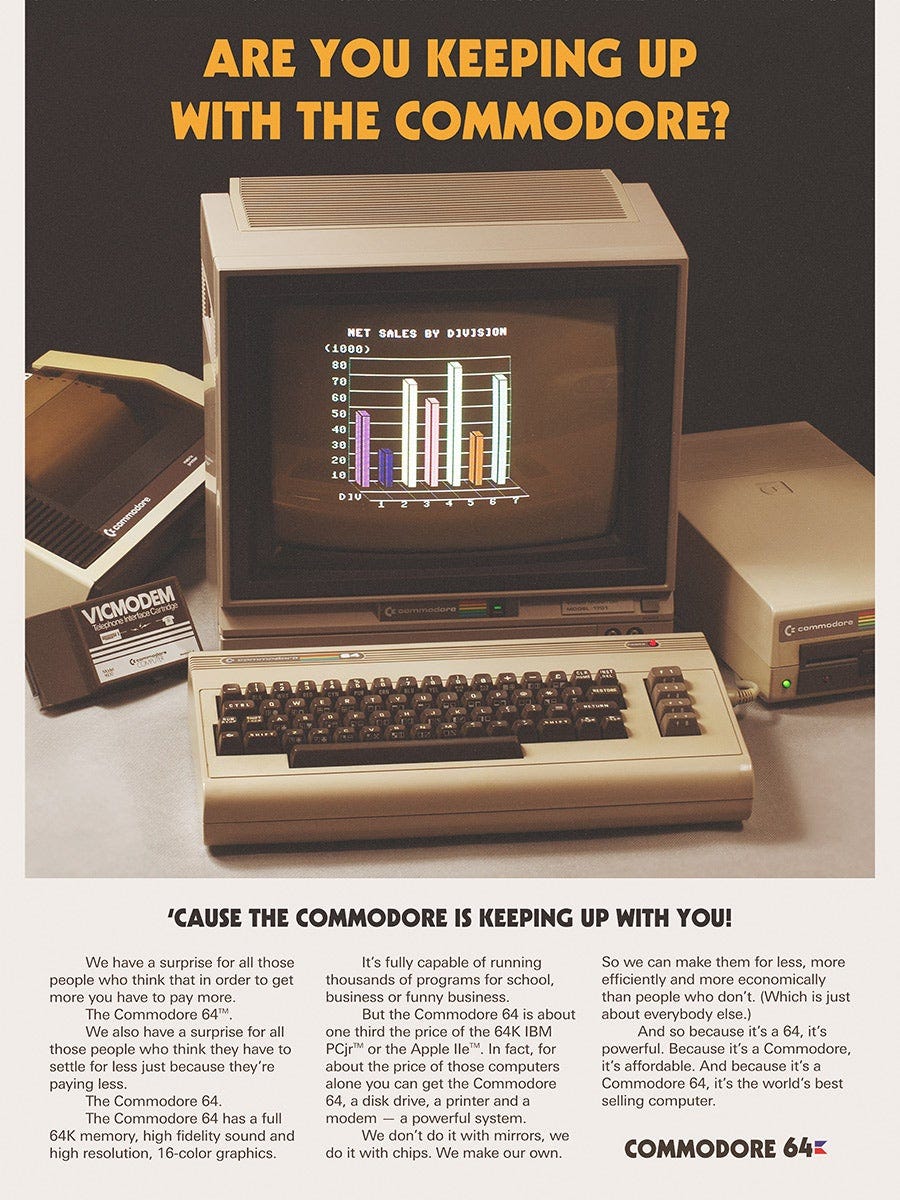
The C64 was pretty much the best of all the 8-bit machines of that epoch, except maybe for super high-end MP/M boxes. It shipped with the full complement of RAM such machines could handle without banking, its CPU was a lot faster than that of the CP/M machines and TRS-80s, it included a sophisticated audio synthesizer, and it had the kinds of color and hardware-accelerated scrollable tiles and sprites that made it possible to do decent 2-D games. Its text resolution wasn't anything special but at least it had lowercase, and it had enough RAM to bitmap the whole screen, even if you couldn't put arbitrary colors everywhere.
The NES (a few years later) had better graphics, and the Apple //e had better text, but the C64 was pretty much the overall champ.
There are 8-bit machines today like the Arduino that can run circles around the C64 in some ways, because they're made with dramatically better fabrication technology so they can run much faster; is that what you mean about it not being a good 8-bit machine? I've synthesized audio on an Arduino that you couldn't have done on the C64.
C64 was very similar to the earlier Atari 800, just much cheaper in terms of price and construction, and (reportedly) sold below cost to drive the minor players out of the business. Nobody cross-shopped a CP/M or IBM PC with a Commodore.
Note the article is from the trailing edge, and the other 8-bit systems pretty much almost dead at that point, and the C64 was just barely still selling for another year or so on cheap fumes.
(Never was even aware of C128, so no comment on that.)
C64 production continued until 1994. Commodore announced that year, just prior to its bankruptcy, that the C64 production would finally end in 1995, but then they went bust. They held onto the C64 production that long because it remained profitable for them.
Commodore didn't have the money to sell the C64 below cost. I don't think there's any evidence to suggest they did other than possibly for very short periods. People thought they did at the time, sure, but Commodore's ability to cost-cut was in large part due to their extreme vertical integration at the time.
In 1988 the C64 was still selling over a million units a year. It was losing market share fast, but due to the growth of the overall market, not due to dropping C64 sales - sales at that point were still stable. The NES sold ~7-8m in 1988.
The IBM PC was 16-bit, though, like the TI 99/4A and SNES, despite its 8-bit data bus. The C64 was introduced in 01982, and people kept selling CP/M systems and TRS-80s for several years after that. I agree CP/M was pretty dead by 01988.
Commodore seems to have really believed obsolescence wasn't real. WDC launched the 65CE02 in 01988, and Commodore tried to build the Commodore 65 on it in 01991.
A decision I've never understood from that period: IBM introduced the PS/2 Model 30, with an 8-MHz 8086, in 01987. The 8086 was from 01976, but at least it had a 16-bit data bus, and at 8 MHz it was over a MIPS (though only 0.4 Dhrystone MIPS if we believe http://www.netlib.org/performance/html/dhrystone.data.col1.h..., that's still 8 times the Cromemco Z2 with its Z80, and 20 times the C64, though at this point we're well outside the area where Dhrystone is a good measure). They did replace it with the "PS/2 Model 30 286" the next year, but unfortunately not before my school district got suckered into buying some of the crippled beasts.
I agree that the C64 was pretty similar to the Atari 800, but it had much better sound, it had 256 multicolor sprites instead of 8 two-color sprites, and the 800 shipped with 8K and couldn't hold more than 48K. So there was a pretty big difference in what you could do on an Atari and what you could do on a C64.
Regarding the PS/2 Model 30 using an 8086, it's important to remember that average consumers didn't quickly adopt the latest microprocessors like they do today, and it was very common for manufacturers to use much older chips in newer products. Hardware was expensive, and the latest hardware was crazy expensive -- the PS/2 Model 30 with its 8086 had a list price of $2,295 ($5,952 in today's dollars), while the contemporary PS/2 Model 80 with its 80386 was $6,995 ($18,142 in today's dollars!). Also, the software commonly in use on IBM compatibles at that time (i.e. DOS) wasn't particularly suited for taking advantage of the newer hardware.
My school had a number of 8086-based PS/2 Model 25's. By the time I used them in 1991, they had been retired to second-tier labs, but they were still perfectly usable for checking email, word processing, telnet to the UNIX server, and some light games. (I remember Star Control ran particularly well on its quasi-VGA "MCGA" graphics.)
To be fair, with Contiki, a Commodore 64 is also usable for checking email, word processing, telnet to a Unix server (if you don't really need 80 columns), and games, even though it's much slower than the Model 30 or Model 25 and has less RAM.
Indeed! I'm familiar with Contiki, and have even done a bit of Contiki programming for fun. :) Sadly, it wasn't around back then, but it's fascinating to see how more value can be squeezed out of old systems.
These particular PS/2 Model 25's probably had an edge on the C64, though. Having proper Ethernet cards and access to Netware servers allowed loading applications a lot faster than, say, a 1541 disk drive. Although my present-day C64 with Ethernet adapter, SD2IEC, etc., might could give it a run for its money. :)
The MSX2 was certainly fascinating, and better on most graphics measures (more colours, more sprites, better scrolling - unless you use the unintended C64 VSP techniques, which breaks on a small number of machines.) However, it had far inferior sound, and despite the higher clock rate it wasn't usually faster, since most 6510 instructions execute in 2-7 clock cycles whereas the z80 typically uses 5-25 cycles. The later MSXes could in theory have a lot more banked memory than the c64, but I don't know how common that was (there were RAM extenders for the c64 too but they were vanishingly rare).
Apart from more colours and higher resolution, there's nothing in those 50 games you linked that would be clearly impossible on a c64. You should link to a demoscene showreel instead ;)
https://www.youtube.com/watch?v=EcVa0zviOJw&list=PLFxDEp8RK4... is a C64 demo playlist, but I'm not sure it shows anything a MSX2 couldn't do either, except for much better sound. It certainly has a lot of stuff that's more visually impressive than those MSX2 games, but I suspect that's because it was made by better programmers and graphicians, not because of the limitations of the hardware.
Definitely if I'd seen stuff like those C64 demos in 01982 when the C64 came out, my reaction would have been total incredulity; it is so far beyond what I imagined computers were capable of that it would have seemed like alien technology. And that is not true of the MSX2 games. But to a significant extent that's not really about the capabilities of the computers themselves but about the SID and the VIC-II, and to a smaller extent it's about algorithms and tricks that were developed years after the C64 itself. Boogie Factor, for example, is from 02005.
MSX* demos I've seen like https://www.youtube.com/watch?v=busiDuS94qY are more visually impressive than the games linked upthread, and very impressive indeed for a Z80, but still not in the league of the C64 demos, despite having lots more RAM to work in. I suspect the anemic CPU is to blame; that demo leans on raster shears pretty hard.
Really, though, I'm more convinced by GEOS. In GEOS the C64 had a WIMP GUI with a WYSIWYG word processor with multiple proportional fonts, a pixel paint program like MacPaint, a faxing program, etc. Because what's really important is how computers increase human ability and especially how they empower human creativity, not how many colors they can show.
Those graphics look comparable to the NES, which as I said above had better graphics than the C64, but it seems that the MSX2 had a much slower CPU (a 3.58 MHz Z80), and possibly as a result it apparently didn't have a GUI environment comparable to the C64's GEOS. Also it only had 48K.
I'm confused, because if I look at Wikipedia it lists the CPU for the C64 as "MOS Technology 6510/8500 @ 1.023 MHz", whereas the (newer) C128 has the same 4MHz Z80 CPU that the MSX had. But you're saying the C64 was actually faster?
> Also it only had 48K.
I think you mixed up the numbers here? The 48K refers to the ROM size (C64 had 20K), not RAM (MSX2 machines commonly came with 128K RAM, but you also had 256K models).
You're right about the RAM, and I was wrong. Yes, a 3.58 MHz Z80 (or even 4 MHz) is generally slower than a 1.023 MHz 6502, but it's not much slower as I said. As pkroll points out, the C128 also had a 6510 as well as the Z80—Commodore was hardly going to ship a C64 follow-on that couldn't run C64 software!
The C-128 had both a Z-80 for CP/M, and a 2 Mhz version of the 6510 (the 8502). Could only run the 8502 at full speed with the regular graphics processor off/using the 80 character display.
This is from 1988, where the incredible upgrade cycle was about to start. Standards for consumer HW went in 4-6 years from 8086s to 486s, from Hercules/CGA to SVGA, from 5 1/4" 360 kb floppies to 400mb harddisks. I think the comment just about predates this incredible upgrade cycle.
I mean, that comment predates the "Andy & Bill law" [1]: what Intel giveth, Microsoft taketh away.
There was no need to upgrade stuff back then.
In that context, not a very weird comment - especially for someone whose job it is to sell these machines.
Amstrad CPC6128 and Enterprise 128 were arguably much better machines than the C64, architecture-wise. The idea that the C64 was the 'best 8-bit machine of the market' is very US-centric - there were certainly far better 8-bit machines on sale at the time, its just that their market wasn't the USA.
(Disclaimer: Oric-1/Atmos user here. A much better machine than the C654 - it taught me to program.)
The MSX, MSX 2, Amstrad CPC and Enterprise all had better hardware and ROM software but they came out later than the C64 (fall 1982), which by then already had lots of games and dominated the market sales-wise. As today, we buy computers and choose operating systems based on the software we want to run. Which would you buy? The system with the most software and the most software currently being made, or a system with somewhat better hardware but little software available?
When the C64 came out, it had the best graphics and sound, but not the best ROM software. I wouldn't even say it had an operating system. It was really just a small, simple KERNAL with some system calls. It didn't have a very good BASIC either, and couldn't auto boot. It was essentially a video game console with a keyboard and a slow floppy drive so parents would think it was a computer. It didn't even have a proper backward compatible upgrade path. The C128 and C65 aren't backward compatible with it, they have a C64 mode.
I had a VIC-20 and then a C64 in the 80's but looking back now, I'd rather have had an Atari 800/XL/XE. The graphics and sound were almost as good but it had a real OS, custom DOSes, and lots of interesting programming languages available for it. But I, as many others in software and IT today who got started with Commodore computers, couldn't afford the Atari or Apple systems so I am grateful Jack Tramiel made computers for the masses, not the classes.
I don't think anyone argues that specific c64 hardware designs, like how the video chip steals CPU time, were all that brilliant. The 6510 chip has some strengths and weaknesses compared to the Z80-based micros. Most micros beat the c64 on filled polygon 3d graphics for instance. But the c64 had the best sound by far of the 8 bit micros, even those very late models that you mention.
The Amstrad CPC 464, 664, and 6128 didn't have hardware scrolling or sprites, but the 464 Plus and 6128 Plus did, making them more comparable to the Commodore 64 and 128.
> There is no such thing as hardware obsolescence.
That's a bit naive. Older hardware devices, such as Android 4 devices, cannot be upgraded to TLS 1.3. Hardware also becomes obsolete when wear items are no longer available - and that could include 3.5" floppies, or compatible batteries, or even RAM modules in some applications. Not to mention wifi devices that support only 802.11a, or G1 cellular phones, or even analogue television in the United States.
Often devices are still needed, but the ecosystem surrounding their usage has changed. That is what often brings around obsolescence in this industry.
"If [this machine] satisfies the need, it is never obsolete. (...) If the need continues to exist until the year 2000, then this machine is still satisfactory. There is no such thing as hardware obsolescence. That is a phrase that was coined by the naysayers in this industry. That's baloney."
It is so far from reality for the general public, but so true for my 1980's machines that are still very funny, to play with and program!
As a counterpoint. I don't find using my old phones and tablets fun. They are all worse than I remember and extremely laggy. Imagine trying to play Apex on a computer from 1980. There's no way you are going to have fun playing that.
That article came out just around the time 286 clones became affordable which was the beginning of the end of the 8-bit age. A 285 machine was still a little over $1000 but that’s inclusive of the monitor and a hard drive. The performance though was ‘on another level’ compared to 8-bitters and people like John Carmack and Mike Abrash were just about to figure out how to make games like Commander Keen.
286 was a very shitty system: it had only a beeper, practically no DMA, no graphics hardware acceleration of any kind (not even hardware scrolling; sprites were science fiction). Almost everything in that shitty PC bucket was driven by the processor, and that processor was dog slow.
There was that time I used my 12 MHz 286 to develop software for a Z-80 based CP/M machine and I could emulate the Z-80 faster than a real Z-80.
Graphics and sound really did suck compared to machines specialized for that. The best you could do for games at the time were tile systems like the Nintendo NES and the TI-99/4A which were not that different from text mode except the ‘font’ was customizable and the tiles were square. The Atari 400/800 normalized changing your video mode on every scan line but the C-64 had the best system balance in terms of quality output on an NTSC television.
The EGA introduced tricks that would let you make the video card copy multiple planes of data at the same time, also you could do some pretty neat tricks with the palette to make layers that blended like sprites. I see Commander Keen as a watershed because it had scrolling as good as Super Mario Brothers and ran on the EGA. Of course they figured out Mode X for the VGA and we got Doom a few years later.
It's interesting that there really wasn't much of a "game video" option for early PCs. CGA was a disaster, and the PC platform never really got sprites or smooth scrolling until it wasn't relevant anymore. The PCjr/Tandy graphics system offered a few more colour options, but that's about it.
Obviously, you couldn't buy a hundred thousand GTIA or VIC-II chips and solder them into ISA cards, but there were some non-exclusive options-- the graphics chips used on MSX hardware, for example.
There were definitely low-end PCs that would have been able to tread into the "home computer" space occupied by the C64 and Atari 800, by price and design (there were a few 8088-class "PC in the keyboard" designs-- some Tandy 1000s, and a Vtech/Laser one come to mind), but they were hardly the ones kids were gonna beg their parents for with those mediocre graphics.
New Mexico Tech had Sun workstations based on SPARC and in 1993 the talk was of Linux because a 386 machine would beat a Sun workstation easily.
Other 32 bit machines like the high-end Amigas and the Atari Falcon 030 could not keep up. Macs were expensive but sold well because of the refined GUI but when Windows 95 came out with an adequate GUI, Apple went into crisis.
In my mind the 286 surpassed high end machines in DEC's PDP-11 line and the 386 surpassed DEC's VAX (a 32-bit minicomputers)
The 286 was "brain damaged" for implementing operating systems according to Bill Gates for two reasons: (1) you could not get back to real mode without doing a terrible hack resetting the whole machine, (2) you could not write to segment registers at all from user mode so writing programs that use more than a 64k data segment and 64 k code segment means doing an OS call.
The 386 on the other hand took forever to get to the point where a 32-bit OS was mainstream, from 1985 release of the 386 to 1995. Some of us (me) were using Linux before then, but that was it.
My conclusion about the 286 being pivotal came from my own experience (switched in 1987) and also looking at old issues of Byte magazine circa 1987 and seeing that all the advertisers were in a state of turmoil. For instance some firms like Cromeco who sold S-100 bus and CP/M machines to OEM's to put, say, a cash register system in a supermarket were giving up the ghost because PC's were crushing them. Similarly there were ads for PC clone makers all over the place but anything associated with the 8-bits was vanished. The original IBM PC was much more expensive than 8-bit machines but not much better in terms of power, PC AT clones were still more expensive but they were so much more powerful that it was worth it.
My experience of the time is from a home computing perspective. From that perspective I saw minimal impact from the 286. I knew many people with 8088 machines and very few that owned a 286. If you walked into a store selling PCs to consumers the shelves were full of 8088 machines but few 286 based ones.
The big change I saw was in the early 90s when 386 PCs with VGA displays became common place. This is when the people I knew upgraded and 8088 machines completely faded from the scene. The killer app driving 386 sales was Windows 3.0.
I was in S Fla then as a boy/teen and it was crazy how many weekend computer expos/shows there were in Miami / Fort Lauderdale (usually in a city or county convention center or some hotel)—- most of them advertised in Computer Shopper. I went to a bunch of them with my dad. They were really a lot of fun. Mostly just a bunch of tables of middle-aged to older computer guys selling peripherals and software (and I’m sure lots of other stuff I can’t remember now)..
I went with dad and brother a few times, and yes, middle-aged computer guys selling stuff. I was always more excited by the hardware than software, so I didn't check out those tables so much.
Of course Galacticomm was HQed in Lauderdale and they made the MajorBBS multiline BBS system so I can't help but wonder if you had any experience meeting the quite brilliant devs that ran that shop?
My company, Magicomm, wrote 3rd party add-ons for the main system and eventually my partner was hired on with them directly...me? Not so lucky I remember interviewing directly with the owner, Tim Striker, and I was so nervous because I wanted to work there so badly...I almost completely blanked out for the interview and couldn't remember even the simplest of C basics. (Describe an union, what command do you use to zero out memory after you malloc etc etc)
I bombed the interview and never did get to work for my dream company like my partner, who I basically trained on how to use C, did, and to this day this fact irks me lol.
Hah, very interesting! Nope never did meet any of those guys or rly run in those circles.. I did a little Amiga BBSing but honestly don’t remember any of them.. I did go to one meetup thingy but also barely remember it in some mall…
I do remember though spending a lot of time at All Books and Records on Sunrise Blvd (I think) next to the Sears. Coolest book and record store around except for maybe Robert A Hittel’s bookstore on Federal Hwy..
Also spent a lot of time going to Sunshine Software on Cypress Creek Rd.. kind of a magical place run by two rly cool computer dudes..
Well, as a kid of the era that had an XT, it really kicked off with Wolfenstein on the 286. Doom changed a lot more, but everyone was pissed at the time if they couldn’t play Wolfenstein. Never felt that way for any of the previous games for the 64/128/XT.
That shows how bad PC clones were at some types of video games. It took a massive programming effort to do a side scroller, requiring machines that arrived six years after the Commodore 64 or Famicom.
They were the beginning of the end but 8-bit systems were still available until the early 90's and purchased by those who couldn't afford the 16-bit systems.
Low end PC's were getting pretty affordable by then. This 1988 ad has an 8088
machine which was about $650 inclusive of a disk drive and a monochrome monitor.
The entry-level price of a C128 was much less but if you add a disk drive and a monitor so you can use the 80 column mode you're not saving that much money. The 286 machine is a lot more computer at $1100, the 386 is twice that.
I had a hard time finding any 8088 machines advertised in Byte in 1990. To be fair Byte was aimed at the high end of the market, yet, Byte had plenty of coverage of the early 8-bitters, but I think the C-64 didn't get covered in Byte proportional to its popularity because it was late enough to the party that the IBM PC was getting mindshare.
Byte had an odd mismatch between what was getting advertised (you'd have thought Cromeco was really something, other vendors of S-100 bus machines that supported CP/M were big) and was getting written about (low-end 8-bitters got a lot more press than CP/M ever did)
Oh wow, that made me feel old. I actually read that article just before making the switch from the Radio Shack TRS-80 ecosystem to Commodore. See the Tussey ad for a 64C with an FSD-2 floppy? I bought that package from them with a repackaged c.Itoh thermal printer. It actually had the mail-in redemption offer the Commodore guy referred to in the article.
It felt like I had that C64 forever. I learned CBM BASIC, 6502 assembler, and even K
I did see that but just wasn’t sure as I remember Compute! being more general purpose and I guess never realized they had offshoots oriented to specific platforms
No, COMPUTE!'s Gazette was not C64 specific. It covered all the Commodore 8-bit home systems: VIC-20, C64, Commodore 16/Plus/4, C128. It started with the VIC-20 and C64 as that is all there was, and in the end it only covered C64/128. The C64 was certainly the only model the Gazette covered during its entire lifetime.
The gorgeous thing about these was that, the thing that sold a game was clever playability. Even the games that tried to create an immersive world had to span 4-6 floppy disks, and mostly had to lean on imagination, and your ability to see a fantastic world in colored pixels. I learned to code on a vic-20, then a C128, though the C64 had basically all of the fun software. When the Amiga came out, you had to pay $500 to get a C compiler to build software on it, but it was a dream. When Commodore finally tanked, I looked at the 80286 and Win 3.11, and nearly gave up on computing. Then: Linux. But for all of them, the beauty came because you could "touch the bottom" of the virtual world they offered.
1988 was definitely the pinnacle of the C64 in Britain as the games developers there had stretched the HW to the absolute limits then. I don’t think USA C64 owners had as rich an experience with those machines as we did in Britain. From 1989 onwards was the rise of the Amiga but the C64 still kept Commodore afloat until 1993.
The pages of code beginning on page 82 bring back some memories. There was a certain childhood thrill that came from changing some of those values despite not really knowing what was going on.
Instead of focusing on the obvious progress story lets try to see what the C64 still has going for it and some unmentioned drawbacks:
- It was a somewhat open system that you could build something for without asking for permission!
- You could copy all software.
- The longevity of the hardware surpasses most devices built after for a fraction of the cost.
- It was repairable.
- Most sold compatible architecture with ability to be productive ever in the history of mankind, probably forever.
- 15W is pretty low power considered the lithography at the time (micrometers).
- Keyboard built in that still works 40 years later!
- S-video built-in before it was even called that, not even the amiga had that!
- The SID is unparalleled still in some regards.
- The VIC was incredible, sharing the 2MHz RAM with 1Mhz CPU interleaved and hardware sprites!
The only flaws I can find are:
- The IEC bug that slowed IO from the VIC until the 128.
- One button joysticks?! the device has POTx and POTy why not use those?!?!
- No built in assembly monitor in the default setting.
To me human progess has ONLY been the C64 -> Raspberry 4 arc: from micrometer to nanometer. And the raspberry uses linux and has all compilers built in, and still very few kids use it for it's initial intended purpose: to build software!
With electricty prices rising I think the Raspberry 4 will have a resurgence so I always develop my software to work on that device too.
But most important; with computers as with protocols there is no competition, you need to follow the standard and in the 80s that standard was the C64. I think ARM+linux will be that final standard unless risc-v can pull the open hardware trick off!
Seen that kids, that weren't even born when the C64 died, buy one and try to develop for it is a pretty good sign that the C64 will survive!
The video chip was called the VIC-II. The VIC was in the VIC-20. They are similar in operation but not compatible.
Digital joysticks were best for most games. It's too bad no one brought out a game pad as they are better for some games. A second fire button could have been added. There were analog joysticks available but typically for special software such as flight simulators. It is too bad Commodore didn't put out an analog stick to encourage their use in driving and flight games. The joystick industry would have ran with it and would have brought out lots of them.
The VIC-20 didn't have a built-in assembler either. Jack wasn't a computer user so he didn't see them as being important and was more focused on keeping the prices low, especially for the home models. Commodore did release ML monitors and even the Super Expanders on cartridge for the VIC-20 and C64.
The IBM PC only won because it was built from off-the-shelf parts, meaning the hardware was effectively open source. Once the BIOS was cloned, there was no way anyone else could keep up. The only survivor is Apple and they almost didn't make it. If the CP/M machines had time to become mainstream on 16-bit processors before the IBM PC was cloned, it might have won and Digital Research might have become what Microsoft has.
I wonder what the equivalent headline would be today. Which hardware or software technologies are currently blasting away, but if you look at the cutting edge, are actually obsolescent?
I'm going to get buried for this but, even though I have been a JavaScript programmer for many years, in the software side I think it's JavaScript, and even further a few years after that, web browsers.
I see web assembly as a compelling target for many types of applications on the backend, or blockchain etc.
I think that _could_ also eventually translate into momentum for standards for i/o devices for web assembly.
After years of trying many languages, I started using JS many years ago, and it's so fast and familiar (w/ a big routines library built) and versatile (with HTML & CSS) that I won't be leaving it behind for personal projects.
I also feel that JavaScript or something similar is also the most practical language for many projects. Especially as you mentioned with the huge library (npm etc.).
Having said that, web assembly has the potential for an even bigger library of modules to be built up, since modules written in one programming language could potentially interoperate with those written in another language.
'Sometimes I listen to software developers, and I get a little bit angry. I want to ask them "Why are you trying to kill this product? Is there not enough installed base to support your efforts?"
Oh boy Rich... posterity has given you an answer!
Edit: There is a review later on, however, that was fun. A game called Trap! could be sped up by poking memory.
And then I got to the file listings... some of the programs you literally entered in machine code! How did people ever find the time?!
Typing in those hex bytes didn't actually take that long. The worst part was making a data entry mistake. Later "versions" of the listings had a checksum for every line, but the earlier ones didn't. Finding where you typed "6E" instead of "6F" could be a real chore.
Exactly so as a 10-12 yr old it was kind of either read physical encyclopedias, do random prank calls from white pages, or hack around on your Atari 400/C64/NES/Amiga.. (well I guess or go skateboarding)
8-11 year old me made the time because after the sticker shock of two video games, my parents learned about and got me a subscription to Compute! I also spent the summer gathering up bottles and doing odd tasks so that I could afford to get a disk drive because my siblings kept stealing my tapes to record songs off the radio.
You could've stopped them by breaking off the plastic covering the read-only hole, it would have prevented writing to the tape. And, then when you were using the tape and wanted to write to it you could cover it with adhesive to make it writable again. As long as they weren't aware they could do the same, your tapes would have been safe. Because, the moment they went to record over it they'd think the tapes were defective or not compatible.
> some of the programs you literally entered in machine code! How did people ever find the time?!
IIRC there was a program in BASIC you had to run to start the machine language prompt. Entering lines basically involved typing a series of numbers and their checksum. If you entered the line without errors, a bell sound would play. Otherwise you would hear a buzzing sound.
I knew how to touch type and would just treat the number row on the keyboard as the home row. It was actually faster to transcribe the machine code due to the checksum feature compared to BASIC code.
Looking back on it, I wish they would have just had the program listings in assembly language instead of machine code. That would have made it easier to follow along.
It's worth thinking that the just-in-time supply chain so prevalent now is probably what allows the fast pace of change. In the 80s, you made a product, and needed to lock in supply contracts, warehousing, sales etc. There was so much inertia in those, you ended up wanting to keep your working product going without changing it.
Comparing the millions of man-years that have been poured into 16-bit CPUs and architecturers, gotta suspect that the ROI by sticking with 8-bits would have been a better choice.
More generally, I'd suggest that ten-thousand ants could convey a ton of leaves with much better overal energy-efficiency than using a single pickup truck. ('Relative greenness') Might even be a law of nature!
I see no mention of a harddrive for the $449 system? And also, it's not really $449: "Must be purchased with MS DOS & G.W. BASIC Software for an additional $79.95". And that is excluding the monitor, which you can't avoid, whereas the C64 can be used with a TV. And a monochrome TTL monitor card (heavy phosphor to reduce flicker, at the cost of lag), so no colour. And of course no proper sound.
To me, had I been forced to buy a computer based on page 38 alone, then unless I had specific software needs (e.g. Word Perfect or similar), I'd have opted for the Complete Commodore 64C System for $395.95, even though I'd have preferred to buy one without the monitor and used a colour TV instead (but the price in question is competitive w/packages without a monitor, so I'm guessing they were clearing out old stock given it's a tiny monochrome monitor).
Had PC's stayed like that, the C64 would have kept doing just fine in the low end of the home market. Of course PC's didn't stay like that for very long at all.
Those sound cheap today but were very expensive in those 35 year old 1980's dollars. Businesses and the more well-to-do could afford them but the majority couldn't. This is the reason Jack Tramiel's Commodore 64 and Atari ST were targeted at, "the masses, not the classes".
> The C-64's designers blamed the 1541's slow speed on the marketing department's insistence that the computer be compatible with the 1540, which was slow because of a flaw in the 6522 VIA interface controller.
I believe they were able to work around the original flaws in the disk drives introduced for backwards compatibility with the Vic-20.
> Without hardware modifications, some "fast loader" utilities (which bypassed routines in the 1541's onboard ROM) managed to achieve speeds of up to 4 KB/s.
These days, fast loaders achieve speeds up to 19.6 kb/s (Krill's Transwarp, although it does require a custom file format), or ~50 times the usual speed.
Using the clock line for data too. The disk drive was a computer too with a CPU, it run on very similar speed to the C64, so you can rely them being in sync.
Trilogy? I have four Brian Bagnall books so far...
People decided which hardware to buy based on what software they want to run and their budget. If they wanted business software before the IBM PC came out, they chose CP/M, Tandy's TRS-80, or perhaps the Apple II with VisiCalc, or sometimes with Microsoft's Z-80 card to run CP/M.
If they wanted education for their children, they'd often buy what their children's school had, if they could afford it. In the US this was usually an Apple II, Atari 800 or Commodore 64. In Canada it was usually the Commodore 64. In the UK it was the BBC Micro. In France, it was the Thomson.
In North America, if they wanted the best games, they bought an Apple II, until the Atari 800 came out, and only until the Commodore 64 came out. In the UK it was the BBC Micro if you had money and wanted more than just games, and the Sinclair ZX Spectrum if you didn't have money or wanted more games. The Commodore 64 was also a popular option there, once it was released.
If people couldn't afford those options, they bought a Commodore VIC-20 or 64, or the Sinclair ZX Spectrum in the UK. Another lower cost option was the Tandy Color Computers.



Gazette: Despite this, the machines sometimes get rapped as being old-fashioned, obsolete.
McIntyre: Today, if we positioned the 64 in the marketplace – forget RAM, bytes, bits – if we went out and functionally described the Commodore 64, it would be heralded as a fantastic advancement in personal micro-computing.
The problem is that if you start to talk to people who have been in the business since its inception, they start to get jaded: "it's only eight-bit."
Who cares? You are buying this machine for a specific reason. If it satisfies that need, it is never obsolete. Only your requirements become obsolete. If you no longer require it, then you obviously no longer need hardware to satisfy the need. The need ceases to exist – not the hardware. If the need continues to exist until the year 2000, then that machine is still satisfactory.
There is no such thing as hardware obsolescence. That is a phrase that was coined by the naysayers in this industry. That's baloney.
---
In a way, he's not entirely wrong, but I think it's also quite myopic. Sure, a C64 can be "satisfactory" even today for many tasks in the sense "it'll work", but that's not the same as "good". The C64 is 320×200; even just a doubling of that to 640×400 (never mind fancy things like 800×600 or 1024×768) can be a huge productivity boost in many scenarios simply because you can display more text, never mind all the "RAM, bytes, bits" that do actually matter since you can do more faster.