I find this interesting because I just saw a story in my local news about Western Union getting flack because they were making it difficult for certain customers to send money to known terrorist countries. They were called 'bigoted' and 'racist'.
They really can't win here. If they allow anyone to send money anywhere, they get fined by the government for supporting criminals. If they try to make a judgment call, the public gets up-in-arms about it and thinks they are bigoted (and potentially lose customers or get involved in other lawsuits).
Based on the article, it's much simpler than that:
"Fraudsters offering fake prizes and job opportunities swindled tens of thousands of U.S. consumers, giving Western Union agents a cut in return for processing the payments, authorities said."
In other words, it's not that they are "allowing anyone to send money anywhere"; they didn't discipline their agents for taking a cut of known fraudulent transactions.
Um, isn't this describing their regular activity, worded in a way to make ot seem more sinister? Their agents take a cut for processing payments regardless of whobis involved, no?
It's very possible, but the wording said something like, "allowing many agents to take a cut.." so I would read that like it was an additional payment or kickback of some kind.
If it was just part of business, it would have been every agent right?
> Fraudsters offering fake prizes and job opportunities swindled tens of thousands of U.S. consumers, giving Western Union agents a cut in return for processing the payments, authorities said.
I don't see it. I'm reading the actual court documents now, which I found by googling and going to the FTC's website:
I don't see how that can happen. I have few friends that work in WU and every suspicious transaction is checked at few levels by different people. Maybe unless it's not "agents", but somebody higher up. Or WU have different procedures in EU and USA.
> If they allow anyone to send money anywhere, they get fined by the government for supporting criminals.
They could allow the transactions, but secretly support anything suspicious to government anti-terrorist agencies. They wouldn't get called racist because any transactions they block were at the behest of the government. They wouldn't get in trouble with the government because they're handing all their data to them. And customers wouldn't complain they're divulging private data customers people wouldn't know. It's a win-win-win.
Why does it have to be "any suspicious activity", and why "anti-terrorist agencies"? Why not start with "things that are obviously crimes" and "the police"?
The one time I tried sending money from Los Angeles, CA, USA to Portland, OR, USA, I wasn't able to meet the criteria necessary to complete the transaction. Some my friend and I, both US Citizens, raised a red flag. It felt pretty lame, and the person manning the Western Union location couldn't care less about helping me navigate the system. I haven't lost a lot of sleep over this, but I never tried using the service again!
It had something to do with my friend not being able to provide enough information to prove "I'm not a terrorist" to what felt like a pedantic level of satisfaction. I don't remember the specifics.
Here's the US Justice Department, the Federal Trade Commission, and the Treasury Department’s Financial Crimes Enforcement Network (FinCEN) complaints:
I got hit by credit card fraud related to this story.
I either got skimmed at a gas pump or at a restaurant.
What I saw were 4 Western Union transactions on my card, each for $255 USD. Two per day with this string - "WU*XXXYYYZZZZ" - where XXXYYYZZZZ is a phone number.
My issuer shut down the card and issued me another one. I was not responsible for the charges.
Also, the issuer said the reason they did not send me a fraud message was because the charges were occurring around the holidays where large charges are commonplace.
Makes me wish that banks provided some easy self-protection checkboxes. Much like you can disable international calls and premium services with most mobile providers, I'd like to say "mark western union as fraud, unless I confirm it on the phone first".
I wish they provided the opposite. They are constantly deactivating my card or changing my card number when I've never had a single actual fraudulent transaction on my account. In the event that my card is stolen, I'm not liable, they are. By deactivating my card they're not protecting me, they're protecting themselves, by inconveniencing me.
So... you want no fraud liability, but don't want to be inconvenienced either?...
You could always look for a less zealous credit card provider, but generally speaking, the entity that takes the liability should be able to set the bar for risk. Otherwise you get subsidized risk taking, which has a way of getting out of hand.
You may well find that credit card companies who are not very zealous about security are merely more successful at weaseling out of the liability that their customers assume they are taking.
At the end of the day, fraud creates costs, and you can be sure that SOMEONE is paying those costs. If your credit card company doesn't seem very zealous about preventing fraud, then it's more likely that you are the one who will ultimately pay when the bill comes due.
I want them to upgrade their technology past the 1990s so I don't have to share a semi permanent unique number with every person I want to pay, along with name, signature, expiration date, card type, CVV, zip code, address, and/or phone number.
There are smarter ways of adding security - like letting me know via my phone and allowing me to cancel "suspicious" operations using it.
Disabling my card constantly doesn't help me at all, it's just a PITA. Imagine if any other service provider (webmail?) disabled your account frequently to "avoid fraud".
So you assume. Have you ever investigated credit card fraud? Perhaps there are edge cases that are more difficult than you imagine.
> Imagine if any other service provider (webmail?) disabled your account frequently to "avoid fraud".
Webmail is absolutely lousy with fraud. Webmail companies explicitly disclaim all liability... so... you kinda bolstered my point there. That is, you helped add the significant texture that companies that disclaim all fraud liability can be pretty lousy at preventing fraud.
To reiterate: The entity that accepts liability should be the entity that draws the line on what risks are acceptable.
Credit card companies are pretty unique in the types and magnitude of risk that they accept and manage. They already do quite a high wire act balancing fraud prevention against user convenience. And despite some things that seem inconvenient on the surface, they are typically still the most convenient way available, by a wide margin, to conduct most payment transactions.
I've had like 15 credit cards and in my experience, fraud alerts/shutdowns can always be fixed with a phone call or sometimes even a text message or email followed by login to their website. I have never gotten a new card number for suspected fraud that never actually occurred. Your bank seems very unusual in this regard.
If you really want to go hardcore there's card issuers that let you freeze and unfreeze your cards online/from their app, so you can keep it frozen until you are making a purchase.
I had this issue with Visa so many times, I've canceled my card and will never use them again.
One out of three purchases was rejected, and I had to call them, wait in line like 10-20 minutes, and have them reactivate it. They kept saying it was "for my own protection", but I kept losing time constantly. This worse especially awful when I tried to catch an offer that ended by the time they fixed the issue.
Visa and Mastercard only handle payment networks and third parties handle issuing and administering the cards. So its not Visa's fault, as they don't issue their own credit cards. It's the bank that issued the card's fault.
Contrast this with American Express and Discover who both issue their own cards and handle the payment network. There's also third parties that issue AMEX cards (any maybe Discover, but I don't know of any)
So in other words, don't blame Visa, blame the bank.
Chase lets you setup transaction alerts, where they send you a text if a transaction of more than $X occurs. I just have it set to $0, so I get a text for every single charge on my credit card.
It has helped me spot fraud last month, and it also acts as a quick check to make sure the amount charged was correct (very helpful in restaurants or the like).
I get a text for every transaction on both my debit card, and my main daily use credit card. Twice now things have popped up and I've been able to resolve them before the next billing cycle.
Most banks, and most card companies offer this - for free. If yours doesn't, you might want to shop around for one that does.
It most likely wasn't skimmed. 13+ years ago I did some WU carding and it was really hard. I'm sure their security has gotten even better.
They only accepted credit cards online and by phone. They required a ton of information in order to process it, often verifying items from your credit report. To pull it off you had to have a lot of info about the cardholder.
In other words, Western Union is guilty of not being zealous enough at being a quasi-law enforcement agency and investigating its customer transactions...
To those cheering here, you should remember this next time you try to open a bank account or make a payment, and your bank wants to see a thousand of proofs and certificates before moving a finger.
>guilty of not being zealous enough at being a quasi-law enforcement agency and investigating its customer transactions...
Did we read the same article?
>Western Union (...) admitted "to aiding and abetting wire fraud" by allowing scammers to process transactions, even when the company realized its agents were helping scammers avoid detection
Furthermore:
>Between 2004 and 2012, the Colorado-based company knew of fraudulent transactions but failed to take steps that would have resulted in disciplining of 2,000 agents, authorities said.
If the prosecutors were able to prove that WU was aware that the transactions were fraudulent your comment makes no sense. They didn't need to be "a quasi-law enforcement agency" because they already knew that the transactions were fraudulent.
You realize you are taking the prosecutions press release at face value, don't you?
If a few WU employees helped a few customers navigate the compliance hurdles, and some of those customers happened to be scammers, the press release would say the same thing.
There is a significant problem in the US with essentially extortion of financial companies by various Federal and State agencies. The risk of a conviction for financial misconduct is not the financial penalty, it is the consequences which would essentially destroy the company as the regulators would lock them out of markets.
Companies may very well be in the wrong and deserve punishing - but all they get are massive fines. Agencies like it because it looks good and money is always handy. Companies don't mind it as it removes risk (share prices often go up in the aftermath) and individuals don't get punished. That last part is the important bit, the individuals at fault here are able to continue to operate in regulated financial services roles, they can continue to be directors of companies etc.
Say you rob a bank for 1 million. The federal government offers you a deal that if you pay 100k you will be free and clear of all charges. You don't take that deal? You'd prefer to risk a decade in prison (at 10k a year)?
That decision should be independent on whether there was 1 million or 10k in the bank when you robbed it. The proceeds from the robbery is a sunk cost (well in this case a profit). Your decision should be purely based on forward cash flows and outcome, you pay 100k or you do not and you take the risk to do jail time.
Whether you stole 1M or 10k makes a big difference to the expected utility of a 100k loss, which is obvious if you consider someone who doesn't actually have 100k left to spend on a fine.
even when the company realized its agents were helping scammers avoid detection
I'm inclined to say on the record here that actively assisting and rendering aid to someone seeking avoid fraud detection kind of answers that question right off the bat
Yea, this could mean that a WU employee explained to a customer why they were being refused service, and explained how they'd have to redo their request in order to send money.
The prosecution will spin it as in cahoots, when it could have just been good customer service explaining a bunch of stupid rules.
At the end of the day, assuming someone has to know about scammers in order to stop then, there's only two ways to make it happen:
One model is that the authorities get all the info from Western Union and then do the filtering on their side. Then you need to trust the authorities to have all transaction data and use it responsibly. This is the model for, say, license plate reader data.
Another model is that filtering happens at Western Union's end, and only suspicious transaction data get reported.
I infinitely prefer the latter model, even if my bank ends up doing outsourced police work on the side, because at least it's my bank that has the data and not the cops.
What I am discussing about with my correspondent is none of the business of the FBI or my email service provider, and if they want to read my conversation they need a warrant, exactly like they do for physical mail.
- Someone is still scanning e-mails, except now it's a judge and/or lawyers rather than cops or business
- Moving things to the legal system imposes potentially very high friction costs, since your bank/email provider presumably has context about their relationship with you that the judge (or law enforcement) doesn't have. As we all know, context switches are inherently expensive.
- Emails aren't exactly the same as transmitting money, because reading emails tends to violate more of your privacy than the metadata about who you send money to. Also it's illegal to, say, send money to finance terrorists, so some checking has to happen at some level no matter what. You can say 'get a warrant', but if cops don't have access to data, and banks can't look at who you send money to, then how can cops have sufficient data to find probable cause under which to ask for a warrant? You're putting law enforcement in a situation where it's impossible to lawfully fulfill their duties to the public, unless your model is literally that judges always get all data without a warrant, and a court decides what's suspicious.
You might think that the incremental improvement in liberty is worth the friction cost of having lawyers and judges run everything, but I'm not sure everyone would agree.
> Someone is still scanning e-mails, except now it's a judge and/or lawyers rather than cops or business
You are still starting from the assertion that every email has to be scanned for crime, that every financial transaction has to be investigated for fraud. I disagree with that. And where is the limit? Should the bank also check that the product you are trying to sell is compliant with the latest health & safety regulations and that you didn't violate environmental protection laws? The bank is potentially facilitating a crime if it isn't.
> Also it's illegal to, say, send money to finance terrorists
But it is not illegal to conspire to commit a terrorist attack by email or phone or mail?
> banks can't look at who you send money to
Banks always know who you send money to. Phone companies always know who you call. What banks do not need to know is why I am sending this money. What phone companies do not need to know is what I am discussing about.
> You're putting law enforcement in a situation where it's impossible to lawfully fulfill their duties to the public
Was it impossible to do their work before the internet when law enforcement had to get a warrant to open mail and tap phone lines?
> You might think that the incremental improvement in liberty is worth the friction cost of having lawyers and judges run everything
Again you are still stuck in the logic of either my phone company listens to my calls or the police listens to my calls. Well, neither unless they get a warrant. Same for my emails. Same for my mail. Same for my financial transactions. The content of my calls is none of the business of the phone company. The content of my emails is none of the business of my email provider. The reason for my transaction is none of the business of my bank.
Yes, I think it's fundamentally impossible to effectively prevent or prosecute certain types of crime without scanning financial metadata, such as funding of terrorist groups or cross-border fraud.
The model of 'wait until someone complains, then get a warrant, then use that data to prosecute' simply doesn't work in practice, and the article notes exactly why. For criminal networks, by the time the judicial gears have started running, the criminals are long gone with their ill-gotten profits. For terrorist enterprises, it's easy and cheap to create puppet companies or non-profits to take donations, and prosecuting terrorists after they've used the money to commit violence is not acceptable to society.
> Should the bank also check that the product you are trying to sell is compliant with the latest health & safety regulations and that you didn't violate environmental protection laws?
No, because you can effectively punish companies that violate health and safety regulations after the financial transaction takes place. For scammers, that's not true.
You might think that having these crimes is simply the price of liberty, but I think many people would disagree. I don't think the rhetorical strategy of denying there is a problem, and claiming that policing strategies from 30 years ago will fix all the problems, is a reasonable one.
> Was it impossible to do their work before the internet when law enforcement had to get a warrant to open mail and tap phone lines?
Yes, because now criminals aren't communicating with mail and phone lines, they're using the internet, which is a completely different beast. You can't run a business like you did 30 years ago and succeed. You can't make a movie like you did 30 years ago and expect to succeed. What makes you so confident and sure that wiretap laws from 30 years ago can be perfectly and successfully applied to the internet today?
I don't think you can mold your argument so that it doesn't apply equally to searching everyone's closets for skeletons once a week without suspicion because that's the only way to root out the Jeffrey Dahmers of the world.
- In practice, we as a society value stopping fraud and terrorist funding quite a bit more than rooting out every last Jeffrey Dahmer
- Looking through financial metadata is a couple orders of magnitude less invasive than physically searching everyone's closet every week
All I'm saying here is there is actually a tradeoff between privacy and law-enforcement effectiveness. Of course we should think of ways to have both, but it is not always possible in every case. As engineers, that should be easy to understand.
If we're being honest with ourselves, we should admit that we're willing to pay a cost (perhaps even a substantial one) for greater privacy. We should then have a discussion about which costs we're willing to pay, for which particular forms of privacy, and how to get the most bang for our buck.
We should not simply pretend that the cost of upholding our liberal values is zero, as tempting as that might be rhetorically.
Would you mind educating me as to when "we as a society" made the decision to shift away from valuing the privacy of an individual to the point that it is a foregone conclusion that we should eschew those liberties and implicitly throw away the protections of due process rather than improve and reform the judicial system whose inefficiency is the real bottleneck?
Yes, there are tradeoffs to be made, but existing due process, including warrants, is the legal manifestation of those very tradeoffs.
Specific to American Legislation, and for those who may be unfamiliar: look into the passing of the USA P.A.T.R.I.O.T Act passed shortly after the 9/11 terrorist attacks, a bill of over 2000 pages which was rushed through congress in span of a few days from finalization to ratification under the prosumtion of necessity to provide the tools to combat terrorism. It stripped away many powers of the judicial branch to provide oversight, and provisions intended to be 'temporary' have been continually extended by presidents (executive branch) on both sides of the aisle since. (edited: misspelled patriot acronym)
I never posited that, and of course we should not throw away our liberties. I just happen to think that defending your liberties requires a healthy dose of realism about how the police and judicial system actually work. As difficult as that may be to accept, that also requires some level of trust in those institutions and in what the leaders of those institutions say.
When police or FBI say that current laws and processes are insufficient to deal with a changed environment and they need help, I've seen that the left tends to demonize them, question their motivations (like of course cops want to set up a surveillance state), and then give a hand-wavy argument that 'well, getting a warrant worked in the past, so it must work fine today'. Basically accusing cops of lying about having problems, or lying about needing new tools and processes.
That doesn't seem very fair, and it's certainly not a way to have a constructive discussion. I mean, these two statements are basically the same:
1. You can't any trust climate scientists, because of course all they want is to scare you into giving them more funding and power
2. You can't any trust cops and the intelligence services, because of course all they want is to scare you into giving them more funding and power
IMHO both these statements are false. Even though they're imperfect, our cops and intelligence agencies by and large try to do right, and it'd be better to understand challenges from their perspective and come up with innovative, privacy-protecting ideas that work, rather than to blindly accuse them of malice when they suggest something that we disagree with.
If you think people are doing things wrong, first try help them do right.
- "We as a society" claims, painting your opponent as out of touch with society. I'd say instead that the ecosystem of recent U.S. politics has been favorable to actors gaining power on those grounds.
- Equating opposing surveillance to pretending the costs of liberty are zero. I didn't see anyone else claim that above, though maybe I should go back and reread it all.
> In practice, we as a society value stopping fraud and terrorist funding quite a bit more than rooting out every last Jeffrey Dahmer
You say "we as a society" but then posit something ridiculous. Regular everyday murderers kill orders of magnitude more Americans than terrorists. They are monsters of the same order and there are more of them. How is it that we have stood to tolerate them for centuries, but now this new threat (which is not actually new at all) suddenly requires a departure from our longstanding principles?
Terrorism isn't new, it isn't unique, it doesn't require an extraordinary response unlike that of every other category of bad in the world. It's just the boogey man du jour that has recently become highly profitable for a wide variety of fear mongers and demagogues.
Don't fear the terrorists. You're letting the terrorists win.
Regular everyday murderers kill orders of magnitude more Americans than terrorists.
Jeffrey Dahmer wasn't a regular everyday murderer, he was a serial killer - a category which does not kill orders of magnitude more Americans than terrorists, and a distinction which is entirely apropos in this discussion because unlike regular everyday murderers, serial killers are generally quite hard to identify with usual police investigatory methods.
You're trying to narrow the category but the distinction you're trying to make isn't there. A huge proportion of the "regular everyday murderers" are committed by gang members in communities with the "snitches get stitches" ethos. As a consequence they go unsolved given the usual police investigatory methods.
A cynic might speculate that politicians care more about terrorism because gangs kill predominantly poor people while terrorists often kill bankers and government officials.
Yes, sometimes the best you can do without violating everyone's privacy is just the best you can do. You work with it. You lose sometimes, maybe you pay a percent or two extra for insurance to pay out in such cases of fraud, but you accept that it's better than the blatant privacy violation of the other systems.
To put it another way, just because terrorists could use unencrypted email to communicate doesn't mean we have to go and scan everyone's email for threats.
And to further this point. You address the root causes of these issues in government and society. Why is the debate "Should we take away more of peoples privacy?" and not "How can we stop things from happening that create reasons to remove privacy?".
The logic is basically this: Terrorists now are communicating over encrypted p2p systems (or any new tech)! we need to backdoor encryption standards. Then! we will defeat the Terrorists (once and for all).
Crime works in a similar fashion. The police will never "solve crime" no matter how much power they have to invade your privacy. They will become great at catching criminals though.
So try something else that's less intrusive. Get photos/fingerprints of people who pick up, educate WU employees in how scams work and train them to warm would-be transfer originators, require them to tell customers what percentage of transactions turn out to be fraudulent and that they have had to pay millions in fines for abetting them before they take anyone's money. It's not hard to come up with other ideas.
You want to put the onus of enforcement on Nigerian Western Union operators and police?
It's not like they let the money sit around in the branch. Once it appears they send in the street rat to pick it up and run. These scams aren't just two bit crooks, they were straight up organized crime. It is an industry, one of the most productive in some areas.
Then so be it. None of this is in any way a justification for giving the State the power to trample on our right to privacy. There will always be crime. Why pretend otherwise in some ill-conceived effort to engineer the "perfect society"?
Why even have police? I mean crime is going to happen right? And the cops just trample all over your rights. Why even bother having laws or society? It just kills your freedom.
Agreed, especially considering that most of what passes for "law" these days is just statutory nonsense which has nothing to with the law[1] in the more general sense.
By "certain" you mean child porn, right? I can't think of any other crime that meets the two criteria that 1) it can be done over email and 2) detection can be reliably automated.
How about a third way: rather than surveilling all of everyone's private data constantly, law enforcement gets warrants authorizing them to access private data in a limited manner for specific investigations.
> Then you need to trust the authorities to have all transaction data and use it responsibly.
They do have that data.
Most Western nations have financial intelligence agencies that require all bank transactions or money wires (if they're over $10,000) to be reported to them. I forget the American equivalent, but Canada has FINTRAC, where I interned a decade ago.
They have all the data. When you move any large sum of money anywhere, they get a report with your name, driver's license number, everything the bank knows about you basically. They can (and do) keep it for up to five years. Ever bought a house or car? A report is in their database, being scrutinized by analysts.
It's been like that for nearly two decades now. FINTRAC at least has seen some success and did major damage to the Montreal Mafia.
From the article, "wiring the money in smaller increments to avoid federal reporting requirements" means they knew why the customers were wiring $9999 twenty times rather then $200,000. They didn't care. That's why they're paying the fine.
The problem with Western Union is there is zero accountability. Try calling the police about a scam using WU and they'll give you the same response: nothing will come of it. If somebody receives fraudulently obtained money from WU it's as good as gone. You won't even have a name or address to go on.
>"in other words, Western Union is guilty of not being zealous enough at being a quasi-law enforcement agency and investigating its customer transactions."
No not at all, they are guilty of willfully being a party to criminal enterprise. You might want to read the full DOJ brief:
"In its agreement with the Justice Department, Western Union admits to criminal violations including willfully failing to maintain an effective anti-money laundering (AML) program and aiding and abetting wire fraud.
Note the word "willfully."
Further:
"“Our investigation uncovered hundreds of millions of dollars being sent to China in structured transactions designed to avoid the reporting requirements of the Bank Secrecy Act, and much of the money was sent to China by illegal immigrants to pay their human smugglers,” said U.S. Attorney Decker.
“In a case being prosecuted by my office, a Western Union agent has pleaded guilty to federal charges of structuring transactions – illegal conduct the company knew about for at least five years
They structured transactions to avoid detection so they could continue to collect lucrative fees and knowingly did so for years.
Ironically, I stopped using Western Union ten years ago because of all the completely inappropriate and personal questions they would ask whenever I tried to do a transaction. Questions that I would expect during airline screening and international travel - but not for a company who wants to win customers and business. It happened in enough destinations and different offices that I feel it had to be a policy.
> The Economist estimated the annual costs of anti-money laundering efforts in Europe and North America at US$5 billion in 2003, an increase from US$700 million in 2000.
> There is no precise measurement of the costs of regulation balanced against the harms associated with money laundering, and given the evaluation problems involved in assessing such an issue, it is unlikely that the effectiveness of terror finance and money laundering laws could be determined with any degree of accuracy.
> One commentator wrote that "[w]ithout facts, [anti-money laundering] legislation has been driven on rhetoric, driving by ill-guided activism responding to the need to be "seen to be doing something" rather than by an objective understanding of its effects on predicate crime. The social panic approach is justified by the language used—we talk of the battle against terrorism or the war on drugs".
Recently I wanted to transfer money to my broker account to make some investments. The branch manager of my bank got involved and locked the funds until I provided them some proof that I would indeed use these funds for an investment. How do I do that? Do I get a letter from my mom certifying that I have the honest intention to buy amazon shares???
It's a hassle, but such wires are hard if not impossible to reverse so it's better they get involved than not (if you were hacked or being scammed this is how you lose all your money). A lot of people get taken advantage of in investment scams.
When my bank makes me jump through some extra hoops it makes me sleep a little better at night knowing that its a little harder for people to steal my life savings. Even with these hoops it's scary to me how easy it is to transfer tens, or hundreds of thousands of dollars.
did you do it via wire or ACH and did you initiate it through your broker or your bank? Perhaps what happened is your bank saw this other bank (your brokerage that you maybe rarely use) try to make a huge ACH withdrawal to your account. The amount is probably way bigger than you normally transfer so they're trying to protect you.
If thats the case, what might be easier is tell your bank "ok cancel the transfer", then get your brokerage's bank wire information, physically go to your bank, and initiate a "fed wire transfer" to your brokerage. Fed wire is like moving physical cash, it hits your account in minutes (not overnight like ACH usually is, and no "available balance" vs pending deposit bs)and is absolutely final. And if your bank refuses to move your money when you walk up in line and show them your ID, get a new bank.
No in this case it was KYC, not fraud prevention. They wanted to check I wasn't going to use the funds for bad activities. But they backed down when I mentioned the note from my mum and they realised they were being unreasonable.
I just used WU 2 months ago for a $400 international transaction and I wasn't asked anything other than to whom and where I wanted to send it.
My beef is with paypal: the company that wants to look and act like and do everything that a bank does, but without all those pesky bank regulations designed to protect the customer. I quit using them 10 years ago.
As someone who grew up in a neighborhood where Western Union/Money Gram were commonly used -- Only criminals use it. Full Stop.
Now, not all these criminals are violent or into drugs. Many were illegals sending money home. I get WHY they would use it, but it makes no sense for the US Government to even allow these services to exist.
Not so long ago I had to move some money between two different accounts (both mine, but at different banks). It took a week of back and forth, form signing and getting the banks talking to each other to complete the transaction all because they deemed the signature they had on file to not be similar enough to the one I signed with when I tried to initiate the transfer. It wasn't even that much money.
Financial regulation is a pain in the ass for banks but it is also a formidable barrier to entry for any competition. Bank shareholders should be happy about it within reason.
>The only people who are against this are the usual types - the shareholders who want to cut costs to the bone and increase profits at the cost of everything else, including long term sustainability, integrity of the system as a whole, etc, then of course when the system collapses they run to the taxpayer crying for a bailout.
I'd be curious to see whether or not the proliferation of retirement and investment funds that are geared to profit members in recent would have had an impact on that rising trend.
Western Union has also been aiding international fraud from romance scammers etc. Even though they know the sources are suspicious they still let people send large amounts of money to countries like Ghana and Nigeria.
It's difficult to "know" the source is suspicious when a fraud hotspot also receives $35 billion a year in remittance income from the same countries targeted by the fraud, and supplying a means for people to send income earned working in Western countries to various unbanked relatives and their creditors in small African towns is Western Union's raison d'etre. That doesn't mean they can't be more helpful in dealing with fraud and that no agent has ever suspected anything of any of their more regular customers, but sending a few hundred dollars to a Nigerian is a standard legitimate use case for Western Union.
So true. I used to work closely with investigations department during my tenure at Western Union. There have been so many heartbreaking stories of people emptying their retirement accounts and sending all of their money to "lovers" from Nigeria or other non-US countries.
We tried to stop these payments but they would find other ways to send cash directly. Dealing with international wires is tough. When we stopped payments and tried to protect people, the story wouldn't end there. The people would find other means to screw themselves over. That's what loneliness and desperation do to gullible people.
>Even though they know the sources are suspicious they still let people send large amounts of money to countries like Ghana and Nigeria
On one hand we want Bitcoin with no constraints on money transfers, on the other we want money transfer services to vet the recipient and allow or disallow the transaction.
Why do we desire homogeneity in service? Let the market offer a variety and we can choose the level of "transaction safety" we desire.
I worked at a computer shop many years ago. We had a guy come in wanting us to help him send an email with his personal information (bank account, social security number, IIRC) to- a Nigerian scammer! We told him it was a scam, and he insisted it was not, he refused to listen to reason. I don't know if he ever found someone to help him or figured it out on his own or what came of it.
Honestly, if people get conned into sending money to Nigeria, why should it be anybody else's problem but theirs. Yeah, it sucks, but it's fully their fault. It's a pretty stupid thing to do and they should know better.
But individuals and businesses aren't the justice system. (Something in which both sides can take comfort.)
I know firsthand that some retail businesses have found much better ROI by just presuming fraud (guilt, if you want to call it that) about certain countries (Nigeria and Romania frequently wind up on that list), and working to establish bona fides if someone from one of the banned locales contacts them directly to try to work out a purchase.
Which in one sense does sound horrible, but I'd imagine most personal eBay sellers would seek similar bona fides if the iPhone they're selling is purchased by someone reportedly from, say, Nigeria. It's hard to fault the risk mitigation instincts that humans have practiced for their entire history.
The reason these retailers developed the policies they did is because they were manually reviewing orders and very, very few–if any–were legitimate. Visits to the street markets in said countries turned up table after table full of highly discounted, almost certainly stolen goods. That's hard to ignore when setting corporate policy.
I'm not sure what the answer is, as one quickly gets into things like societal contracts, because we all pay some collective cost for the bad actors in our society, and at some point bear a non-zero degree of responsibility for not being either willing or capable of constraining those bad actors.
Banks historically have also profited from racial profiling, and insurance companies have also profited by discriminating against women, especially in countries with paid maternity leave.
Country of origin discrimination is no worse than that. I do not think those are ethical business practices, and is morally no better than scamming via e-mail.
And auto insurance companies currently profit by discriminating against males, the young, etc., all based on statistical realities. Health insurance companies charge a 20-year-old less than a 70-year-old. Nobody seems to take real ethical issue with that.
If someone owns their company and doesn't want to ship to Romania, is there an ethical way for me to force the owner to do so? There isn't one that I've heard. Many just won't sell internationally, partly because of the hassle, partly because of the lack of reasonable recourse systems. Does this kind of discrimination which bothers you become OK provided it's mass discrimination? Because that, to me, breaks down really quickly in the face of scrutiny.
Regardless, I take issue with your characterization of it. Deliberately trying to defraud someone is ethically the same as a good-faith effort to defend one's self against fraud? That's a moral equivalence that I think one would have a very difficult time building a system of ethics to justify.
Even car color is discriminated against. Red cars are tied to extroversion and risk taking.
Then... yes. Discrimination can be very harmful. Lack of health insurance for example can have fatal consequences, which can be more severe than scamming someone.
Discrimination can be very harmful, yet all things have opportunity costs. The logical terminus of what you're advocating is that all companies should be required to sell all products (perhaps with some export restrictions respecting natural security) to all countries (again with some restrictions respecting trade embargoes).
Is that correct? Because if so, what you're going to do is increase the cost of doing business, as the costs of both absorbing scamming, and increased anti-scamming efforts, increase. Which will eventually in some form or another impact either the employees of companies, the cost of goods, or both.
Increasing the cost of goods and suppressing wages can also have tragic consequences–somewhere, someone will starve to death. Or be unable to afford health care (the costs of which have been poorly mitigated by our attempts at doing so by way of changing the health care apparatus). Or be unable to afford an experimental procedure that might change their child's life, but isn't covered by insurers. Or lessen charitable contributions to organizations keeping people alive in impoverished places. Reduce taxable income thus reducing federal assistance program budgets. There are countless more similar scenarios.
If you equate increasing health insurance costs based on anything an insurer knows about the ones they're insuring with fatal consequences, then it isn't a stretch to see your idea also has fatal consequences.
One couldn't even discriminate to do more good, in such a system.
Except it would be using American law to improve the lives of Romanians and Nigerians (both the honest and dishonest, tho probably proportionally in favor of the dishonest, since the thing preventing Nigerian access to American exports has less to do with shipping policies and more to do with basic economics, and Romania is part of the Schengen Area, so they're hardly cut off from the world), at the expense of American voters, taxpayers, citizens.
Which strikes me as an awfully difficult thing to justify ethically, and a short slope away from a globalized system that would have to redistribute all benefits to everyone, regardless of whether they wanted them or not, would benefit from them or not, be corrupted by them or not, be weakened by them or not, and it would probably start with transferring wealth from developed nations to developing ones until parity is reached.
Which is a noble sentiment, but going from theory to implementation would be something between a train wreck and a blood bath.
Or, we allow people who make things to decide whether they want to sell things to certain countries.
Incidentally, I have a shipping insurance provider I use that won't allow shipping to certain zip codes in the US. Those zip codes tend to have high levels of theft of packages off doorsteps. Is that ethical for them to stipulate that I can ship to some zip codes, but not others, based on the effects of the behavior of some people in those zip codes? For the record, looking them up I saw no major correlation with race, gender, or poverty. But it's still discrimination.
I think your basic idea is noble and worthy, but I think it ignores the realities present in how policy shapes reality. Great ideas have sometimes resulted in horrifying human tragedy, and with the world improving in most places by most reasonable measures, I'm not inclined to throw out what's been elevating humanity pretty effectively for something that is akin to systems that have been shown to debase humanity pretty effectively, when practiced.
First time user of WU sending more than $500 to Nigeria or Ghana seems pretty reasonable to me. Let alone thousands or tens of thousands.
At the end of the day though, scammers will be scammers and victims will be victims. You can't prevent everything but you can still try harder than WU.
Some people have family in Nigeria or Ghana, and everyone is a first time use once. The whole point of Western Union is sending money to places that don't have a solid banking system.
Asking if they are sure it's not fraud is not necessarily preventing them from using the service. People with family in those areas will presumably know based on the wording that it doesn't apply to them. A notice that the person has to acknowledge seems a fairly innocuous defense mechanism.
If you are buying a laptop off of eBay from Nigeria and they demand that you use Western Union to pay for it there is very close to a 100% chance that you are being scammed.
I think it is valid to think in terms of expected value here, where value is negative (a loss), since there is a large volume of transactions so the law of large numbers will apply. Set a threshold of expected loss below which you will not flag transactions. Then either very large payments or relatively smaller payments to countries with a higher known percentage of fraudulent transactions will flag a transaction. You can further refine this if for example there is a relationship between observed fraud rate and transaction amount.
If a company profits off of fraudulent transactions and is aware of the fraud, and the attorney general or equivalent stops viewing this as negligence, there is an incentive for the company to encourage this fraud to increase profits.
It is as reasonable as proactively detaining everyone using tatoos or sports clothing.
Correlation does not imply causation.
Ethically, I do not think it is correct to outright flag an entire country. It can be used as one factor, but that in itself is not enough.
Japan for example, a country that is not usually associated with crime, has one of the most profitable crime organizations in the world, the Yakuza. The UK might be where most transactions tied to money laundering are conducted, and so on so forth. In the grand scale of things, Nigerians are in a lower order of magnitude when it comes to dirty money.
Fraud detection, at scale, takes not one or two but many factors in consideration. That would produce a level of confidence that will translate into a suggested action. If the confidence is high, a fraud detection system will take an action without human intervention. If the confidence is low, a human needs to intervene and take action.
You are confusing legal restrictions specifically set up to limit the power of the state with tools every company will use to limit fraud.
For example, you speak of "presumption of innocence" and "burden of proof" as "core concepts of our justice system". These are only core concepts of our criminal justice system; our civil justice system has very different rules for burden of proof, for example.
Some countries have much, much higher percentage of fraudulent transactions than other countries, and it's perfectly reasonable for Western Union to use country of origin as a factor in raising the fraud red flag. Western Union doesn't have the power to arrest anybody, and they have no reason to "presume innocence" for any one of their customers. If anything, when it comes to monetary transfers, I think it's safer to "presume guilt", that is assume all transactions have reason to be fraudulent, and then only let transactions through if you have strong reason to believe they are not fraudulent.
The burden of proof is still on the party forwarding an accusation in civil cases. Presumption of innocence still holds in civil cases.
Presumption of innocence is even in the UN universal declaration of human rights.
What is considered burden of proof would be different, but it is still responsibility of the person forwarding the accusation. What you describe would be an accusation through "probable cause", described as reasonable grounds to conduct a search or investigation.
That being said I think country of origin are not reasonable grounds. Could be an individual sending money home, could be a merchant, could be anything.
> Presumption of innocence still holds in civil cases.
This is just flat out, 100% wrong. Mainly because "innocence" and "guilt" aren't even concepts that apply in civil cases.
All of your responses still seem to assume that businesses somehow have the same level of responsibilities and restrictions of a government, and that is just not true.
It matters less what the ratio of bad actors to population is, and more what the ratio of bad actors to legitimate orders is. In the examples I mentioned above, they were seeing hundreds, perhaps thousands of bad orders without seeing any genuine ones. From countries with known issues of trafficking stolen goods.
The truly genuine customers can contact the company directly and deal with them directly, rather than buying through a site.
When your per-capita GDP is a few dollars a day, the odds that the order for a multi-thousand-dollar consumer electronics item is genuine gets awfully close to zero.
You call it discrimination against an entire country, I call it a sensible policy for a seller to enact. If you'd like to volunteer to police these fraudulent purchases, I'm sure they'd appreciate the help, but when you have an entire department that spends most of its time dealing with orders from two countries, orders which almost always turn out to be fraud, the most sensible way forward becomes nearly self-evident.
As others have mentioned, you seem to draw no distinction between constraints on governments, justice systems, and private policy determined by individuals and companies. I think until you stop confusing the two concepts (and the vocabulary thereof), you'll have a difficult time persuading anyone to come around to your thinking. (To say nothing of forming a coherent ethical argument for why you think this is some great injustice and what possible solutions might be.)
I'm taking exactly that into consideration–Nigeria has a sizable population, but very few people who can actually buy expensive consumer goods from western countries. So the odds are even more likely that orders are fraudulent. This isn't a country with a giant middle class.
Those few are actually in the order of hundreds of thousands if not millions. You are talking about a 173 million people country.
If only 1% of 173 million had a western-like middle-class+ purchasing power, that gives you? 1.73 million. A lot of people you can do business with. Like 4x that of Luxembourg.
You are also not taking into consideration that I, quite frankly, do not have the time or expertise to vet everyone who tries to buy something from me.
I'm a simple (and data driven) man, I just look at statistics, see a pattern and factor in the probability of fraud when doing Western Union money transfers to Ghana.
>Between 2004 and 2012, the Colorado-based company knew of fraudulent transactions but failed to take steps that would have resulted in disciplining of 2,000 agents, authorities said.
So there were 2,000 Western Union employees in on this scam? That sounds like a huge number.
Also, a $586m fine for a company that makes $14b a quarter? Is that stardard?
> Also, a $586m fine for a company that makes $14b a quarter? Is that standard?
It could be quite fair depending on the scope of the fraud. Fines at all levels in the U.S. are roughly based on the scope of wrongful activity, not income. Two people both speeding 10 mph over the limit don't get fined different amounts based on their income.
agents are not employees. They are just people at stores.
Source: I worked at customer service at a grocery store and had to do that. There was (at the time, ~2006), no official training. The most I ever wired was about $12k to Africa for a family that was immigrating, most wires (90%) were to latin america for about ~$1-300 or emergency help to family for a few hundred as well.
> Also, a $586m fine for a company that makes $14b a quarter? Is that stardard?
Important to remember that fines should match the severity of the violation, not the wealth of the violator. The purpose of the fine is to discourage the behavior, so ideally the following holds:
(size of fine * chance of being caught) > profit from not being caught
If the above is true, rational people won't bother trying to do something illegal.
Because the question isn't whether the fine will bankrupt the company but whether the expected value of the illegal transaction is negative. Illegal transactions that lose you money are a generally bad idea regardless of whether your net worth is ten dollars or ten billion.
That's the profit part. It could be the following:
  * $x of fines for every $y of wire fraud
  * $x of fines for every individual instance of wire fraud
The point is if a company that makes a billion dollars does $100k in fraud they should probably pay the same fine as a company that makes a million dollars and does $100k in fraud.
>>Important to remember that fines should match the severity of the violation, not the wealth of the violator. The purpose of the fine is to discourage the behavior...
Most of Scandinavia determines fines based on income, because they recognize that fines that constitute pocket change don't actually act as deterrent.
Fines that constitute "pocket change" are sufficient to discourage crimes that would generate something less than pocket change. It's not as if scamming $250 becomes a cost-effective bet when you're independently wealthy.
Sure. That's not relevant for illegal activity undertaken for profit though.
Scaling up fines based on wealth might help reduce minor crimes like speeding. I'm not sure how effective that really is, though, since low income people still speed.
I remember hearing about this. Seems like an interesting way to prevent traffic fines from becoming a regressive tax. And obviously it points out one of the many ways in which my comment oversimplifies the criminal justice system :-)
In this case the "profit" part of my equation would change based on individual circumstances.
The "profit" of speeding to your finance job where you make $500/hour is much higher than that of speeding to your minimum wage job at McDonalds.
I think that's why we punish serious crimes with time in prison, not fines.
This is true, which is why we also invest in preventing crimes in addition to punishing crimes. We should proactively have safeguards for things like wire fraud (I'm sure we do). The equation is only how to punish people that escape prevention.
If we granted that such a precisely calculated fine might discourage people who do a precise calculation of expected profit, and who know the odds that they'll be caught...
Is this something we can really calculate so closely? What if it turns out the banks are better at such calculations than the government, and crime is profitable?
I don't think anyone proposed that we attempt to make the penalty precisely offset the profit. Penalties can be scaled up by 50 or 100 percent to offset whatever ineptness you assume the government will possess.
The comment I replied to was arguing against high fines, with a recommendation to use that formula.
Personally, I feel there's a disparity here between punishment for the rich (make the fine slightly higher than the expected profit) and the poor (put them in a cage for years).
> The comment I replied to was arguing against high fines, with a recommendation to use that formula
No he wasn't. He was arguing against scaling up fines based on a company's general profits. The formula given simply said that the fine and the chance of being caught should be greater than the profit from the illegal activity. How much greater was unspecified.
> Personally, I feel there's a disparity here between punishment for the rich (make the fine slightly higher than the expected profit) and the poor (put them in a cage for years).
I agree with that, but don't feel that scaling fines resolves the issue that poor criminals land in jail while wealthy criminals don't even pay their own fines (instead the corporation does). You don't fix this discrepancy by raising fines on the wealthy.
However great the difference between the expected profit and the fine, a purely financial penalty for crime will always encourage three things: gambling, trying outsmart the government by finding ways to make more profit or reduce the chance of being caught, and rich people ignoring the law and committing the crime for non-financial reasons (for example: thrill seeking, as a favor to someone, to enable another crime, or from pure malice) with no real penalty to them.
I think we both agree jail is a more appropriate punishment, though we're making the argument in different ways.
> As far as the paying procedures go, the only thing I needed to check it's the recipients name. I couldn't pay a "John Doe" wire to a "Joseph Doe".
Reminds me of a story my SO told me once. For some reason I can't recall now her company was to get some money via Western Union. She was supposed to pick it up, but the sender refused because she had a polish character ("ł") in her surname and they believed that WU won't be able to handle such transfer. For that reason, the company had to send someone else to pick up the transfer.
Western Union doesn't "make" $1.4bn (not $14bn) per quarter, any more than Amazon "makes" the list price of every item they sell. WU's quarterly profits are closer to $200MM.
Fun fact: in the Flanders we had a show called "Basta" in which they had fun with a Nigerian scammer.
The person at the local Western Union actually warned them that it was a scam. I'm not sure if all of them would actually try to stop people from wiring money. In the end it's company police to wire the money if the client wants it tho.
Money is being returned to the people who were conned into sending it over Western Union. (They're setting up a fund.) My guess is it's people with less education who actually truly needed the money.
I'm putting my cynicism aside, because that really does sound like a good thing.
If I rob a house or a bank, and the money is returned, I still go to jail, court and prison. Same if I drive the getaway car.
The people who actually, knowingly (hard to prove) did the aiding and abetting committed crimes and conspiracy to- crimes. They should be tried. The managers who likely pressured these crimes for revenue should be variously fired, banned from the money industry, and tried.
But corporations get to buy their way out of jail.
In my opinion, perpetrators going to jail. Return the money, and you've helped the victims of one set of crimes. Set a precedence and you've potentially prevented the need to help the victims of countless crimes. Not to mention it would help to break down our tiered system of justice.
That being said, I think we ought to do both and don't see why we can't or shouldn't.
This reminds me of how Google does nothing about AdWords frauds: try to forget disabling third-world countries and your website will all of a sudden be most popular in Nigeria and Afghanistan (that's what they said when I confronted them about it, that people in Nigeria where interested in the content even though it was in Italian).
I guess when a big percentage of a company's profits come from fraud, they're not incentivised to fix the problem.
Wha? This is pure stupidity. If you choose to show ads in third world countries AdWords will show them constantly in those areas since the cost per click is so low.
It's not their fault you used the default setting to minimize cost per click then turned on ads in places you weren't at all interest in.
Since you're so bright, perhaps you can enlighten me as to why in a system that works, even with default settings most clicks will come from only 2 countries (but mostly Nigeria) out of 1000 other countries (including low-cost clicks), and why it would make sense from a Nigerian to click on an ad in Italian.
Then, there's the problem of multiple (up to 10) clicks from the same IP within a couple of seconds.
Last, why in Nigeria they only stay on websites for a fraction of a second, even though they scroll to the bottom of the page (which regular users often don't do).
Are Transferwise profitable and earning at least their cost of capital?
While I hear your startup vs big guys point, I looked at the public companies in this industry before and was amazed at how much they do spent on compliance systems (much of which is for automated checks) and also of course on human checks/follow-ups.
Two things stood out:
1. How unprofitable the smaller of the public players in this space (e.g. Moneygram) were as a result of regulators pushing for ever-higher reductions in fraud, using threats of the kind of action that was taken against WU as a stick. WU spends $200m a year on compliance, and if remember correctly unprofitable Moneygram just completed an $80m IT system upgrade.
2. In addition to the large up-front fixed cost for systems, how much ongoing variable compliance cost these companies have to spend because fraudsters are notoriously good at figuring out how to beat automated KYC checks.
If Transferwise are just using automated checks and not the additional human reviews that WU uses (per the article 25% of their workforce are devoted to compliance) , aren't Transferwise just basically biding time until they get large enough to attract the attention of an attorney general due to the undiscovered fraudulent transactions going through the system? Then bam $586m fine like the one just handed to WU and you go out of business.
How can a startup that charges 25% of the revenue of the only profitable public player in the space hope to cover the variable compliance cost required to mitigate this risk?
I recognise that the argument often put forth is that the fintech startups match people on either side and hence take out the bid/ask spread on the exchange rate transaction, but doesn't this ignore that the largest money flows are uni-directional - i.e. remittance payments from immigrants in wealthy countries sending money back home? The matching breaks down if the money-flow is predominantly one-way.
Genuinely interested in the answers to the above - I passed on an investment in the industry because I couldn't get comfortable with the above.
So the reality is that - "moving money" costs - almost nothing.
Think about it. The process of doing a bank to bank transfer (what transferwise does) - involves one bank in one country, crediting another banks account in the originating country, and then the money turns up in a "correspondent"or "nostro" account in another country. The matching bit helps - but the real magic - is that monopolisitic incumbents have been charging spreads for years - TransferWise is different as they aren't greedy.
You are right - that fraud and KYC checks - are significant in the industry - but lets step through what these are.
I can share that we actually have pretty sizeable complaince and fraud teams - larger than many established financial services companies - but unlike them Fraud and KYC is part of the product - not a sign off team. The team understand our global regulatory responsibilities, and try to understand how tomeet them; whilst trying to figure out how to reduce customer and friction andcostin the process. There's been a complete lack of innovation in this domain for decades due to the dynamics you've outlined.
Forexample with KYC:
From KYC perspective - you have to verify that a customer is who they say they are - and check they aren't on any AML blacklists etc.
Different jurisidictions - have different thresholds (limits) at which they ask for KYC checks in place.
With Western Union Digital (and with transferwise) - someone may take apicture of their passport, driving licence, scan and upload. This then needs to be verified.
For its first few years - like other players in the industry - validated every single one of these documents individually - but over time got to a point where they had built up enough data to be able to validate these documents in an automated fashion. Inevtiably given how strict regulation is in this industry - the onus is still not on letting the bad guys through
I can't comment in public on transferwise's profitability - but can say the business has been operating sustainably for over a year - i.e. not losing money on a transaction - and investing sensibly on marketing.
Marketing is relatively small spend for Unicorn B2c startup - with over 80%+ of new customers coming in through WoM
Hi there, enthusiastic and regular Transferwise user here.
I think the answer is that while Transferwise is a great product, Western Union serves a niche that Transferwise/PayPal/Web Startups aren't fulfilling. That is anyone even with low income can just go into a store and use it. No need for a bank account, a PC (even basic computer knowledge is not required which may hinder older people) or the internet.
Do you still only allow transfers between different currencies? I tried to use Transferwise once but lost interest when I realised I couldn't send my friend the currency we were both using.
They advertised it as being "cheap international transfers" and I was excited but they don't allow EUR<->EUR which makes it basically useless for most of my cases.
There's also Bitcoin, which costs significantly less than all these money transfer services, doesn't require disclosing tons of personal info to use, and is decentralized.
Scammers in a foreign country used Western Union to steal from my grandfather. Glad to see a penalty that will hopefully encourage W.U. to put better controls in place going forward.
Chose to post this comment because I see a lot of people in the thread effectively asking "does this really happen" or "who are these stupid people that get scammed" and I figured letting the HN community know that at least one or our members has been personally affected might bring a different level of consideration to the topic.
Edit: Seeing this headline feels great. I can't describe the feeling of frustration at not being able to help my family solve the case when the fraud happened or the extreme anger I felt that the scammers pretended to be a grandchild calling my grandfather for help, using one of our names to legitimize the scam. Ever since, I introduce my self by name when I call my remaining grandmother and I worry when she tries to recognize me before I have a chance to introduce myself. I hope no one else has to experience this.
I strongly believe that the most effective thing people can do is to help educate others about the existence of these scams and about the safe & secure use of technology. People can develop self-defense mechanisms and an intuition for when they may be getting scammed or phished.
Didn't the Citizens United vs. FEC case argue that money is free speech, and therefore campaign finance laws limiting Super PAC's spending were overturned?
How might that affect banking laws that require banks to flag suspicious transactions and restrict who can send and receive funds? Have the banking laws that restrict payments ever been challenged in court as a free speech issue?
Just wondering if these two dots are in any way connected. I am not pro-money laundering but also don't like the idea of government overreach. Thinking that since banks are non-government that the constitutional protections don't apply, but what about the laws that bring about the banking regulations?
I am not a lawyer, but I don't think so. Citizens United didn't rule that money was literally speech, but instead that laws prohibiting the expenditure of money on speech (i.e. a political ad) are impermissible impediments on protected speech. Fraud isn't protected speech, and money laundering isn't speech at all, so I don't think the first amendment comes into play at all. And yes, I don't think constitutional protections would apply to a bank simply refusing to be the medium for a financial transaction.
What about if the expenditure is prohibited by mistake, is not fraud or money laundering, and it gets locked up in bureaucracy indefinitely? In that case it seems like protected speech could be restricted.
Anyone know if constitutional law can be applied to quasi-government private organizations? At what point is an industry such as banking so regulated by government that it can't be distinguished from government?
"Reuters seemed to suggest that nearly one out of every thousand transactions was fraudulent, reporting that Western Union 'said consumer fraud accounts for less than one-tenth of 1 percent of consumer-to-consumer transactions.'"
Did she file a complaint? Others have mentioned that the money is establishing a fund to refund transactions, but I doubt you'll get far into that process if a formal complaint wasn't filed.
Nope. We went to the cops but they said they wouldn't even spend time investigating unless she was taken for 100 K or more. Given that information we figured it was moot. Too bad the exporters could not be fou too bad the exporters could not be exposed. Fn shame
I got hit with a Western Union scam when I was a teenager. I spent numerous hours on the phone with WU trying to get any information on who picked up the money. Name, id, or even city where they picked it up. WU understood I had been robbed but refused to help me.
Apple should be next. Once I had an iPod stolen and Apple refused to help me recover it. They wouldn't give me the IP or geolocation of where it was or even tell me if it connected to iTunes and whos account it connected as.
From these two events, I always felt that Apple and Western Union aided and protected criminals and thieves.
From my experience, most large companies have support policies that basically blacklist all forms of help that may incur cost for the company. What I found works quite often though, is drafting a formal letter (can be email) referencing your country's consumer protection act and sending it directly to the corporate office :). I've used this method with ISPs, Godaddy, a few other companies.
Of course, that could also lead to someone selling their phone, then having Apple provide them that same information. Would that also be a desirable outcome? If not, how is Apple to tell the difference between the two scenarios?
How else would you send money to someone across the planet if neither of you have bank accounts? You can hand WU cash and your recipient can get cash at the other end. "Just get a bank account" is not always an option.
I've never used Western Union, but if you want to send money across the world quickly, I'm not sure of a better way to get it done. Transferring a thousand dollars from my bank account to the bank account of a relative would likely take at least a couple of days. Just transferring from my online bank to my local credit union takes a couple of days.
(Plus as others have noted, not everyone has a bank account.)
Phh mortgage uses these guys and the whole thing is a scam. Phh mortgage needs to be shorted into bankruptcy. Fannie Mae shouldnt even allow them to service loans.
More I read about such stuff, more the idea of a "decentralized" financial system with "no trusted party" makes sense. Fiat has lot's of problems in this globalization. It was never meant to be used globally. It's time we upgrade! It's time for bitcoin.
I'm 100% on board with bitcoin but damn are we annoying with our proselytizing.
I think bitcoin will slowly seep in as the solution to many problems as they arise. I don't think cramming down everyone's throat is going to help, it comes off very scammy.
If the problem is criminals using Western Union for money laundering and fraud, replacing it with a decentralized system of quasi-anonymous irreversible transfers seems like it would make things easier for said criminals.
Unless your complaint is about the government stepping in to penalize Western Union. In which case, I misunderstood.
Bitcoin's whole system is transparent. You can always see all the transactions happening. So there is no way one can hide. I recommend you reading this article for details.
Actually, no -- if you look into that specific case the jury awarded >$2m which was immediately reduced to $670k by the judge, and then settled out of court for a presumably smaller amount. Nearly all of it went to medical bills for this lady whose skin and genitalia had been burned entirely through by the near-boiling liquid.
The "crazy lady gets insane punitive windfall for being too stupid to know that hot coffee is hot" was a PR effort by McDonald's and other firms in a (successful) attempt to get the laws changed so that such suits would be harder to bring in the future.
She asked for $11k for medical bills. They refused.
"""
After four hours of deliberation, the jury found for Liebeck. She was awarded $200,000 for compensatory damages, reduced by 20 percent because Liebeck had contributed to the accident. They also awarded $2.7 million in punitive damages. One juror said, "It was our way of saying, 'Hey, open your eyes. People are getting burned'."
GP: you also have punitive fines - that's why that lady got $2M or so for the coffee burning her at McDonald's.
OP: "crazy lady gets insane punitive windfall for being too stupid to know that hot coffee is hot" was a PR effort
Me/article: They also awarded $2.7 million in punitive damages. One juror said, "It was our way of saying, 'Hey, open your eyes. People are getting burned'."
It sounded like the general idea with the "crazy lady gets insane punitive windfall" was "No, it wasn't punitive fines and it was for legitimate medical bills".
That's not the case, the jury specifically wanted to award punitive damages. The money was not for medical bills.
So, the final tally is asked for $11k, jury awarded $200k in compensation and $2.7 million in punitive damages. The trial judge reduced the final verdict to $640,000, and the parties settled for a confidential amount before an appeal was decided.
The basic fact remains that there were, in fact, punitive damages.
I realize we're on a tangent now, but I can't let that stand unchallenged.
Mcdonalds' brewing/holding temperature was the recommended temperature for coffee by the the NCA, a coffee industry group, not to mention any number of enthusiasts. This is between 195F and 205F for brewing, and holding around 170-190F. A quick google search confirms this. ~195ish is also where home drip brewers are set. McDonalds' temperatures were not unreasonable or outside the norm.
Most adults will sustain third degree burns with contact of 150F water for two seconds, a full 45 degrees lower. It is not reasonable to expect coffee to be brewed and held even at that temperature, let alone below it.
Furthermore, Liebeck's burns and their location were sustained entirely because she put a styrofoam container (i.e. something easily crushed) between her legs to add cream&sugar outside the store - and then, sure enough, she crushed it.
Given the absurd volume of coffee that they were selling even back then, which was brewed at identical temperatures, and did not result in any injury (on the orders of multiple millions of cups per day), I chalk this one up to 100% user error, judge be damned.
The severity of her injuries do not even factor into the question of who was at fault. Coffee brewed correctly is extremely hot out of the serving container, and should be treated with appropriate care - including not putting it in a position where you can dump it on yourself.
This case is a study in how emotional manipulation (poor old lady vs multinational corporation) works on the justice system. Mcdonalds would have done well to just pay her medical bills, even though they didn't actually do anything wrong or irresponsible, and be done with it.
NCA's recommendation applies to a wholly different context and ignores relevant considerations of the instant situation. You're trying to apply a single-criterion optimization function to a problem that calls for multi-criterion optimization function. Here, we are not merely talking about brewing coffee. We are talking about a business model based on brewing coffee and then serving it to customers in "easily crushed" containers who are driving in their cars. Whatever the appropriate brewing temperature happens to be in that context, it is not given by NCA's recommendation.
Whatever the appropriate brewing temperature happens to be in that context, it is not given by NCA's recommendation.
The temperature at which the flavors and oils that make up coffee are optimally extracted from ground beans does not change based on the business model of the people selling it.
That's true, but the fact that there is an approximate ideal water temperature for coffee brewing has no bearing on what appropriate storage and serving temperatures might be.
Assume for a minute that they were holding at 170F (chosen because it's a middle ground between 160 and 180, common hot beverage holding temps from [1]).
Even at that lower temperature, Stella would still have sustained third degree burns in under one second [2]. Even if you're generous and take 20 degrees off to account for cooling between the time of pouring and the time of spilling, that's only one extra second's difference to get second/third degree burned. Given that her burns were exacerbated by her clothing trapping the hot liquid next to her skin, that isn't enough to have made a difference in the outcome.
The conclusion is clear. Any reasonable hot holding temperature will result in serious burns if you get the liquid on you soon after purchase.
That's presumably why the jury found her partially at fault. However, increasing the temperature above that greatly increases the severity of the burns, which is why McDonald's was also partially at fault because they served the coffee at a higher temperature so her burns were more severe than they would have been if it had been served at a normal temperature.
...did you just miss where I explained that any reasonable hot holding temperature would result in second or third degree burns in one or two seconds? If you've got clothing trapping burning liquid next to your skin, the extra 20 degrees temperature ceases to be a factor - you're getting third degree burns either way.
"Given the absurd volume of coffee that they were selling even back then, which was brewed at identical temperatures, and did not result in any injury (on the orders of multiple millions of cups per day), I chalk this one up to 100% user error, judge be damned."
Nope. From wikipedia, citing the WSJ:
"Other documents obtained from McDonald's showed that from 1982 to 1992 the company had received more than 700 reports of people burned by McDonald's coffee to varying degrees of severity, and had settled claims arising from scalding injuries for more than $500,000."
Mcdonalds claims to sell 2.5M cups of coffee per day - ten years of sales at that rate would be 9.1 billion cups. 700 reports works out to a 0.000007671232876712329 percent chance.
Even with generous fudge factors for daily cups sold, 700 incidents over 9.1 billon servings is nothing. It's a 1 in 13 million chance. To put that into perspective, your lifetime chance of being struck by lightning twice is 1 in 9 million.
So yes, I'm still going with user error. People can be dumb.
"Always allow your coffee - or any hot beverage - to reach a comfortable temperature before enjoying (specifically below 140 degrees Fahrenheit)."
Maybe serving temperature isn't the same as brewing temperature? I remember (vaguely) that there was a lot more to the story than was released publicly because as part of the settlement McDs got the plaintiff to shut up. But somebody else who was there (son in law?) wasn't under a gag order and spill the beans, as it were. Apparently McDs had been warned several times about the coffee being too hot, and, IIRC, ignored court orders to turn it down.
Now I've seen people talk about drinking beverages hotter than 175 deg F being implicated in cancer of the esophagus.
Drinking liquids at that temperature is painful. Besides, McDs coffee tasted like shit in those days (IMO).
It IS, however, reasonable to expect McDonald's, knowing the temperatures at which they serve coffee, to do so in a vessel that can withstand the heat.
And actually they had plenty of complaints of injury on their coffee. It just happened that none involved scalding someone's genitals off.
Her grandson was operating the car, and the car did not have cup holders.
The car was not in motion at the time, her son pulled over so she could add cream and sugar.
McDonalds claimed to serve coffee too hot for human consumption because they thought most of their customers were commuters who weren't going to consume the coffee until they got to their destination.
In a civil suit brought by an individual (like the McDonald's case) the plaintiff might receive compensatory damages (payments to compensate you for your loss), and in rare cases punitive damages (payments to punish the defendant for its conduct/deter similar conduct in the future).
In that sense, all civil fines by the government are punitive (money is paid to the government to punish the defendant, not to individuals to compensate them for their harm). But there is still a general idea that the fines should be proportional to the harm done. There is a Constitutional dimension to this (the Eight Amendment's Excessive Fines Clause, see: http://www.taxlitigator.com/wp-content/uploads/2015/03/FBAR_...) but mostly it's a matter of practice. Our fines are tied to conduct, and the scope of the wrongful activity, not income.
Other countries, like the U.K., do it differently. They expressly key certain fines on income. (Though, I think for corporations, their fines are based on the scope of the bad conduct, like ours.)
That would be a bad example of a "punitive" fine, not in small part due to the PR efforts of the company being sued and the trigger-happy media.
The final verdict for the case was $600K in punitive damages, which McDonalds appealed, and ultimately settled out of court for an undisclosed (and, obviously, smaller) amount.
Quoting Wikipedia (and its sources), the setup for the case:
Liebeck was taken to the hospital, where it was determined that she had suffered third-degree burns on six percent of her skin and lesser burns over sixteen percent. She remained in the hospital for eight days while she underwent skin grafting. During this period, Liebeck lost 20 pounds reducing her to 83 pounds (38 kg). After the hospital stay, Liebeck needed care for 3 weeks, which was provided by her daughter. Liebeck suffered permanent disfigurement after the incident and was partially disabled for two years.
Liebeck sought to settle with McDonald's for $20,000 to cover her actual and anticipated expenses. Her past medical expenses were $10,500; her anticipated future medical expenses were approximately $2,500; and her daughter's loss of income was approximately $5,000 for a total of approximately $18,000. Instead, the company offered only $800.
- - - - - - -
So, in the end, "that lady" wanted $20K, which didn't even cover all the expenses - and McDonalds offered $800. That might give you a scale on what she probably ended up getting out of court.
In the end - bold font, <h1> - McDonalds paid no punitive damages. And what they paid was an order of magnitude less than the figure you mentioned.
From your tone (and seeing you're not American), I assume you think that was a frivolous case that shows how bad the American system is. I encourage you to read up a little more on that.
This is really good. Perhaps now they will put some controls in place to try to reduce this. Don't want granny sending money to con artists via Western Union.
Maybe the Nigerian scammers are still using Western Union but other scammers have moved on. Cryptolocker attacks use bitcoin, fake "computer locked down" scams use Bluebird or other reloadable cash card, and phone scammers use iTunes gift cards.
This is mostly about phone scammers, pretending to be from either law enforcement, the IRS or, in the right country, to have kidnapped a family member. They don't rely on the victim having a computer, but just a cell phone. They just use high pressure tactics that don't give people time to think.
I think that if you have ever been in a position where such broad brush generalisation affects you, an otherwise decent and hardworking individual, personally in a really negative way, you will understand why it is not right to make these sort of statements.
I have been requested by the Nigerian National Petroleum Company to contact you for assistance in resolving a matter. The Nigerian National Petroleum Company has recently concluded a large number of contracts for oil exploration in the sub-Sahara region. The contracts have immediately produced moneys equaling US$40,000,000. The Nigerian National Petroleum Company is desirous of oil exploration in other parts of the world, however, because of certain regulations of the Nigerian Government, it is unable to move these funds to another region.
You assistance is requested as a non-Nigerian citizen to assist the Nigerian National Petroleum Company, and also the Central Bank of Nigeria, in moving these funds out of Nigeria. If the funds can be transferred to your name, in your United States account, then you can forward the funds as directed by the Nigerian National Petroleum Company. In exchange for your accommodating services, the Nigerian National Petroleum Company would agree to allow you to retain 10%, or US$4 million of this amount.
However, to be a legitimate transferee of these moneys according to Nigerian law, you must presently be a depositor of at least US$100,000 in a Nigerian bank which is regulated by the Central Bank of Nigeria.
If it will be possible for you to assist us, we would be most grateful. We suggest that you meet with us in person in Lagos, and that during your visit I introduce you to the representatives of the Nigerian National Petroleum Company, as well as with certain officials of the Central Bank of Nigeria.
Please call me at your earliest convenience at 18-467-4975. Time is of the essence in this matter; very quickly the Nigerian Government will realize that the Central Bank is maintaining this amount on deposit, and attempt to levy certain depository taxes on it.
I know more than one English teacher that absolutely hate the fact that the current "Nigerian" e-mails in order to skip past spam detectors have better grammar than some of their students.
Its fairly well documented that "Nigerian scammer emails" deliberately use poor grammar so as to filter out people in the smarter end of the target pool, since those people will never fall for their story and will just waste the scammer's time.
Which makes your English teacher's chagrin even more justified.
I don't know, some of the stuff we are getting (that is taking a massive pain in the butt time to filter) is written well. I get the feeling that bad grammar was true early on, but some of this stuff is damn near art.
Online versions of the scam originate primarily in the United States, the United Kingdom and Nigeria, with Ivory Coast, Togo, South Africa, Benin, the Netherlands, and Spain also having high incidences of such fraud
I suggest the parent takes some time, do a little study and call a criminal act what it is, rather than lazily labelling 200m people as scammers.
On the one hand, I'm sympathetic to concerns about insulting a large group of people. On the other, "Nigerian scam" is an extremely common way to refer to this, and is more specific than "advance-fee scam" which covers a class of similar scams. I don't think the name "Nigerian scam" is good but it is the name many people know.
Also, there's no citation for the "primarily in the United States, the United Kingdom and Nigeria..." claim. The reference to Encyclopedia Britannica is dead and presumably was for the "419" name since that's the sentence it's actually on.
I'm not sure what you're suggesting or whom you are addressing.
AFAIK, the reason the country of Nigeria is frequently associated with advance fee scam probably has more to do with a particularly famous example of a scam phishing email, where the email writer claims to be a Nigerian prince cut off from his substantial family fortune due to political issues of some kind.
Please do not generalize your remarks to 'Nigerians', if anything specify 'Nigerian scammers'. As it is, you are earmarking a whole country with a negative connotation.
Eh. I think you're misreading this a bit - it's not about the use of the service, it's about the fact that employees knew the service was being used illegally. So sure, if the manufacturer can be demonstrated to be aiding criminal behavior, then sure.
The fact that a manufacturer doesn't sell direct is another reason to think there's no relation to this case.
Well if the employees manufacturing the guns take payments from criminals to alter the guns in some way to help them do bad things AND the gun company knows it, but ignores it then yes they should.
Given the direction of IoT devices, I hope the generic form (if the employees manufacturing the X take payments from criminals to alter the X in some way to help them do bad things AND the X company knows it, but ignores it then yes they should) of your statement is always true.
Store owners and employees are absolutely prosecuted if they fail to run background checks, or sell guns when they have even a suspicion that the buyer may be purchasing it for someone else, or intending to use the gun for illegal purposes. They're frequently audited, as well.
I'm pretty sure the real damage is at least 100x larger than that. But hey, this will allow some US authority to declare victory and their heads will get bonuses/promotions.
The $586M mentioned covers 8 years (2004-2012). So $73M/year.
In 2015 they moved $82B.
Edited:
This settlement is saying the amount of money they move fraudulently is less than 0.1% of their total money movements. This seems entirely implausible. 10% seems a lot more plausible.
Western Union is VERY commonly used for immigrants to send money out of the US to family abroad. Just because you never use it, and only hear about it in the context of scamming doesn't mean that's how the whole world works. One of the commenters here also suggested preventing large money transfers to countries like Ghana and Nigeria. That would be terrible for Ghanaian and Nigerian immigrants with family back in the country, depending on their support. It's a cheap and reliable way to send money to people that doesn't rely on both parties having bank accounts. My husband works with Ghanaian immigrants who frequently use Western Union to send money back home, just as a personal note.
I speculate that Walmart thinks it's good business to make a minimal profit on the money transaction because a substantial portion of the money winds up being spent in the Walmart store where it's received.
However, the low overhead of the service probably contributes to the lower cost as well. This isn't their main business and Walmart already have TONS of locations, they don't have to pay rent or commission on physical locations nor do they have to pay for labor, the employees would be there anyways. It doesn't cost them hardly anything to add this service to their main business.
Maybe just asking to see the person's Nigerian or Ghanaian passport would be enough to cut into the fraud without seriously inconveniencing legitimate users?
I get the sense that almost none of the fraud victims are themselves Nigerian or Ghanaian, while virtually all of the legitimate senders will be.
"For example, a seven-state survey found that approximately 29 percent of Western Union money transfers to Canada in excess of $300 were fraud-induced."[1]
and
"The world’s largest money-transfer company reported a 27 percent drop in fourth-quarter profit, largely due higher costs linked to tightened regulations to prevent money laundering."[2]
"a follow-up study in 2013 found that the number had jumped to $12.7 billion. This would make the 419 ‘industry’ roughly the same size as the GDP of Botswana."
I believe the vast majority of this is transferred via Western Union.
Yeah, that was a bit rushed :). I edited my comment, please re-visit it.
(And yeah, it's still an estimate, since no-one except WU has any possibility of knowing the truth. Still, 0.1% seems fraud seems like an awefully low estimate, doesn't it?)
How does being rushed justify a complete an incendiary allegation based on a WAG? Do you have any basis for this allegation, or is it just an "Obama was the head of the illuminati, because, someone's gotta be heading the illuminati"-type guess?
You revised it down to 10% now; why? Don't get me wrong, 10 is a great number, much better than 11, but I still don't see any rationale.
No, it was a Wild-Ass-Guess based on my instinctial knowledge of how money they are moving around yearly and how much is likely fraud.
To add a perspective: They paid about a penalty for about a 1/1000th of the money they move around. What's your guesstimate for how much of WU money is based on fraudulent transfers?
The story says 2,000 agents were involved. Do you trust that number? I'll assume so through the following reasoning: I'm not sure how many agents they have, but https://corporate.westernunion.com/ says there are 500,000 Agent locations, so let's conservatively say there are 500,000 agents (surely there's at least one per location). That suggests (at most) 0.4% of their agents were involved. I doubt 100% of those agents' work involved aiding and abetting scammers, so less than 0.1% sounds totally believable to me.
That said, I think arguing about how big the fine should be is accepting the faulty premise that a fine is an acceptable penalty. Wire fraud is a felony. I know someone who went to prison for it. The article says "[Western Union] agents were helping scammers avoid detection" and "Fraudsters [...were...] giving Western Union agents a cut in return for processing the payments". They willingly participated in felonies for personal profit. Shouldn't they—and all the supervisors who can be proven to have condoned their actions—be going to prison? Or is this okay just because everyone's doing it and they have a fancy corporation to hide behind?
My guess would be that Western Union has transferred between $0-$100 000 000 000 per year in fraudulent transfers, and I really don't know where in that range they might fall. You don't have to make a guess, and if you have no reason to do so, you should just avoid it. Opinions without reason are just feelings.
You remind me a lot of that guy I used to supervise who totally refused to do any work estimates on anything, because "there was not enough data to conclusive estimate the amount work needed".
There are concepts such as "experience", "pattern recognition", extrapolation etc.
I can tell you that I perform $0 in fraudulent transfers, but would not then guess that 0%, 10%, 30%, or 50% of your revenue is derived from fraudulent transfers, because I don't know you or what you do.
Well, there's a difference between fake numbers under 100% and fake numbers over 100%. Surely anyone would know you're lying when you use a figure over 100%, but maybe I'm putting too much faith in the general public.


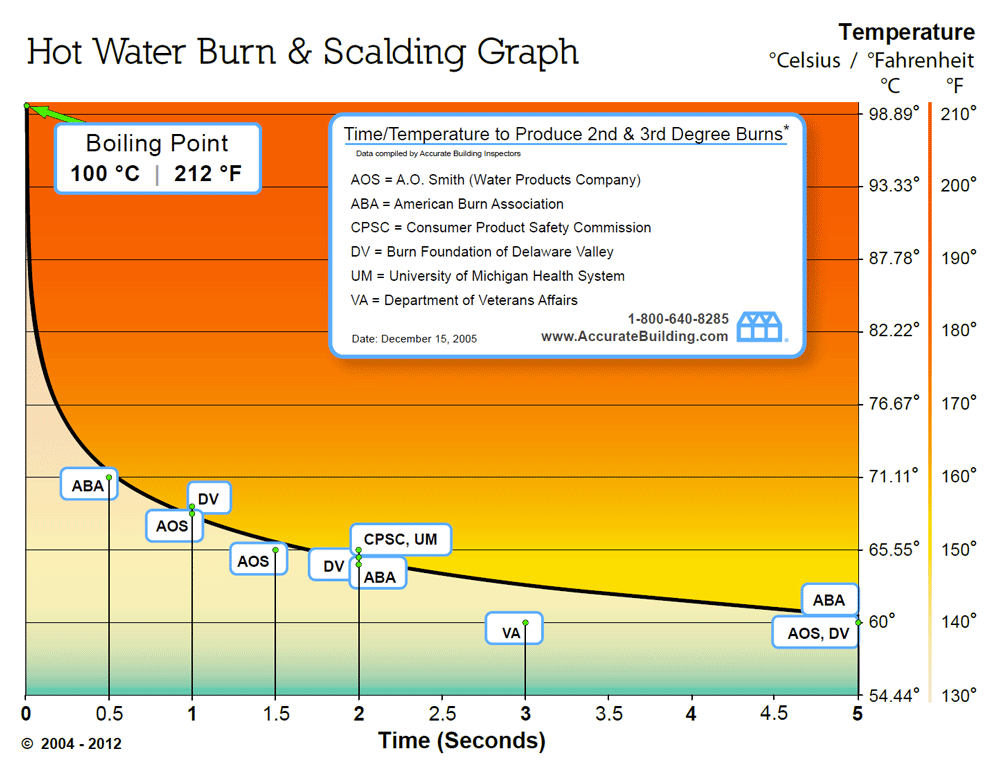


They really can't win here. If they allow anyone to send money anywhere, they get fined by the government for supporting criminals. If they try to make a judgment call, the public gets up-in-arms about it and thinks they are bigoted (and potentially lose customers or get involved in other lawsuits).