It's a collection of features meant to sit on top of ActivityPub.
ActivityPub is a general protocol for decentralised social networking. Instead of Facebook or Twitter servers generating a feed for each user, user's servers send updates to each-other.
I think the audience is expected to know about distributed systems and the fediverse. Think of it like being linked to https://luajit.org/ without knowing anything about lua, programming and so on. Some links on HN are pulled from places where certain knowledge is pre-assumed.
Hi! Spritely's main author here. Spritely is taking on quite a few things, so it's understandable that it might not be completely clear what from the tagline.
Here's the short version: we'd like to bring better security, privacy, and rich interactions to the federated social web. I was one of the co-authors of the ActivityPub standard so I have some strong opinions about what it's capable of that isn't happening yet.
It goes over (most of) the layers in a fairly friendly way.
Within all the subprojects listed, the most ambitious is the Fantasary one, which is distributed virtual worlds. Not as out there as it sounds, such a thing was built in the mid/late 90s: https://www.youtube.com/watch?v=KNiePoNiyvE
But in the dot-com crash, went up in flames. However many of the ideas were carried forward by the object capability community, particularly the E language, on which Spritely Goblins is heavily influenced: http://www.erights.org/
The distributed games goal then becomes a driver for the other components, so even if that fails we should hopefully still get cool stuff. Spritely Goblins, the foundational layer, already exists and has support for such features as time travel debugging: https://dustycloud.org/blog/goblins-time-travel-micropreview...
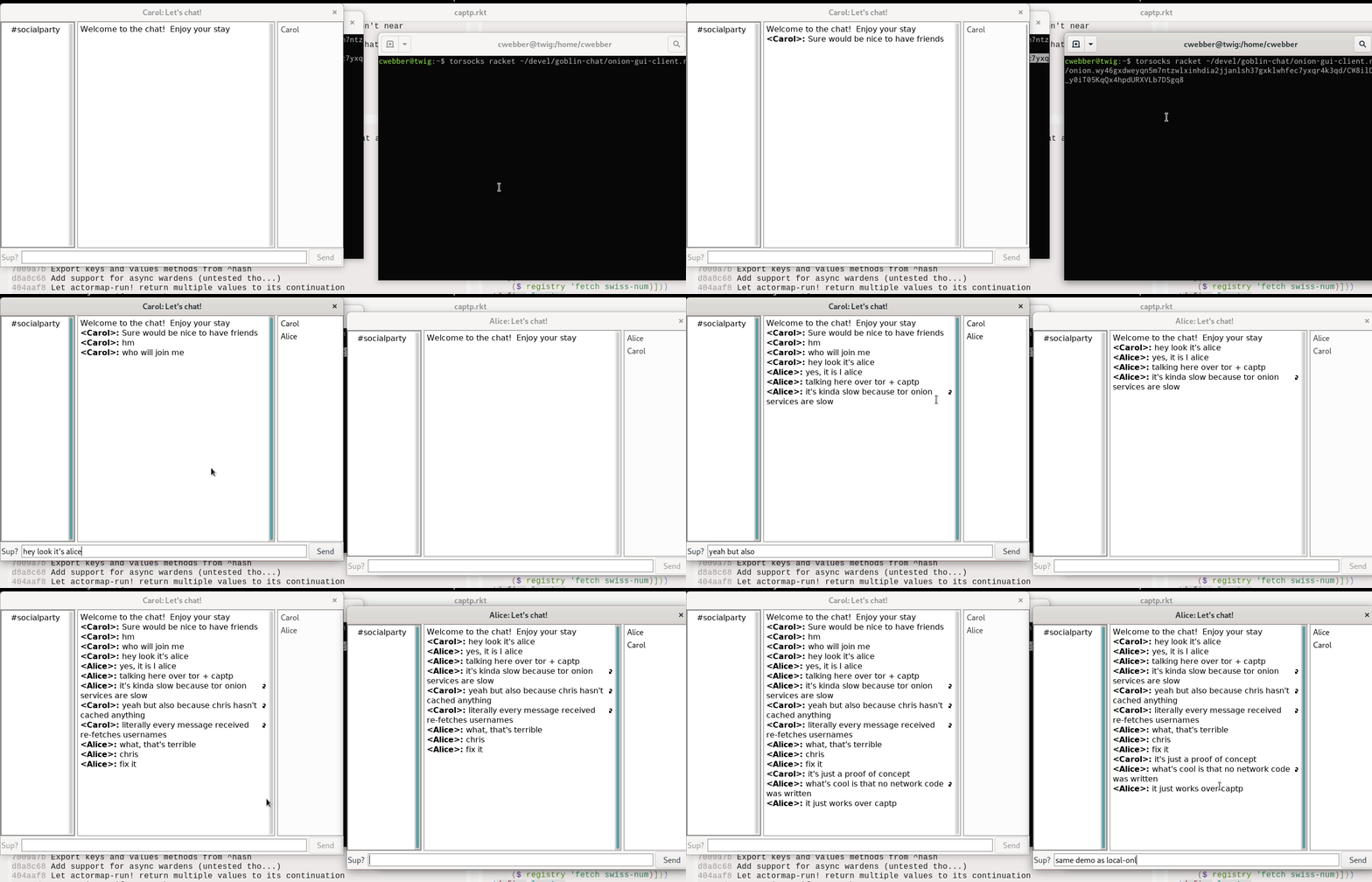
and distributed networked programming, safe to run in a hostile network... here's a chat program where the "protocol" authenticates the users joining the channel and also that the messages came from them, with the chatroom and user "protocol" both written in 250 lines of code combined... and without being planned at all for networked interaction, it just worked over the network... here's a gif of it working over Tor Onion Services: https://dustycloud.org/misc/goblins-chat-captp-onion-service...
No code was added to the "protocol" to expect network interactions; Goblins' CapTP (Capability Transport Protocol) took care of that for us.
Already that should sound pretty cool, but that's just the foundation for the system. Look at the other subprojects to see where we're going from there.
Also even then, I don't expect people to understand just from hearing me explain about it in words. Seeing is believing, and this is why Spritely is taking a "demo-centric" approach. More thoughts on that here: https://dustycloud.org/blog/if-you-cant-tell-people-anything...
I think this is incorrect. It looks like it's intending to be a set of libraries or protocols(?) to support development in the distributed web.
> Spritely consists of a number of modular components bringing new and rich features, from distributed programming, to decentralized storage, to virtual worlds.
"Fantasary" in particular seems to match with your description. I'd guess it would be built on top of the other mentioned things.
I had read it as all of the libraries/characters(?) being different parts of the same whole project, with the whole project being to achieve that goal.
I'm familiar with your (1) and I think it fits extremely well with the negative emotion explanation.
At least for me, making a difficult decision that might have far-reaching consequences can be very uncomfortable if I don't have all the information. And it can be very easy to procrastinate because I tell myself that more information might be available in the future (even when that is clearly not true).
So, it's not so much that I search for an optimal strategy and more that I know there isn't one and I don't want to bite the bullet yet and make a decision.
My brain latches onto the few examples where it did pay off, though. "Imagine if I would've started earlier - all that work I did would've been completely wasted."
In reality, that work probably wouldn't have been completely wasted, and even then, I certainly wouldn't be any further behind on the project if I'd done it instead of slacking off.
The author, Andrew Gelman, is one of the best statisticians of our times. And his criticism that they should have consulted an expert seems fair, since this blog post clearly shows that the study did not give strong evidence for a high prevalence of Covid-19. It might have all been false positives.
The off-topic comments make more sense when one has read the blog for a longer time. The author has criticized so many studies over the years that he must feel a bit of frustration by now. I guess the hacker news crowd wasn't the intended audience for such comments.