This might have been correct at the time Steve Jobs made the statement, but Apple really needs to reconsider.
Apple has always claimed to make devices for "creative" people, yet pretty much every artist on the planet wants Apple to release an iPad with a built in digitizer. Any student that knows what a digitizer is will also be likely to want one.
There is a huge market right now for stylii for the iPad, yet every single one of them is absolutely terrible. There are even a few third-party attempts at a adding a digitizer, and they are just as bad or worse.
Samsung's Note phones and tablets have been selling very well in spite of the fact that the digitizer's are often slow and buggy due to poor application support. If a company like Apple decided to give such a product their full attention, they could make something truly amazing. Perhaps they could even write their own pressure-sensitive compatible drawing/painting/note-taking programs to accompany the addition of the technology.
Sadly, there isn't any indication that they are interested in doing this. Instead, they are developing televisions that most people won't be able to afford and smart-watches.
> Apple has always claimed to make devices for "creative" people, yet pretty much every artist on the planet wants Apple to release an iPad with a built in digitizer.
Apple only really claimed this back when they (barely) subsisted primarily off of the creative market. Once Jobs came back the focus turned to the wider consumer audience which I think was a big reason why they started cranking out so many hits. They became successful, I would argue, because they largely ignored the demands of the power users.
The difference would be that the iOS interface is built for touch, even if drawing apps would support a stylus.
Microsoft didn't even build their interface for a stylus. It was built for a mouse, and the stylus was a crutch for making it work on a tablet.
But using a mouse based interface with a stylus is really suboptimal. I had a Wacom digitizer for drawing, but I would switch to using the mouse as soon as I needed to interact with the interface, because it was so awkward.
I agree, but I wasn't suggesting that they abandon the touch screen, just that they develop a version of the iPad with a digitizer for people who like to draw/take notes. These people number in the tens, if not hundreds of millions, so clearly there's a market for it.
The iPad was created as a content consumption device, but the popularity of productivity apps seems to indicate that quite a few people are trying to use them as laptop replacements. My laptop weighs just under 10lbs (I like games) so it's helpful to have something that gets me 80% of the functionality of an ultrabook when I don't feel like lugging it around.
I myself have two cases, a normal protective case for when I want to read / watch movies / play games, and a Clamcase Pro, which basically turns the iPad into a macbook air clone with a mobile OS. The keyboard is as nice as a real Apple product, and I can type about 90 WPM on it without any problems. I've written dozens of term papers and even a bit of code on it. I just wish I could also use my iPad for drawing/design without it being an absolutely horrible experience.
As long as it's an optional accessory, I'm all for it. There for the artists and designers who need it, but not something that would affect how you use the OS itself.
I think the problem at the moment is mostly technological. I think if there was a cheap, high-resolution digitizer they'd probably do it. What people may not realise at the moment is just how crappy the touchscreen is on the iPhone/iPad in many respects -- it's something that only becomes apparent when you try using a stylus. I'm sure it's just a matter of time until it becomes better, though I imagine it'd still be thirty parties selling the styluses themselves.
Certainly, current tablets are still too slow in keeping up with a stylus but I'm sure Apple would love to have their own stylus in the market considering they already have 3rd party accessories. The iPad's smart cover is very popular as is.
Yes, I'd say it would be a no-brainer for Apple to add an active digitizer and a pen at this point, considering how many artists are craving for it at this point. They don't even have to bundle the pen to increase the price for everyone, just the digitizer. I'm still hoping Google would do the same at some point with one of their Nexus 10"+ tablets (along with a 3:2 ratio resolution).
Wacom is actually working on a art-focused tablet that's supposedly going to be announced or delivered over the next few months. That being said, I doubt their ability to deliver something as smooth and stable as an iPad.
I like android just fine, but the Note series of devices seem to lag and glitch a bit when using the stylus. I have more confidence in Apple's ability to refine the technology. I also happen to like my current iPad more than any other mobile device I've used.
All great ideas are just that until the technology is ripe. A successful tablet required, amongst other things:
(1) a high quality screen;
(2) a chipset that could run a full browser and playback high quality fullscreen videos seamlessly, including over wifi;
(3) some combination of advantages vs laptops (generally mobility, battery life, price) as a tradeoff for the lack of being a full powered machine.
For #3 you can see something like the phone/touch having laptop like battery life but pocketability. The ipad, while more mobile than a laptop, was not dramatically so, and basically had to last through an entire work/school day. Had to.
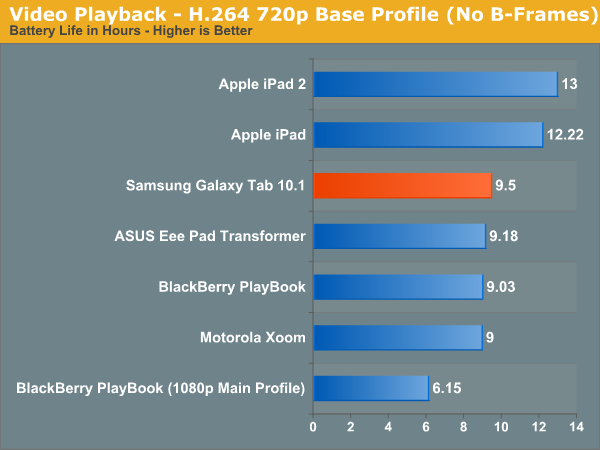
This is why, more or less, all earlier tablets failed. Because when the iPad came out, it was already all batteries, and if you had tried to do that at 60 nm that many batteries would give out at 5-6 hours. Adding 30% more batteries starts to lose your form factor advantages and costs more. In fact, Apple - with it's vertical design scale from chip to OS - was probably able to squeeze a viable tablet out a generation earlier than anyone else could have simply from a battery life standpoint.
Here's video playback over a year after the iPad was released:
The real technology requirements of a new mass consumer device seems like something we should keep in mind when we think about things like wearables and when we should expect things like Glass to really be viable.
I disagree that the iPad succeeded because of the 3 reasons you stated above. Tablets had been around for years and had all of those things. I believe the focus on usability and the lack of a stylus were what made the iPad (and the iPhone, for that matter) successful. Microsoft's approach to the tablet was to bolt on a few tablet specific features to the standard Windows operating system and focus on a stylus driven experience.
Apple decided to use iOS rather than standard OSX for their tablet which was built primarily to be a mobile operating system based on multi-touch, not a stylus. I remember an interview with Steve Balmer laughing about the lack of a stylus, but it was a genius move on Apple's part. Often with new technology it's not the hardware capabilities of a device that makes or breaks it but that crucial moment when the average user picks it up and the experience either "clicks" with them or not. The iPad experience clicked with people immediately and that's why it succeeded.
"Tablets had been around for years and could do all of those things."
You're mistaken. Those were just laptops that had a $200 feature where you could hide the keyboard underneath and poke at the screen with a stylus. They offered nothing over a laptop to 99% of users.
And none of them lasted all day or offered the average user much over a laptop. And they failed miserably at market. The main selling point of the ipad is certainly not the lack of a keyboard.
I'm not sure what your point is re: windows slates/tablets. They certainly did not meet the criteria above.
The battery life wasn't great on those slate tablet PCs, I'll admit, but I also don't think battery life was the main reason the iPad took off. I really think it was the emphasis on multi-touch interaction over a stylus and the dedicated OS.
Microsoft has serially dropped the ball on this. They could have done a good tablet virtually any time, but the internal politics always got in the way of the design and engineering. It would have needed to run Windows, for instance, which would have killed it.
One of the most successful consumer products, the Xbox 360, runs Windows, but it's got most of the bullshit stripped out (e.g., no registry, no WMI, no services to go sideways).
Putting full-blown Windows in everything is a huge mistake, and unless a project can get the political capital to overcome that, it will doom it.
Microsoft actually used non-windows OSes for lots of tablet-like devices. Windows CE was "windows" in name only - IIRC it was a small custom OS they rebranded from some company they bought, much like what Apple did with the first iPod OS. PocketPC also was stripped-down, not full-blown Windows.
WinCE is also an architectural train wreck. It is unbelievably bad on the inside. I have personal experience with its USB stack, which is so full of layers that we couldn't get more than about 10 mbits/second out of it (on hardware capable of well over 300 mbits/second).
Had MS decided to do a tablet entirely in-house, I mean.
(I'm talking pre-Surface, which is why this is a somewhat tortured argument. But it also proves my point :-) )
Microsoft needs to wake up to the fact that Windows as it exists today is a really crappy OS for embedded systems. Worse, the management culture of "We need to put Windows in everything else, too" is going to continue to kill perfectly good future projects.
I really doubt that Steve made ipad as response to Microsoft >"Fuck this, let’s show him what a tablet can really be." here why http://allthingsd.com/video/?video_id=70F7CC1D-FFBF-4BE0-BFF... go to 0:37:12 min in this video Steve Jobs tell a secret how he got to build a tablet by one day he had idea to make screen without keyboard multi-touch.
It's also a story about how big ideas does not always start from big vision. It can start from something much less grand - like simply a revenge or an act of ego. And then you need other skills to evolve it, it is those evolving that makes small ideas big and big ideas real grand things. The tablet vision is from MS, Steve made it iPhone.
Saying "the tablet vision is from MS" is a bit of an overstatement. The party mentioned would have been in 2005. Apple had released the Newton in 1993 (after having worked on it for many years) and refined it over the next 5 years, inspiring a raft of competitors including Palm (whose first product was software for the Newton) and Microsoft. The Apple MessagePad 2000 (released in 1997) had an entirely tap-based interface with no dedicated hardware buttons - the whole interface was whatever you saw on the screen. The initial vision for the Newton was that it would be a tablet OS that could scale to a variety of sizes - "from a post-it pad to a whiteboard" - the actual sizes released were driven by market considerations at the time.
So Microsoft's efforts might possibly have given Apple the kick in the pants it needed to try AGAIN at a tablet OS at that specific time, but the reason they could do it so quickly and effectively once the decision was made is that Apple had already iterated through the design issues and had stuff along those lines already working in the labs.
Also, Jobs's 50th birthday party would have been in 2005, but the "Project Purple" team that worked in earnest to release iPhone was formed in 2004. And the iPhone took three years to develop (as dated from the formation of that team), not 6 months. So I don't think this story really works on any level. Maybe Steve remembered it wrong - it's more likely he was sitting on the knowledge of what his team had already done in secret and it was killing him not to say anything about it, making the moment especially memorable.
"One of the people who was building Microsoft's tablet was friendly with Jobs' wife, Laurene Powell. He asked Jobs and Powell to come to his fiftieth birthday party."
"Lamborghini was fond of the Ferraris, but considered them too noisy and rough to be proper road cars, likening them to repurposed track cars.[20] When Lamborghini discovered that the clutch on his Ferrari was broken, and actually was the same clutch that he used on his tractors, Lamborghini went to Ferrari and asked for a better replacement. Ferrari responded, saying that he was just a tractor maker, and could not know anything about sports cars. Lamborghini decided to pursue an automobile manufacturing venture with the goal of bringing to life his vision of a perfect grand tourer."
Even if their NDA's have expired their employment may not have and if you value your employment at apple breaking an NDA, even an expired one may be a bad idea.
For mouse based interfaces it is awkward. For touch based interfaces it is about as awkward as a mouse/touchpad. Ever used the iPhone simulator with Xcode? That's how it feels.
Perhaps an interface designed from the beginning around a stylus would work well. I never used the original Palm PDAs, but maybe they did it right?
Thinking about what is unique about a stylus, I can see a few low hanging ideas:
* A stylus is great for tiny, precise movements but awkward for larger motions. Use the stylus only for small, precise motions? Like circling a word to highlight it or striking through one to erase it.
* Distinguish between stylus and fingers, so you can scroll with a finger and edit with a stylus?
I think you're missing the point... At the time the stylus was the device you used for everything, typing, navigation, and so on.
That was awkward and frankly just "bad." Humans don't want to poke at a device with a pen all day, it is unnatural, and also slow (particularly for typing!).
Many of the touchscreens were also terrible (thus why the stylus was seen as a good alternative).
A stylus for drawing is wonderful. But the iPhone/iPad was never a device designed for drawing or creative endeavors specifically.
Not for what it's meant for, but how they used it is.
One of the main things you have to remember is that when people try to do something quickly they have to apply more force to move their limbs, which requires that you apply more force to stop your limbs as well. And getting high peak forces in place with just the right timing to stop perfectly on a specific point in space rapidly becomes more difficult the faster you're moving.
You can even see it if you look at people learning to draw a gun quickly to fire it at a target: they'll overshoot their target slightly and then settle on target. It's one of the reasons for the old saying 'Fast is fine, but accuracy is everything.'
I've digressed slightly, but the point is that it's the same for everything, including user interfaces: to do anything quickly people need either a ridiculously high degree of repetition, large hit boxes, or some sort of immediate feedback that they use to trigger a response that does something. (Like, you can type without looking at the keyboard fairly easily, but you can't type without looking at the keyboard on a tablet as easily - at least not without really good correction software - because it doesn't give you the same sort of feedback.)
Related, this is why the better shooter players often turn their mouse sensitivity way down. It's also why, when you're designing a user interface for a program you want the most commonly used options against the edge of the screen - since when someone flicks their mouse there they hit an effectively infinitely deep hit box. (Unless they're on a multi-monitor setup =p )
Stylus interfaces have pretty much always been designed around using the stylus to hit small targets - that's one of the reasons why they used it rather than your finger, so that they didn't have to re-write large portions of their interfaces. And when you do that you pretty much kill usability because there's little real tactile feedback to allow you to fine-tune what you're doing so you have to be looking at the device and taking your care over where you're placing the stylus. It takes forever.
To an extent, people did try to get around that sort of issue with handwriting recognition for text input. However, there's also an element of resistance that you get with pens and an even greater extent with pencils that you don't get with a stylus, which allows you to be more careless in how you apply force. Writing on tablets is messy and large, (and the translation of the writing into text is inexplicably bad.)
It's also worth mentioning that you can hold your arm much more loosely when you're not holding a stylus. As any half-decent boxer will tell you, tension makes you slow. So, again, that's an advantage for the no-stylus camp since you don't have to hold you arm in a particular way to keep the pen in the right position.
So, yeah. They're not bad, for what they're meant to do - mainly sketching. But to bypass not having an interface designed for touch, and to bypass having awful implementations of touch screens, they're the kiss of death. You can sketch with them, you can take (usually messy) freehand notes. But if you're going to be operating an interface entirely off them, then that interface is going to have to be large - and if it's going to be large fingers are better because you get better (though still not great) tactile feedback and you have that absence of tension.
And all this is when the stylus is good, mind, and doesn't require you to click on the icon for a bit to get it to register.
The type of stylus I was talking about involves an active digitizer and pressure sensitivity. You can draw and write pretty much naturally with them. Your handwriting with a stylus designed for a digitizer should be just as neat and fluid as your normal handwriting. The pictures you draw can be as rough or as finished as you want them to be. You are only limited by your own skill.
I agree that they are terrible for navigating an operating system.


This might have been correct at the time Steve Jobs made the statement, but Apple really needs to reconsider.
Apple has always claimed to make devices for "creative" people, yet pretty much every artist on the planet wants Apple to release an iPad with a built in digitizer. Any student that knows what a digitizer is will also be likely to want one.
There is a huge market right now for stylii for the iPad, yet every single one of them is absolutely terrible. There are even a few third-party attempts at a adding a digitizer, and they are just as bad or worse.
Samsung's Note phones and tablets have been selling very well in spite of the fact that the digitizer's are often slow and buggy due to poor application support. If a company like Apple decided to give such a product their full attention, they could make something truly amazing. Perhaps they could even write their own pressure-sensitive compatible drawing/painting/note-taking programs to accompany the addition of the technology.
Sadly, there isn't any indication that they are interested in doing this. Instead, they are developing televisions that most people won't be able to afford and smart-watches.