Reading Infinite Games, they tell an anecdote about a Microsoft exec on a flight telling an Apple exec that the Zune was a way better portable music player than the iPod. The Apple exec was just “yup, you’re probably right” and then soon after the iPhone dropped
I recall reading this story of some user doing a sync with Zune on their new computer. The computer had no songs on it and the Zune synced with that machine and wiped all the existing music off his Zune without warning him(or something like that its been years). I recall thinking, yep thats Microsoft. And to this day I still encounter dumb ways of thinking in many of their products. The endless negative stories I hear about Windows 11 are just the tip of the iceberg. The entire company has to be following a cohesive vision with leadership at top needing to be truly involved to make great end to end products and really Microsoft has not been that in a long time.
I was a zune user. I had my music organised meticulously and could simply drag and drop to my zune from my (parents) windows desktop. It was simple and it was fantastic.
Then I got a iPod so I needed to download iTunes. I downloaded iTunes, it told me to import my music. I imported my meticulously organised collection. It duplicated every single file into the iTunes approved format (AAC?) - my meticulous collection was now less meticulous, messy even.
It caused me to swear off Apple products for decades. Though it also led me to some very basic programming in order to delete the duplicates. I was only partially successful.
Programming led me to use Linux, before I eventually moved over to Mac. I like to think this was their plan all along.
iTunes for Mac was also awful. I don’t know where the idea comes from that iTunes on Mac was good software but I remember reading that and getting a my first (then Intel) Mac and wondering why it got so much praise on Mac. It was the same software with slightly better UI but generally the same awful UX (except for drivers and performance which was never an issue on Win for me)
As a hobbyist teen I built my own itunes clone for PC from scratch and remember getting so excited when Apple posted a job for someone to port iTunes officially.
I remember getting so excited, then depressed when I realised a hobbyist teenager could never compete with the people Apple would have applying. Later seeing how bizarrely bloated iTunes for PC turned out, guess I probably could have.
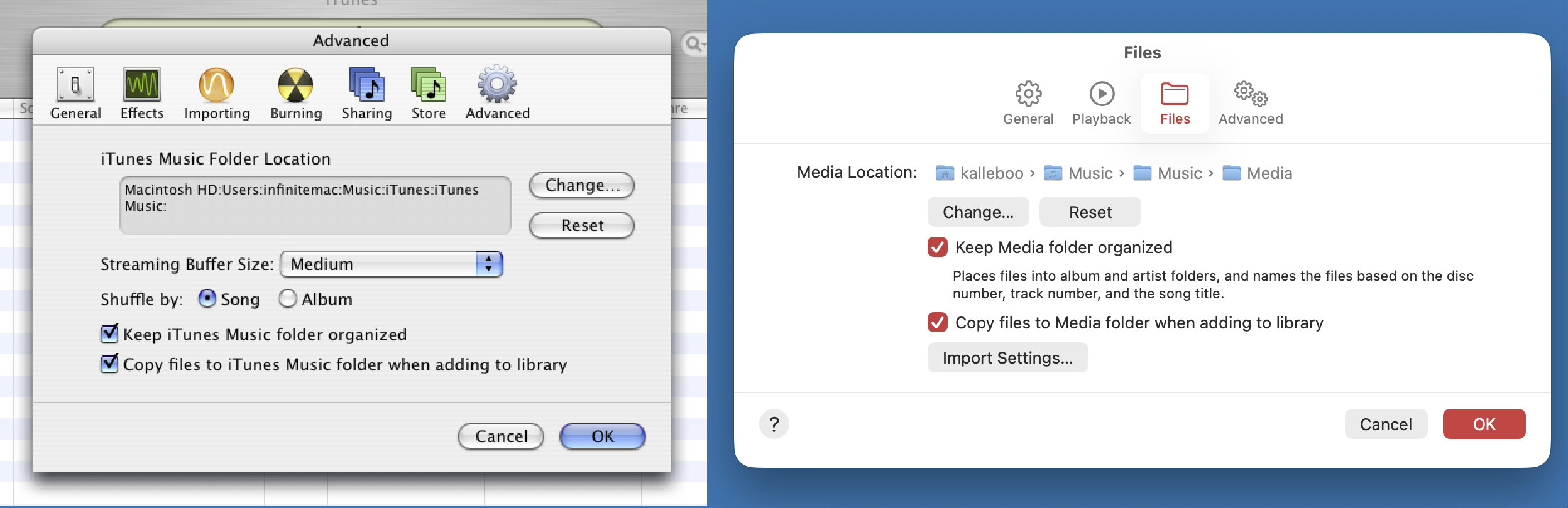
If only you had bothered to check the settings, you would have found the option to keep your music files where they are when adding to the iTunes library. It's been there all along, and it's still there in SoundJam's current reincarnation as Music.app.
I believe that, (possibly only) in the early days, it offered to add any imported music to your library, which I think it indeed did by converting to AAC and putting in a directory structure of its choosing.
It probably could convert to AAC, but the biggest issue for collector nerds with carefully curated collections of mp3's organized in folders by artist and album and with perfect metadata was that iTunes would take all your hard work, shake it around, rename all the files and dump them in a single folder and fuck up your metadata. At least that's how I remember it, but it's over 20 years ago ...
I think the core lesson of the story is knowing if your hobby is listening to music or curating a music collection. Optimize for one or the other.
I went from meticulously curated MP3 collection on Linux to letting iTunes do it for me, and I realized that the meticulous curation and hunting down album art and everything was a hobby I didn't actually love. But if you do love it, great! Different tools for different jobs.
Submitting to iTunes made syncing to the phone much easier, but I've been using claude to rebuild/repair my 20+ year old library, and have learned that iTunes has very weak if any support for "work" - a feature it has to split up classical music the way the CD does (once file per movement). Frustrating that there will likely never be a high-quality syncing player that works well with iPhones.
I remember the trick was to use a network hard disk or drive for the music. iTunes kept the organized folders and all files untouched while building its metadata-only archive in local. But in general, yes, the tendency to mess with your file was built-in.
The trick was to skip the onboarding and go into the Preferences, there was an option there to disable putting your files in the music library folder and messing with the layout
edit: I just compared iTunes 4 and Music in Tahoe and they still have the same preference! It's funny how they clearly did a s/iTunes/Music/, resulting in the "Music/Music" dir https://kalleboo.com/linked/itunes4-vs-musictahoe.png
As I recall it, the AAC option was for syncing to iPods with lower capacity (like the Shuffle) so that it would convert your 320/256kbps MP3s to 128kbps AACs to fit more music. It did this for a copy of them though, I've never heard of it actually converting your main library and checking out an old version of iTunes it has no way of converting your whole library (just individual tracks one by one).
Having iTunes organize your music into its own folder structure was an preference you could turn off, but that option was not shown in the onboarding so it ruined many a people's meticulously organized files...
I'm sure there are other examples, but you picked one here that is very unfair.
> their new computer. The computer had no songs on it and the Zune synced with that machine and wiped all the existing music
This is identical to the default way the iPod worked. If you bought a new Mac, and needed to get your music onto it, you had to use the migration assistant (connect via ethernet or firewire) or copy the music yourself. If you just plugged in your iPod to the new 'empty' mac and hit Sync, you'd lose your music too.
This was done as a show of good faith to the RIAA - their nightmare was that users would go from one dorm room to the next, dumping all their music onto all their friends' PCs. As a result, an iPod (or indeed still an iPhone today) can only sync with one music library (aka one computer) at a time. If you put it in "manually manage" mode, you can copy onto the iPod/iPhone from a 'foreign' library, but you can still never copy in the other direction. And all of this is true even when your music has no DRM encryption.
Heh, sounds like Windows Phone. Release Windows Phone 7, get early adopters and traction. Thank the early adopters by releasing Windows Phone 8, which is incompatible with existing Windows Phone 7 devices. Also make it use a new app development SDK so that Windows Phone 8 apps don't work on Windows Phone 7 (modulo some weird transition tech that almost nobody uses).
The funny thing was they could have done the adaptation--instead of doing it they just presumed devs would transition.
They were also done with the android-apps-on-windowsphone project but dumped it because PC marketplace managers got mad at it because then devs wouldn't use their sdk. Luckily we still got the first version of WSL because of that project's partnership with that linux team.
And the Zune ecosystem had it's own DRM music format that also died IIRC.
However, what the Zune ecosystem DID have that was insane for the time, was a $10 or so monthly subscription that let you listen to and download ANY song, as long as you had Wifi, with the bonus that you could download completely unprotected MP3s of ten of those songs a month. Songs at the time were still $1 each, so this was essentially free music streaming for people who bought songs regularly, with no potential for rug pulls.
Outside of this subscription, you could loan a song to your friend, who could listen to it on their Zune like three times.
They also had a nifty procedural playlist feature.
They were trying to do social media of music! Microsoft used to be freaking nuts.
One of the many reasons I moved away from ipods is because iTunes (which was awful; some of the worst software I've used) did the same thing to me just before I went on a trip.
I thought to myself: "I better add these two new albums to my ipod so that I can listen to them while away".
I plug in the ipod, itunes loads up, I walk away.
I come back 10 minutes later and it had not finished yet and I wonder what is going on.
Turns out it deleted my entire 40gb library off my ipod and started re-syncing.
I had to leave so I unplugged the ipod but it was basically useless at that point.
I do agree with Microsoft in general but Apple seems to be very much the same in my experience.
iTunes was great in the beginning. If you can, find someone with a G3/G4 and OSX 10.4/10.5 and see just how snappy that thing feels even with a 100th the RAM of today and a spinning disk. A real nice piece of software.
But then they just started dumping everything onto it and it eventually crumbled under the weight.
To be fair, I had that experience with my first iPod. As soon as I got it, I synced it with my computer and loaded up a ton of songs on it. This took a while.
Some time later, I connected it to my dad's computer to put a couple more songs on it. The first thing it did when I hit "sync" was delete everything on the iPod.
I learned that day that "sync" meant something different to Apple than it did to me.
I'm sure it gave me some kind of prompt but it was not a clear "hey this is going to delete everything" prompt.
To be fair, iTunes suffered from the same defect at one point. Microsoft is now a clinic on defective design, execution, and attitude. But back then it wasn't that bad.
The iTunes case was also a classis UI 101 blunder combined with stupidity. If there was no iPod plugged in, the "Sync on connection" toggle in iTunes simply disappeared. First of all, when something is inapplicable, you grey it out. You don't just make it disappear.
But in this case, even greying it out would have committed the same blunder, because the default state for this behavior was YES.
So if the hard drive in your computer went bad and you installed the OS fresh on a new one, thinking that all your music was backed up on your iPod, you were right... until you plugged it in.
So, so dumb.
And finally: Apple never addressed the lack of "computer overwrites mobile" and "mobile overwrites computer," which Palm OS syncing nailed in the '90s.
This weeks fun example of 'What will Windows 11 do today?' is that it suddenly wants to max out the Ethernet adapter with nothing. No packets are actually going anywhere but it just ends up hogging the entire data bus until you restart it once or twice.
This is the kind of nonsense we have been putting up with for years.
Oh, you mean like MacOS (OSX) installer deleting whole hard drives if there was a space in the volume name? It's so funny how fan boys can selectively ignore the bugs by their favorite company
Exactly. The same for Windows Phone. Both was amazing software on great hardware. They just never gained enough traction because MS was a bit late to the party and wasn't willing to push through (e.g. by compensating the late start and poor market position with heavy marketing investments and partnerships), so they eventually trashed those projects.
It's such a shame that the shitty MS products survive the ages while the great ones never gain real traction. I feel a bit sorry for the people who built such amazing stuff just to see it being cancelled and then having to work on the unsolicited background execution of the SharePoint 365 rev4.7 update manager (I made this up, but it probably exists).
Also, in my experience the Windows Phone hardware was dodgy. The first one I bought was a Dell and failed under warranty…and the replacement failed out of warranty. Then after an LG Android, I bought one of the last Lumia’s. The camera failed just out of warranty. Then the whole thing failed while I was traveling.
Yes, the death of Windows phone was a tragedy for the mobile phone market; it had a fresh take on things, and could have stirred up healthy competition with the duopoly of iPhones and Android phones.
I never could understand why MS would not put heavy muscle behind it. Maybe they deep down knew hardware execution was not their strong suit. People think the software was the problem, but I think if MS really believed in the product, the software side was eminently solvable.
At the time when they killed Windows Phone they had a $7 billion write off and that was huge. A decade or so later they would buy Activision for $69 billion without blinking. I would happy swap those in an instant.
It felt like once they dropped mobile, their whole direction become misguided. Also UWP made sense when there was also a mobile/tablet side to it, could even deploy those apps to the Xbox and it kind of worked. But then they kicked out that supporting support and suddenly they got working on trashing what good Windows still had.
The iPod's click wheel was amazing. Grab one if you have the chance and play a bit with it.
I imagine a lot of people don't remember or have never used.
Such a great feel and UX, Apple at its best.
iTunes was also unrivaled in its first versions, before it became an everything app.
And syncing was pretty great before ubiquitous internet was a thing.
I owned one for a very long time. I know people loved the clicky clack, but that thing was a UX abomination. The only thing it was good for was high speed jogging - not something that you typically do very often on a music player.
"Apple at its best" ... I sure hope not. But for sure, people LOVED that wheel. I would take a 4-way clicky from the Zune any day.
> …high speed jogging - not something that you typically do very often on a music player.
That’s exactly what you often do on them, when they are good at it. How would you rather browse a large library: one by one, slowly, or use a non-linear accelerator to quickly get close to where you want to be and then precisely pick your choice?
The click wheel was brilliant software and hardware, simultaneously, which is why I call it “Apple at its best”.
It could have been good software with unreliable, wobbly hardware, or robust hardware with a slight rendering delay, which would break the illusion. Instead it was sturdy, responsive and just a joy to use. Much like Apple’s trackpads, which remain surprisingly unmatched.
But I guess we have different tastes on music players.
I think it was an example of a well executed idea taken war too far, like the touchscreens on a Tesla replacing essential physical buttons. Or the obsession with getting rid of buttons on the iPhone (which we’re now thankfully retreating from).
It did have its sweet spot - jogging to an exact spot in a song, or scrolling a long list. But you do a lot more than just that on a music player. And the overall experience of the iPod was actually somewhat sub par because of the overuse of that one feature.
I had the first iPod, and later the first Zune. The Zune had a beautiful UI, but by then Apple came out with the iPod Nano 2nd gen and that took the cake.
I had the OG white Zune. It was the same price as an iPod ~$250. The reason I chose Zune was the Zune Pass. A precursor to Spotify. Plus growing up in the Seattle area, I knew other people who had them and we would trade songs.
100% - the iPod wasn't just good enough, it was more than enough for almost everyone. The Zune was firmly in the diminishing returns category by the time it came out.
Yep. To overcome an incumbent that sells a very good product and has momentum, it is almost never enough to be somewhat better. You have to be "knock my socks off" better.
The Zune may have been somewhat better (until the nano and iphone), but it wasn't enough better to overcome the ecosystem switching costs.
And the Zune media player was a much better media player than the other 6 Microsoft media players. It was crazy how much Microsoft invested in cannibalizing its own products--I remember they had a similar number of word processors, email clients, etc.
Until you actually need to run a business. Then money is much more important than the preferences of your employees. That's why Apple has barely penetrated the business world beyond overfunded startups that are more driven by hype and design wanna-bes than actual profit.
Microsoft fumbled the Windows ball so hard, everybody i know got rid of their Windows PC and either went to Android/iPhone or got a Mac or Linux.
At work we can freely choose which OS we run on our machines. Guess what everybody wants since IT got forced to upgrade each laptop to Windows 11? Macbook Pro.
I personally am running Linux just because I already know how to use it but macOS (despite its flaws) is way less intrusive and much faster than Windows. Even Microsoft's own programs (Office 365, Teams) are running faster and have better UX on macOS than on Windows.
10% of Microsoft's revenue is Windows. Azure is closer to 40%. Their focus has shifted hard from software to services. Azure is making them around $100B and growing. It'd be far more surprising if they were putting their focus back to Windows in a saturated market given all the incentives they have to chase bigger revenue elsewhere.
We chose Azure for our startup because of data location, and it was cheaper than the other two as well. Data center locations may not matter much in the US (because everyone has this covered well), but it does in other places of the world.
Can't reply to @shorel, but of course Azure is running Linux servers. It has nothing to do with being tied to a Windows ecosystem.
Your choice to go with Azure probably has more to do with where you're getting value for cloud services, and where you started your project - in other words, how tied you are to the Azure ecosystem, or the AWS ecosystem as the case may be.
Most devs choosing Macbooks has a lot to do with culture. It's boutique, cool, and all the other successful people have it. Yes, officially it's always for technical reasons, but no one would ever admit to get something just because it's shiny.
A large majority of windows devs choose Apple hardware has to major challenges for MS.
If devs just want shiny flashy then MS has failed at providing that directly or through their partners. If devs are able to make credible technical reasons, year after year, that sustain IT & budgetary scrutiny, that also is a failure from MS.
Personally “being able to run docker without this bs” was credible for many years, tech that now is a de facto expectation for most .NET dev jobs and well-integrated-ish into windows and WSL.
One can argue they made much more money selling to people than business. Business forces you to compete on price and that drives everything down to 0. The market clearly values selling to people more than selling to business: look at their stock price. So if you are actually running a computer company wouldn't it be better if you took Apple's approach (if you could)?
I feel like businesses could spend way less (money-wise and time-wise) on technical support if they just gave out MacBook Airs to their employees which could then remote into virtual Windows desktops for whatever legacy software they need to use.
Why should 90% of people need to deal with BIOS updates, driver updates, daily operating system updates, and blue screens of death?
> Until you actually need to run a business.
Did you mean to say "Until you actually need to sell to a business."?
They did do very well for a long time mostly by focusing on consumers...
Never had a zune, but I did have an iPod. I am willing to accept Zune was superior. But its just an example that, yea, often times the superior solution doesn't actually win. There is a huge list of better technology that lost out to worst technology. Which is why I find it funny the claim that the market is optimal in choosing winners and loosers.
The market is optimal, you're failing to value brand perception and any social effects as a price factor
Androids are probably better than iPhones. But you may lose a first date with a girl for sending a message with green bubbles instead of blue bubbles, so people buy iPhones. The iPhone is worth more than the Android, in this example.
I haven't heard of people losing a first date, but I remember a few years ago seeing articles about teens being excluded from group chats if they were using an Android because it was considered something you'd only buy if you couldn't afford an iphone. Android and iphone also didn't share the same features for texting, so people didn't want Android users in their chat because it meant they couldn't use all the imessage features.
I was being a little exaggeratory on the 'first date' specifically, but there is 100% a subculture of 'normies' who care about things like that. The iPhone, and even the amount of cameras on your iPhone, became a status symbol.
Apple knows it, it's why they do everything they can to prevent 3rd party 'workarounds' to use iMessage. It's one of the things that gets people in the ecosystem, and keeps people in the ecosystem once they're in.
Blue bubbles and Facetime has probably kept more customers than anything else they have
People have preferences. Some preferences are shallow. That's it, really. All kinds of people exist in this world, and wanting to be perceived as high-status is practically quintessential human behaviour.
I dated someone studying at a conservatory (the music kind) around that time. IIRC the Zune was quite popular with the students - even if most of them had an iMac - because it had one of the best microphones for recording live performances in an affordable package.
I remember multiple tech reviewers praising the marketing at the time. It was the first time my younger and more naive self experienced that now-familiar feeling in relation to the tech industry: "am I taking crazy pills? have I slipped into the bizarro universe? have these people ever interacted with another human being?" etc
I'm with you. It was brown, and if I remember right, in the light the edges had a sort of greenish tint to them? I thought it looked so cool, hadn't seen anything like it before.
Zune was probably a better player. It was too late, and arrived when MS didn't much care.
There are emails unearthed in various lawsuits where you can read Bill Gates screaming at his subordinates: "why the hell can't our partners like Sony and Creative create a similar device? Give them all, give them early access to everything, work with them". In the end MS felt compelled to make their own.
Sony can't be bothered to compete with Apple in that era. They were trying to recover from their DRM dreams, and their devices were already sounding great with in-house software and hardware.
Creative's Muvo^2 already was the poor man's iPod with surprisingly good audio quality as well.
I feel like this completely misses the mark. Audio quality was never the compelling feature of the iPod and people weren't clamoring for it because it sounded good.
When the iPod came out you largely had two options for carrying your music collection on the go. You either carried a binder of CDs, or you had some niche player like Mini-Disc or an MP3 player. Both alternatives were expensive and had limitations similar to a CD in terms of number of tracks you could carry.
I had an MP3 player on either side of 2000 that was slightly smaller than a deck of playing cards that could use Smart Media flash memory cards. The largest card at the time was either 16 or 32mb and was enough to hold 1 album at near CD quality.
Creative's Muvo was a weird form factor that was larger than an iPod. It had a horrid interface both on device and for loading music. It's only grace was that it was slightly cheaper than an iPod and didn't need a Mac with FireWire. Although iircc this was pre USB 2.0 so not having FireWire would mean loading music took forever and a day.
The iPod allowed you to carry most, if not all, of your music collection in a package slightly larger than a deck of playing cards. And it had a fantastic interface for navigating music on the device.
This was at a time before most people had laptops and if you had a PC it was at home and used sparingly. The iPod was such a compelling mobile computing device that it drove adoption of the iMac. Apple would eventually release iTunes for Windows and USB support but that was many years later.
> I had an MP3 player on either side of 2000 that was slightly smaller than a deck of playing cards that could use Smart Media flash memory cards. The largest card at the time was either 16 or 32mb and was enough to hold 1 album at near CD quality.
I had something similar. The storage was the iPod's killer feature, along with iTune's $0.99 songs. Suddenly you no longer had to buy whole albums, and you didn't have to swap out what was on your MP3 player every day when you wanted a different playlist. A 5GB hard drive in your pocket was a huge innovation then.
"1000 songs in your pocket" was the entire driving force behind the thing. It was constantly bellowed in the marketing and it's what Steve Jobs demanded of the engineering team from day one. The size and the storage were paramount and they knew no one else could match it.
> I feel like this completely misses the mark. Audio quality was never the compelling feature of the iPod and people weren't clamoring for it because it sounded good.
> And the competition still couldn't do it for almost a decade
There were a couple things Apple had in their favor but it certainly didn't take 10 years for folks to catch up. They mostly one because they captured people's hearts and minds.
The key things Apple did right was a high speed connection and owning their software. The Creative Nomad Jukebox used the same HDD as the iPod and beat Apple to market by a year, but Creative didn't own the software. The iRiver H series of players showed up around 2004 and were comparable to iPods in terms of quality and capability, though their aesthetic wasn't polished minimalism. Their UI wasn't as good but it was still very good. Their crux was Windows and Mac support wasn't great. I had an iRiver in 2007 and was running an opensource (rockbox?) firmware to get around some of those issues.
Apple has always been good at innovating around the problem which is usually the UI or software at large. This comes in part because of their vertical integration and being able to make minor tweaks to other parts of the ecosystem (e.g. desktop OS) to dramatically improve the experience of their product. The iPods are another great example where they made minor tweaks to iOS Bluetooth that magically made the experience of using wireless headphones dramatically better.
Yeah I had an iriver. That thing was great because it essentially acted as a giant (for the time) USB drive. And it could play any mp3s and you put on it.
You synced music by manually managing folders on the device. All my non technical friends were horrified by it. They didn’t have neatly organised mp3 libraries. For all of iTunes’ problems, being able to plug in a cable and hit the big “Sync” button was really simple and convenient.
> Creative Nomad Jukebox used the same HDD as the iPod
The Creative Nomad Jukebox used a normal laptop 2.5" drive. The iPod used a new 1.8" drive from Toshiba that Apple bought up the whole initial run of. That's why the iPod was smaller and more pocketable, the Jukebox was more the size of a CD player.
I had a Rio Volt which somewhat bridged the gap. 700MB mp3 CD/RWs (about 10 hours of music per disc) and a CD player when traveling and picking up new music. Not as small as an iPod, but no book of CDs was necessary, either.
The iPod’s user interface was good once you figured it out. I bought a 2nd gen one, I think, because it was the only large capacity device that supported audible audiobooks, and the UI frustrated the heck out of me. I consistently had trouble navigating it.
Then it clicked, the control, no matter what it looked like, it wasn’t a d-pad. It was a weird touchpad emulating a physical dial. Which exactly nothing in the documentation that it came with mentioned.
I worked for Microsoft at the time, and took a lot of grief for not using a Zune. Except I owned one, bought cheaply at the company store. It just never supported Audible.
Looking at photos of the OG iPod, the control looks a lot like a modern Apple TV remote which is a D-pad. But if you've ever held one you know instantly that it isn't a D-pad. And there was so much hype and advertising about it at the time, I'm not sure anyone would expect D-pad behavior from it.
I want to say that Apple invented that particular design language, and prior to the original iPod nothing resembled that UI but I'm not sure.
It seems to me that the OP was either too young or not alive when the OG iPod came out, and so they're looking at it like a modern man trying to figure out caveman tools.
In some ways, anyway. Never owned a Zune myself, but a university classmate did and I was shocked by how poorly it handled non-Latin languages… she had a ton of Japanese and Korean songs loaded onto it, and their metadata all displayed as "missing character" blocks. She used it a lot like one might use an iPod Shuffle despite it having a nice screen because the only way to tell what was playing was by hearing it play.
By contrast my 4th gen B&W iPod which was about 5-6 years older handled unicode just fine.
Because why would Sony go out on a limb and take all that risk for tiny hardware margins just so Microsoft could grab the lion’s share of margins with software licensing fees?
“Squirting” was ridiculed at the time and the word itself scaring away women. Jobs killed it then in an interview with a classic quote: Microsoft = Cold tech and Apple = Humanity. MS scares her away, Apple gets the girl.
> QUESTION: Microsoft has announced its new iPod competitor, Zune. It says that this device is all about building communities. Are you worried?
> Steve Jobs: In a word, no. I’ve seen the demonstrations on the Internet about how you can find another person using a Zune and give them a song they can play three times. It takes forever. By the time you’ve gone through all that, the girl’s got up and left! You’re much better off to take one of your earbuds out and put it in her ear. Then you’re connected with about two feet of headphone cable.
The anecdote is likely a false rip of the actual story:
[2017] Speaking at an event Tuesday, Scott Forstall, who lead Apple's iOS software division under Jobs, recounted the surprising history behind the company's first touchscreen prototype, which ultimately lead to the first iPhone.
It all began, Forstall said, because Jobs had an acquaintance at Microsoft who he really, really, didn't like.
"It began because Steve hated this guy at Microsoft," Forstall said during the event. "Any time Steve had any interaction with the guy, he'd come back pissed off."
The unnamed Microsoft exec, who was apparently the husband of a friend of Jobs' wife, apparently bragged so much it pushed Jobs over the edge.
"He just shoved it in Steve's face -- the way they were going to rule the world with their new tablets with their pens. He came in on Monday with a set of expletives and then was like 'let's show them how it's really done.' "
In Steve's case "fueled by spite" would be more precisely "borderline personality disorder". If you read him in that lens it might help distinguish how to be successful like him without all of the bad parts.
Actually, Microsoft came with "modern" smart phone much sooner.
Actually too soon, technology wasn't there (price, computing power, size, weight, battery life).
Apple never came first ... but often just at the right moment and had marketing skills to make it a new trend.
I'm the opposite of an Apple fanboy (typing this on a Windows box), but this is some grade A nonsense.
Sure, MS launched PDAs and phone-ish devices long ago, running Windows CE and whatnot but they were awful. It's absolute bollocks that the iPhone was a splashing success because of Apple marketing. It was a splashing success because it worked spectacularly well. Random non-tech people would randomly pull out their newest purchase to show their friends. "And now it's a notepad!" "Look and now suddenly it's a calculator!" Sure, your awful HP Tablet had all that, and a call function, well before. But it sucked. It felt like using a computer while squinting, and not like a magic calculator that can turn into a notepad and then into a phone and then into an iPod.
The iPhone was a success because it worked so well. And it worked so well because the technology was there - in part because they invented it and in part because they had the taste to not bring out a shit product but wait a bit instead.
Having used a variety of pre-iPhone WinCE, Palm, Psion, etc PDAs, going purely by bullet points specs, the best WinMo devices launched in 2007 were capable and even feature-rich, but I agree the overall user experience was hobbled. Large touch-screen devices integrating phone, data and media needed a different UX and OS. MSFT's business was too platform-centric to take the strategic risk and their mindset was too incremental to make the conceptual leap.
I was at the 2007 iPhone announcement, got hands-on a prototype in the booth and had a dev unit pre-ship. As a technology strategist for a F500 ISV, my job was to assess the changing mobile device landscape. With the iPhone I think Apple deserves significant credit for two big things: the conceptual leap to a new UX/OS and going all-in on the large touch screen. Completely sacrificing both a physical keyboard or pen was bold and controversial.
While it was the right long-term vision, the reality which often gets glossed over, is the iPhone 1 didn't deliver on the vision and early adopters struggled. It wasn't until the iPhone 3G shipped 18 months later and the app store was released that the iPhone first began to slowly fulfill it's promise. I didn't daily drive an iPhone until the 3G. In recent years, I think many look back with rose-colored glasses at the iPhone launch and give Apple even more expansive credit for the "iPhone breakthrough" than the legitimate credit they justly deserve. Of the major players at the time, Apple was the only one who could make those bold choices because they didn't have existing phone products or platform agendas to preserve.
Apple understood software/hardware and how to marry the two together (in a way that the general public wanted to use) if it was easy, Microsoft or someone in the Linux world with hardware would be further long but they’re not.
Combining hardware and software the OS was done by many companies in the 1980s because if you wanted to sell something you had to do both and it’s been well over 36 years no one has really stepped up.
Apple first of all, knows their customers.
When a main selling point of AIO is transparent azzure CRT case ... you know this kind of customer doesn't need options.
Just give 'em ATI rage and tell them they have best workstation for graphics.
This shorthand that marketing means a bad thing is actually not true for Apple. Apple's marketing is how it ought to be at every company. They do market research to figure out what users need, they famously came up with the iPod's click wheel, they don't just do the ads. Of course Apple is eminently critiquable, but its marketing division is what everybody should do.
Whenever I've seen an explanation of UX (to differentiate it from UI), one classic example was Tesla's supercharger network.
We all remember Steve Balmer's comments about the iPhone when it was launched. That, without a physical keyboard, it wouldn't appeal to business users.
Yet, you can see the night and day difference between using the native keyboard and using a simulated one in games like Wordle. Whatever tricks they pulled to make the keyboard work like magic speak to the execution of the smartphone that Apple excelled at.
And that separated the iPhone from whatever came before it.
The Kin was pretty cool. Very usable with cheap hardware and cheap data plans. If the timing was a bit different, Microsoft might not have been tempted to commit infanticide.
From what I remember, they bought Danger which had a popular product that worked, but some VP made them rewrite all their software on a Microsoft stack. This took years and didn’t work very well. By the time they were finally released they were woefully outdated and only on the market for a few weeks before being killed.
Reading with understanding is absent in your skillset.
I exactly wrote that Microsoft devices were quite bad as they came too soon.
And Apple came at the right moment, when low power chips were powerful enough, touchscreens were precise enough without a pen. And device had acceptable consumption, batteries had decent capacity, lifespan.
> I exactly wrote that Microsoft devices were quite bad as they came too soon. And Apple came at the right moment, when low power chips were powerful enough, touchscreens were precise enough without a pen. And device had acceptable consumption, batteries had decent capacity, lifespan.
The argument is heavily reductionist because it treats technical breakthroughs as passive market timing rather than active, high-risk engineering.
Apple did not succeed by waiting for silicon to become fast enough to brute-force a desktop UI into a handheld. Instead, they reimagined the hardware-software stack from the ground up specifically around human fingertips and GPU acceleration.
Apple incorporated a GPU to accelerate the graphics. Apple acquired Fingerworks in 2005 and built custom chips to make multitouch viable. When Blackberry engineers were in disbelief about battery life, they cracked open an iPhone and found the battery occupied nearly the entire case. Apple also invested in aggressive thermal and power co-design such as power-gating states, dynamic clocks, ambient light sensors, etc.
It's because Apple was vertically oriented, they were able to make the necessary hardware advances.
It’s easy to forget what a difference multitouch capacitive touchscreens made to mobile devices. As far as I’m aware, the iPhone was the first device to use it at scale. Apple also spent years designing a new interaction paradigm for it, taking multitouch from cool tech demo (Fingerworks) to the mainstream.
Microsoft had Windows Mobile and WinCE for years before iOS, but typically they got the UI wrong and tried to jam a desktop interface on a mobile OS (a few years later they overcompensated and jammed a tablet interface on a desktop OS). By the time the iPhone was out it was too late to rework Mobile into a multitouch OS.
Famously, the BlackBerry guys thought it was impossible to put a full desktop os on a phone, and that Apple must have faked the initial demo. Again, by the time they could respond by ditching their existing software and buying QNX it was too late for them too.
Android only survived because it was a new OS and the team immediately ditched their Blackberry clone UI and built an iOS clone instead. Even then it took until at least v5 before it was as smooth as iOS, and the tablet story is still poor.
Until Apple developed it. Those early iPhones employed a lot of tricks to squeeze usability, battery life, and performance out of underpowered devices.
Prior smartphone attempts mostly applied PC-centric concepts to the device, it’s no surprise they ended up failing.
Microsoft never had a chance because Apple is the last vertical computer company (OS plus hardware) a survivor from the 1980s when there were many vertical American computer companies. Even Apple would have been dead if Steve Jobs had not come back with the Next operating system.
You can see the failure of Microsoft in their performance in mobile when the playing field was level Microsoft and Intel have trouble competing, you can also see it in the Surface computer efforts Microsoft has no clue.
It’s too bad SGI, Sun, Digital, Amiga, Acorn didn’t make it because you can see many elements within Apple OS from that bygone era in the hardware and software.
If you're mentioning SGI, Sun, Amiga ... would be good to mention Xerox ... company which brought us lots of remarkable technology, and never seen it's potential and let others to capitalize on it.
Also, capacitative/multitouch touchscreens were ridiculously expensive until Apple made orders at a scale large enough to bring the technology costs down.
Apple developed capable multitouch technology. Germans made it happen and manufacure at scale through Chinese venture.
It was again the right time, when technology was there and Apple's skill was the ability to spot the moment when otherwise overly expensive touch screens can be cheapened by scale of production to acceptable level, had the marketing machine to sell an expensive device in millions at times, when most people were used to cheap cell phones for calls & sms.
You're framing it as lucky timing but if Microsoft had tried to ship a smartphone in 2006 with the same available technology it still would have flopped.
Years after the first iPhone release, Microsoft had a dogshit mobile OS, and every single device using it was dogshit. Before Android, the industry's answer to iOS and iPhone was a resistive touch screen and stylus because, other than the launcher, absolutely nothing was adapted to fingers. That was if you were lucky; some didn't include a stylus, reducing usefulness for making calls. It was like running regular Windows applications scaled down to a smartphone screen.
I just want to take a minute and be grateful for getting the chance to live through the 90s again. I always felt a bit sorry for myself being a child through the og 90s. Now I feel like in a decade or so into the future I will look back and be happy I got to live in the naïve days of windows 95 again, as an adult this time. I really appreciate it.
To be fair, this kind of dominance is not unprecedented. Intel was even further ahead in the early 2000's. Every new competitor process was further behind the leading edge and not closer. TSMC started launching half nodes like 28nm just to have something in the market that would sell.
But then you started to see the cracks. New competitors would launch new products with very slightly better metrics than Intel's older stuff, just to be, heh, meep-meeped at the next press conference. But the overlap was real, if small. And it grew over time until everyone looked up around the 5nm node and realized Intel had lost.
That's where we are right now with Apple. "Funny in a way", sure. But history says this is more likely to be the beginning of the end. Everything goes in cycles.
TBH Apple never should've been the one who makes the best CPUs -- that's not really their area of expertise historically speaking either. It just appears that everyone else did such a terrible job for so long that they caught up
- Apple: We have matched Intel in CPU performance thanks to this new PowerPC! (Shows ad that uses carefully handpicked benchmarks to suggest that the PowerPC is actually faster when it really isn’t on average)
- Intel: Oh, we just found a 30% clock rate increase in the pocket of our other fab pants.
- AMD: Hold my beer, I have the DEC Alpha guys making an x86 CPU… How about 64-bit while at it.
I said late 90s though. The insanity which poured through early 2000s.
5.25GHz Pentium 4s, intentionally lower binned Athlons, the era your CPU got obsoleted the moment you booted it for the first time.
I don't remember early 90s much. I was too young back then. I don't remember much stuff from that era. But late 90s, early 2000s.
Oh, boy.
P.S.: AMD64 was a great sucker punch though. One of the professors in our university rejected to believe and got mad when he learnt that Intel licensed AMD64 from AMD, heh.
Ironically enough, I knew a polar opposite prof… swore off Intel after the FDIV bug (he did cosmological simulations on Beowulf clusters)… although he was a stickler for time management, when Opteron came out he threw out his summer schedule to find grant money for a new cluster.
I had a G4 MacBook when I switched to the first-gen Intel MacBooks, and subjectively, the G4 performed much, much better. Probably because the best pairing for any Intel CPU is thermal throttling.
I lived through the PPC->Intel transition porting real Mac apps, and "I liked the G4 laptops better" is definitely not a take I heard from anyone back then...
A lot of the important applications took a while to get ported. Also the last two generations of G4 hardware just overclocked basically unchanged chips. The 12" G4 laptop was infamous for slowly cooking your junk with their titanium shell.
The black MacBook I remember especially for leaving me with denim burns. And then I read all of the eulogies from people who never had to run it as a daily driver…
It's been really weird reading laptop reviews over the last few months. I've seen a bunch of reviews where they have their usual bar graphs comparing a bunch of laptops, and the laptop that is at the bottom is an Apple. It's the really inexpensive Neo, of course, but even the M5 laptops are consistently beat on performance and battery life by Intel Windows laptops.
I assume the M6 will take the crown back and then a few months later Intel/AMD will release a new chip and take that crown back again. That's the state of the world we used to expect, but it's a state that has been missing ever since the release of the M1 in 2020 until Intel finally caught up again this year.
> even the M5 laptops are consistently beat on performance and battery life by Intel Windows laptops.
When plugged in... This caveat is so enormous it should almost be legislated. If your computer use is at all portable, a computer that scales down to 20 - 40% of GPU power when unplugged is an enormously significant factor. So far as I'm aware (could be wrong about arm devices?) there's no non-apple laptop that operates at 100% speed on the road.
Newer Intel Panther Lake chips perform the same or very similarly on battery as they do when plugged in - as do Qualcomm chips. However, I don't know where they're seeing "consistently beat on performance and battery life by Intel Windows laptops". Multi-core performance can definitely beat M5 in some configurations but single core performance is still fairly far behind and battery life is comparable again depending on the exact specifications and design of the laptop. I've seen analysis showing M5 is still the perf/watt king though regardless of configurations.
Sorry, poor wording. It's the Neo that's on the bottom in many reviews, but the M5 is regularly beaten by Windows laptops. My usage of "consistently" was in the sense of regularly beaten, not in the sense of always beaten.
Because the naming convention was used for chips based on Skylake microarchitecture (but with other differences such as process node). Not changing the name implies they've either changed the naming convention (why?) or they haven't improved the microarchitecture since 2012.
> but even the M5 laptops are consistently beat on performance and battery life by Intel Windows laptops
The real question is whether all these Intel Windows laptops spin their fans at full speed when doing absolutely nothing. That’s something I can never go back to. I do some light gaming on my M2 Pro MBP and it gets hot when trying to push 120 fps. But my Lenovo Legion (that’s now collecting the dust) is so loud I could hear it through headphones.
Yeah, as a somewhat new MacBook air user I'm also sceptical when people claim that any windows laptop is now better or at least as good as a MacBook.
I'm still traumatized by my windows laptop randomly turning on in my backpack, heating itself up and draining the battery because of windows.
Aside from that I'm now used to MacOS for my daily needs aside from gaming so windows laptop have to do a lot of work convincing me of getting back to them.
Those Windows laptops always have a dealbreaker for me (besides Windows itself). If they have decent screens, sound, and battery life then the trackpad or keyboard will suck. If it's cheap it'll creak and groan like a Tesla interior...and have a terrible trackpad.
> [...] but even the M5 laptops are consistently beat on performance and battery life by Intel Windows laptops.
Hold up, in what metric/benchmark? Feel personally like we life in an age where, no matter the SOC vendor, something high performant and efficient is offered, so seeing a claim that any vendor, be it Intel, AMD, Qualcomm or Apple, is consistently outperforming another, I'd like to get more context on that.
Intel were x86, Apple Silicon is ARM-based. ARM-based chips are more power-efficient.
Also, it's built on a much smaller process. 3nm, if I'm not mistaken, older Intel was something bigger than 10nm. Heck, if you take a really old Intel Mac, you have something like 65nm process, which is much less efficient than 3nm.
> It's the really inexpensive Neo, of course, but even the M5 laptops are consistently beat on performance and battery life by Intel Windows laptops.
Of course you can beat the entry level MacBook Neo by comparing it to larger, more powerful, more expensive laptops.
The M5 is an entire family with a range of performance. Intel/AMD have done a lot to improve performance but they’re not beating the high end M5 chips on performance or battery life yet.
It's also not hard to find a Windows laptop that beats the M5 on battery life. Single-thread performance is the only remaining measure where the M5 is king.
x86 is way more complex when compared to ARM processors, as a result their TDP is way higher when you request performance from them.
Intel had to reduce the frequency of their processors when running AVX2 instructions and the AVX2 frequency of the processors were non-disclosable to anyone.
Also, benchmarking Intel processors and publishing these numbers were forbidden in some cases. I don't know whether this ban is still in effect.
x86 processors can't keep up with the ARM processors TDP and thermal profile wise. So they slow down a ton when running on battery. See Jeff Geerling's last video on Apple Neo vs. some Intel laptop. It's as "efficient", but slow as a newborn tortoise learning to walk when unplugged and trying to get the most endurance out of the battery.
My M1 Mac gets almost 2 days of low-intensity use after ~6 years of use, and it got warm once or twice because something ran away in the background for tens of minutes.
It doesn't really matter, because x86 processors inside are almost similar to modern ARM processors, the instructions that most programs use are more or less the same, and more complex "legacy" instructions are just emulated by splitting them into simpler instructions inside the CPU.
To me people that say that x86 is slow etc. never used an x86 processor with anything other than Windows. Yes, Windows is shit and laptops that run Windows are for the same reason shit. I get it. But on an x86 system you can run other OS, and, for example, a Linux distro with well tweaked power consumption parameters can get you even 3 days of battery life, or even more.
The point is that Windows keeps almost always the CPU above the minimum frequency, because it's full of useless background services, because programs are not well optimized for the hardware (to maximize backward compatibility they don't compile target x86_64 v3 for example and thus don't leverage on features and instructions available on new CPU or fall in the emulation case I've mentioned initially), and other reasons.
With a Linux distro you can keep the CPU at 600Mhz while web browsing, you can even turn off cores that you don't need, and the battery with this configuration surely lasts ages (at that point it becomes more predominant the consumption of other peripherals such as the display).
Being mistaken on the CISC vs RISC debate (besides, modern x86 is closer to RISC via micro-ops then old school CISC) is understandable. There is a lot of misinformation out there and myths, plus, it just feels right to consider CISC overly burdened, etc. TLDR: Intel x86_64 is closer to RISC then you likely think and Apple Silicon arm is closer to CISC then you likely think. These lines are blurry and have been for decades, very much for good reason.
> But talking this authoritatively on something without doing the reading, that's grating...
Thanks for your prejudice on me without knowing anything about me. In short, I'm a HPC sysadmin and programmer who works in a HPC center, separated from the actual hardware by a couple of floors.
We can discuss how transistors' heat generation doesn't discern about ISAs or being in a DAC or a cutting edge microprocessor, and we can even discuss how implementation of some functional blocks generate heat regardless of the ISA being involved. If you want we can discuss how saturating memory controllers affect pipeline saturation in processors even...
But talking this authoritatively on something with that amount of prejudice, that's grating.
Because being too confident about someone you don't know is a bad habit. Where I work doesn't matter though, but what I do is.
Pointing me to C&C is a nice touch though. Not only I read the site and very article you sent me before, I used to consume Anandtech before that.
As a mere mortal, I can make mistakes and gladly accept them, but I can't accept rude replies. Pardon my French, but being called a low-key liar or smoke blower gets me a little upset.
> Pointing me to C&C is a nice touch though. Not only I read the site and very article you sent me before, I used to consume Anandtech before that.
All I'll say is, that's worse then. Presuming you had not read up before promoting a long disproven myth, that was an assumption by me, I'll admit that and maybe I should not have done that, my mistake. But it was a gracious mistake, it was done in your favour, it was giving you credit.
Intel Panther lake beats the M5 in GPU and multi-core performance, and is only behind in single core (and not by much). Panther Lake is also on some Windows laptops that trounce MacBook battery life (e.g., Framework 13 Pro according to Just Josh Tech medium-brightness productivity benchmarking).
The Snapdragon X2 Elite beats the M5 multi-core performance (the HP Omnibook Ultra 14 is priced identically spec-for-spec with the MacBook Pro with M5). Still behind in single core and probably graphics, but squarely in the same realm.
Both of these chips are within small deviations of the M5. We could call Intel and Qualcomm 1 year behind at best.
Same. My personal laptop is an M1 Air and I also have an M1 Studio desktop.
My work machine is an M4, and in "regular" use I can't tell the difference between them.
I don’t get that sentiment. I have an m4 16gb and it’s such a sluggish machine. and that’s not even doing development, just browsers, word, excel, PowerPoint. (And so many eternal bugs… I feel like I’m on windows)
do you have a corp laptop with a dozen scanners like Carbon Black, Crowdstrike, etc. installed? My corp M4 Max with 48 GB is slower than my old M1 16GB machine by a large margin. I don't know what evil things those scanners do, but they're alwayus spinning like 35% CPU, and the M4 Max machine just drags..
Nope. Just a MacBook with office, safari, Firefox, and some finder replacement. And preview. If every tab and window uses 1GB+, then you don’t need many tabs/windows to bring the system to it’s knees.
I have an M2 Pro MBP 16GB, compared to the latest MBP issued by my employer a couple months ago, I see zero difference in real world performance. Can’t speak for Office on Mac, I have not used it in over a decade, but for typical full stack web dev I literally don’t need anything more.
Sounds broken, somehow. The M1 iPad Pro I just traded in worked fine. Traded it for a Neo and the Neo does some stuff faster, but for day-to-day casual use, it's not notably different.
THE (Col.) Billy Mitchell was actually a badass. His time in Alaska alone, running telegraph lines in the wilderness, made him a legend even before his forward thinking during WWI and beyond.
That's sadly true though. Also booting something was really simple.
Now we boot an embedded microcontroller (or CPU) which boots the main CPU which boots another OS semi-persistently to boot the main OS (if it's allowed).
Sometimes there are other processors needs to be up to allow processor to continue booting as well (these are mostly servers, but eh).
You can still have the 90s OS experience, even today, but these days we use the name bootloader, not operating system, for that amount of functionality.
NetBSD for the Mac didn't come out until after the SE/30 was already discontinued, and even then was little more than a crashy, unusable beta mess, not a real operating system. It was a tech demo, not something you could do work with.
I think it’s weird to say Apple is faster than Xiaomi when both are just using arm chips and using TSMC to build them, and this chip is only any faster because TSMC made a smaller node.
I know Apple do some special hardware software integration magic too.
Yes as I said in the comment, I know they do design them - based on arm.
But come on - if they had to use intel’s fab - their chips would be terrible. The reason the m6 is faster is largely because TSMC invented a smaller process node.
It's interesting to see how defensive some of these pro-China posters get on HN and elsewhere. I'm genuinely curious why there seems to be an inferiority complex here with respect to America/American companies.
> Xiamoi is some random chinese company not known for high end chips and was able to catch up impressivly in a short period of time
Xiamoi is a huge company and is a commonly known brand. They’ve been making chips for a long time. They didn’t start a few months ago and catch up with Apple on their first try.
That might be the funniest thing I read all day. Xiaomi is a massive company that makes all sorts of things, including a lot of pretty high-end mobiles, and has an annual revenue in the order of 75 billion US.
It’s no Apple, but it’s not exactly “some random Chinese company” either.
Intereresting point I will try to see if i can find more about it. I would assume apple has a lot more magic sause than just TSMCs best node and a little bit of ARM architecture addons.
And exactly how far ahead has Apple been since 2010 or so? That’s why you would assume that. ARM designs have different constraints than Apple’s designs.
Are they well known in China? I'm seeing that Chinese tech has decoupled from the West. They have all this cool stuff that we do not hear about because they aren't selling it to us because they don't need to. It's usually been stuff with better price to performance or ultra low prices though, rather than ultimate performance stuff. I wouldn't be surprised if they made a top end chip that everyone in China knew about, and we didn't.
I think for a while it was because they had a superior user experience that would compound with the more Apple products you acquired.
That, combined with sleek marketing and a good eye for product design, and building what was the best smartphone by far (IMO) in the world at the time it was first released, snowballed into Apple becoming the behomoth it is today.
I remember in 2018 they didn't have widgets, had like 3 different apps that had bugs, the swiping was slow after disabling animations, and everyday I was told I had to update.
And in 2018 the Pixel 2 was the Android flagship with 3 years of updates promised, with a Snapdragon 835 that was half the single thread speed of the corresponding A11 and slower in multicore with two extra cores.
Remember (not that long ago) when Apple was years ahead of ARM on performance, had vastly better support windows for their hardware and vastly better UI and UX? It is just that today Android has mostly caught up if not surpassed on a phone basis, but e.g. we still see a better ecosystem of iPhone + Watch with Apple, as well as between users.
I think it's great but it's important to remember that we haven't seen Xiaomi's chips in actual devices under real world tests. We don't know if the speeds are sustainable, under what wattage, etc. Competition is still great and I look forward to learning more, of course.
I find it funny not because I support Apple. I find it funny because it feels like the leapfrogging happened in early superscalar CPU evolution. The era when the Moore's Law was working.
I enjoy it because of progress, not because of Apple.
25 day old account, very first comment about using US models because you can't trust China? Be gone russian bot
@TRACK: yipinwong
Just kidding but seriously man, this level of paranoia isn't healthy. Try talking about it with someone you trust. The comment you're replying to is completely normal.
I'm just a german dude not finding this 'joke' funny.
I'm not an apple fanboy nor a xiamoi fanboy.
Its impressive that a random chinese company was able to catch up to the 2th richest company with global experts so fast and this achievement is not dimnished just because apple announced their M6 today.
I've seen so many I am not from China comment in all of the countries I mentioned like in HK, Japanese, Korea, Malaysia, but all turns out they are. Some of those countries communities expose countries, and yes, they are from mostly Guanzhou.
It's just funny how it's consistent they deny their own heritage. Be proud of who you are.