slightly related .. I saw a talk on DCs in space, and it said median Earth orbit had a latency of 500ms .. but back of envelope seems to be : 15,000km above Earth would have around 100ms latency, comparable to internet ping times.
I'm still working on the blog, but as a quickie: it's the lesson of the Datasaurus dozen, that sometimes you need to look at the actual distribution rather than statistics.
There's no (safe) gaps. Plenty of physical space, but the safety margin eats it all up. Nothing else is allowed to use those orbital shells or anything between them.
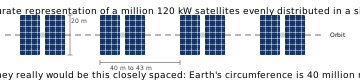
Also, this is what happens if you put them all in a single orbit at the same altitude:
> slightly related .. I saw a talk on DCs in space, and it said median Earth orbit had a latency of 500ms .. but back of envelope seems to be : 15,000km above Earth would have around 100ms latency, comparable to internet ping times.
500ms means ~150,000 km travel distance; for that distance as round-trip time from origin to destination and back again means the one-way distance is 75,000 km, so if it's via a single satellite bounce then the average distance to the satellite would be 37,500 km: [You]-37.5Mm-[Satellite]-37.5Mm-[Them]-37.5Mm-[Satellite]-37.5Mm-[You].
I think they must be assuming all comms are via geostationary satellites. In some talks, this is what the speaker actually meant, though they may not have been clear about it; other times, there's talks from people who copied the former but perhaps didn't understand.
For DCs in space, even in GEO, it would be half the distance because you're communicating with the satellite itself not with someone else somewhere else on the ground.
People already talk about that, so I wouldn't be adding much new. That said, had already put in a bit about cost of launching.
TL;DR: Alphabet researchers (and Alphabet owns more of SpaceX than the entire IPO so if anything they're biased to optimism), recon it will take SpaceX launching about 370,000 tons to orbit before they've even figured out how to get the costs down to the point it makes sense to put these in orbit.


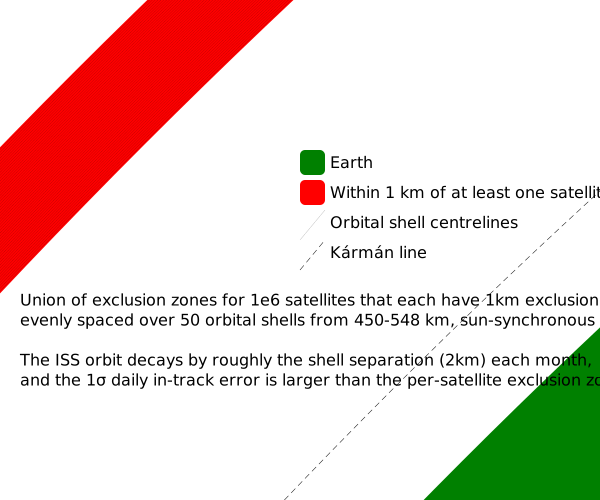
I'm currently writing a blog post, and there's one big thing everyone, including Scott Manley, missed.
Once I realised it, I wondered what took me so long to spot this issue.