Lots of interesting insights, but their affirmative action take is a miss.
> Critics of affirmative action often commit the fallacy of letting a failure in one area doom the entire enterprise. This ignores the interdependent nature of affirmative action. [1]
Affirmative action sets up a zero-sum game where fixed resources like university admissions and employment offers are redistributed to people with the "correct" demographics. The conflict is not a disagreement over effectiveness. It's a misalignment between meritocracy and equity.
Do you disagree that some critics of AA are committing that fallacy?
AA is being used as an example of the failure mode where:
"The failure of a single component does not mean the program is fatally flawed; rather, it highlights the need for a comprehensive, coordinated approach"
Indeed, I'm sure the author would agree that part of the comprehensive solution is to increase the amount of university admission slots.
The argument is that critics of AA are committing the Fallacy of Composition. Specifically when saying that since giving out scholarships doesn't result in equal educational outcomes, then we should stop giving out scholarships.
I am with the author on this one. Creating better educational outcomes (for all students) is a coordination problem.
> Do you disagree that some critics of AA are committing that fallacy?
This is is such a weird non-argument dressed as some gotcha. "Some critics of x are committing y fallacy" is probably universally correct statement. It is so devoid of any meaning that this particular type of discourse has not only a name, but a mascot too.
If that was the supposed point of the excerpt then the article falls flat on this purpose. The supposed fallacy arises when AA is defined as a coordination problem axiomatically. This is "one more subsidy, bro" false cause tautology in itself. The only argument made is a reference to an article which more confirms the critique than opposes, yet no other parts of the supposed coordination puzzle are even as much as speculated.
This is evident in later paragraphs:
> Often it won't be obvious what issues need to be addressed in a coordination problem, which means despite our best attempts to find points of weaknesses while researching and designing a plan, the nature of a coordination problem is that missing one element can lead to failure. If we eliminate individual failed solutions as options it becomes impossible to find the successful coordinated solution.
A statement is made here that a failing individual solution can still be a part of a working coordinated solution, which is not inherently wrong in itself. However, another point raised in this paragraph is that it is supposedly impossible to evaluate suitability of an approach without finding a successful coordinated solution. This marks every failing policy as potentially part of a working coordinated solution and therefore a claim that a policy is part of such a solution inherently unfalsifiable.
> Coordination problems are a particular type of non-zero-sum game, and they are all around us. Until they are solved, they are very much a negative-sum game. The key to solving coordination problems, including affirmative action, is understanding all variables, designing a system-wide approach, and not letting a failure in one area doom the enterprise.
Here affirmative action is defined to be a coordination problem precisely over failure of existing, supposedly uncoordinated, approaches.
That feels more like a cop-out than a legitimate criticism of a fallacy.
If the author could propose an affirmative action program that didn’t have that “single component” at the core of how it operates then I’d be more interested in the argument, but as-is it just feels like an attempt to forcefully ignore valid criticisms.
The "single component" in this example is scholarships. The goal is successful education outcomes for minorities. The other measures required for success are to fix the things the article mentions about why the students are still dropping out, besides tuition. I.e. the program would be comprehensive beyond just admissions slots.
They are in fact committing the exact fallacy by focusing solely on competition for admission slots instead of how we comprehensively improve educational outcomes for underprivileged kids.
Admittedly, the article does a bad job framing that as the real goal while AA is a specific component. It makes it sound like AA in admissions is the goal itself.
There is a lot more work to do to prove that "investing in education for historically disadvantaged groups" doesn't improve society at large.
> A large part of the value of elite education is its scarcity,
That's a stupid thing to value. Nothing worthwhile is gained by limiting education to a select few. The value of an elite education should be the actual education. Plenty of very wealthy idiots get a golden ticket to an "elite education" and are still uneducated idiots afterwards. If a large part of the value is nothing more than giving others the perception of having a lot of money or connections we should probably come up with other ways to signal that.
I agree it's incredibly stupid. Just saying that our current society's valuation of scarcity makes access to an elite education very much a zero-sum game.
I certainly claim that almost nobody "commits" that "fallacy" and that it is not a remotely notable viewpoint in the civic discourse of any country I know about.
No doubt in a world of 8 billion people, there exists someone, somewhere, who has for some reason voiced the belief described - i.e. that if institutions really heavily based their selection of applicants on skin color rather than merit, that would be good, but that because in reality institutions have only been convinced to somewhat compromise on merit-based selection in favour of skin-color-based selection, it's bad, and should thus be abandoned completely in favour of total meritocracy. But that belief would really be rather odd, and I have never seen it expressed even once in my entire life.
Nor am I convinced, despite its oddness, that it is properly considered to contain a fallacy! After all, sometimes it really is the case, for various reasons, that some endeavour is only worth doing if total success can be achieved, and not worth the downsides if you can only succeed partially. No doubt if someone really held the allegedly fallacious view described, they would believe affirmative action is exactly such an endeavour and be able to explain why!
You haven't remotely described the alleged critics' belief. Which is that since scholarship recipients still drop out at a higher rate, the scholarships don't work.
How many people actually hold such beliefs is a debate between you and the author.
Are you assuming elite college admission counts are rigid in the count of people admitted because of real teaching constraints or reducing the supply of prestige?
> Affirmative action sets up a zero-sum game where fixed resources like university admissions and employment offers are redistributed to people with the "correct" demographics.
I wish I could find the source, but the vast majority of universities don't have a fixed admissions quota. They are criteria based (if you meet the criteria, you get in). In principle, AA admissions did not prevent others from getting a seat.
Of course, it's possible the general admissions criteria is raised slightly to compensate, but again - for most universities, AA admissions wasn't a significant number, and however much the bar raised, it was likely minuscule.
I'll be blunt. Everyone I've personally known who didn't get admissions in a particular university and blamed AA for it was trying to get into a top school, and likely didn't earn his spot.
But you can look at trends in other comparable states compared to California both before and after CA outlawed AA at public California universities by referendum.
I was more thrown off by their definition of "Coordination Problems" than anything. They say:
> We sometimes run into problems where a number of factors have to be addressed simultaneously in order for them to be effective at all. One weak link can ruin it for the rest. These are called Coordination Problems.
Coordination problems are about multiple actors choosing interdependent outcomes, rather than a problem that needs everything to be done right. This sounds more like a "Weakest Link" problem than a coordination problem.
Not that it invalidates the rest of the post, but it did make me dig in more into the person's background and showed that they're more of a journalist than a game theory expert.
Yeah, they are assuming that different actors are responsible for those different links, probably with different incentives. And it is also a resource allocation problem.
It depends, there were a lot of studies that showed prejudice and bias in the meritocratic process. You had examples of CVs with woman names removed getting more callbacks, and anonymous interviews having higher rates of hire and such.
Due to this, people considered affirmative actions to correct for this skew. That would actually make it a meritocratic motivated AA.
And then you have the idea of missed potential. Those who weren't given the opportunity to develop, it limits the pool of exceptional candidates. It's similar to when black athletes weren't allowed in sports. We thought we had a meritocratic process, but we were artificially limiting those with potential. The challenge is bigger here, so you need a bootstrapping process, because you're faced with a chicken and egg situation. You wouldn't know if it works or not unless you give it at least one if not two generations to take effect. I admit that this is the more controversial one, as it means temporarily favoring disadvantaged groups to bootstrap things. I just wanted to point out that there's a meritocratic angle to it as well.
Equity doesn't mean give those that suck a boost. It means give those that weren't given the environment to develop their full potential a chance at it, they may end up being even better than the alternative.
Yes, that's what I'm saying. These systems claimed to be meritocratic but empirically weren’t. AA was introduced as a corrective, not a rejection of merit. Was it successful at correcting it, did it introduce other defects, I don't know, but you can see that implementation of AA can result from wanting to be more meritocratic, not less.
> It depends, there were a lot of studies that showed prejudice and bias in the meritocratic process.
A meritocratic process by definition is not prejudiced or biased. There were studies that claimed to show processes to not actually be meritocratic. In my experience, these findings either haven't reproduced or don't appropriately account for confounders; and if they held up they would be pointing at things that are already illegal (and irrational).
> It's similar to when black athletes weren't allowed in sports. We thought we had a meritocratic process
What? How do you come to the conclusion that "we" thought any such thing? The term (https://en.wikipedia.org/wiki/Meritocracy) was coined in the 50s for socialist criticism invoking satire. The discourse had nothing to do with race and was about disputing how merit is measured, not about supposed prejudices (except perhaps class privilege). Nor did coaches, managers etc. imagine any inferiority on the part of black athletes in regards to physical prowess. Segregation was to keep the peace; see e.g. https://en.wikipedia.org/wiki/Baseball_color_line :
> Before the 1860s Civil War, black players participated in the highest levels of baseball.[2] During the war, baseball rose to prominence as a way to bring soldiers from various regions of the country together. In the aftermath of the war, baseball became a tool for national reconciliation; due to the racial issues involved in the war, baseball's unifying potential was mainly pursued among white Americans.[3]
Anyway,
> You wouldn't know if it works or not unless you give it at least one if not two generations to take effect.
This time lapse isn't required for a moral judgment, however.
> Equity doesn't mean give those that suck a boost. It means give those that weren't given the environment to develop their full potential a chance at it, they may end up being even better than the alternative.
An employer, or a college admissions officer, cannot provide what was missing from someone's "environment" during the formative years, and should not be expected to try; nor ought they shoulder the risk of anyone's "full potential" being absent. Everyone might as well hire randomly from the general population at that point.
Historically, institutions were widely believed to be selecting the best available candidates within the accepted social boundaries of the time. They did not call it meritocracy, but it was assumed.
AA advocacy exposed cracks in systems that claimed to be merit based and pushed reforms like anonymization and structured evaluation, which made selection more merit based, not less.
Merit is noisy and ties are unavoidable. When candidates are effectively equal, a tie breaker is required. The old default was incumbency and other status quo dynamics that favored the existing cohort. Random selection among equals would be defensible. Favoring candidates from groups historically denied opportunity is another possible tie breaker. You can disagree with that choice, but it is coherent to see it as pro merit rather than anti merit.
And that's just my point, some proponents of AA were arguing for better merit based systems, not all, but a lot did.
> within the accepted social boundaries of the time
Pulls a lot of weight there.
> AA advocacy exposed cracks in systems
No; it proposed a supposed justice for those former social boundaries.
> and pushed reforms like anonymization and structured evaluation
No, these are clearly not anything to do with AA programs as actually observed today. It's extremely disingenuous to attribute the "colourblindness" of the 90s to "AA" and then use that to justify the explicitly race-conscious policies of today.
> You can disagree with that choice, but it is coherent to see it as pro merit rather than anti merit.
No, it is not. It completely ignores what the word "merit" means.
>The conflict is not a disagreement over effectiveness. It's a misalignment between meritocracy and equity.
A lot of proponents of affirmative action will agree with this. They'll explicitly acknowledge that people admitted under AA will be underqualified, due to factors mentioned in the article:
[Minorities] may lack foundational skills (taken for granted in more affluent households and schools) and therefore might require breaks from study, which can lead to dropping out. They might have developed unhelpful habits or attitudes formed in teen years, or a sense of identity tied up with being part of a historically maligned group, affecting confidence and performance. [Affirmative action] does nothing to address these factors.
Said proponents would agree that AA is a failure if assessed strictly by these criteria. However, they would then go on to say that the benefits conferred by an elite education to the current crop of AA beneficiaries lead to future generations of minorities being less likely to experience the aforementioned issues, so after accounting for all future externalities, AA is a net good. As Justice O'Connor famously wrote in Grutter v. Bollinger (2003) [0],
It would be a sad day indeed, were America to become a quota-ridden society, with each identifiable minority assigned proportional representation in every desirable walk of life. But that is not the rationale for programs of preferential treatment; the acid test of their justification will be their efficacy in eliminating the need for any racial or ethnic preferences at all. […] It has been 25 years since Justice Powell first approved the use of race to further an interest in student body diversity in the context of public higher education [California v. Bakke (1978)]. Since that time, the number of minority applicants with high grades and test scores has indeed increased. We expect that 25 years from now, the use of racial preferences will no longer be necessary to further the interest approved today.
That said, it's been almost 25 years since she wrote that (and 50 years since California v. Bakke), and it's debatable whether those future externalities have manifested.
And many against affirmative action will agree that there have been massive historical injustices for certain demographics that have lingering effects. The difference between these two sides is which value they prioritize.
>The difference between these two sides is which value they prioritize.
Yup. Though there is a third option: completely ignore the meritocracy vs. equity zero-sum game and simply argue that demographic-based weighting of applicants is an ineffective way to rectify those historical injustices. It is treating a symptom, not the underlying disease.
> simply argue that demographic-based weighting of applicants is an ineffective way to rectify those historical injustices. It is treating a symptom, not the underlying disease.
Is there any effective way to rectify them or the underlying disease that you'd recommend?
> Singapore does the whole "race based quotas for everything"
By American constructions of race, almost everyone in Singapore is of the same race.
Even going by genetically objective ethnicity, almost three quarters of people in Singapore are Han Chinese. It's not remotely comparable to the American situation.
> and they have by many metrics, the best standard of living in the entire world.
As self-reported by people from cultures that happen to share common values. They rate higher on HDI than the US, sure; but so does the UAE, and Slovenia is almost as high. They're unusually wealthy per capita, but so is Ireland (capitalist shell games). And there are a lot of things the average American probably wouldn't like about that society, e.g. the strict rules against littering and the threat of https://en.wikipedia.org/wiki/Caning_in_Singapore .
But those resources are already redistributed (from a distribution that somewhat aligns with demographics) with things like personal relationships (think legacy admissions or a father's buddy handshake internship). AA is meant to correct historical instances of this which snowball into familial / generational wealth and (most difficult to diffuse) social capital that was distributed unfairly.
That's the argument for it, not my belief. The argument for AA is that the so-called meritocracy had/has its own unequal distributions.
>AA is meant to correct historical instances of this which snowball into familial / generational wealth and (most difficult to diffuse) social capital that was distributed unfairly.
If that was the case it would be based on family wealth/income.
Social capital is not measured in family wealth / income, but it can very easily translate into jobs and other valuable things (like when your father knows someone who can get you an interview)
I never said it did that; It pushes back against the phenomenon.
The most neutral way I can put it: Every school turns away a LOT of equally qualified applicants, at some point decisions must be made. Next issue, schools don't exist purely for the benefit of the students, but the world at large. This is why you want a -- dare I say it -- diverse population. To maximize the good your students can do.
Now, one may not love race as a proxy for this, but it's at least arguably a workable solution.
> with slots going to the rich and privileged) [...] AA just pushes against THAT
It doesn't give away the slots reserved for the rich.
And it's not a tiebreaker between equally qualified candidates. At Harvard, Africans who performed in the 4th decile were admitted more often than Asians in the 10th decile. [1]
I went to a school in the suburbs with kids from middle class families and lower-middle class families. Many of us wanted to get into the Ivy League schools, but what I saw was that, presumable because of AA, the middle class kids from over-represented minorities (Asian, white) did not get into the Ivies, and the 1 or 2 who did get in were middle class kids from under-represented minorities (Black, Hispanic). But their families were still pretty well-off. Under no circumstances did a kid from a lower-middle class family make it into an Ivy, regardless of race. I really don't get why AA has to be about race, if we just did AA based on parental income alone, I would support it 100%. I think most concervatives would be happy because it wouls support poor whites, and most liberals would also be happy because it would in actuality URMs would still be the most benefited because they are the majority of low-income families. My only assumption is that it doesn't leave any openings for the rich and powerful to game the system, so people with the power to make changes will never make that change.
I think something that often isn't considered with affirmative action is the benefits that are conferred to the people who are not in a minority. In other words it is a genuinely useful thing to go to a university with a broad spectrum of people and ideas.
In a purely meritocratic sense, all other beings equal a university that provides a diverse faculty and student body will better educate its students than a university that doesn't, all other things remaining equal.
The problem in practice is that these programs don’t actually select for diverse ideas, they select for demographic traits like gender or ethnic background.
If the team uses relational databases but someone shows up to an interview with a strongly held belief that NoSQL is the way to go, they’re likely to be rejected because their ideas don’t match the team’s. Same if the team strongly believes in some version of agile but a person they interview doesn’t like agile. Diversity programs in practice never even attempt to push diversity of ideas, they ignore all of that and focus on things like gender and ethnic background.
This feels like a dangerous opinion to voice, but the workplace affirmative action programs I’ve seen in practice have been very poor in their implementation. At my last workplace that instituted diversity targets, HR would just start rejecting hires if they thought it would skew the diversity numbers in the wrong way. So you’d hit a wall where the only candidates you were allowed to hire couldn’t be, for example, men or of Asian descent or some other demographic trait they thought was over-represented. None of this improved diversity of ideas, it became a game to find a person whose ideas matched the team who also happened to have the right gender or skin color to keep our diversity statistics going in the direction HR demanded.


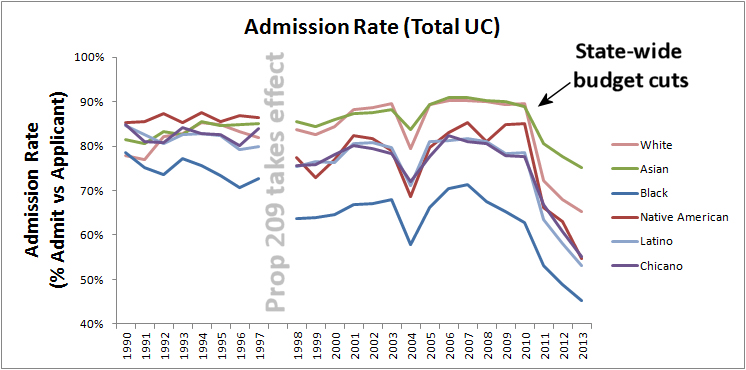
> Critics of affirmative action often commit the fallacy of letting a failure in one area doom the entire enterprise. This ignores the interdependent nature of affirmative action. [1]
Affirmative action sets up a zero-sum game where fixed resources like university admissions and employment offers are redistributed to people with the "correct" demographics. The conflict is not a disagreement over effectiveness. It's a misalignment between meritocracy and equity.
[1]: https://nonzerosum.games/unlockingsolutions.html