Cancelling trains to preserve on-time statistics is the kind of perverse activity you get when metrics aren’t correctly setup.
A cancelled train should be counted as delayed until the next train (close to the worst-case scenario) so as to discourage it.
But the real problem with deteriorating service is that people will put up with it for a long time - as long as they get to where they’re going eventually.
But they’ll stop choosing the train, and over 20 years you’ll find that everyone has moved to private vehicles or alternate transportation methods.
And then you have no riders and trying to get back on track will take 20 years or more.
People claim that they cancel trains to try and preserve the statistics, but there's not really any evidence of it.
The actual reason is that if a train is too late, it will conflict too much with the other scheduled trains and there's simply no room for it. Keeping the delayed train will just cause more delays for other trains on the same route, because German trains are scheduled with very high frequency.
E.g. where I live in Cologne, there's typically a high speed train every 20 to 30 minutes to Frankfurt. If one train is delayed by 30 minutes, then suddenly you have two (ore more) trains right on top of eachother heading to the same destination, both on very very congested lines that theyre simultaneously trying to do repairs and expansions to.
Those are the sorts of situations where it makes sense to just cancel the train, not because of metrics but because of actual track constraints.
The main thing people dont understand about Germany's train system is the scale of it. The network is physically very large, but also very densely packed, and has very frequent trains.
It looks more like a circuit board than a traditional transit map. That's why this problem is so hard to solve and will take a long time and a lot of investment before it improves.
What they should be tracking is average delayed journeys. A train may be late by 15 minutes, but if that means I'll miss a connecting train, that might delay my journey by an hour or more. That would also take care of the issue you're describing.
Indeed, that'd be a more useful metric. Very hard to measure well though and probably actually leaves open more room for them to game the metrics than the current system does.
Keep in mind that for the majority of trains in Germany, nobody bought a specific ticket for that journey. We just use the DeutschlandTicket which is a flat subscription of 58€/month, which gives unlimited access to busses, trams, and regional trains (basically everything but high speed trains).
With the deutschalnd ticket, you typically just walk onto a train of your choice and go wherever you want. They dont actually know where all the travellers are going or even how many people there are
Yeah I know you cannot track all journeys. Deutschlandticket, BahnCard 100, and similar things will be invisible. You can track the ones booked through the app though, and with a high enough sample rate you should get sufficiently close to the truth, unless there is a bias I haven't thought of yet.
You could also select random virtual journeys, I suppose. In arbitrary units you should at least be able to measure whether DB is improving or not. You could even delegate this to an independent organization. Actually, now that I think of it, isn't the API public? I'm reminded of the talk by D. Kriesel about DB data mining.
>> The main thing people dont understand about Germany's train system is the scale of it. The network is physically very large, but also very densely packed, and has very frequent trains.
> A train may be late by 15 minutes, but if that means I'll miss a connecting train, that might delay my journey by an hour or more.
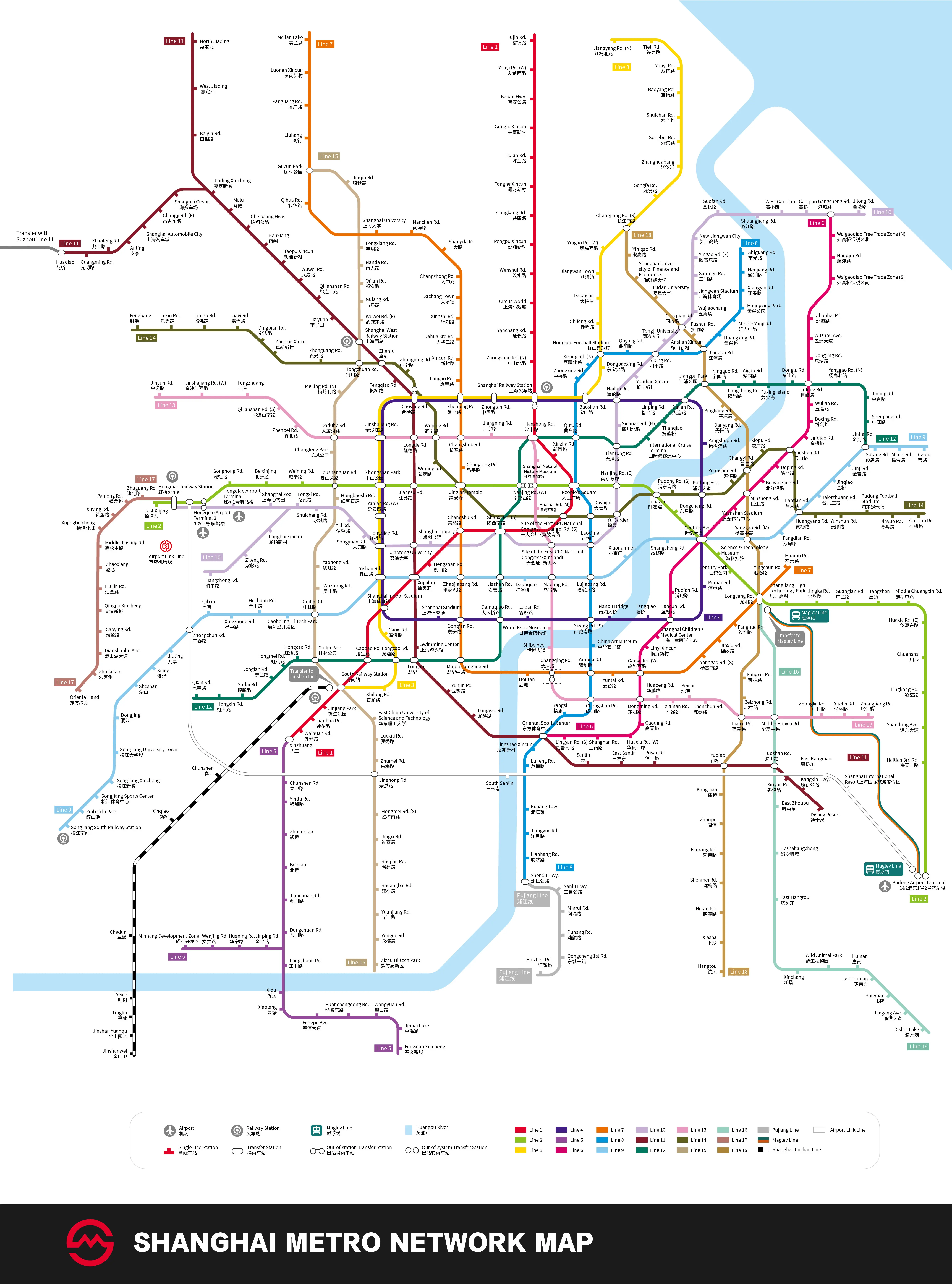
Speaking from experience taking the subway in Shanghai, if a train is 15 minutes late, and it still manages to arrive before the train that was scheduled to follow it, it cannot be true that the network is "very densely packed" or that it has "very frequent trains".
A subway is very different from an intercity railway network. For one, there's probably fewer different routes on the subway so trains conflict with each other less. Also, a subway doesn't have to accomodate freight traffic as well.
The German intercity rail network certainly identifies more lines, around 57 to Shanghai's 18, but this isn't directly related to the complexity of the topology. For example, line 14 appears to begin in Aachen and dead-end into Berlin, at which point line 95 begins in Berlin and runs out to Poland. As far as the routing is concerned, those could be the same line. But they're given different numbers. When the same thing happens (at a smaller scale) in Shanghai at the west end of line 9, the tail bit of the line going to Songjiang is still called "line 9". Note that if you want to ride out to Songjiang, at some point you're going to have to get off your "line 9" train and walk over to another station where a different "line 9" train will take you the rest of the way.
Discounting that, the two layouts appear to be roughly similar on the fundamentals, if differently scaled.
The most obvious difference is that the routes between major German cities are served by several lines. This is clearly meaningful in some cases; line 29 from Munich to Nuremberg continues north to Hamburg via Berlin while line 41 from Munich to Nuremberg continues northwest to Dortmund via Frankfurt and Cologne. On the other hand, line 8 from Munich to Nuremberg parallels line 29 for the entire length of line 8 (line 8 stops in Berlin, but line 29 doesn't).
My first guess would be that conflicts arise from the fact that the German trains are on the ground, and when their tracks cross, conflict can occur. This isn't true of a subway system; when subway tracks cross, they do it at different altitudes, allowing both tracks to be in use simultaneously.
Not only do tracks cross, trains also share tracks and platforms. In Shanghai only Line 3 and 4 share tracks and platforms.
Your map only shows ICE/IC lines, there are many more other lines which share the same tracks. This shows a more complete picture: https://www.deviantart.com/costamiri/art/Transit-diagram-of-... but it still doesn't show international trains and freight.
How does that affect the question of whether the network is densely packed or whether it has frequent trains?
Passenger trains from Frankfurt to Cologne are infrequent because there is virtually no demand to move between cities 120 miles apart. Because the trains are infrequent, they aren't dense on the tracks.
But that's the opposite of saying that they are frequent and densely packed.
Read up on what affects railway bandwidth. A densely packed 250km/h line won't appear similar to a densely packed subway line to a bystander despite of maxing out its abilities.
I agree. Funnily enough I had a journey sped up due to a delay recently. I had a change, and the train I was changing to was delayed so that I could make the earlier one which I should have missed had it been on time.
> The main thing people dont understand about Germany's train system is the scale of it. The network is physically very large, but also very densely packed, and has very frequent trains.
And that's a wonderful thing, you can reach "everywhere" with a train in Germany. That's something I wanted to say that we need to keep in mind when we see a headline like this. It's a sense in which Germany's train service is one of the best in the world.
Yeah, the dependency graph for scheduling trouble to procreate is massive. Not comparable at all to a star topology as in France, or to a two coasts topology as in Japan. Closest thing might be Switzerland, but while that network is also very dense, it's also so small it might just as well be compared to some of the larger subway networks.
And then there's a pet hypothesis of mine, that a factor in the unreliability of German rail is the famous absence of a general speed limit on the Autobahn: that this might make DB strive for fast best case connection times more than it would if driving was slower, pushing them to schedule an unrealistic house of cards with not enough slack to recover from the unexpected.
Yeah, both Switzerland and the Netherlands have distributed networks like Germany, but their relatively small size means that they don't need to design around speed, and can focus more on synchrony.
That said, this doesn't mean it's impossible the fix Germany's trains. Germany's network did work quite well before, and it can again. The fixes are happening right now, but it's going to get worse before it gets better, because all the construction that needs to be done interferes with the network.
I have been to places in Germany where it was a 45 minute drive to the nearest train station. I'm not talking about somewhere in the Black Forest but an actual village where people live. It's great for cities but for villages I typically take the car.
Yeah. While I understand why Germans are so frustrated by BD these days, as a Canadian living , the train network here blows my mind constantly. It has problems, but it's still incredible.
Those numbers are pretty much irrelevant. Canadians arent evenly distributed throughout the country (nor throughout Ontario. That province is empty other than a tiny corner of it), the overwhelming majority of them live in a few areas that are quite population dense (i.e. metro-Vancouver area, Edmonton/Calgary axis, and the corridor from Toronto to Montreal.
Besides, Canada used to have a much more extensive train network back in early 1900s when the population was a tenth of what it is now.
Canada could have functioning train networks if we wanted them.
Rail networks are no longer a government priority in Canada because of planes and cars. We've kept some of the rail tracks, but theyre mostly just used for freight transport, not for people.
> where I live in Cologne, there's typically a high speed train every 20 to 30 minutes to Frankfurt. If one train is delayed by 30 minutes, then suddenly you have two (ore more) trains right on top of eachother heading to the same destination, both on very very congested lines that theyre simultaneously trying to do repairs and expansions to. Those are the sorts of situations where it makes sense to just cancel the train, not because of metrics but because of actual track constraints.
Never mind congested lines, remember the trains are full of paying passengers!
(Let's assume both trains were more than half-full of passengers, which is fairly typical), what would you plan to do with the passengers on the cancelled train who can't get on the other train because there is literally no room for them?
I recently travelled on a badly-delayed ICE train (to Frankfurt Airport, as it happens) and it was running so late I ended up rebooking my flight from the stationary ICE because I lost confidence we would get to the airport in time for my flight.
I’m curious how Japan’s train network deals with these issues. That map looks like the train network in Tokyo alone. Japan’s network is also quite large, densely packed, and with very frequent trains. Despite Japan being well known for timeliness of its trains, it does have its occasional delays, but not often enough to think about.
That's always the case for through stations, I believe. However even terminus stations don't have their platforms locked to a fixed destination. Milan Central station has 24 platforms and each of them hosts multiple routes. Rome Termini has 32 platforms, same thing. You can monitor departures at this link, if you are very patient to keep track of them
Re-reading up on ETCS-Level3, that would enable all of this. We're just fucking slow to implement it, while having let our infrastructure decay, and intentionally built back. Like switches to change tracks, for overtaking slower trains, if the other side is free, too expensive to maintain, da da da ah jetzt ja! Dumm gelaufen...
Selbst Schuld Ihr Arschkrampen!
ALAAF!
And finally fence all that shit in, and let the rats and crows have their fun with all the suicidals. No need to close the track. Light a candle, if you must, just another one bites the dust. Yawn.
Its true that the network is quite dense and used by also cargo trains, but there is no denying that things got worse and worse. I constantly experience delay to do some stuff not working. I forgot even the minute threshold when a train is still punctual according to DB. I believe it's 10min by now, which can be deadly if you need to switch trains :)
In the US I've been on a intercity Amtrak that was so late they combined it with the train ahead of it and had a massively long train (it had to stop twice at one or two shorter stations).
> But they’ll stop choosing the train, and over 20 years you’ll find that everyone has moved to private vehicles or alternate transportation methods.
This is a country with a $2.68 per gallon gas tax, compared to $0.51 on average in the US (€0.60 v. €0.11 per liter). This is partly justified as nudging people to use less carbon intensive transport. That nudge works a lot less well when the lower carbon alternative is painfully worse than your car.
Car ownership is pretty expensive. But holistically speaking it's not more expensive than the Deutschland Ticket, because it gives you access to cheaper housing options that you wouldn't be able to live in if you depended solely on public transport.
Can confirm for the US too. I live in a rural county with zero public transport, but when I tell city friends what the lot cost and the property tax on it, they have to hold back tears.
There's a way to combine those, and some countries have it done well (I believe this includes Germany) - you have a rail network that is good enough that you have small stops on feeder lines in rural areas; if you want to be rural you can be a mile from a train that gets you to a moderate-sized city where you can get the fast train.
Not sure about Germany but in Spain tax on petrol is 44%. At current prices for petrol (1.3€/l) you need to pay around 78€ to fill a sedan (assuming 60 litre deposit) of which 34.3€ will go to the government.
>This is a country with a $2.68 per gallon gas tax, compared to $0.51 in the US.
Irrelevant comparison since US is a widely different animal to most European countries.
It might be expensive compared to the US, but Germany is still one of the countries with the most affordable income-to-cost ratios for car ownership in the Eurozone, so car commuting is incredibly common, especially for those not living in densely populated metro areas.
Well yes, not difficult to see why. Germany is quite big and quite sprawled, and given how expensive home ownership is in big metro areas people choose commute longer in exchange for affordable housing.
And also the government gives you tax rebates for your fuel expenses the further you have to commute for work which is a double edged sword.
> when metrics aren’t correctly setup.
All management is about massaging metrics, things are getting 'better', here, see this chart. It is going up/down.
Executive (VP+): I like to see a burndown chart (or some other format). I want a dog in a cat form factor.


A cancelled train should be counted as delayed until the next train (close to the worst-case scenario) so as to discourage it.
But the real problem with deteriorating service is that people will put up with it for a long time - as long as they get to where they’re going eventually.
But they’ll stop choosing the train, and over 20 years you’ll find that everyone has moved to private vehicles or alternate transportation methods.
And then you have no riders and trying to get back on track will take 20 years or more.