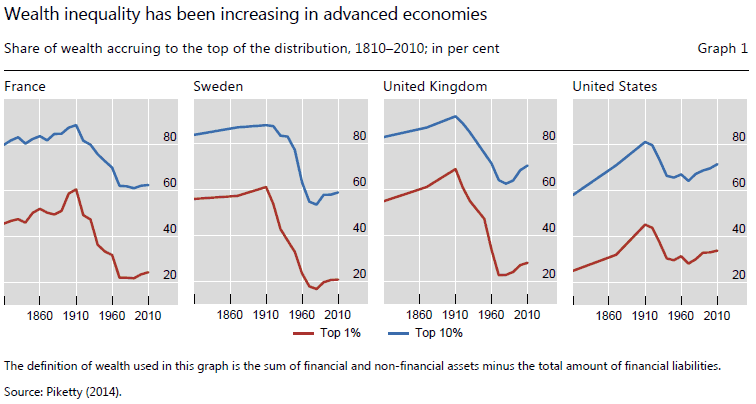
[1] has some actual numbers to answer that question, with e.g. [2] for modern US numbers (since [1] has only Europe). The wealth gap peaked in 1910, took a nose dive until the late 1960s (though much more pronounced in Europe than in the US) and is on the rise since then.
The post-industrial US dipped as low as ~1300 or ~1650 Europe, but is now back to levels Europe only reached in 1750, well on track to repeating the rising inequality during industrialization. Sweden is still at 1280/1600 Europe numbers, better than 1960s USA.
Actually it probably has risen a bit more since then since those are 2010 numbers, hence the comparison of US numbers to the French Revolution
1914-1918 is the more precise date range that you are looking at for causation.
One of the victims of war is Capital. Much Capital is destroyed in some places, and countries generally begin to do things that look an awful like command economics (i.e. Your factory is a tank factory now, you will make tanks, we will tell you how much you are getting paid. If you resist we will use the propaganda machine to make you look like our enemy). During both world wars the returns on capital were well below the rate of growth, and what would otherwise be expected.
On top of all that, the world wars were huge events for income taxes. If you look at a history of income taxes in the US, you see three local maxima for the top brackets. The Civil War, and the two world wars. The same is true of estate taxes in the UK, for example.
From what I gather a number of factors. As one article puts it: "Social solidarity engendered by the wars, wartime experience of governing the economy, unemployment in the 1930s and the rise of socialist ideas."
Both pension systems and labor unions were first created in the late 1880s/1890s and got a lot of steam in the early 1900s. Similarly with the modern iteration of minimum wages. Both the Nordic Model and Rhein Capitalism were created in the 1930s. On the more extreme spectrum, the Russian Revolution brought communism to Russia in 1917.
In a way you can see this as the fruits of the critique of capitalism by Marx in the 1840s. They grew and took root in light of rising unsustainable inequality and lead to mostly positive reforms that brought down inequality even in societies that retained capitalism at the core. Then the trend reverses as the US starts their war on Socialism and Communism, and Reganomics and Thatcherism become dominant.
I understand how those elements would lead to a decrease of wealth inequality past 1920/30, but it doesn't directly explain why the decrease seems to start before World War I.
If the unionizing and minimum wage movement was the cause of the big drop, wouldn't the drop have started before 1910?
Wouldn't the opposite be expected, an aristocratic caste system less equal than an ostensibly democratic society ostensibly based on fairness and human rights?
You're talking about expectations from economic theory, while I'm talking about expectations from societal values; or, in other words, the economy defining society, vs society defining the economy. Obviously the first is factually correct in the US at the moment, but I think the second is what most people believe/wish for. Worth noting that other capitalist countries put better brakes on those feedback loops, they're not inherent to the system.
What you're describing is "idealism" - the idea that people's ideas are not conditioned by the material conditions of their lives. That doesn't seem to be true. Instead, "The ideas of the ruling class are, in any age, the ruling ideas". Most people believe the things that are necessary in order for the conditions they live under to perpetuate themselves. People's ideas change mostly as a result of change in their material conditions.
After the Great Depresson and the second world war, most capitalist countries put brakes on those feedback loops in order to keep the whole system functional, especially in view of the apparent success of a socialist alternative. But those brakes have been in the process of being gradually stripped away since the 1970s, and even faster since the failure of the Soviet Union.
> Worth noting that other capitalist countries put better brakes on those feedback loops
Seeing how the wealth gap is increasing between them and the US, most politicians and wealthy individuals are doing all they can to remove those brakes, pushing evermore to follow the US. Defund, privatize, deregulate.
If you think the system is designed to do anything but transfer wealth from the poorest to the wealthiest, then you should seriously do some critical thinking on the subject.