People here seem to be underestimating the advantages that Google gets just because of Chrome:
- When you sign in to Google, you sign in browser-wide. Google now gets all of your browsing data, perfect for advertising. (If you ever doubt it, go check out Google Takeout. You'll be shocked at the amount of data you see there.)
- They have special APIs and features that they get to use, and nobody else. Only because they own Chrome. [1]
- They get to move forward with enabling and pushing features that allow for more advertising: see Manifest v3, FLoC.
- Google specifically serves a worse version of Search on Firefox for Mobile. You have to get an extension to get the full experience.
This isn't an isolated attempt. You can see more of the same thing with Android.
- AOSP (the open source counterpart of Android) is now unusable. It doesn't ship with most essential apps, including a Phone app. In previous versions of Android, all of these were a part of AOSP.
- Most third party launchers/stores struggle to implement features because they are only available for Google themselves.
- The signing in with Google thing from above continues here too: you sign in to Google system-wide.
> This isn't an isolated attempt. You can see more of the same thing with Android.
Here are more:
- (jumping off of your second point...) Play Services does more than just handle stuff you sign into as a user -- it's also a dependency for everything from push notifications to screen casting. This actively poses issues building competing platforms, in that in order to give developers a path to shipping in your ecosystem you have to provide functioning alternatives to all of those ancillary features. The compatibility issue also impacts user adoption, and then the user adoption and the barren marketplace impact each other... Even the combined resources of Amazon and Microsoft weren't enough to overcome this. (Facebook did, but I'm also not sure forking the OS into a separate VR platform is necessarily the same thing.)
- It also comes with integrity checking, so even if you do find a good third party image, and sideload Google packages, numerous things won't work unless you take part in a dumb arms race that ironically requires you to also root your device. By which I mean a feature that was originally built for banking applications is now used everywhere from streaming services (as an additional layer of DRM) to gacha games (for anti-cheat). This is actually the entire reason I dropped Pokemon Go, personally.
> Even the combined resources of Amazon and Microsoft weren't enough to overcome this.
Pedantically, their resources were never combined. They independently tried to compete, and they independently failed.
For what it's worth though, Amazon seems to be doing tidy business with entrypoint tablets and FireOS, which is a fork of Android, but still one they own.
Microsoft's exit of mobile was a short-sighted decision IMO. They have the entire office suite. They have windows and Windows has essentially become an app store model too.
I can easily imagine a future where Microsoft leaned in hard on Microsoft Mobile-exclusives for Word/Outlook/Excel/Teams/etc., bundled it with the rest of Office/Windows subscriptions, and had every office worker in the world carrying a windows phone for their work device.
I know, I know - everyone wanted only an iPhone. But it feels to me like Microsoft didn't try very hard.
> Pedantically, their resources were never combined. They independently tried to compete, and they independently failed.
I'm talking about Windows Subsystem for Android, which leveraged Amazon's app store.
Though honestly, their application strategy since Windows 8 has been fascinating. Watching them:
- ship Linux and Android app support
- replace their first-party browser with a Chrome derivative (and inherit all the PWA support of its parent)
- ship first-party support for .NET and PowerShell on other platforms
- ship React Native builds for Windows and macOS
...all suggest they're really trying not to get into the same hole as what happened with Metro, by giving you a lot of different ways to build something that can then run on modern versions of Windows -- regardless of whether that's even necessarily your goal.
- the browser is undeniably critical as everyone's window through which they view the online world;
- the user gains a huge amount of value by a browser being integrated into the OS, webviews in other applications, etc
- browsers aren't really a self funding product
- having a single for-profit US advertising company control everyone's view of the online world, however slightly (e.g. by obstructing adblockers), is Not Good
Splitting it off solves the latter problem but immediately raises the question of how to pay for it. A very artificial arrangement where Google pay "arms length browserco" to maintain Chrome?
I feel the same. I also feel the same about a modern C library and C compiler (and C++, if you like). They are essential to build any modern system and applications. Yet, those are also (mostly) no longer self-funding products.
What do you think will happen if Google is forced to divest Chrome?
Netscape used to cost the equivalent of $100 inflation-adjusted dollars and was only forced to go free to compete with Internet Explorer. Now the genie can't be put back in the bottle, and anyone trying to sell you a browser would become irrelevant the same way Delphi's paid compiler lost out to free C compilers.
Maybe you could carve out a niche that's willing to pay, the same way C# did before dotnet core. But for a mass product the best-case scenario would be something similar to today's Opera.
However what it would do is open up the market to competition. Right now Google is spending a lot on Chrome development and Chrome advertisement. Opera and Edge both have given up on their own engines because they couldn't keep pace with Chrome development, and Firefox kept its engine but can't compete with Chrome's ad spend. If Chrome had to compete on a more even playing field there would be more room for diversity and competition. That could be a net positive, even if it makes Chrome worse.
Windows is a paid-for product; either enterprise licenses or via the manufacturer. Yet few people (mainly those who build PCs themselves) realise this.
What if the browser had a similar model? The manufacturer pays a certain 'browser development fee' into escrow, then on first boot, the copmuter shows a browser ballot, which gets set as the default, and the fee goes to the chosen browser developer? There's probably a bunch of problems with this approach, and, at least initially, wouldn't break the monoculture, but it might be a good starting point for how to fund browser development.
It was never required to pay for it. As was common with software back then, the free download was a fully featured "evaluation" version denoted by an "N" appended to the version number. That didn't last long though and it just stayed free.
There was a "Gold" version they sold at retail for some time that had a WYSIWYG editor in it, until they made it standard as part of the Communicator suite.
Oracle Chrome would remain free at first, but one year down the road all new versions would become free for home use but $50 per seat yearly for commercial use, with a clause that allows Oracle to enter your offices to audit your compliance at any time
Return to Konqueror Browser from KDE - the grandfather webkit browser.
In all seriousness, I kind of wish that someone could build a sustained non profit like apache to take over chromium - if Google or Microsoft or others want to custom roll their own flavor fine, but Google being for-profit has been making decisions against the best for everyone browsing the web (such as the new plugin stuff around adblocks) (conflict of interest)
Firefox has made Mozilla billions over its lifetime by selling the default search engine rights to Yahoo and Google. Chrome, having a much greater user base, would demand a correspondingly higher fee (probably around $10b a year). Now, the other problem is there is no other search engine to compete with Google at that level, but that might change with independence of Chrome.
But not everything must be for-profit. Free/Libre/Open Source Software is a prime example. Projects like GNU, Linux, GNOME, KDE, WebKitGTK, LibreOffice are sustainable for a long time.
Every browser also gets a significant amount of money from Google. Mozilla is profitable too. But when Google is forced to stop paying browsers to use their search, it'll put Apple and Microsoft at an even wider advantage since they're the ones that can afford to push their own browsers at a loss...
Vivaldi's business model is primarily revenue from deals with search providers. they don't exclusively get money from Google, they get money from all their search partners, including Google.
Brave is into crypto scams and advertising scams, so I guess you're right there. Their revenue is also tiny.
The rest aren't what I'd call "real" browsers, most don't have the same level of functionality and compatibility as Chrome, Firefox, Safari, Edge... Servo for example is literally just the rendering engine Firefox gave up on.
What's wrong with 2005 where desktop user experience goes? Why is the new sexy only 'let us remove all user choice and customization, throw decades of stable desktop UI features like menu bars, tooltips, keyboard shortcuts and mouse optimized icons, simply stretch a mobile touchscreen onto a widescreen display with gigantic fonts and dumbed down icons and call it a day'?
Opera is not a browser at this point but a chrome skin. Yes, there is some engineering still going on, but they don't run as much engineering as would be needed to build world-class browser software.
Currently, talented engineers flock to google to contribute their skills to making the best web browser. My concern for a publicly owned utility is that the top talent won't want to work there.
> Currently, talented engineers flock to google to contribute their skills to making the best web browser.
I don’t think these engineers have the right incentives, and their interest is not aligned with mine. I don’t really care what they do to Chrome and their efforts benefit me only indirectly. I am also not convinced by the "best browser" thing, even using it every day on my office computer. So, meh. I don’t care too much either way but I won’t lose anything if Google has to spin it off.
Agreed! I was on Arc for a while and really enjoyed it (obviously Chromium-based), but have found that both Orion and Safari are phenomenal choices! I don’t see any reason to switch back, although I will admit that I keep Chrome around in case I need/want to cast content to a Chromecast-enabled device (until I find an inexpensive alternative to that).
The way governments fuck up basically anything (with very few exceptions) IT related I would say no. Personal example: my name is Marcello and I had troubles applying for a permit online because names can't contain musical instruments (Cello in this case).
Create a consortium or interested private entities but let's not give such an important piece of technology to governments where meritocracy is non-existent (also based on personal experiences).
I generally agree, I don't want this to be government-owned but since it can't be funded privately and is of great public value an utility-like contract would be in order. I don't see it happening with at least initially a stake from the government (maybe I'm wrong, will gladly be!)
My experience is that utilities don't innovate at all. In fact, the do their best to get the government to give them funding for innovation ("you know, because we love people") and then just... don't actually do what the money was for.
> The way governments fuck up basically anything (with very few exceptions) IT related I would say no.
Just wait until you have to justify IT expenditure to a for-profit corporation that isn't solely focused on technology.
Government screws things up because it's (by design) slow. Business screws things up because f*ck your needs, we need to get a check to a retiree who never even worked here.
Free market competition sorts that out right quick.
Either your business is spending the economically optimal amount on IT or you're running at a net deficit disadvantage.
Note that the economically optimal amount may not be what people want or expect, which is why in general we rely on (mostly) free markets and not centralized human planning like the USSR.
Free market competition does not sort it out right quick, particularly in an economy where capital has consolidated as much value as they have through an oligopoly.
The problem with this is that people think that the net deficit disadvantage matters.
It doesn't. Companies are now owned by shareholders that are set up to not have to care about that company within a fairly short period of time. They're not owned by people who have any pride in "winning" that market or an existential threat to their finances if things go poorly. Most publicly-traded shares of companies on stock exchanges are owned by pension and retirement funds, and the person at the head of that fund has exactly one job: make money for the members. If that means gutting the company they hold shares in like a fish, while simultaneously setting up to exit the position, that's what that means. The company's net deficit disadvantage is not the fund's net deficit disadvantage, and that's by design.
Now, that has massive economic consequences for the people who are at the company (and, y'know, actually do the work), and for customers who relied on the product or service, but the fund has made money. Whether its members spend it on anything that will create more economic value over time is another matter. For example, fast-rising homeowners insurance rates in places in the Southeastern US that have been popular with retirees over the last few decades would indicate that they aren't spending it wisely, but, hey.
Any potential buyer will have to be looking to use Chrome to accomplish the same kinds of synergies that Google is using it for, to get ahead in some adjacent market. Depending on the buyer that could be good for competition, at least in the short term, but it's not clear that it will be better for us as users.
Hypothetically, why would some buyer using Chrome's monopoly to establish a market advantage in an adjacent domain be different than Google using Chrome's monopoly to establish a market advantage in an adjacent domain?
Because the relationship between Google and Chrome goes both ways. Chrome helps Google keep their monopoly on search and ads, and Google helps Chrome keep its monopoly via Android and its other products.
After the separation, Google won’t have an incentive to promote Chrome - so it’ll lose market share eventually, and Chrome won’t have an incentive to require things like Google accounts or use Google search by default - opening space for other companies to compete.
How does splitting off Chrome as a separate company solve anything? They would still rely on Google for funding (like Mozilla) and being close friends they would do whatever Alphabet tells them to do.
A better solution is to implement a bill like DMA in the EU to enforce competition among web browser vendors and fight monopolies.
Not that I disagree with the overall point, but this is something the DOJ does not do. They would just look at the current laws and decide who to prosecute based on their interpretation of events.
>Bing is already the default search engine on the default browser of the most used OS in the world.
It's actually more embedded in Windows than Google is in Android.
If you change your default engine in Android it changes across the OS.
In Windows, there are dialogs that say "search bing for" embedded into places like the right click menu when you have text highlighted that remain even after attempting to express a different search choice. Another example is the search bar in a new tab.
I don’t think Bing is the default search engine for Android’s browser. I could be wrong though. Is it? That would be a surprisingly fair-minded move of Google.
By context I’m pretty sure they mean Windows OS and not android, sometimes you have to take things in context. Depending on context one could easily argue that linux is the most common operating system depending on where you draw the line on operating system
I am pointing out that Windows is not the most common OS, and Android is.
The original comment was saying that Google is able to perform anti-competitively because they control the most popular browser.
The followup (which I responded to) is saying that the existence of Windows as the most popular OS, and Microsoft’s control over the default browser there, mitigates this anti-competitive potential.
The fact that Windows is not the most popular OS (and that, in fact, the most popular OS is controlled by Google) undermines that argument.
Linux is not the most popular OS in any context that includes doing searches with the thing, unless you include Android, but Android just uses Linux for the kernel mostly, and an OS is more than a kernel.
It's the most common desktop OS. No one was confused by what the parent meant since Windows is not a mobile operating system and doesn't compete in that market.
I think it's fair for them to point out (however snarkily) that Windows is not the most popular OS. In the context of the discussion, I think it matters that there is another OS, Android, that is more popular.
I think their point is that you can't just say "most popular" without more context because not only is it often subjective, but it can also be interpreted in different ways. Most popular by type of device? number of total users worldwide? etc.
Every Linux distro just uses Linux for the kernel, right? What else is there? Init system and user space stuff isn’t Linux in any Linux distro either, because Linux is a kernel. The real thing that might make Android not a normal Linux distro is the heavy modification of the Kernel.
A Linux distro uses the Linux kernel by definition, I guess, so I think you are right about that. We could talk about distros in general, maybe Homebrew and Cygwin, if we didn’t want to define a distro as being a Linux distro. But I’m not sure what the point is.
I’m not clear on what they meant by Linux. But if we use a definition of “Linux OS” that includes Android and is restricted to devices which people typically use to perform searches (aka consumer devices) (since that was the original topic), then Linux is mostly Android and it is a kind of pointless distinction to make.
If we want to use some definition of Linux that precludes Android, and covers all devices that use the Linux kernel, then we have a bunch of servers, streaming boxes, smart lightbulbs, whatever.
If we want to use a definition which is, like, what I think everyone means when they say Linux in the context of market share: GNU/Linux or BusyBox/other/Linux (I was hoping to avoid the GNU/Linux meme, but here we are), then that doesn’t have much market share.
There is much more Android phones, tablets, TVs, Linux routers and other gear sold every year than Intel-based PCs with ME, so the articles' claim may need narrowing to "OS used in PCs" and even that has a chance of being wrong, given how AMD is doing these years.
Almost certainly that would be part of a consent decree, which would prohibit Google from creating or controlling a browser for some period of time, and would include court supervision.
Yes because government regulation of tech has been so successful in the past. Just look at how well the anti trust lawsuit against IBM went - that they later just dropped because it wasn’t relevant anymore - or the Microsoft lawsuit in 2000.
No there was never a browser choice mandate in the US
> Yes because government regulation of tech has been so successful in the past. Just look at how well the anti trust lawsuit against IBM went - that they later just dropped because it wasn’t relevant anymore - or the Microsoft lawsuit in 2000.
You can surely do better than these examples. Nobody would be better for lack of action against IBM, and lack of serious action against microsoft continues to hurt us today. C'mon. Break these useless, unproductive fuckers up.
Selling devices with a browser installed or available for installation is completely tangential to creating and/or controlling the development of said browser.
I expect there will be some material constraints that emerge in what browser features they're actually allowed to ship as shipping without a browser also seems to be anti-consumer.
Yes, in the sense that me putting a gun to your head and ordering you to stay still isn't the same as me handcuffing you, because you can still physically move.
Firefox lost too much market share. And while some of that is due to bad leadership at Mozilla, Chrome running big advertising campaigns and Google advertising Chrome on their own properties (hints to download Chrome on Google Search, Drive, etc. when you visit with other browsers) were also a big driver. Google flew too close to the sun.
I would say almost 100% of it is due to bad leadership at Mozilla. They seem to have zero interest in improving Firefox, and lots of interest in all sorts of random... stuff, like decolonial climate justice using AI in Zambia.
I wish the result of the case was just “you can’t pester users to switch browsers. Unless the browser they’re using isn’t meeting an open standard that’s necessary to the proper function of the site you’re pestering them on.”
If another entity buys Chrome, they’re only doing so based on the belief of increased future value/revenue from it. Google doesn’t want to sell it because they see more future value in it. If Chrome sucked, there’d be no antitrust case. So this is all a “you’ve done too good a job, now give it all up.”
I don’t use Chrome or Chromium based browsers because Safari works well for all of my use cases. But I want to see alternatives prosper. I don’t think needing Chrome gets anyone there.
The issue is who controls Chromium. I would create a non profit and staff it with a handful of maintainers. Their primary job would be to ensure safety and squash exploits. Their other job is to curate and approve pull requests from volunteers for enhancements. They should make it open source with the caveat if it is used for commercial purposes, there will be a licensing fee to pay for security enhancements, bug bounties, and the like.
If 90% of the contributors were non-Google, then it would effectively be controlled by non-Google, because they could fork it and their fork would still get 90% of development.
See Terraform for a live example.
The only reason Google "controls" Chromium is because Google funds almost, but not quite, 100% of its development.
On a similar note, there's nothing stopping Microsoft from investing equal or greater amounts and forking Chromium (well, arguably they might already have with Edge). Except that they're benefiting from all of Google's investment, for free. Why turn down a massive developer investment from your competitor with no strings attached?
Do you think Google will continue to invest money and resources into the development of Chromium if they were forced to sell Chrome? I don't. The first thing I would do is close source the Chromium project and work on a new closed source browser to compete with Chrome. I also don't see Chrome surviving when all of the Google/Chromium developers have left.
They could sell a lot of the data that Google now gets for free and uses for its ranking algorithms, like Clickstream sells data to SEO tools like AHrefs and SemRush.
Google doesn't use Chrome data for Ads or Search. They're not allowed to based on the TOS, and also they have government regulators watching carefully to make sure they don't make a mistake like that.
The regulators in question are pushing for divestiture of Chrome because they don’t believe that the current structure prevents using Chrome data, so it seems that Google did “make a mistake like that”.
They are, see how both Safari and Firefox, the 2nd and 3rd most popular browsers, have brought in tens of billions of revenue per year. Safari is immensely profitable, Firefox too would be if Mozilla wouldn't be run in an absurdly poor manner.
> the user gains a huge amount of value by a browser being integrated into the OS, webviews in other applications, etc
What is the huge value gain that e.g. Safari being integrated into MacOS is bringing me? Why couldn't webviews be backed by a browser of my choice?
Mozilla literally gets paid by Google, and not sure how you can quantify Safari as being profitable on its own when it's the default for all Apple products and realistically, the only browser on iOS.
This DOJ case isn't looking to ban payments for default search engines in browsers. It is very unlikely that this entire practice will be outlawed/stopped as a result of this DOJ case.
> As set forth in Section IV, the PFJ prohibits Google from offering Apple anything of value for any form of default, placement, or preinstallation distribution (including choice screens) related to general search or a search access point.
In what way is Safari profitable? How is that even measured? Has any consumer in the last 10 years ever specifically paid for safari? Or do you mean the payments by google to be the default search engine?
Why not though? Apple could still install Firefox and set Bing as the default search engine. Or even just Chrome, without selecting google. They don’t get the money for making a browser but configuring their browser in a specific way. That would work with any browser.
No? But why does it matter? They can include Firefox in their OS and set the default search engine to anything they want.
The point was that developing Safari isn't what makes apple the money, it's setting Google as the default search engine of the default browser. So if Apple would stop maintaining safari tomorrow and would switch to preinstalling Firefox, they would still get the Google money (for setting Google as the default search engine of their Firefox installation). So Safari isn't profitable for Apple, as was claimed before.
Yeah... Because massive companies use them anti-competitively as a moat against other companies, and as a loss leader to enable massive data collection and vendor lock in.
"browsers aren't really a self funding product" is a symptom of dysfunction, not the inevitable conclusion of a fair market.
I'm not sure that software entirely obeys normal market theory. So much of it is zero-cost free.
The synergistic effects are so strong that most users would prefer there to be The System, in which everything works together and there's no risk of incompatible choices. They don't necessarily care which system.
The market in things like, say, file explorers is tiny. There's a few shell replacements (free), Midnight Commander and clones, and maybe over in the corner someone making a few thousand dollars a year from an Explorer replacement.
You might have missed recent news about Linux maintainers being kicked off for reasons having nothing to do with Linux. This will not work across "political borders" because psychologically we're all still cavemen in need of a tribe to stick to, and a group of "them" to hate on.
> psychologically we're all still cavemen in need of a tribe to stick to, and a group of "them" to hate on.
I'm not sure this is fundamentally true, but regardless of whether it is or not, our political systems have followed an historical path of development such that it behooves political leaders to think like this, and encourage their followers to.
At the end of the day every employee is the most granular bit of profit-making - I trade my time and zero money for money. 100% profit.
If you removed the money you paid me could say you're being more efficient, but I don't know if that's a useful definition of efficient. Just as you could steal some raw materials and say you're being efficient.
Well yes, if you find a way to generate value with no input costs, anything you charge people will be pure inefficiency and you'll be put out of "business" by the first person who gives this idea away for free. I'm not sure what sort of insight you can glean from this.
In this specific case I'd be willing to bet that Firefox 3 probably doesn't handle current HTTPS/TLS standards and might not be able to browser the modern Internet at all (let alone display modern webpages, HTML5 video players, single-page web apps, WebRTC live calls, etc.)
Firefox 3.5 was actually the first browser to support HTML5 video and audio. In general for old browsers TLS is the main issue. Most websites that don't rely on JavaScript or newer CSS still render well enough or "fail gracefully" but are still readable.
- Why would Google (which famously didn't index Javascript well, and liked clear super-optimized URLs) have contributed to the existence of single-page applications (which used to have terrible drawbacks for SEO)? Where's the incentive?
- And what is a SPA blog? That seems like such a far-fetched idea.
Google realized if they don't control the search distribution they gonna lose out sooner or later; which is kinda contradictory for them if they claim Google is the best search out there and that they are constantly improving it and that's why(they say), people choose it over other alternatives. But tbh distribution of your product/s is crucial.
Just look at Microsoft and their internet strategy, they chose the other route; push their internet browser(IE) down their massive distribution pipe called Windows and then introducing their search engine to this massive userbase. Fortunately this didn't work out for them but unfortunately that worked out for Google. And now Google essentially controls the Web in the more than half of the world.
> Fortunately this didn't work out for them but unfortunately that worked out for Google.
No, Google was better, then they used Chrome as an extremely powerful moat to protect their situation. Google at first was like magic compared to the Altavista of the time.
Google won the search market on merit but they've maintained it with Chrome. Google search has been garbage for a long time and in the last few years it's gotten bad enough that even laymen are noticing it.
Surely making deals with companies like Apple and Mozilla to be the default search engine was a big part of building that market share. How many iPhone users bother to set a different search engine in Safari?
We all agree Google-the-search-engine is losing relevance (literally). So they should also lose their distribution channel, Chrome, because being nagged until you synchronize your Chrome profile and use their search engine is anti-competitive, on top of being pretentious from a less-relevant search engine.
I don't disagree, but I'm also not sure what the alternative is.
Who's going to buy Chrome that also doesn't suffer from the same anti-trust problems? Who would want to buy Chrome? Who would want to fund Chrome?
What browser would Android ship? In one view I kind of like the idea that Google would have to shop around and 'buy' a browser for its OS (competition good!), but also that seems ridiculous and easy to fall right back into the same trap.
> Who's going to buy Chrome that also doesn't suffer from the same anti-trust problems? Who would want to buy Chrome? Who would want to fund Chrome?
Hmm. It's a good question, and I don't know the answer. I think there's a compelling argument that the problem is the scale of the harm. That is, even if the new owner has the same problems, the new owner won't also be the largest web company. So the problem still exists, yes, but becomes smaller. In particular having the #1 web browser strongly tied to the #1 web company has a lot of problematic dynamics that the #1 web browser being owned by the #25 web company doesn't. Maybe that company would be more open to forming beneficial relationships with the #2 and #3 web companies, for example.
Google already funds Firefox and makes Chromium[0] as well, which seems like quite a lot of effort to go to as a single company in funding/enabling competition. Microsoft had to do far less to resolve their EU dispute: just give users other options for browsers on install of their OS.
[0] Unless if today you take Chromium and make your own browser, and it still has all the stuff in about logins and tracking.
> Who would want to buy Chrome? Who would want to fund Chrome?
This is interesting question especially when companies are usually just use Chromium instead of creating new browser (not even making hard fork of Chromium).
Before a couple of weeks ago where a Google Play Services update changed the first set-up process, almost all global (non-CN market) devices forced Chrome as default: Xiaomi, OnePlus, Realme, Motorola, Oukitel and whatever other weird brands there are left in the Android world. AKA anything other than Samsung
How about this: sell the browser to the entreprise [1] and use the profit to offer the browser to the public for free, which in turns helps you secure a user base.
You raise an interesting point. Every job that I worked in the last 10 years offers "real" Google Chrome on a Windows PC. I never considered that they would pay Google for it, but I guess Google could add a bunch of nice admin and security features that would be useful to mega-corps but retail normies don't care about. That is probably well-worth the 6 USD per month per user. In a modern corporate workplace, a huge amount of your day is spent using web apps... running in Google Chrome (or Electron!). It like a WebVM that runs inside of Microsoft Windows (from the perspective of corporate IT folks).
An independent Chrome company will start with an established & proven product, huge userbase and a marketplace for extensions. That's a huge advantage (and liability too).
If FF can get millions for its default search option, Chrome can easily command more and if Mozilla can afford to venture into other product areas with their budget, it doesn't sound impossible to have a self-sustained chrome development once you eliminate all the non-essential feature work that helps only Google.
FF can't get millions for its default search option. Where's the other sellers lining up to give FF millions of dollars? Google gives it to Firefox out of "pity" and in an (unsuccessful) attempt to ward off anti-trust claims.
> If you ever doubt it, go check out Google Takeout. You'll be shocked at the amount of data you see there.
I sign in browser-wide and I do takeouts regularly. I don't see my browsing data.
> It doesn't ship with most essential apps, including a Phone app. In previous versions of Android, all of these were a part of AOSP.
And back when they were part of AOSP I never saw these example apps in the wild. Every vendor ships their own phone app. Every single one.
There's some "hey we compile a extremely old and vulnerable version of AOSP"-style Android distributions, mainly advertised for builtin su/Magisk or "degoogle", which did use these example apps, though.
That's unfalsifiable conjecture. I could just as easily assert that dang is building secret dossiers on all of us from our IP-request logs - we just can't see it
> - When you sign in to Google, you sign in browser-wide. Google now gets all of your browsing data, perfect for advertising. (If you ever doubt it, go check out Google Takeout. You'll be shocked at the amount of data you see there.)
I have yet to see evidence that Google uses browser sync data for advertising.
Go do something in chrome (look for cruises maybe), then delete the activity from myactivity.google.com, then wipe and reinstall chrome. You will see that you aren’t advertised based on that activity yet it’s still in your chrome history.
Another major point highlighted by Fishkin and King relates to how Google may use Chrome data in its search rankings. Google Search representatives have said that they don’t use anything from Chrome for ranking, but the leaked documents suggest that may not be true. One section, for example, lists “chrome_trans_clicks” as informing which links from a domain appear below the main webpage in search results. Fishkin interprets it as meaning Google “uses the number of clicks on pages in Chrome browsers and uses that to determine the most popular/important URLs on a site, which go into the calculation of which to include in the sitelinks feature.”
It could be marked as chrome because Firefox doesn’t support it (without a default-off config value) and Safari technically implemented it at a later date than Chrome, with non-chromium Edge supporting it years after chrome.
This would indicate Google is using chrome to tell it when (via its support of the ping property) but wouldn’t indicate they are decrypting and analyzing chrome sync data.
I know this is anecdotal and that I should look further into this but I recently had to switch to chromium because google suite products were slightly unusable in firefox: youtube used way more CPU than it should’ve (maybe this is due to codecs but I was not able to solve it), google sheets crashed constantly, google meet slowed my laptop to a halt and I couldn’t even share my screen, and for some reason google calendar would suddenly start to hog CPU and RAM randomly. Since I switched to chromium everything is smoother and I just can’t believe chromium per se is just this better than Firefox.
I'll ask what extensions you use on your Firefox, because I regularly use Google Meet on an 2014 MacBook Pro with latest Firefox, and it doesn't even make the fans spin, plus all the goodies like environmental noise cancellation is there. Meet team also recently ported some of the Chrome only features back to Firefox, due to some fear, I guess...
The YouTube videos in higher bitrates (like 4K) is generally due to Firefox's ability to hardware accelerate things, and there's a bit of difference there, yes. But on Linux and macOS (moreso in sequoia), I see no extreme CPU use. Just testing it on Firefox 132.02 on Debian Testing with Radeon 550 with open drivers, While I see a spike in CPU load, there's definitely some GPU load is also being produced, pointing to at least some GPU acceleration.
On the other hand, Intel N100 with on board graphics can visibly struggle at 4K as far as I can tell. That one runs Firefox ESR though, I need to retest.
I don't use WASM based Google Workspace tools (docs, sheets, etc.) heavily, but they don't crash when we use it on other pepople's documents that we collaborate on.
That's strange; I use all of those Google products (except Meet, I can't speak to that one) on a daily basis on Firefox (on Linux) and they all work just fine. YouTube in particular works very well, perhaps because I have the "Enhancer for YouTube" extension installed, plus uBlock Origin.
Teams was acting up on Firefox the other day, too. It wouldn't have Q&A and whatever button is to the left of it enabled. "Not supported in your browser", or something.
> - AOSP (the open source counterpart of Android) is now unusable. It doesn't ship with most essential apps, including a Phone app. In previous versions of Android, all of these were a part of AOSP.
Your comment unfortunately implies that Google still maintains them, which is farthest from the truth (as this document shows, it is only maintained for automotive use - it is not usable on a regular phone).
> Google specifically serves a worse version of Search on Firefox for Mobile.
I don't think Google owning Chrome is really a factor here, but just a raw traffic question where FF Mobile has basically zero uptake. The experience they serve on FF Mobile is just the "we arent subscribed to validating that all of our shiniest JS works with this version of this browser".
The extension spoofs the user agent and arbitrary obscure features that only trigger on specific queries may be broken.
Google does do the effort of validating on other browsers where the traffic threshold is higher, including Firefox on Desktop. If they didn't own Chrome nor Firefox they still wouldn't really have incentive to spend more time supporting the tiny fraction of users.
A browser with a huge userbase would be extremely lucrative for an unscrupulous owner. A new owner could sell full and identifiable clickstream data for all browser activity. A new owner could siphon information from the non-public web for AI training, corporate espionage, or any other purpose.
> Google specifically serves a worse version of Search on Firefox for Mobile. You have to get an extension to get the full experience.
Huh, I wonder if this is why I have perceived a drop in quality from Google Search. What a stupid move from them -- not only have I stopped using Google Search and now pay Kagi (yes I know money still flows from Kagi to Google but even still) and have been evangelizing Kagi as well as taking every opportunity to shit on Google Search.
Great job G, you made the product worse and made me a customer of someone else
Everything here you accuse Google of doing, Apple is running circles on. Ultimately, if this case goes through Google are right about one thing. The UX on Chrome is going to take a steep nose dive.
Apple does not run the largest advertising network on the planet. As simple as that.
Even for the matter of the browser, Apple does not have the same push as Google does. Yes, Safari is the default browser on a phone. But outside of the mobile world, Safari is a rounding error.
There's nothing inherently illegal about monopolies, just anti-competitive behavior. While Apple is engaging in clear anti-competitive behavior (eg shoving the app store down customers throats), they've reined in restrictions of competing browsers so that they're actually worth using now.
Can't you apply the exact same logic to Google and Google's services being bundled together? The bundle is their product; nobody's forcing anybody to use the Google services bundle, but you're certainly at a disadvantage if you don't - the exact same - as with Apple, not using their provided APIs/following their ridiculous rules/not upsetting daddy or he'll take your app away is the exact same thing.
Probably worse so as Google don't seem to copy the features of companies and then spin them as their own all the time like Apple gets away with. Or to kill/remove/restrict competing apps when Apple decides to get into the market for something, or just generally as a "punishment" for not following Apple's strict rules (that only exist to benefit Apple, whilst they tell consumers "it's all 4 u baby").
Before Google, there were multiple competing browsers based on different technology, all of which were either offered for free or explicitly licensed as FOSS. Google used Chrome to put the web on an upgrade treadmill. The only way to keep your own code up-to-date with what websites expected was to either commit unending amounts of resources to the problem (Google), do the bare minimum to keep websites working as your resources are stretched thin (Safari, arguably Firefox), or just ship modified versions of Chrome so that it's easier to merge in new features (Edge, Opera, Brave, Vivaldi, etc).
Before Google, all of those options sucked. Chrome was a breath of fresh air, which was why it exploded in popularity.
I don't do web dev, but from what I've heard, web devs also suffered trying to support multiple conflicting browsers, and Chrome's dominance actually makes life much easier.
No, they just corrected the punctuation. It's now "Don't. Be evil!" Reflecting their inability to do almost anything, and their lack of morals when they do.
The APIs thing: it's not just Chrome, but Chromium too. I first noticed this when trying to replicate some of the screen sharing UI (buttons to share different things) from Google Meet, only to find that no non-Google domains have access to those APIs in the Chromium source code. Made a huge deal about it but nobody seemed to care.
To add: Google uses Chrome's established user base to bundle other products in the same way Microsoft uses Office subscriptions to push Teams.
The most recent example being Gemini now deeply integrated into Chrome. Had Gemini been a stand-alone product, it would have to fight for every user. Now billions of users have it at their fingertips.
Yes, Google gains advantages through the Chrome browser so do we as consumers. The competition for Chrome should come from a better Browser not by being forced to sell it. DOJ is wasting time and taxes on this pointless verdict. Even more economic wastes are coming when the selling happens.
What other solution do you have in mind? Legislation about architecture decisions taken in software products seems preferable?
In principle there is nothing wrong for example with a shared account for multiple products from the same company, many even prefer it. The problem only appears when this gets concentrated into too much power and can be leveraged in ways that distort the market and hurt consumers.
> Legislation about architecture decisions taken in software products seems preferable?
To me this option seems more practical. And we already have some precedence for this kind of solution.
For aviation we have entities like EASA issuing standards like ED-109 and for healthcare we have the HL7 organization issuing the HL7 standard. Another example in the healthcare industry is the DICOM standard created by the NEMA organization. This is not a new idea.
I'm not arguing this approach is without problems. But we are already doing this for some pretty important topics, and I don't see why we couldn't use the same strategy for an "open web standard" that all browsers have to implement.
> and for healthcare we have the HL7 organization issuing the HL7 standard. Another example in the healthcare industry is the DICOM standard created by the NEMA organization.
If only anyone fully respected the standards instead of everyone implementing their own twist...
Yes, Chrome is the de facto standard for the open web. And everyone agrees this is too much power for a single company to have.
But most people seem to think that just removing Chrome from Google would fix this issue. People seem to forget that Chrome isn't the only tool Google can use to steer the web standard in a particular way.
The Google crawler is probably an even more effective tool in shaping the web standard. "To be indexed by Google your page needs to comply with these requirements" puts A LOT of pressure in everyone working in the web.
This is why I think creating and enforcing a web standard is the only practical solution to this problem.
> The UNIX standard was made in part because the government
> wanted an operating system standard, right?
Wrong? Or at least where's the citation to back this up?
"UNIX Standard" presumably means POSIX which was a work of the IEEE, not a government body. If some government had something to do with making it happen, I'm not aware of that. At the time (1988) UNIX wasn't used much outside of academia and niche industries.
There was a point in time where the US government was considering mandating POSIX compatibility in everything. It's why Windows NT shipped with a comically barebones POSIX subsystem and why A/UX (an Apple port of Unix to the Macintosh, years before they bought NeXT) existed.
I'm happy to give all this to a cohesive experience google provides. There are competitors in this market too, but google was the first and best not sure why they deserve this blatant overstep in abuse of power
- They get to move forward with enabling and pushing features that allow for more hardware and software lockin to their platform: see unexportable passkeys


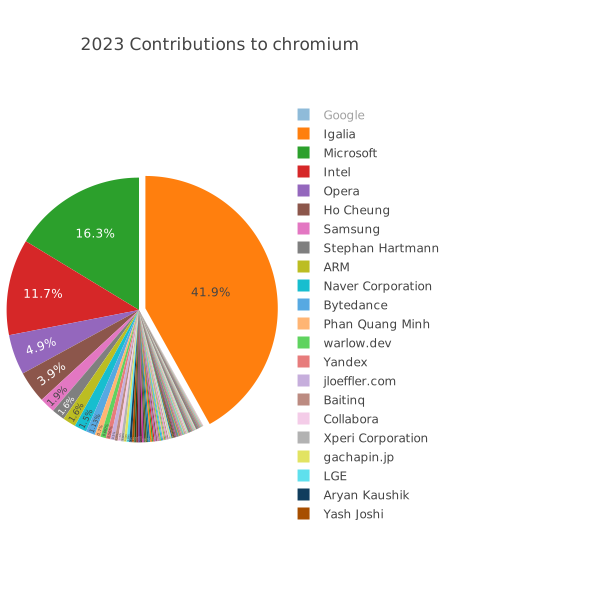
- When you sign in to Google, you sign in browser-wide. Google now gets all of your browsing data, perfect for advertising. (If you ever doubt it, go check out Google Takeout. You'll be shocked at the amount of data you see there.)
- They have special APIs and features that they get to use, and nobody else. Only because they own Chrome. [1]
- They get to move forward with enabling and pushing features that allow for more advertising: see Manifest v3, FLoC.
- Google specifically serves a worse version of Search on Firefox for Mobile. You have to get an extension to get the full experience.
This isn't an isolated attempt. You can see more of the same thing with Android.
- AOSP (the open source counterpart of Android) is now unusable. It doesn't ship with most essential apps, including a Phone app. In previous versions of Android, all of these were a part of AOSP.
- Most third party launchers/stores struggle to implement features because they are only available for Google themselves.
- The signing in with Google thing from above continues here too: you sign in to Google system-wide.
[1]: https://x.com/lcasdev/status/1810696257137959018