but why, oh why, does 12 but not 12*1 nor 6+6, not even 5+7 but precisely as 2+2+1+2+2+2+1=12 is so important for music !?
how can we make a general object that describes such a "folded" structure?
this strtucture arises naturally from repeating 3^1 all the way to 3^12 and inserting the appropriate 2^n (where n is negative integer) to keep all between 1 and 2 (or 2 and 4)
is 2212221 a group?
if we stop at 3^7 instead of going all the way to 12 we have a diatonic major, if we stop after 5 iterations of multiplying 3*3 it's a pentatonic.
It’s only so important for “Western” music. Other musical traditions/cultures (including some from the “West”) find other scale patterns more important. Or they don’t even use the 12-tone division of the octave that this is working within.
Because that pattern forms a scale that allows for playing several intervals such that the harmonics line up nicely, so that they're either very similar or very distinct, but not annoyingly almost similar. William Sethares has a good overview here:
Note how figure 3 shows dissonance minima close to degrees 3, 4, 5, and 6 of the major scale when played against degree 1. Although there are many other possible combinations of notes, combinations with degree 1 are very important because degree 1 provides a kind of "home" that the music often returns to (the "tonic"). But the goal isn't just to maximize consonance, so these notes alone would make for a boring scale. For better musical value, we need some more dissonant intervals to build tension before it can be resolved with the consonant intervals. The obvious place to put them is in the big gaps. Putting degree 2 a single semitone above degree 1 is probably overdoing the dissonance a bit, but putting it two semitones higher gives a useful mild dissonance. Considering only combinations with degree 1, degree 7 could theoretically also go a single semitone above degree 6, which gives the mixolydian scale, but the major scale is more popular. I assume this is because of combinations that don't involve degree 1.
It's pretty much historical, and initially based on the tastes of medieval priests doing Gregorian chant. It started with the handful of intervals they would use and more intervals were added as needed when music grew more complex until we got to similar-ish 12 intervals, which were then actually equally spaced later.
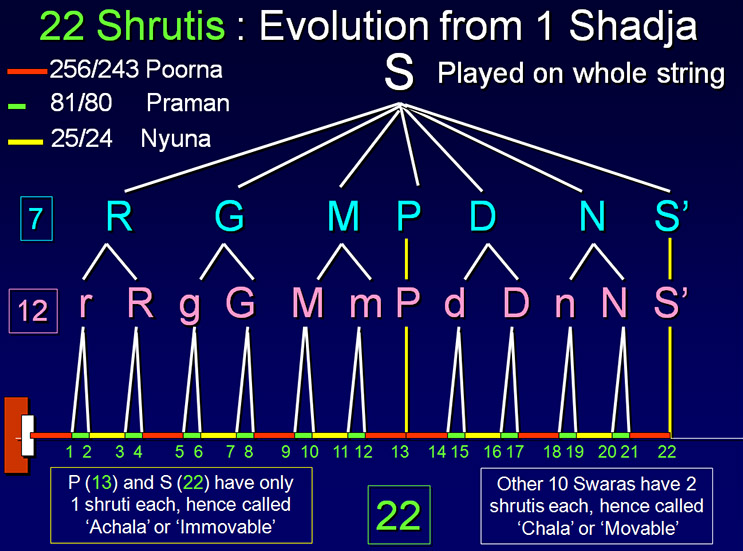
Indian music theory identifies an octave 7 notes, which are modified further to make 12. Beyond these 12 some of them have finer divisions that map onto an underlying 22 tone system.
Notice something peculiar. The P note which corresponds to perfect fifth in western theory, is the same through those layers. It does not split into multiple fine or grain pitches.
Those pitches that we would identify as flat fifths are related to M, not P. And in fact, jazz theorists take a similar view: that in many contexts flat fifths are actually augmented fourths, related to the Lydian.
To make a 7 note scale, you would need an M. In the 12 tone layer, there are two flavors of it: M and m. Something analogous to your perfect fourth and augmented fourth. Then each of these has one of two possible representations in the 22-tone layer. The P is always just P.


but why, oh why, does 12 but not 12*1 nor 6+6, not even 5+7 but precisely as 2+2+1+2+2+2+1=12 is so important for music !?
how can we make a general object that describes such a "folded" structure?
this strtucture arises naturally from repeating 3^1 all the way to 3^12 and inserting the appropriate 2^n (where n is negative integer) to keep all between 1 and 2 (or 2 and 4)
is 2212221 a group?
if we stop at 3^7 instead of going all the way to 12 we have a diatonic major, if we stop after 5 iterations of multiplying 3*3 it's a pentatonic.