We have lots of variable production (wind and solar) and those peaks don't line up with peak load (generation peaks in the morning and peak load is noon-8pm). So utility scale batteries to capture the morning excess and discharge in the afternoon makes perfect sense.
Unfortunately it these batteries are unable to multiple gigawatts over many hours of excess wind energy. It will be at least a decade before the battery energy storage systems are close to big enough to absorb the oversupply of wind energy that happens a few times a week.
Don't get me wrong. The BESS helps with frequency, synchronization and voltage issues. They just do very little to flatten the wind spikes without turning off 10-20% of the wind fleet.
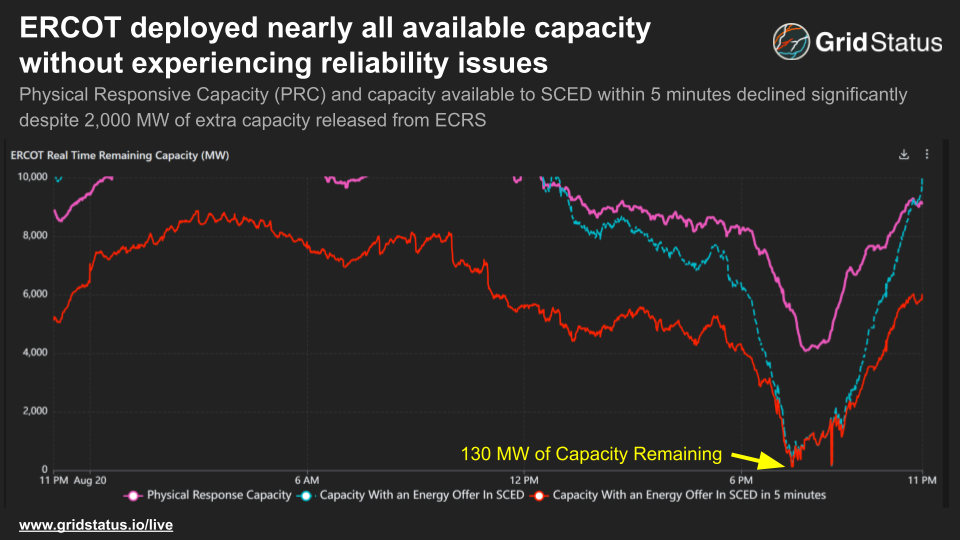
Summarizing from the article, this link [1] shows that there were more sources of generation that ERCOT didn't ask to come online. Specifically, all the capacity that could come online with 5 minutes was online except for a tiny 130 MW of generation.
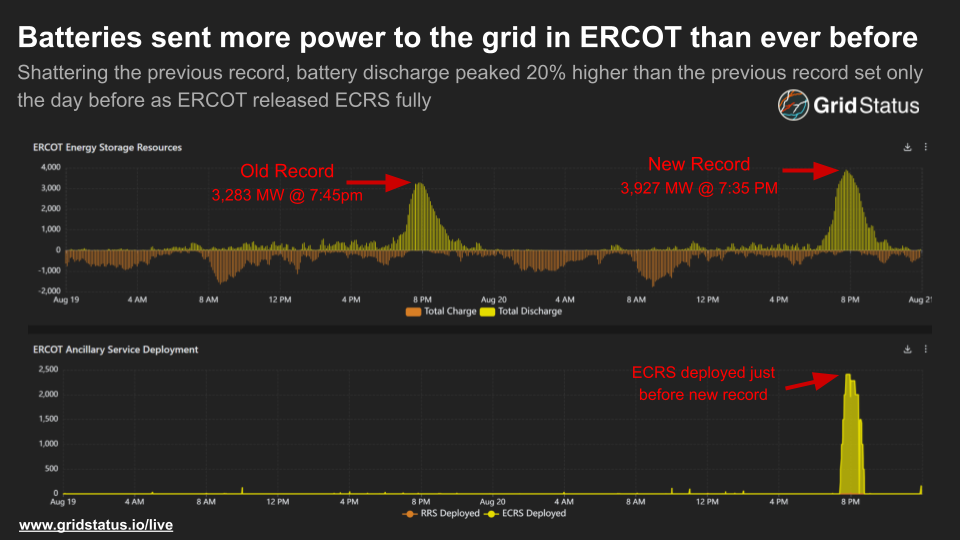
The graph has units of Megawatts. In other words, the thing that was record setting about the batteries was not the Megawatt-hours, or total storage in battery systems.
What set the record was the instantaneous power usage, and apparently the batteries in Texas were at their hottest ever. (No idea if anything caught on fire though!)
Here are some more assumptions I am reading into this:
* The 130 MW that didn't come online may have been rotated around. Maybe all the generation jumped in at different times, guided by supply and demand, but ERCOT regulations likely played a role in keeping the existing systems from exceeding the demand or blowing up transmission lines, etc.
* The article says "Solar and Demand Were High Throughout the Day" but I assume that simply means that over time, more and more solar will be installed and more businesses and cities are becoming aware of https://www.ercot.com/services/programs/load (Demand Response). It means they can get cheaper electricity at night for instance, so they run their power-hungry machines when the prices are low.
* Never underestimate the power of Nature. Probably the daytime temps in Texas right now drove the high solar production and high demand. High temps usually mean clear, sunny days and everyone huddling near an air con.
> Probably the daytime temps in Texas right now drove the high solar production and high demand.
Probably?
> High temps usually mean clear, sunny days and everyone huddling near an air con.
Or all of those mandatory RTO forcing large open spaced cubicle farms to run AC in a building made of glass. Not sure of the image you have in your head being the reverse of homeless huddled around a barrel fire.
RTO is actually energy positive from a heating/cooling point of view (i.e., excluding transportation). People set their home HVAC to "away" to reduce use, and the central HVAC systems found in commercial buildings are far more efficient than home systems.
Contingency reserve services are used to maintain system reliability during unforeseen events. Think of power plants that can quickly ramp up generation, or other assets that can quickly reduce their demand.
In this case, ERCOT tapped 2,000 MW of capacity from ECRS.
afaik there are no residential loads in emergency response programs in Texas
ECRS is a program run by ERCOT, they trigger the battery discharge directly, or in some situations the resources might respond to an under-frequency relay.