> It's pretty obvious that the wings push air down
The air being pushed down is actually a side-effect of the lift-creation process, not the cause of it.
A nice "counter example" is a wing in ground effect (flying very close to the ground), where there is less downwash, because of the ground, and yet the wing produces more lift. It's an effect that can make high aspect-ratio airplanes tricky to land.
> air being pushed down is actually a side-effect of the lift-creation process, not the cause of it
The turning of the gas is absolutely what causes lift. (Where the Newtonian explanation is misleading is in “neglect[ing] the physical reality that both the lower and upper surface of a wing contribute to the turning of a flow of gas” [1].
Put another way: if you know the mass and acceleration of the gas about the wing, you can calculate lift. (This is impractical for many reasons.)
> a wing in ground effect
VTOL aircraft also experience ground effect due to the fountain effect.
> Curvature of streamlines is related to pressure gradient across said streamlines
Sure. Ultimately just considering pressure or mass deflection doesn’t work without elaborate workarounds. Because neither describes the reality of an airfoil turning a moving viscous fluid.
> If the turning of the gas was the necessary mechanism for lift, planes in supersonic flight would fall out of the sky
Why would pressure (Bernoulli out of Euler) propagate supersonically while momentum (Newton) does so subsonically?
> Instead of relying on an airfoil shape for lift, you could fly by sucking air from the top of your wing and dumping out the back of your plane
Wings (and the other bits that contribute to lift) are bigger than engines. That’s the leverage you get with a lifting body: you move more molecules than your thruster alone.
The correct answer here is unintuitive. But the very wrong answer is pressure alone. (As the article we’re commenting on clearly shows with its brilliant flat-cardboard example. You don’t need camber to have a lifting body, just angle of attack.)
> Why would pressure (Bernoulli out of Euler) propagate supersonically while momentum (Newton) does so subsonically?
I'm sorry, I didn't understand the question.
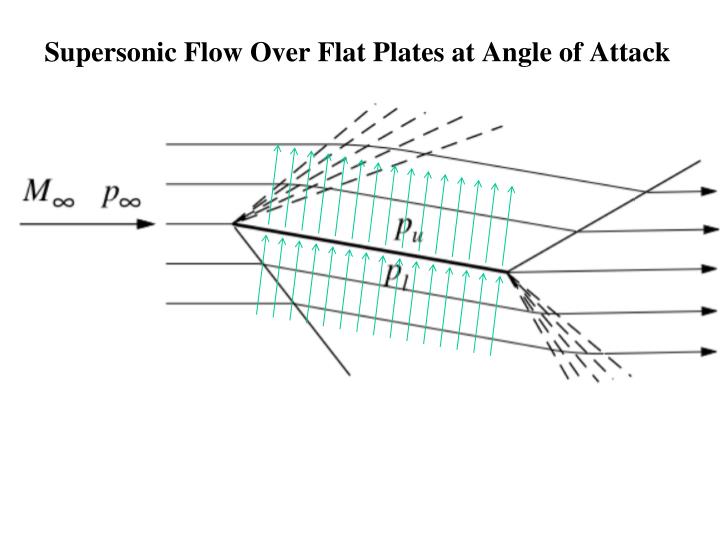
But in supersonic flight, with a flat plate, you don't have any rotation in the game, as illustrated here [0]. And yet you will be producing a lot of lift.
No, it really is the pressure alone. And viscous drag, if you want to be pedantic. Those are the only forces at play, the rest is only a side effect of those forces.
> you don't have any rotation in the game, as illustrated here
The arrows literally moved down!
> it really is the pressure alone
NASA, pilots and aerospace engineers would disagree with you. But yes, you can construct a working model of flight with just pressure. Same way you can make a Copernican model match our observations of how the stars and planets move.
On the top part, you've got a supersonic free-stream deflected with an expansion fan to a supersonic parallel flow over a plate, deflected back and slowed-down to free-stream conditions through an oblique shock. The only thing the upper-surface "sees" is a parallel, supersonic flow.
On the lower part, you've got a supersonic free-stream deflected to a lower-speed supersonic flow through an oblique shock, creating a parallel supersonic flow over the lower surface of the plate, deflected back and re-accelerated to free-stream conditions through an expansion fan. The only thing the lower surface "sees" is a parallel, supersonic flow.
Now, unless you can come up with a force component emanating either from the oblique shocks or from the expansion fans and contributing to the lift vector, it fair to say that the flow deflection is not directly what is causing lift on the angled plate.
To create lift with a symmetrical airfoil, you are going to need a non-zero angle of attack. You can see the effect of a varying angle of attack on a symmetric NACA 0012 airfoil here [0].
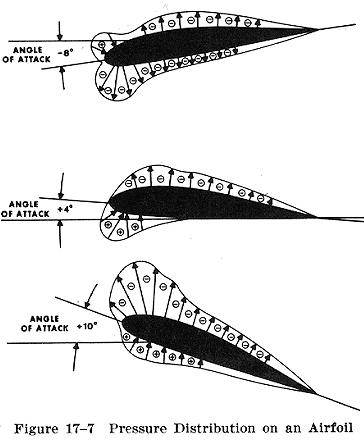
The following plot shows the pressure distribution over a wing at 3 different angles of attack [1]. As you can see from the first plot, some lift is created at -8 degrees AOA, but clearly a lot less than the +10 AOA example, as that airfoil is optimized for positive angles of attack.
Explanation based on Bernoulli effect requires longer path of air taking on top than on the bottom of the airfoil to create speed/pressure difference. With symmetrical airfoil both paths are the same regardless of the angle of attack. So when you mention AoA you implicitly lead to the explanation that lift, in majority, is not based on the Bernoulli effect.
I've read excellent article debunking the Bernoulli effect and lift many years ago, I'm not sure I can find it again...
Explanations based on the Bernoulli effect are trying to explain a speed differential by pretending that two particles that were separated on the leading-edge of an airfoil, to then travel one above the airfoil, one below, would then rejoin at the trailing edge of the airfoil. And so, if you were to change the upper-camber of the airfoil, the flow on the upper part would need to accelerate to be able to join the trailing edge at the same time. And that would create a lower pressure, therefore lift.
The nonsensical part of this model is that a particle on an upper streamline has anything to do with a particle on a lower streamline and that it is trying to keep up with it. Not so of course.
But the lift created by a pressure difference due to a locally faster flow still holds.
> So when you mention AoA you implicitly lead to the explanation that lift, in majority, is not based on the Bernoulli effect.
For a NACA 0012, you'll need an AoA, to have a faster flow on the upper part of your airfoil, as it it symmetric. Other airfoils are perfectly fine creating lift at 0 AoA.
The Bernoulli effect only contributes to making wings more efficient. It isn’t fundamentally why lift occurs.
You can make almost anything fly if you have enough power and a tail. But how efficient will it be? Not as efficient as an airfoil that takes advantage of all the fluid motion properties.
I think you wanted to respond to the parent comment. My questions have been a lead to debunk myth that the major contributor to the lift is the Bernoulli effect.
The pressure differential, in essence, is created by a faster airflow over the airflow. As the total pressure in your flow stays constant, if you increase the local dynamic pressure (with a faster flow), the local static (measurable) pressure decreases.
So if you manage to shape your airfoil so that one surface experiences a faster flow (on average) than the other, you can create a pressure difference, and therefore lift.
And in effect it is true that the gas will most probably need to be turned and displaced, but that is really the airflow adapting locally to the obstacle (airfoil) it encounters. The nose of the airfoil, where the acceleration is high, can be a place where a lot of lift is created, but it is not necessarily so.
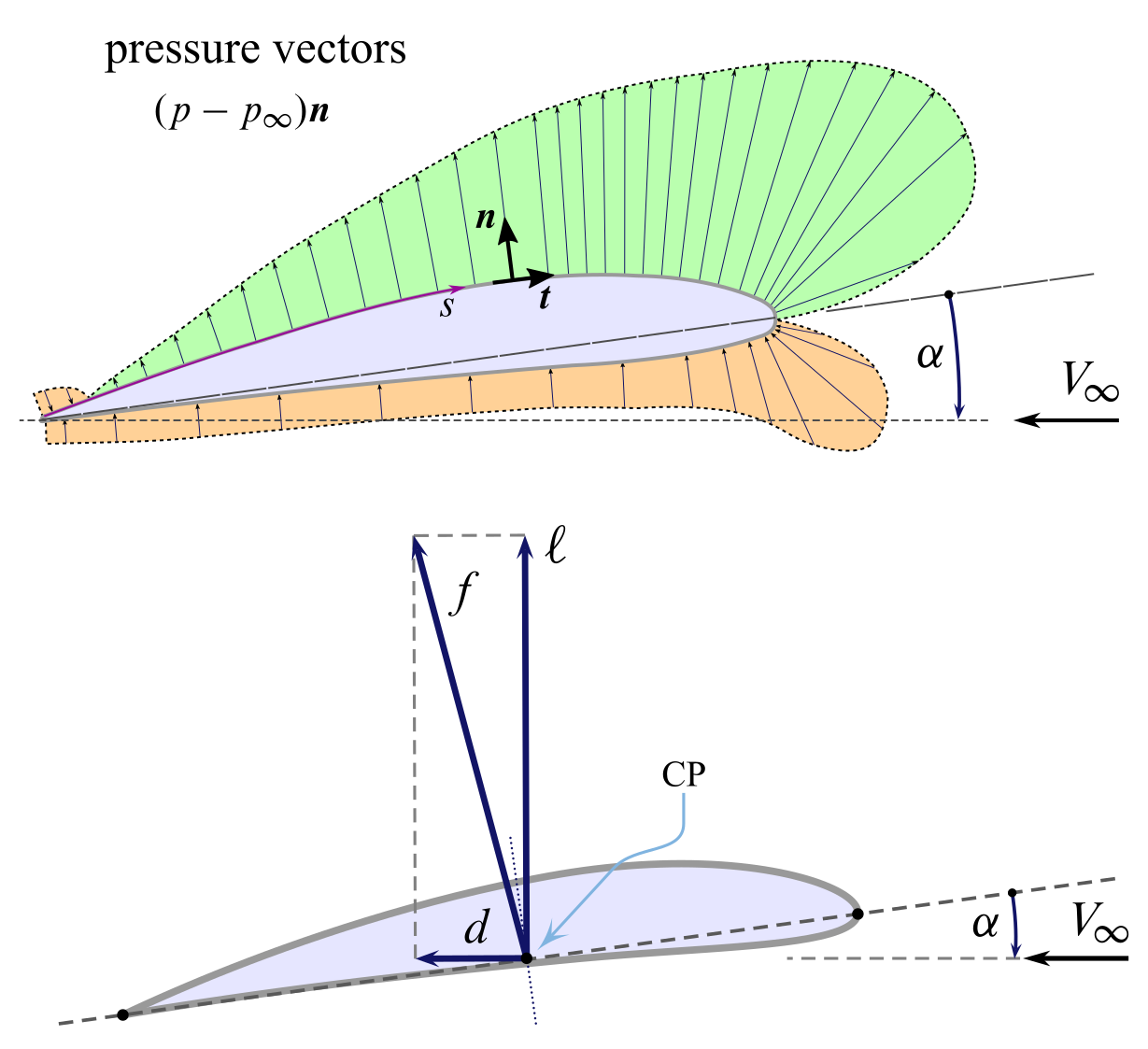
You can see example pressure distribution plots below:
It's not a cause and effect situation, because you can't have one without the other. A pressure differential can only exist if the flow is altered somehow, because a pressure differential means that the air molecules are subject to a net force which accelerates them. This is really just Bernoulli's theorem, which is Newton's second law. However, it doesn't tell you anything about why the flow around a wing arranges itself into such a configuration.



The air being pushed down is actually a side-effect of the lift-creation process, not the cause of it.
A nice "counter example" is a wing in ground effect (flying very close to the ground), where there is less downwash, because of the ground, and yet the wing produces more lift. It's an effect that can make high aspect-ratio airplanes tricky to land.