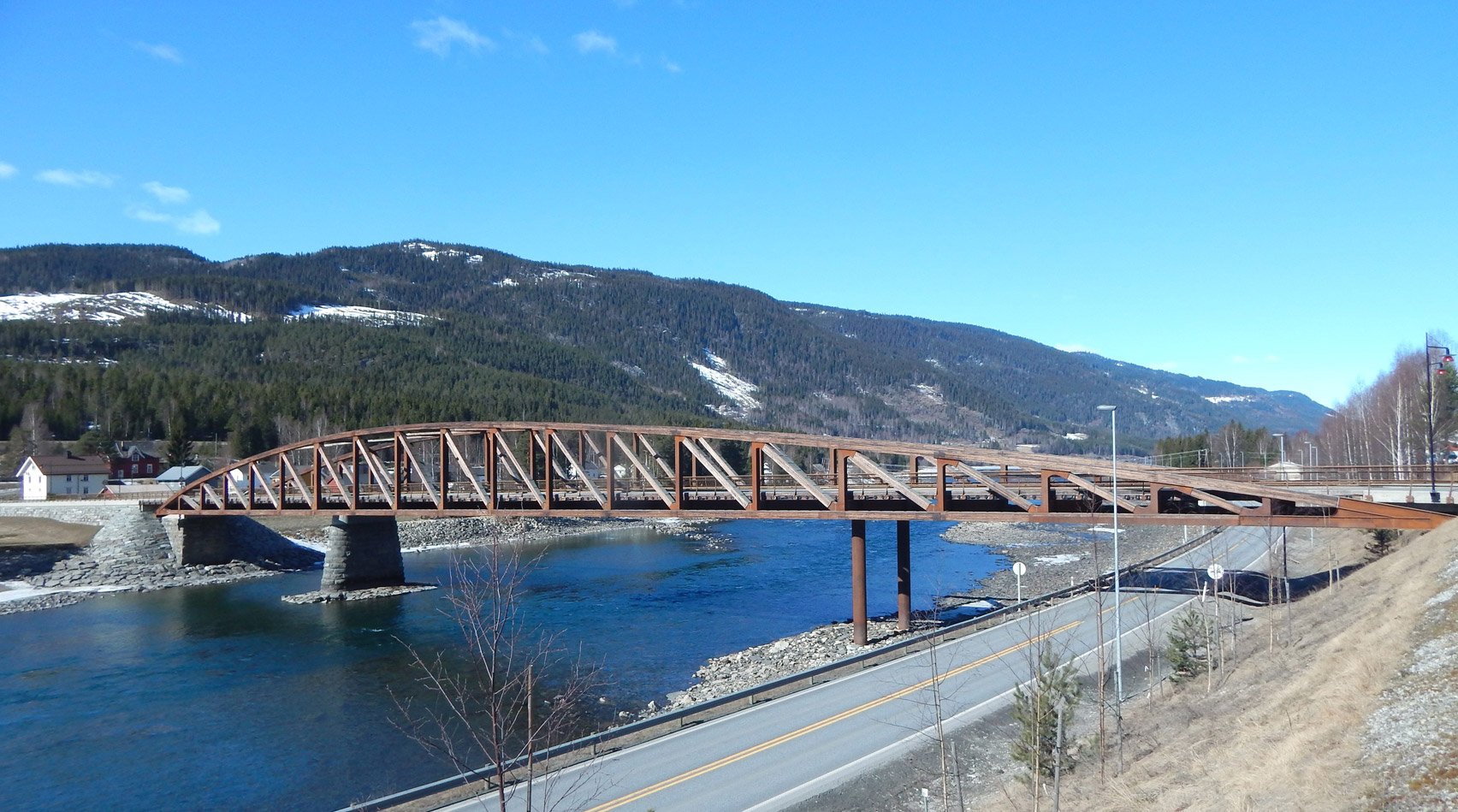
Nor of any other material. Between the insanely shallow truss depth at the right end of it, and the "can't tell compression from tension" decision to slant all the diagonal members in the same direction - that bridge is a poster child for "I Flunked Engineering 201".
I almost feel like intuition tells you that. It literally looks like it can fold down flat. A regular truss bridge looks like a honeycomb, straining, but balanced.
that's a pretty political spin. if i remember correctly the bridge in florida was entirely feasible but they got the pre-tensioning and assembly wrong.
> The new pedestrian bridge was designed to connect the campus to student housing in a dramatic, sculptural way and also to showcase the school's leadership in the ABC method of rapid bridge construction.[16][17]
And from my recollection of coverage at the time - FIU's administrative pressure to deliver their dramatic & leading-edge-construction bridge, quick and cheap, lead to all sorts of corner cutting in the engineering & fabrication.
To me the root cause was they just could not see a way to inconvenience even one single driver ever. They had to grade separate pedestrians from cars over a freeway and a gigantic parking lot. Universities should be pedestrian focused.
The bridge could have been designed correctly. But the fundamental issue was the bridge didn't need to exist.
I think that's more of an auxiliary issue than the "fundamental" one. Space is limited, and a nice (and non-collapsing) bridge could be more convenient for pedestrians than however things would be laid out on the ground even if there wasn't a road there. Safe bridges should be able to exist, whether one would have been needed in this exact spot in an alternate reality or not.
It's also very telling for you to condense "a freeway and a gigantic parking lot" down to "one single driver ever." Five motorists wouldn't have been killed by the collapse alone if "one single driver" was the only one who ever used it.