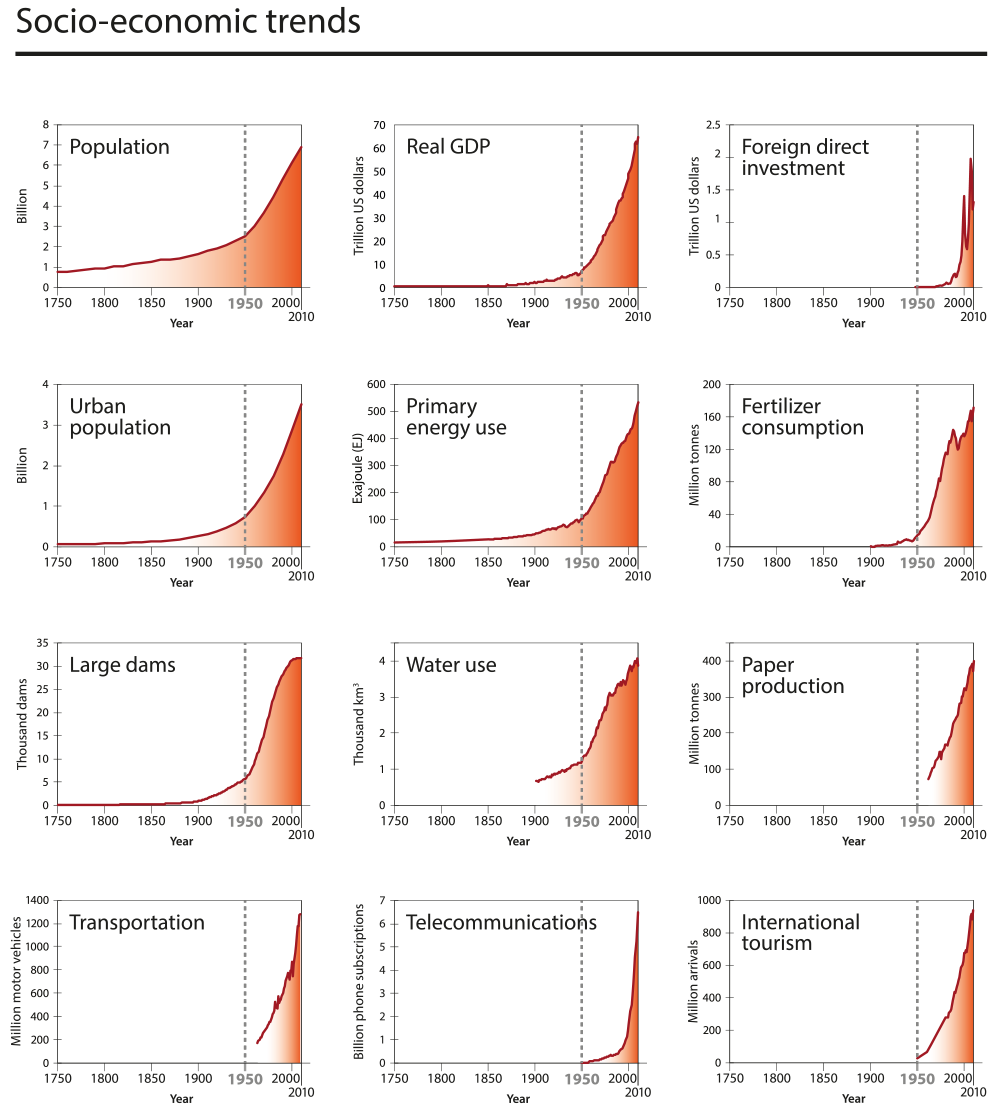
So what are actual viable solutions, that don't expect a angelic socialist neo-human to be coaxed and tortured from the raw humanity given? I refuse to read disaster porn without the authors doing positive modeling too..
Basing taxes on income and/or expenditures as opposed to property, and supplying a universal basic level of support for necessities?
As things are now, many or most are defacto forced to work(and consume - I believe the two are correlated {e.g. "I'm working like hell but will make up for it with a big vacation"}).
I believe universal guarantees of the necessities are justified in virtue of most or all resources being privitized and opportunities regulated. Besides, it appears many or most don't have an appetite to watch their fellow citizens starve or go completely without.
Please note that many or most people don't really want to "do nothing", they just want acceptable circumstances. It's hard for acceptable circumstances to exist in an environment that values extreme wealth. (For example, intellectually it may not seem like a big deal to compensate for increasing expenses by "working a little harder", but at some point that becomes "a lot harder".)
How the financial system drives unsustainable, exponential growth:
- Profit Imperative: Prioritizing shareholder profits often overshadows environmental and social considerations
- Debt-Based Economy: The need to repay loans with interest fuels constant economic growth
- Short-Term Focus: Financial markets can prioritize immediate gains over long-term sustainability.
- Externalized Costs: Businesses can offload certain environmental or social costs, profiting without bearing these expenses.
- Speculative Investments: Instruments like derivatives can lead to rapid, unsustainable wealth bubbles.
- Growth Metrics: Overreliance on metrics like GDP that don't distinguish between positive and negative growth.
- Financialization of Nature: Turning nature into commodities can lead to exploitation.
- Misaligned Incentives: Financial rewards can drive growth-focused decisions over sustainable ones.
- Consumer Debt: Encouraging consumption through easy access to credit.
- Globalization: Capital seeking high returns can exploit regions with lax regulations.
- Lack of Sustainable Investment: Historically limited focus on investing in sustainable sectors.
- Overemphasis on Efficiency - financially efficient practices might not account for environmental costs
Other drivers of exponential growth:
- Consumerism: The cultural emphasis on consumption as a marker of success or happiness encourages overconsumption and waste.
- Technological Advancements: While technology can aid sustainability, it can also drive faster resource extraction and consumption, especially if not directed towards sustainable outcomes.
- Population Growth: A growing global population increases demand for resources, energy, food, and housing.
- Policy and Regulation: Inadequate environmental regulations or policies that favor unsustainable industries can exacerbate resource depletion and environmental degradation.
- Economic Paradigms: Traditional economic models that prioritize GDP growth often overlook ecological and social boundaries.
- Information Asymmetry: Lack of knowledge or awareness about sustainable practices among consumers and producers can perpetuate unsustainable behaviors.
- Infrastructure: Built environments and transportation networks that favor car use over walking, cycling, or public transportation can drive up carbon emissions.
- Limited Resource Pricing: Not accounting for the true environmental costs of resources (like water or clean air) can lead to overconsumption.
- Short-Term Political Cycles: Politicians might prioritize immediate economic gains over long-term sustainability due to the short duration of their terms.
- Global Supply Chains: Long, opaque supply chains can hide unsustainable practices and make accountability challenging.
- Cultural Values and Norms: Societal values that prioritize individual wealth accumulation over communal well-being or stewardship of nature.
- External Pressures: International trade, competition, and geopolitics can pressure nations to prioritize growth over sustainability.
- Lack of Education: Inadequate emphasis on environmental education leaves many without the knowledge to make sustainable choices.
- Resource Ownership: Common resources like oceans or forests might suffer from the "tragedy of the commons," where individual users act in their interest contrary to the common good.
All these areas (and more) need to be addressed. It's obvious that this cannot be condensed into just a few social media comments :)
As growing climate change impacts are experienced across the globe, the message that greenhouse gas emissions must fall is unambiguous. Yet the Emissions Gap Report (EGR) 2022: The Closing Window – Climate crisis calls for rapid transformation of societies finds that the international community is falling far short of the Paris goals, with no credible pathway to 1.5°C in place. Only an urgent system-wide transformation can avoid climate disaster.
* Further speed up replacing fossil-based power generation with renewables or nuclear, and add grid-scale storage like there's no tomorrow
* End subsidies & stop investment in fossil fuels yesterday
* Electrify everything (factories, transport, air travel, ...) as much as possible
* Stop buying unnecessary goods whose production has big environmental footprint (specifically: CO2 emissions. But also water, land use, mined resources etc)
* Stop slash 'n burn rainforest practices. Return degraded agricultural lands to nature
* Eat less meat
Just to name a few. Most of these are political / economic choices (and to a lesser degree, personal choices). Not so much technology limitations. And don't make us less wealthy or our lives less comfortable (quite the contrary, in many cases).
SRM: “It is not a solution but an extremely dangerous band-aid that covers up the global warming problem without healing it, creating a false and unwarranted sense of climate safety while the core of the problem continues to fester.”
We have the solution, and not just for the warming, but for most symptoms of the overshoot, we just don't like it.
Climate change, resource depletion, deforestation, loss of biodiversity, pollution, overpopulation, soil erosion, and overfishing are all symptoms of ecological overshoot.
If we'd stopped fossil fuels ASAP, reformed agriculture and switched globally to plant based diets, we'd free up 80% of agricultural lands we use for animal agriculture. That's the area a size of Africa.
Reforest/rewild it (cca 3+ trillion trees) and we'd store enough carbon to return CO2 to pre-industrial levels and enable biodiversity to return to previous levels.
Rapid global phaseout of animal agriculture has the potential to stabilize greenhouse gas levels for 30 years and offset 68 percent of CO2 emissions this century
Nuclear Power would have been the solution. There are ways to even reduce the radioactivity of the waste that are technically feasible. Though I am not against renewables at all, I love solar as well, we have a solar powered water heating system in my apartment.
A single solution won't suffice. That could have worked 50-70 years ago, not now.
Climate change, resource depletion, deforestation, loss of biodiversity, pollution, overpopulation, soil erosion, and overfishing are all symptoms of ecological overshoot.
Agriculture is a key culprit in 5-6 out of 8-9 of those symptoms, and animal ag accounts for 80% of all agriculture.
Nuclear will/should help with the climate change, but will do very little in other areas. And we should solve most of them, otherwise we're still ... in a bad place.