Direct solar light is more than any plant can handle, but the plants are adapted to this, which is why the terrestrial plants are green, instead of being black, in order to reflect a large part of the solar light to avoid overheating, even if this reduces the amount of captured energy.
On the other hand the oceans are dominated by diatoms and brown algae, which absorb a much greater part of the solar light.
There are many plants which are adapted to live in shadows and which would grow well under solar panels, but I do not know if there are many useful crops among them.
> Direct solar light is more than any plant can handle, but the plants are adapted to this, which is why the terrestrial plants are green, instead of being black, in order to reflect a large part of the solar light to avoid overheating, even if this reduces the amount of captured energy.
It is true that the reasons why phototrophy does not work in a too strong light are much more complex than a heat effect, but also the theory proposed in the paper quoted at your link is too simplistic to be convincing.
The primary pigment use to capture light in all phototrophic living beings which produce elemental oxygen is chlorophyll a, which is blue-green not green.
In the land plants, the blue-green color is masked by the more abundant green chlorophyll b, which is an accessory pigment that transfers the captured energy to chlorophyll a.
So if it is assumed that the color of the pigments has influence upon the regulation of the energy flux (as claimed in that paper) and it is not due to historical accidents, then any such theory must explain why when oxygenic photosynthesis has evolved first in Cyanobacteria, most likely in a terrestrial freshwater environment or in intertidal zones, the optimal color was blue-green, not green as claimed in that paper, then when the Cyanobacteria spread in the oceans in environments with lower light levels (where the luminous flux has even greater fluctuations that require regulation, according to the hypothesis from that paper) the algae have evolved to have accessory pigments that absorb most of the available light, and then, when going back to the continents and exposed to strong light, they have replaced the more efficient accessory pigments with a green pigment, which produces a lower amount of photoelectrons at a given illumination.
The latter fact is easy to understand as just a means to limit the fraction of captured energy versus total energy (in order to not produce more redox agents than can be used by the chemical syntheses that are limited in speed by other factors), but it does not make sense as a means to supposedly diminish the effect of light fluctuations, because these are much smaller in a more intense light flux, with much more photons per second.
The chlorophylls always have a gap in the green or in the blue-green, where the light is reflected.
However, in the non-green algae there are various accessory pigments, which absorb light in bands not used by chlorophyll and which transfer the generated photoelectrons to chlorophyll, enhancing the amount of the light whose energy is captured.
The ancestors of the green algae, which adapted to a terrestrial freshwater environment, then to the dry land, becoming land plants, have lost most accessory pigments, because they now received more light than they could use.


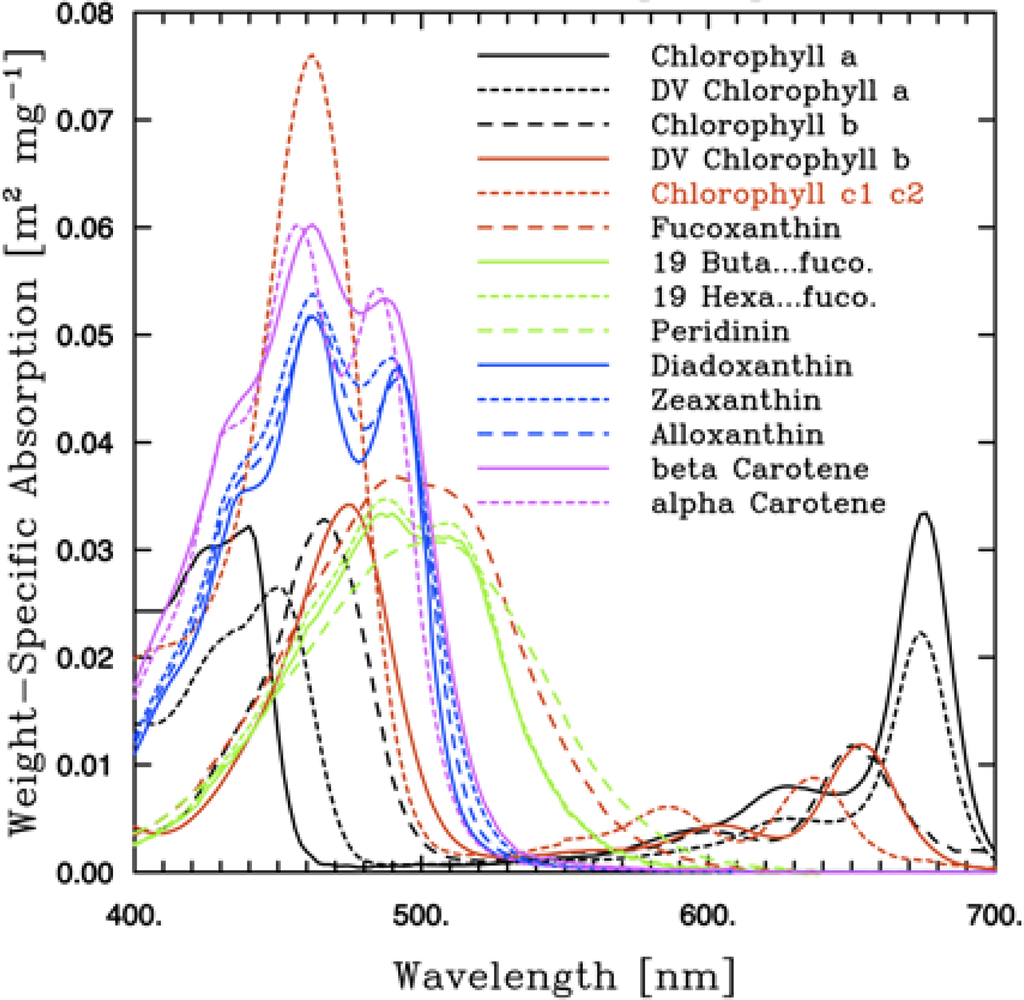
On the other hand the oceans are dominated by diatoms and brown algae, which absorb a much greater part of the solar light.
There are many plants which are adapted to live in shadows and which would grow well under solar panels, but I do not know if there are many useful crops among them.