We could always have been moving faster, saving more money and more lives, but we really didn't have good science on the last few percent of carbon emissions from the power system.
The deniers updated their messaging too, so you regularly see (and see in these comments today) people saying "Yeah, renewable energy is cheaper and cleaner but ... desperately makes up something to justify their believing lots of obvious lies ... in 2050 when we have lots of cheap, clean renewable energy something vague and bad will happen so we should just slow down and burn more fossil fuels for reasons.
So it's good to recognize that we now have better answers for the delaying tactic questions.
Yeah sure. But if you have an abundance of electrical power you can literally lift up concrete blocks with a crane and generate electricity by letting them down. You can pump water up and use turbines. If you live in a flat area you can do the same in mine shafts. A German guy developed a way of cutting huge granite cylinders out of solid rock that you can lift up and let down producing high pressure waterflows that can be used to store energy. You can split water into hydrogen and oxygen and run turbines off of it, you can charge batteries. You can warm up sand in insulated containers and use the heat to power turbines. There is so many ways to store energy it is hard to enumerate them.
And if you have much more wind and solar power than you need you don't even need to worry that much about the efficiency of the storage system. Sure, you're gonna select the one that you can finance, maintain and find the space for, but a lot of that stuff could be built literally everywhere.
Storage is no argument any serious engineer would pull out. Serious engineers would say that our electrical grids are not capable to deliver that much energy if we try to replace every form of energy with electrical energy — and they would be right. But this is again not an impossible problem to solve. We know how to transmit electricity pretty well. We just need to build the infrastructure.
There are numerous ways that you can store some amount of power - batteries, various potential energy storage options, hydrogen and other synthetic fuels, even stuff like flywheels. The unsolved problem is storing power on the vast scale actually needed to make an 100% renewable grid possible. In particular I think the numbers on storing energy by lifting and lowering concrete blocks work out really bad and a long way from being useful as a form of energy storage.
You’d probably be better off assuming no new grid connections tbh. You can effective force a distributed energy network. It just wouldn’t work for cities.
I don’t think a lot of people outside of homesteaders or people working in energy understand.
I can spend $25k for the solar I need for my house, but I’ll be spending another $50k for energy storage. And I’m in a more southern region… if you live somewhere in Europe, particularly the north, you’d need $50k solar and $50k storage.
Btw that $50k only covers batteries for 36-48 hrs of usage. Have 10 days of heavily cloud cover, gotta pull out the diesel engine.
I’ve looked at alternatives energy stores and nothing really has capacity we need. There’s ways to cut energy usage, there’s other forms of energy capture, but battery storage is basically it for single homes.
Fly-wheels and what not might work to stabilize grids for 24-36hrs. But I highly doubt on a week of energy, for instance. So you still have the same issues as single homes. You need the ability to start up engines (so to speak).
Of course there are alternative energy stores which have the capacity we need. What do you think we are using for energy storage now? Now we have huge piles of coal, natural gas stored in huge caverns, massive tank farms storing petroleum products. So the question is can we convert the electrical energy when wind and solar are at maximum output into gases, liquids, solids. The answer is yes. One obvious gas is hydrogen. And if the liquids and solids include carbon then to be carbon neutral we need to pull as much carbon out of the atmosphere as we will put back in (carbon capture technologies).
So it can be done. The problem is the higher cost than fossil fuels.
The answer is no, actually. Pulling carbon out of the atmosphere is way harder than you think is is. The carbon in the atmosphere is at a very low concentration. The Sabatier process is presently only done with concentrated carbon dioxide that comes from industrial byproducts. Pulling it from the atmosphere is not efficient enough to be viable.
Even producing the hydrogen is a challenge. Almost all hydrogen is produced via steam reformation, which emits carbon dioxide. Producing it through electrolysis remains difficult because electrodes corrode and lead to high maintenance costs.
If we go the carbon-capture route, it'll almost certainly be via bioengineering, since lifeforms are able to scale themselves up. Something like giant GMO algae farms in the desert.
> Australia's growing hydrogen sector has an investment pipeline of A$133–A$185 billion ($92-$128 billion), equating to 35% of the country's total non-renewable energy and mineral resource investment, state body Geoscience Australia said July 19.
First of all, these are almost certainly costs per Kilowatt hour, not megawatt hour.
These costs would skyrocket if the world actually tried to deploy them at grid scale. The entire world only puts out 300 GWh of lithium ion batteries. By comparison, one hour of electricity storage is 2,500 GWh. You'd have to direct all battery Production to storage for 8 years, and pause the production of all EVs and electronics that use batteries. This drove the cost up above $500/KWh in New York for example: https://www.utilitydive.com/news/new-york-battery-storage-co...
Similar story with pumped hydroelectricity. You need the right geography to build pumped hydro. Most of it is in remote inaccessible places (Tibet has huge pumped hydroelectricity potential). The only economically viable sites are the ones that are close to transportation infrastructure. Once those are developed, the cost climbs as more and more remote sites need to be developed.
Liquid air was promising, but the pilot plant took $600/KWh just to build. And who knows what the maintenance costs will be and if it'll live up to it's promised lifespan.
No. It's fine that different technologies are used in different situations. The big problem is finding technologies which are cheaper than fossil fuels.
Not at all. Fossil fuels have to be phased out, so CO2 charges and tariffs will be increased until they are. What renewables + storage have to be cheaper than is the other non-fossil alternatives.
We didn't wait until low air pollution technologies were cheaper than just dumping soot and SOx into the air, we acted to stop the pollution. Because negative externalities are a shining example of where government action benefits society. CO2 also presents large negative externalities. This is why you see climate deniers try to argue there are no such externalities from CO2 emission, because they understand the logic for regulation becomes inescapable otherwise.
No, the problem is that the one that wins the competition is still not viable at grid scale. The competition isn't against other storage systems, the competition is against energy systems that don't require storage. Nuclear was build at around $1-2 billion per GW when it was built at scale during the 1960s and 70s. It's hard for any renewable + storage system to compete against that.
I've explained over and over again to you that you're wrong. Studies such as this one (and others) confirm what I say. I have wonder why, in the face of repeated explanation, you are so resistant to understanding.
Because your "explanations" are incorrect. You just assume storage systems will become multiple orders of magnitude cheaper than they are today, and offer no reason to justify this assumption.
In fact, read what TFA actually says about storage;
> Key pillars of this new energy system are solar and wind energy, energy storage, sector coupling, and electrification of all energy and industry sectors implying power-to-X and hydrogen-to-X solutions, complemented by upcoming carbon dioxide removal.
I chuckled when I read "Power-to-X". It's a pretty funny way of saying "we no idea how to deliver storage at this scale".
No, I do not assume storage systems become multiple orders of magnitude cheaper than they are today. Even the storage systems available at today's price points would allow renewables to be leveled at a price that could be afforded. Rather modest reductions in cost would be preferable, of course, and we can expect those to occur.
Power-to-X is using technologies that are mostly off the shelf. The particularly important one that wasn't, low cost electrolyzers, has seen tremendous progress. The Chinese are now selling these for < $300/kW, a fraction of the price assumed in the 2030 assumptions in that modeling site I like to point to.
Except storage systems today don't scale and become more expensive when deployed at anything close to grid scale. Google told me that lithium ion batteries are $130-150 per KWh. But it turns out when you try to buy loads of them they become scarce and the price goes up. New York ended up paying over $500 for it's storage: https://www.utilitydive.com/news/new-york-battery-storage-co...
Keep stanning "Power-to-X" solutions. But until you actually have a solution for X that works at grid scale, there's no real solution. Just empty promises.
You edited your post after I replied:
> Power-to-X is using technologies that are mostly off the shelf. The particularly important one that wasn't, low cost electrolyzers, has seen tremendous progress. The Chinese are now selling these for < $300/kW, a fraction of the price assumed in the 2030 assumptions in that modeling site I like to point to.
Except none of those systems scale. If they did, the article would have actually specified the storage system. But then they'd have to stand up to scrutiny over whether that storage system can actually deliver at the promised scale. Because it can't, they use ambiguous language like "power to X".
You are repeating the same tired bullshit here. When supply is constrained, greatly increased demand can drive up prices. That doesn't mean storage doesn't scale, it just means we haven't built enough factories yet.
I'm sure you can remember many episodes in computing where the price of something (DRAMs, GPUs, whatever) temporarily went up because of supply constraints. It would have been deeply foolish to proclaim this mean price declines were over.
A similar thing happened with PV back around 2009 or so. The long term decline trend appeared to stall, because of poly-Si shortages. Dishonest skeptics claimed PV cost declines were over. What happened then? The prices provided incentive for more manufacturing capacity to be added, and the decline tracked back to the long term downward trend line.
You know what we call it when factories and raw materials can't keep up with the demand and lead to skyrocketing costs? A system that doesn't scale.
DRAM and GPUs aren't bottlenecked by raw materials the way energy storage is. It was a shortage of electrical components, not a shortage of copper. It is a very wrong assumption to think that resource extractions behaves like semiconductor manufacturing.
I will further say that for your argument to be correct, it must be correct not just for Li-ion batteries, but for all possible storage technologies. You have not, and indeed cannot, make that argument with any level of honesty, since you do not know the bounds of such technologies. This does not stop you from making it though, which is very sad.
No, you can't just "scale up" mining by a factor of 1000. And yes, that's the kind of increase we'll need to make storage systems viable. I don't think you fully appreciate just how massive an undertaking it is to provide the storage required to make intermittent sources viable. It's estimated it'll take 3 weeks of storage to make intermittent sources viable: https://pv-magazine-usa.com/2018/03/01/12-hours-energy-stora...
By comparison, the world uses 60TWh of electricity daily.
There is no realistic plan to build this amount of storage. You have not, and indeed cannot, honestly make the argument that it's within our capacity to build storage at such a scale. Hence why you point to untested storage systems like compressed air or hydrogen electrolysis. We don't know that they will scale, since we have not attempted to build them at scale. You take this absence of evidence as proof that they will scale instead of recognizing it for what it is: and absence of evidence since hardly any of these storage systems have been built. This is your pattern of commenting: you concede that the storage systems that we have built at scale don't work. Then you point to the storage systems that we haven't built at scale and assume they will work at scales dwarfing anything we've built so far.
We do not have the capacity to build storage to make intermittent sources viable. You just assume that every new and untested storage system will be super cheap even when it's built by the terawatt hour. And then you call people dishonest when the point out that you're the one being dishonest about our experience with energy storage.
They said that with only solar, wind, and HVDC but no batteries you could get 80% renewable.
Or, with 12hr of battery but no HDVC you could get 80% renewable.
And, if you used only batteries, you could get the last 20%.
Which, is pretty good? They're not recommending you ignore other technologies, they're just trying to establish rough costs for simplified models.
They seem to think so back in 2018 anyway:
> “The fact that we could get 80 percent of our power from wind and solar alone is really encouraging,” he said. “Five years ago, many people doubted that these resources could account for more than 20 or 30 percent.”
>But beyond the 80 percent mark...Options could include nuclear and hydroelectric power generation, as well as managing demand.”
Here's where it gets cited in the current work (footnote 275):
> Critics of 100% RE systems like to contrast solar and wind with ’firm’ energy sources like nuclear and fossil fuels (often combined with CCS) that bring their own storage. This is the key point made in some already mentioned reactions, such as those by Clack et al. [225], Trainer [226], Heard et al. [227] Jenkins et al. [228], and Caldeira et al. [275], [276]. However, while it is true that keeping a system with variable sources stable is more complex, a range of strategies can be employed that are often ignored or underutilized in critical studies: oversizing solar and wind capacities; strengthening interconnections [68], [82], [132], [143], [277], [278]; demand response [279], [172], e.g. smart electric vehicles charging using delayed charging or delivering energy back to the electricity grid via vehicle-to-grid [181], [280]–[281][282]; storage [40]–[41][42][43], [46], [83], [140], [142], such as stationary batteries; sector coupling [16], [39], [90]–[91][92], [97], [132], [216], e.g. optimizing the interaction between electricity, heat, transport, and industry; power-to-X [39], [106], [134], [176], e.g. producing hydrogen at moments when there is abundant energy; et cetera. Using all these strategies effectively to mitigate variability is where much of the cutting-edge development of 100% RE scenarios takes place.
> With every iteration in the research and with every technological breakthrough in these areas, 100% RE systems become increasingly viable. Even former critics must admit that adding e-fuels through PtX makes 100% RE possible at costs similar to fossil fuels. These critics are still questioning whether 100% RE is the cheapest solution but no longer claim it would be unfeasible or prohibitively expensive.
> Even former critics must admit that adding e-fuels through PtX makes 100% RE possible at costs similar to fossil fuels
E-fuels and "ptx" are ambiguous terms for energy storage. That plan is making the same allusions to storage systems that do not yet exist. What is "X"? Can it actually be built as cheaply as people promise? Until that's answered, this is just wishful thinking.
> Modern 100% RE scenarios often make wide use of power-to-X (PtX) technologies, in particular, power-to-heat [22] and power-to-hydrogen [23]–[24][25][26]. Where direct hydrogen cannot yet be used, such as in the chemical industry or for long-distance marine and aviation transportation, hydrogen can be further converted to synthetic electricity-based fuels (e-fuels) as chemically bound RE and such as e-methane [27], [28], Fischer-Tropsch fuels [29], [30], e-ammonia [31], [32], and e-methanol [33], [34].
This is hydrogen electrolysis and the Sabatier process. There have been attempts to do this, but difficulties continue to prevent it from being deployed at scale. Hydrogen electrolysis is less efficient and maintaining the electeolysis systems expensive.
The Sabatier process (aka power to gas) requires hydrogen as an input so it shares all of the above. It also requires a source of carbon dioxide to fix into hydrocarbons. Usually this is only done opportunistically when industrial processes produce carbon dioxide as a byproduct. The carbon dioxide in the atmosphere is at too low a concentration to be useful. This could be delivered through biofuels but there's not much energy density in them.
If they can actually deliver these systems at viable costs, great. But no one has accomplished this so far.
If you are assuring us storage won't do it, the ambiguity doesn't matter, as it is on your plate to refute every last possibility. So step up and do you job and refute all possible interpretations of those terms. It's your responsibility to do so. You also have to refute all possible combinations of all the elements in the message you are responding to. But I assume you've done that, otherwise your assurance that 100% renewables can't work would be a lie.
No, the burden of proof is one the one saying that X is a viable approach. You're asking people to prove a negative.
Here's a thought: we don't need fission nor renewables nor storage. Fusion will give us unlimited cheap energy! Now you have to refute every possible implementation of fusion energy - even methods we haven't built or tested - otherwise you're lying. Step up and do your job refuting all possible implementations of fusion!
This is the kind of logic you're making with energy storage, and it's faulty logic. If someone wants to claim the viability of fusion, they actually have to deliver a working fusion reactor and at a viable cost. It's not the burden of other people to disprove every possible implementation of fusion.
> But if you have an abundance of electrical power you can literally lift up concrete blocks with a crane and generate electricity by letting them down.
Their point isn't that that's the best idea, but that we have lots of things that would actually work, and between them there was never any reason to worry too much about it.
Like you might not know what your going to eat next Friday, you don't know if the cafeteria might sell out of chicken, or if they'll be doing a special on your favourite fish. But that's different from "I will starve next Friday" or "I am allergic to nuts, and there will be nothing but nuts to eat" and it certainly doesn't mean you should put poison in your food today.
It's not physics that the limit, it's economics that suggests green hydrogen will probably be the winner, since as well as storage it has other uses. Similarly for batteries, the dual use tips the balance economically.
> Their point isn't that that's the best idea, but that we have lots of things that would actually work, and between them there was never any reason to worry too much about it.
And the above commenter's point is that it doesn't actually work.
The fact that so many support and energy policy that amounts to "whatever, we'll figure out storage eventually" is astounding. If that's the mentality you're going to take, just let fusion solve all our problems.
Energy storage is still hard, unfortunately. I don't think any gravity storage other than pumped hydro (where nature allows for it) is viable.
The question I've been asking myself in case we were to go for battery energy storage: would we be better off using decentralized system with solar + battery on every home / small community or just make massive installations and keep using existing power grid to move energy to homes?
Decentralized doesn't work so well for places that require a high ratio of electrical power to solar radiance - like refineries, factories, medium and high density housing, electric vehical fast chargers, low density housing in places that get cold in winter, and more. So a large fraction of society will need to import some energy from somewhere (either from the grid or a fuel like hydrogen).
Fully decentralised solar + battery might be the best option for rural / semi-rural settings, but even low-density suburbia somewhere sunny could likely benefit from having all those batteries and panels working together via the existing grid.
> Decentralized doesn't work so well for places that require a high ratio of electrical power to solar radiance
Yeah, another example that comes to mind are flats - the roof is a bit small to cover all residents' energy needs.
As always in life it seems that "it depends" but I think you are right about remote places. It is of course always better to have electrical grid since you shift the maintenance to someone else (as long as the power delivered is reliable and cost effective).
The one issue I can think of is current grid may not be able to handle many small energy producers - they can be cut off when peak power is a problem. In those cases individual prosumers would benefit from having a local battery storage system that fit their needs, even when connected to the grid.
Remember the goal to electrify everything. For the home owner this includes space heating. So if you live in the snowbelt you need to have the battery capacity to handle a two week Polar Vortex with temperatures below zero degrees Fahrenheit with very little sun with your fully decentralized solar system. This will require a very expensive battery system!
I think it will be a mix of both. Local storage at home is great for some grid independance during blackouts and usually you save some money when you have you own solar roof.
But local storage usually will be more expensive per storage capacity vs. larger storage facilities. This means, a large amount of storage will be there, because it is cheaper. Also the power company can control it better than home systems.
And of course there the electric cars which could partially contribute to the grid storage.
Even if in theory local storage us cheaper, most people won't want to invest in replacing their system every 10 years when it wears out.
I think we will see mostly utility scale storage. Most people will have an electric car that they can plug into, but that will only be done to keep the fridge cold when the utility goes out.
10 years seems like a short time, what if we make it 30 years - same as solar? You would need to update it roughly once during your lifetime.
The other idea is having small communities that manage their own energy needs. Meaning 1MWh energy bank for 100 homes instead of 1GWh for 100 000 homes.
Battery life doesn't always work the way you want it to.
I don't know what the limits of different battery chemistry is, but I suspect it won't work. Though 10 years was just a number I made up, I think it is reasonable for discussion.
Yeah, I think you might be right although AFAIK they still hold on to about 80% of their initial charge after that time (10y), which is quite a lot. 30 years was just a random thought that seemed like a sensible minimum to be somewhat low-maintenance solution.
I am just trying to think about different possibilities, they pros, cons and what might be net win in this case. Your remark on people not wanting to service yet another thing is spot on, grid always works for them.
On land you just can’t make it tall enough, you get roughly 2.5kWh of potential energy per km of delta-h per ton of mass. I think if you store energy in a gravity battery out in the ocean where the depths are 10km, you may end up with a system competitive with pumped hydro.
The incremental cost of a ton of mass and a ton of buoyancy are probably gonna be a factor of 2 to 10 less than lithium batteries. For any storage project: if it needs $1B of infrastructure costs for wires, dynamos, robots etc. just to start then you must be talking about building at least 10GWh before it is practical. so probably millions of tons for an oceanic gravity battery
Isn't the round trip efficiency of compressed air terrible? You lose a lot of energy as heat when you compress air which you then have to resupply when expanding the compressed air to avoid things freezing over.
There is adiabatic compressed air, where the heat of compression is transfered to a thermal store, cooling the compressed air before it's injected into the storage cavern. Then, on discharge, the heat is recovered from the thermal store and used to reheat the air.
This illustrates, btw, that compressed air doesn't actually storage energy! The energy content of a gas is the kinetic energy of its molecules (and some small contribution from the potential energy of molecules at the moments they bounce off each other, but that's typically minor). The kinetic energy of the molecules is a function of temperature, but not of pressure.
What the air is doing is acting as a store of reduced entropy, which can later be exploited to convert that separate heat back to work at high efficiency. However, one could also do this by PTES, Pumped Thermal Energy Storage, where a reversible thermal cycle produces heat and cold, which are stored separately, then brought back together to recover the work. This is like adiabatic CAES, but instead of storing the cooled compressed air, it is expanded through a turbine and the cold of the resulting expanded gas is stored (say in a tank of mild cryogenic hexane).
I don't like that video, but yes, I don't think that design is the solution for the future. Using water als gravitational storage is quite well developed and has additional benefits (like storing precious water for droughts).
But that is the nice thing going forward: there are many different ways of storing electricity and many of them will be tried. I am sure there will be a lot of new feasible ways of doing so in the market soon.
Storage via gravitational potential energy is extraordinarily inefficient.
Let's say you have a medium city, like Columbus, OH. This city purchases about 890 GWh of electricity per year [1] for costumers and street lights. Let's say they need to store 100 GWh. A kg of matter raised 1 meter stores about 10 joules, or watt-seconds. We need to store 100 times 3600 billion of watt-seconds, which is 360 trillion. You can trade mass for height. For example you can raise 36 trillion kg to a height of 1 meter. That's 36 billion tons or gigatons (GT). Or you can raise 3.6 GT to a height of 10 meters, just 36 MT to
a 1km hight.
Let's say you want to use blocks of stone. The total US production of blocks of stone in 2021 was 2.3 million tons [2]. You need 15 times as much to only cover Columbus, OH, and only assuming a 100% efficiency in the conversion of the energy from electricity to gravitational potential energy and back.
The only substance that can be useful for this type of storage is water. But even for water, you need the same huge quantities. 36 million tons of water is a lake with a surface area of 1 square kilometer and a depth of 36 meters. If you have some mountains around you, then you can do it. But Columbus, OH is out of luck. It does not have mountains, or even hills around it. Building an artificial hill that's 1000 meters tall, that has a 1 km2 lake at the top with a depth of 36 meters is a monumental undertaking, that was never attempted.
Of course, you can try to play around with the tradeoffs. Maybe you build a lower hill with a larger footprint. But how long is it going to take to offset the emissions from such a huge construction project?
Bottom line: pumped hydro makes sense, if geography allows you. If not, it is uneconomical by many orders of magnitude.
I’m questioning the amount (which is what the whole argument about this being impractical is based on).
Do you really need to have a store of 11% of the city’s entire yearly energy usage? Like, 5 (almost 6!) entire weeks of energy? That seems ludicrously high to me.
Ok, let's say it's one week. Is that still ludicrously high? The scale of the challenge is the same. Storage via gravitational potential energy is not realistic, except if geography is on your side.
That was my point, that gravitational storage is surprisingly inefficient.
But since you challenged me on the 11%, I did some research, and now I think that storage may not even be needed (aside from the day-to-night storage via batteries, which is already economical nowadays).
The EIA gives [1] the US electricity generation by month and source for 2020 and 2021. Solar and wind are small nowadays, but if you were to scale to cover the entire annual needs of the US only with solar and wind, you'd get a profile where on some months you get more than you need and on some months you get less.
The longest stretch is in the Summer months (presumably because of AC). During those months, for 3 or 4 months in a row you produce less than you consume. You need about 6% or 7% of total annual consumption in storage to make up for the deficit. If we include conversion losses, and an additional buffer, then my original 11% sounds about right (although I just pulled it out of thin air).
However, if your just use natural gas for those 6-7%, then you don't need storage at all. Cutting the fossil fuel generation from the current 60% to 6% means reducing emissions by more than 90% (lost of current generation is from coal, which emits about double the CO2 than the equivalent gas generation).
You can also overbuild solar and wind a bit, let's say by 20%, and the deficit gets reduced from 6-7% to less than 3%. You can then balance the load using the hydropower that we already have.
So, I think the whole storage problem may not be such a big problem after all.
Lifting heavy things up is cool but expensive. Batteries are way more compact but don't last too long.
It's a hard problem. Hopefully one of those magic battery tech from the past will be ready at some point.
On the contrary, the difficulty of switching to full electricity is very country dependant: some countries rely heavily on gas, some use electricity for everything. I didn't have gas in any of my houses for the last 10+ years.
On the automotive front, you already have the market and the high price of EV to make sure EV adoption will be gradual. I'm sure over time we can adapt to the increased demand with incremental improvements.
The world uses 60 TWh of electricity daily. About twice that in terms of total energy use. Even just one hour of energy storage is a massive undertaking. Estimates to reach a 100% renewable grid call for 3 weeks of storage: https://pv-magazine-usa.com/2018/03/01/12-hours-energy-stora...
No solution we have can deliver even remotely close to that amount of storage. Sure, you can build giant flywheels or pulleys or what have you. But can you build them at the required scale? What is the rate at which you can build them?
> Sure, you're gonna select the one that you can finance, maintain and find the space for
My point is that this is way, way harder than you seem to think.
I wonder what the FUD line will become once solar plants start coming with 2 or 3 hours of storage because it optimized the ROI of the inverting and transforming equipment. (This shouldn't take too long, since the battery costs are almost there already.)
> The research house expects 9.4GW of energy storage capacity to come online this year and a further 15.6GW in 2023 ,with nearly 60% to be co-located with other – chiefly solar – power plants.
> Developers added 1.33GW of energy storage capacity in the fourth quarter of 2021, exceeding the previous two years combined, and energised more than 3GW last year.
The delaying people are still the same though. As long as they get listened to by politics, we will never transition to sustainable energy before it's too late. In fact, even today might already be too late if you look at the latest data from Antarctica and Siberia. By 2050 we will need nothing short of a miracle.
You'll notice a lot of the political arguments are around will we hit the 2 degrees target, is the 1.5 degrees target now impossible etc. That's not what we'd be arguing about if 8 degrees was looking more likely.
In my eyes, not "having good science on the last few percent of carbon emissions" was never a valid reason. We always had good science on how to get rid of 80-90% of the carbon emissions. So we should have done that quicker, as even if that were the limit for quite a while, it would cut down the problem by 80-90%. That would have given us valuable time to solving the remaining emissions.
Correct, that's what I meant by we could/should always have gone faster.
But, it's still good to acknowledge progress from "We know that we could roll out renewables today to 80% within a specific timescale and actually save money, lives and ecosystems doing so based on proper research" to 100%. It destroys even that tiny kernel of truth that they'd built a very big lie on top of.
We have had good science but the economics were not favorable until the last decade or so (there have been truly massive declines in solar and wind costs in that period--particularly solar).
At some point the carbon lobby will lose the political upper hand.
This will impact their ability to do public relations/lobbying and that will lead to more taxes and lower profits which will impact their ability still further and so on.
I dont think it'll be a linear decline - there is a political feedback loop here.
At some point after that deniers and skeptics will likely cease to be a thing as the money to push it will dry up.
The last 6 months have not helped your cause. Turning off the nuclear plants in Germany and stopping new oil leases in the US has turned out to be a strategic weakness for NATO, and allowed some dictators in Russia and Saudi Arabia to create a recession. Things also aren't looking good for heating in Europe this winter.
Appropriately, I was just reading a climate change denying article by Bjorn Lomborg from the last Ukraine gas crisis in 2014.
He said we shouldn't roll out more solar and more wind, because they are never going to be cheaper than fossil fuels. How does that claim stack up today?
He also really doesn't like EVs. Imagine a German (and global) car industry that was making as many EVs as it is today, and growing every year, but 8 years ago, what would that would do to Russia's geopolitical strength.
I partially disagree. It is true that [Europe] does need to ramp up/diversify fossil fuel right now to prevent disaster as Russia closes the tap. But I think there's a feeling at the moment that this fossil fuels thing is not something that is going to last; and that Europe has a strategic need to divest itself of fossil fuels as quickly as possible.
That feeling seems to have been wrong, though. There isn't enough wind, solar, and nuclear to actually replace fossil fuels yet, and there isn't nearly enough energy storage to cover the gaps in the renewables. I believe there is a need to drop fossil fuels, but it seems to have happened too fast.
I'm failing to derive meaning from that sentence? The feeling is wrong - they're not actually feeling it?
Europe is very clearly ramping up energy alternatives to fossil fuels, for very sound reasons. They not wrong about that.
No, there isn't enough to replace fossil fuels yet; yes, it's an abrupt transition due to external events. changing that is the plan. The plan's not wrong.
But the idea that "this fossil fuels thing is not something that is going to last" and that depending on importing it in years to come, has been demonstrated to be bad idea, is IMHO not wrong in the slightest. It's a matter of security not profits.
No, it means that the thing that Europeans have been feeling - that they need to get off fossil fuels before there is enough technology to enable an all-renewable grid - appears to be wrong. There is no doubt that European governments jumped the gun here, and they are now relying on dictators to cover their energy shortfall. I'm sure that many of them relied on the US as a supplier of LNG in wartime, but they didn't count on the fact that our government would cut production too.
I'm not sure how you have constructed your argument here.
My understanding is that the European Union has had 2 options:
a) pay dictators for non-renewables, or
b) switch to renewables and not pay dictators.
It is a fact that European countries have been slow to adopt renewables, and have continued to pay dictators for access to fossil fuels. Due to the situation with Ukraine, this has now been shown to be an untenable position.
The remaining option is for West European countries to adopt renewables as rapidly as possible. This is now not (just) for moral reasons, but rather it has now become a national security imperative.
The EU had a third option: hold off decomissioning the "dirty" plants (nuclear and coal) until the renewables could actually handle the load. There are literally not enough lithium ion batteries in the world to solve renewable energy storage for the EU. The EU does not have very much domestic oil, but it does have coal, and there is enough fissile material in the EU to fuel nuclear reactors for long enough.
For most politicians, recommissioning those plants seems to be off the table. But why? Yes, it is expensive and not "green," but it will save the EU a lot of potential human suffering (and death) over the next year if they can do it. It only seems to be off the table because the politicians are unwilling to admit that they were wrong. The option you are not considering is to eat crow, turn the coal plants back on, and save lives.
Switching to renewables as fast as possible is literally not an option without the batteries, and there are not enough batteries to solve the problem. Switching to renewables too quickly is what causes the dependence on dictators, since the remaining plants are natural gas fired, which needs oil. Going "all in" on renewables in a more serious way will not improve the dependence on dictators for natural gas.
There is plenty of coal in the EU and plenty of fissile material. Turn the reliable energy sources back on.
> The remaining option is for West European countries to adopt renewables as rapidly as possible.
> The EU had a third option: hold off decomissioning the "dirty" plants (nuclear and coal) until the renewables could actually handle the load.
These are the same? I'm not seeing the difference between "as rapidly as possible" and "when the renewables could actually handle the load" ? That's pretty much when it's possible, isn't it?
The rest (e.g. oil vs coal vs gas, how much exactly to try to buy from Russia) is manoeuvring and details towards that goal.
* The plans to decommission nuclear power plants are looking less likely by the day, so that part we agree on.
* The EU needs to import Gas to run the gas plants. As it turns out, the EU is indirectly paying Putin to use it to blow up their own weapons supplies. Hence this needs to stop as soon as is practical.
* The EU actually needs to import Coal to run all the current coal plants it seems. Lessons Have Been Learned about the import of strategic energy supplies; so I presume that any plans leading to a long-term increase in coal imports would be a hard non-starter. Short term the EU is indeed increasing coal imports for extant plants.
The EU is stuck between a rock and a hard place here. I agree with you that the only way out will need to include very large investments in storage. I also think we both agree that batteries are not a viable solution for large-scale long-term storage, I don't think many people seriously propose them for that purpose though?
> the thing that Europeans have been feeling - that they need to get off fossil fuels before there is enough technology to enable an all-renewable grid
I do not agree that this specific and silly thing about "before it's ready" is "what Europeans have been feeling". It seems like a straw man construction. ASAP means as soon as possible, not sooner.
Then build more. Where I live we have been building wind turbines like crazy for the last 10+ years, and as a result wind is most of our energy mix. Only Texas has more wind generation, and that is a much larger state. (Kansas is right behind us)
The feeling is not past tense. I don't think many people disagree with you: the current precipitous drop in fossil fuel supply in Europe happened too fast.
It wasn't exactly voluntary.
All the more reason for haste in replacing&phasing out of fossil fuels.
IDK, some of that is factual: Germany turning from nuclear was a bet that did not pay off at all. Heating in Europe in the 2022-2023 winter is indeed looking bad.
But.
Europe knows which way to go - away from fossil fuels and being beholden to petrostate dictators, and is going in that direction, faster than ever (1).
I have heard it described as a a shift "on a war footing" (2) . The next winter will be cold, for sure - even on a war footing, these things take a long time. But the idea that this cause is harmed, especially in the time frame longer than 12 months is, I think, very wrong.
A "war footing" implies not just the investment in scaling up production that is not typically seen peacetime, but also that what's at stake is more than free markets and profits. Sure the fossil fuel industry has even more money because of the circumstances; war footing implies that for once profit is not the main concern, security overrides it.
The main hope is that the lessons learned in 2022 are not forgotten quickly, that the direction of travel remains in place, instead of reverting to increasing reliance on imported hydrocarbons.
There will be ups and downs, but the trend is clear. Already 80% of my electric comes from wind power, and if you don't watch the local news or work for the utility you wouldn't know. It was nice to look at the wind on some very hot days and think at least my AC is all renewable powered.
What is your region ? Is it referenced on electricitymap ? I don't remember seing any US state in the green zone apart from those having lots of hydro, so I'm interested in knowing about outliers !
Des Moines iowa. The utility that serves us has a lot of wind turbines. The other utility appearently has much less as the statewide total is less than 50%. Our utility just did a press release claiming 88%.
It'd be interesting, then to know which proportion of the electricity consumed by the region corresponds to the wind energy produced in the region. Utilities will do press release, which is fair game - but if in the end their "80% wind" was a one-of, and has to be compensated by the "50% coal, 45% gas" of someone else to keep the lights on...
We have pretty much the same situation in Europe with Denmark, some parts of Spain, etc... Which still don't help with a big Germany or Poland in the middle.
I thought it was clear I was talking about a timeframe of the next 10 years not the next 6 months. The idea that the carbon industry might start giving up the ghost in 6 months is fantasy.
But yes, war has been good for the carbon industry, both in Russia and the US, and no doubt both are keen to perpetuate this war as it gives them a new lease of life.
German nuclear plants are a blip. The amount them getting turned off get talked about is baffling, frankly, given their extreme high expense, the need to plan out decades in advance, the fact they can only do baseload and how little they actually contribute to german electricity. The current german gas crisis wouldnt be much different if the government made the decision 10 years ago to not kick off the shutdown process.
The drop below zero was literally predicted by experts and even in published articles weeks before it happened. However, it occurred due to the pandemic shutdowns causing a historic demand drop, and the oil currently flowing through the system had nowhere to go.
In contrast, oil and electric markets are actually some of the most predictable markets that exists today. Renewables and the weather are actually the most unpredictable factors involved.
I'd love to use this datum to bash people over the head about volatile markets or so.
However, the reason oil prices dropped below 0 for a short while was due to the pandemic and temporary slowdown of the economy of course. So I don't think that's indicative of long-term trends either way.
I'd say NIMBYism is also a big contributor. Renewable energy farms are rarely located near population centers and convincing rural people to sell their land to generate/transport energy to urban centers is a multiyear process with single holdouts stalling projects. The alternative of invoking eminent domain is also politically unattractive.
I agree, and want to add that I feel that NIMBYism would decrease if the residents (as opposed to huge corporations) would earn the profits from those renewable energy farms. You think differently about a wind park at the horizon if you know that each rotation earns turn earns you money.
Farmers love wind farms on their land. Once the windmills are up they farm most of the land as before, and get a nice lease payment from the land they can't farm.
NIMBY is the town folks who have to look at them, but don't really get any benefit from them. A few farmers refuse to lease their land for wind turbines, but there are a lot more who have run the numbers and are trying to get someone to lease their land for wind turbines.
Is it surprising that people who are looked down upon and kicked at every opportunity might not want to lower their quality of life so those who never miss a chance to broadcast their hate for rural folks can increase their standard of living even further? "Uneducated rednecks" in "flyover country" at least understand the concept of reaping what one sows.
Global warning doesn’t care about the aesthetics of your hiking trail. But, no, no, let’s catch it progress towards a sustainable planet on hold because some folks don’t like the look of solar farms.
> At press time, representatives from the world’s leading economies had signaled that they would continue to heavily rely on fossil fuels until they had something more than an overwhelming scientific consensus to go on.
I somewhat think the obvious political decision is to embrace a bit of corruption for the greater good, and just offer the fossil fuel companies the opportunity to transition to green energy and own the next great monopoly. Or just pick new winners.
frankly dealing with a monopoly and a bit of corruption is better than dealing with the effects of climate change.
I guess it's like working at Facebook and Instagram and learning what the product does to young people. The cognitive dissonance must be profound to just keep thinking that 'steady as she goes' will be a fine approach. What's even crazier is that all of the people working in Oil, and Gas, and Coal industries, they have families that will be touched by climate change. Even the wealthy won't escape (See Californian wildfires.)
I'd modify that to 'greedy states and corporations' as the state-run socialist-style nations with excess fossil fuel reserves (Venezuela, Cuba, Iran, Russia, etc.) are just as bent on exporting their fossil fuels as those that adhere to Wall Street corporate capitalism models (the USA, Saudi Arabia, Brazil, UAE, etc.).
In both cases, the problem is explainable - here's a person sitting on an oil well that brings them US$10 million per year (or equivalent), resulting in a lifestyle of relative luxury and abundance, and you say to them, shut down that oil well, use your saved resources to put up solar and wind turbines and batteries to meet your regional energy needs, and reduce your yearly income by 90% as a result, because no more exports!
Short-sighted greed is certainly a universal phenomenon, we can conclude.
First, it's called "virtue signalling" and second, it's no secret that companies like Shell and Exxon knew about the catastrophic effects of climate change already in the 80s and yet they attacked other scientists who came to the same conclusion and blocked political efforts to curb fossils: https://amp.theguardian.com/environment/climate-consensus-97...
Blaming average people for not trusting or understanding the science when corporations actively tried to discredit said science is just wrong.
Whilst I think there's some substance in your riposte, I think the tone was too harsh. If you get downvotes or negative replies it might be more about the manner of delivery than the content. "Virtue signalling" has become a go-to term of abuse (especially from those on the right to liberals) and "low effort" just feels a bit personal.
It is not virtue signalling to identify the cause of a problem. If a man comes into my room and starts stabbing me, I have every right to say "this man is stabbing me".
Corporations, capitalist production and other institutions (e.g. global militaries) are a core factor in climate change.
My evidence for this is that in the vast span of human history before these things existed, neither did climate change!
> My evidence for this is that in the vast span of human history before these things existed, neither did climate change!
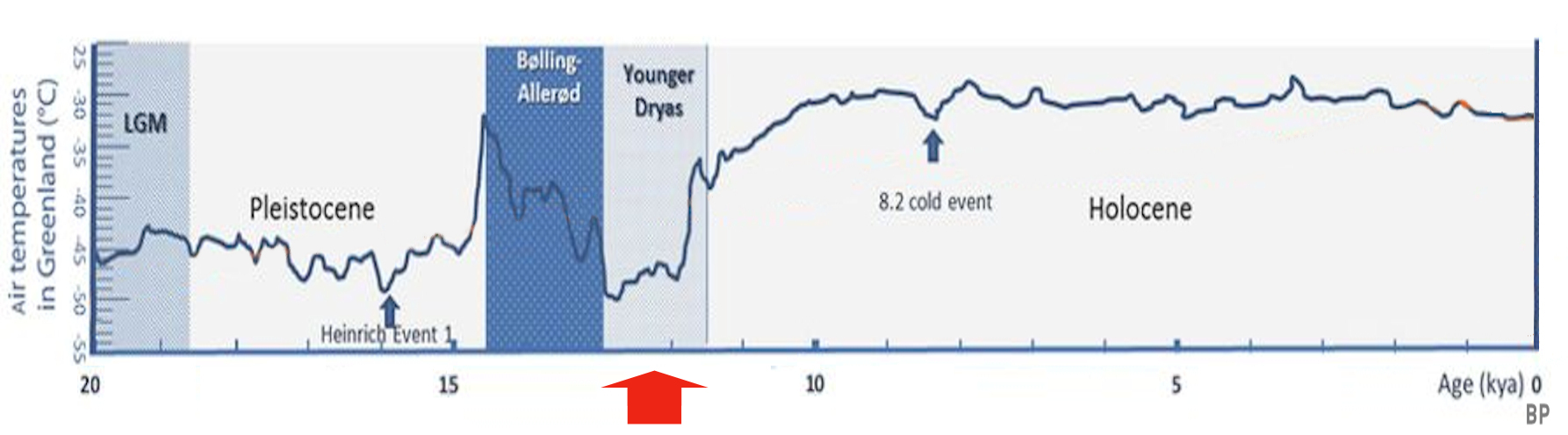
We are currently in the Holocene. Do you know what that means? Have a look at this temperature graph and you might get an inkling of the changing climate:
Realise that this graph only shows the interglacial period (Holocene), not what things looked like during the Pleistocene (the last glacial period) or the Younger Dryas. For a more expansive overview have a look at this graph:
Temperature variations in ancient times are very unreliable, because they can only be inferred indirectly. The big giveaway for anthropogenic climate change is co2 concentration, since we can directly measure its value hundreds of thousands of years in the past thanks to air bubbles enclosed deep in glaciers: https://climate.nasa.gov/climate_resources/24/graphic-the-re...
It clearly shows that the atmosphere never looked anything like this since humans climbed down from trees. Bonus fact: All mass extinctions happened when the co2 levels rose over a certain value (we're already at 419ppm, that 393ppm value in the article is from a few years ago): https://johnenglander.net/co2-levels-and-mass-extinction-eve...
If they rise over 600ppm for example, the oceans will acidify and their ecosystems will collapse. Since most of our oxygen comes from oceanic plankton, we'll literally suffocate when that happens - and at the current trend it could happen before the century is over.
The largest extinction event ever, the Permian-Triassic event (where 80% of marine life and 70% of terrestrial vertebrates died), is currently thought to have been caused by massive emissions of runaway greenhouse gases in the thawing Siberian tundra - similar to what we are seeing right now.
> Temperature variations in ancient times are very unreliable, because they can only be inferred indirectly
> The big giveaway for anthropogenic climate change is co2 concentration, since we can directly measure its value hundreds of thousands of years in the past thanks to air bubbles enclosed deep in glaciers
I can't believe that these two are consecutive sentences. Are you manipulating the meaning of "direct measurement" on purpose?
You can't really get a direct measurement of something from the past without a time machine.
Glaciers are, by definition, an indirect measurement, that relies on a specific model to calculate the measurement value.
There is a lot of criticism of this model from chemists, but since it is no longer a scientific discussion, but a political one, these people typically get repressed.
The key thing to look for is this: The Holocene has been identified with the current warm period, known as MIS 1. It is considered by some to be an interglacial period within the Pleistocene Epoch, called the Flandrian interglacial.
It is not 'the entire period from the last ice-age until present' because we're still in an ice age. The Holocene is the current interglacial period, before it came the Younger Dryas, what comes after it is of course as of yet unknown but given the way previous interglacials came and went it is likely to be followed by a long period of glaciation.
The main takeaway is that the climate has been changing ever since the planet developed and will keep on doing so until there is no more atmosphere, i.e. when the sun blows up to encompass the orbit of Venus and strips the Earth's atmosphere off. That'll take a while so it is not necessary to start planning for this scenario. It was changing when Homo Sapiens developed some 300.000 years ago, it was changing when our species moved out of Africa - who knows, this might even have played a role in that migration. Homo Sapiens was there when a large part of the northern hemisphere was covered in land ice, 'we' were there when that ice retreated. We survived then, we will survive now.
"Climate change" is generally understood as rapid changes, like the ones we are experiencing since 1800s (estimated average delta of at least +1.5C in 250 years). Past "climate change" of +1C in 1000 years is natural.
> Corporations, capitalist production and other institutions (e.g. global militaries) are a core factor in climate change.
And selfish individuals that don't want to pay a carbon tax or have "unsightly" wind turbines. The core problem is selfishness manifest politically, both by corporations and individual voters, who are happy to screw everyone else over if it means their own lives are a little better in the short-term.
> And selfish individuals that don't want to pay a carbon tax
There's research on this that suggests a majority of people want a carbon tax, and the ones that don't have primarily been convinced that it wouldn't work, not that it would cost them more.
And can you guess who has been telling them those lies?
Similarly, democracies are full of people who want to fix the problem, but they've been bombarded with propaganda to confuse matters, but still progress has been made.
I believe the root of the problem lies at the level of the individual. Specifically, the misalignment of incentives between the individual and other people due to tragedy of the commons.
A lot of individuals don't care about climate change only because they happen to live in a cold country, and it won't impact them much. They don't care about people living in hotter countries. I have spoken to such people on HN.
A lot of individuals may say they are happy to pay a carbon tax, but I remember reading some research that when push comes to shove, in practice they don't actually want to pay it, it's only a survey phenomenon. Instead they want other taxpayers to fund the transition, whether it's people on higher incomes or corporate taxes. Again, selfishness. If I am the one causing the problem, I either don't want to solve it, or I want someone else to pay to solve it.
Corporations that pollute want to continue to pollute because they are staffed with such individuals that are responding to those exact same incentives. The corporation is just a collection of selfish individuals with misaligned incentives.
Propaganda and misinformation created by corporations do play a role, but they're not the whole story. The most useful level of analysis (in terms of explaining why we are where we are) is incentives operating on individuals.
> A lot of individuals may say they are happy to pay a carbon tax, but I remember reading some research that when push comes to shove, in practice they don't actually want to pay it, it's only a survey phenomenon.
No, this is yet more corporate propaganda, misinterpreting science as usual.
People support spending their money on climate change, as you increase the amount of money the level of the support goes does down.
This shouldn't be particularly suprising.
But, this only matters if you make the unwarranted assumption that the average person would lose money with a carbon tax, which isn't the case.
So since we already have a majority when it will cost them money, we only get more support if they're getting money back.
Basically everyone has a carbon tax already, even China. They just had to rename it and hide it because 'tax' is too scary a word for people to cope with, particularly Americans.
Fossil fuels have two major unaccounted-for externalized costs: pollution, and the national security risk inherent in importing fossils from unsavory regimes.
Once you account for these, renewables are far cheaper.
All the green movement is really doing is calling for better accounting standards for energy.
The idea was, that gas is certainly much cleaner than oil and coal. And that some gas will be needed in the transition to 100% renewable, gas is ideal for peaker plants. It was of course completely stupid to rely to such a large extend on immported Russian gas, especially since 2014.
It is also a lot to blame the previous government for, who curbed the roll out of renewables, or otherwise germany would be much further ahead with its transition as it is. Nevertheless, producing over 50% of all electricity by renewable sources is an achievement for a large industrial nation.
Just look at France on how cheap and available nuclear energy is for instance.
Germany is paying the price because politicians blocked green energy they effectively hindered the expansion of solar and wind energy.
Take Bavaria as example they don't want wind turbines and prefer nuclear energy but the don't want power lines for wind energy from north Germany or a nuclear repository.
Instead their Minister President suggests fracking, not in Bavaria of course.
Nuclear is the optimal solution only in rather small niches (polar zones with long winters for example). As far as France, the drought has taken several French nuclears offline due to the high cooling water demand for nuclear reactors:
Add in the current European wide-risk of the military destruction of the largest nuclear power plant in Ukraine, and the balance sheet for nuclear relative to solar/wind/storage looks more and more negative.
Oops, that's not right. The cheapest place is Antarctica.
(These assume the cost to install a wind turbine is the same everywhere, which obviously isn't right, but it does give an idea how good the wind resource is in these places.)
The drought doesn't really have to affect nuclear power's output. This is because of environmental regulation that requires that the plant keep a river below a certain temperature. Because apparently warming a river is worse environmental impact than climate change. Furthermore, many nuclear plants are cooled by the ocean or by waste water.
Renewables require immense amounts of storage to even out intermittency. Even just building one hour of storage is 2,500 GWh globally. We'll need around 3 weeks of storage to make a completely renewable grid: https://pv-magazine-usa.com/2018/03/01/12-hours-energy-stora...
We have no feasible way of delivering that much storage. Wind and solar are cheaper to make small reductions in a grid that is mostly fossil fuels. Their intermittency isn't an issue there because it's just opportunistically shutting down the fossil fuel plants when wind and solar are producing. But actually delivering a 0% carbon grid with intermittent sources is not just hard, it's not possible.
You should read more attentively before jumping in on a high horse.
Making statements that imply that the "cost" only boils down to "fuel cost" is essentially lying.
Calculate how much it will cost to power a city 100% with renewables for a week. Oops, you can't, cuz we don't have the technology for uninterrupted power draw from non-nuclear renewables.
> Making statements that imply that the "cost" only boils down to "fuel cost" is essentially lying.
And yet this is exactly how fossil fuel companies and their proponents (even individuals outside the industry, if you can believe it) justify their "lower cost". The true cost of fossil fuels is hidden due to extreme externalities such as their impact on the climate, ecology, and human health.
You realize there's options besides intermittent sources and fossil fuels? Nuclear power has been around for decades. When plants are built in series, it's a lot cheaper than the one-off plants that have been built recently. The plants built in series cost about $1-2 billion per GW.
This doesn't really contradict my point (maybe it's a reply to a different comment). Letting fossil fuel proponents hand-wave or ignore or lie about externalities won't make nuclear power happen any faster.
Pointing out the deficiencies of intermittent sources isn't ignoring the externalities of fossil fuels. Fossil fuels have bad externalities to put it lightly. Intermittent sources require storage which we lack the capacity to build at anywhere near relevant scales. That leaves nuclear as the viable option.
There's also the possibility of using both nuclear and intermittent sources. But between the fact that peak demand happens when intermittent sources are at their lowest production in the evening and the fact that nuclear is just as cheap to run 100% of the time as it is to run at 50% of the time, renewables become redundant. If we're building enough nuclear power to fill in the gaps of intermittent sources' periods of non production then we're building enough nuclear power to fulfill 100% of grid demand anyway. So just skip the intermittent sources.
> Pointing out the deficiencies of intermittent sources isn't ignoring the externalities of fossil fuels.
Oh, but it is. It is such a common trope, always trotted out as a reason to keep using coal or natural gas. Often it is paired with appeals to nuclear power which isn't being built, leaving us with fossil fuel energy while we wait for something to not happen.
> So just skip the intermittent sources.
Let's say we spend $100B on new power generation over the next 10 years: $50B for nuclear and $50B for wind+storage. Which do you think will produce more watt-hours during this 10 year period? Which will reduce dependence on fossil fuels more? We both know the answer to this so consider it rhetorical.
Arguments against renewables are arguments for the status quo, which includes some imagined ideal that won't happen.
$100B on wind and solar with no storage would outperform $50B on wind and $50B on storage. But what happens when we actually try to achieve 0% carbon emissions? Once wind and solar saturate their periods of peak production they become less and less effective because more and more of their energy goes to waste. Worse yet, peak energy demand happens in the evening right after sundown, when intermittent sources are at their lowest period of production. Mitigating fossil fuel use and actually eliminating fossil fuel use are very different goals.
Solar and wind are good for the short-term goal of small fossil fuel reductions. They are not very good at actually providing the bulk of a decarbonized grid. Storage remains a fantasy, so that leaves nuclear and hydroelectricity as the only non-intermittent carbon-free sources of energy. For places with the right geography for dams, great. For everywhere else, nuclear is the only option.
There's a few other sources of energy like geothermal and tidal power, but those are similarly geographically limited.
For quite some time, some pioneers found a use for Renewables and improved efficiency. The ROI was (marginally) viable to them. Over time technology got cheaper/more efficient (gradual improvements to ROI), and slowly more and more people started to adopt renewables, better insulation, heat pumps, etc.
Recently, energy prices in Europe have (roughly) doubled [1].
And suddenly -by comparison- that same ROI starts to look very interesting to a lot more people.
[1] (YMMV, check your local energy spot prices for actual numbers)
Yeah, "green technology" isn't more profitable if corporations don't have to deal with the consequences of non-green energy production. Everyone knows that.
Some people are also interested in not destroying the environment they live in, though. They are interested in acting as a global society to stop destroying the planet.
To that end, they want to pass laws that force corporations to clean up the messes they make and include the cost of that in their energy production. If they had to pay for the mess they make, it might very well make "green" energy more profitable and also help our environment. At the very least, they'd have to stop destroying the environment.
If X inferior to Y but X is supported by politics to a degree that Y is being slowed down and prevented, then Y still needs political support, even if superior in objective terms.


Technology isn't what's stopping us from saving the planet, greedy corporations and corrupt politicians are.