Critic reviews are prescriptive: what they think the masses should watch.
User reviews are retrospective: how much did they actually enjoy watching the movie.
I think there has always been a fundamental disconnect, in that critics think the masses should be watching 'smarter', 'more artistic' or, less flatteringly, more pretentious movies.
The world has become a lot more political over the past couple decades. I wouldn't be surprised if critics are trying to be increasingly prescriptive, using their review to try to change the modern zeitgeist.
I think a very interesting graph would be so see to what extent critics prescriptions are accurately forward-looking to viewer attitudes.
More interesting further research could be:
For movies that came out before 2010 where the user rating diverged from critic rating by more than 10%, are user ratings which were rated after 2015 in the same direction as the critic's divergence? There are certainly movies that I enjoyed as a teenager, but cringe watching today: were critics at the time cringing in the same way, ahead of the masses? Or are critics just in a pretentious bubble that is not predictive of societal evolution?
I disagree that critic reviews are inherently prescriptive. Major blockbusters rely on cliches for the same reason that supermarket chains spend ridiculous amounts of money trying to get every store to look and feel the same: people find familiarity comforting. But to people who watch thousands upon thousands of movies this gets astoundingly boring.
Take any hobby. Literally any one of them. The people who are really into it, whatever you are thinking about, will prefer different stuff from what casual fans like.
Why do people die from erotic self-asphyxiation? Because we have a compulsion to escalate and to push things further. We need novelty. We need new stuff. We go mad if it's just the same thing over and over. At least that's true for most of us. Not everyone takes it all that far, but when you invest a significant amount of time doing one thing in particular, you're always going to want to take it to greater heights.
And that's the thing about critic reviews: they represent movie fans suffering from the cinematic equivalent of erotic self-asphyxiation. Old, tired cliches and predictable plots? No. They want something they haven't seen before. Art movies are incredibly weird, and film critics love them.
Imagine your job is rating beers. And you think pilsners are fine but super boring. But people get incredibly mad at you for dissing their favorite pilsners, and they think you're a pretentious snob for recommending imperial stouts. And they want you to give super-high ratings to ... run of the mill pilsners. That's what I imagine it's like being a film critic.
> But to people who watch thousands upon thousands of movies this gets astoundingly boring.
I would say that there's so many different ways to appreciate films, so many different types of audiences, and such wildly different intentions behind the films and the critics who write about them. It seems reductive and a bit misguided, to me, for someone to write an article about the divergence between metascore and imdb ratings. It's comparing two gigantic blobs of scores and drawing straight lines through them. Does it actually say anything interesting? No in my opinion.
I mean, sure, the films with super-high metacritic scores are worth watching. They're a part of "the canon"-- although for the life of me I could never get through Citizen Kane. But a metacritic score is worth about as much as an imdb score. It's a blunt measurement.
The value of a well written review has little to do with "the score". Many include "a score" because they're forced to, but it's so much better to just pay attention to what the critic is actually saying in the review. It might speak to you if you're in the right headspace, and provide some insight into the film that you hadn't considered. They're typically more valuable to read AFTER you've seen the film. But if you find a writer you grok, you'll get some threads to pull on that will open up all kinds of film experiences you would have never had.
The value of an audience score is garbage, by itself, without any recommendation algorithm to match up your viewing habits and limit the pool of films presented to you. Even then, the high-scores mean almost nothing though the bottom-of-the-barrel low ones usually can be trusted to actually be bad.
But if I want to quickly decide if a movie is worth watching, looking up its IMDB score is a blunt but fairly decent instrument. I'm not going to read reviews of 10 movies, usually.
Personally, I most enjoy watching reviews after I've seen a movie anyway, to get a critic's take on the movie I enjoyed (or didn't).
Before it got killed by Amazon, one of the best things about LoveFilm was that it showed the distribution of user scores for each movie. For many movies the distribution was normal (peak in the middle) and those movies were usually "OK" ... but the interesting ones were the "marmite" movies with lots of 0s and 5s. Both sets would have the same average score, but you could gamble on the marmite ones and maybe get a great movie with a 3 average.
Yeah, it really depends on why you are evaluating these scores.
If it's simply to answer the question, "what will the wife and I watch tonight?" and you're presented with a algorithmically limited set of options based on your viewing habits and your up/down votes, yes, I think scores are a "good enough" blunt instrument.
If you want to explore the work of a particular director, genre, theme, period or actor but don't want to just watch all those films chronologically (or by only viewing "the blockbusters") then reading a bunch of reviews will help A LOT. The scores in that scenario would then merely be trite factoids.
If I am getting your point, you are basically positing that critics are inherently disconnected for different reasons and we should see them as some fringe freaks more than anything ?
PS: to put it out there, there’s people working at beer makers tasting beer samples every single day to check it is exactly the right taste. Ideally every day it has the same taste, if it differs they’ll do what’s needed to bring it back in line. That for decades in some companies. These people exist in spaces.
> If I am getting your point, you are basically positing that critics are inherently disconnected for different reasons and we should see them as some fringe freaks more than anything ?
They are writing for different audiences. That does not make them "freaks".
And their audience is more biased toward a.) those more deeply interested in movies b.) those seeking out of mainstream weirder things. People only casually interested in movies wont regularly read reviews. They read review once in a while if curious, but have no reason to read on regular. And people not seeking can find new movies by looking at local cinema program.
And also, if critics and mass were "connected" in the sense of "producing exact same score and commentary", there would be zero reason to pay critics. You would just go to aggregated mass score for that for free.
I agree with your take on platform where there is near 0 barrier to entry. Netflix for instance, or TV programming. Casual people will be less willing to go through reviews to device on a piece, and they'll also probably have had other customer reviews or view count guide them in their choice.
It is albeit different if to watch the movie you need to carve 3 hours of your time-off, go to a theater and pay 15€. Instead of randomly choosing a movie currently airing in your local theater, you might want to know if it's something you have any interest for (Imagine watching Edge Of Tomorrow thinking it will be some Star Trooper like spectacle). In that setting I think people expect critics adjust their assessment to the target public of the movie and give an accessible review of the piece. Which is super hard, but that's what they are expected to do.
I had both casual and "serious" periods. And in casual period I just check IMDB score, genre and few top mini-reviews there. That is it, I definitely wont read full length article to figure out whether I want to see the movie. Half casual movie watching experience is about social anyway, you go because friends go and selection of movie is less important.
In periods when I am more interested, I don't read what movie critics write to determine whether I will see the next action movie. I read that to learn more about movies, to find movies that are different or because reading it is fun.
My point here is that movie critics nowdays are not all that much serving the function of "make average person know whether they will like the movie". Average person has easier lower effort ways to find that.
Historically, aggregated mass scores weren’t really possible until social media, so one could argue that being a movie critic was something that had a pre-Twitter value that may have since changed.
Box-office receipts kind of correlate with this, but take a while to shake out, and sometimes what does and does not succeed at the box office is a matter of timing and chance.
> Why do people die from erotic self-asphyxiation? Because we have a compulsion to escalate and to push things further. We need novelty. We need new stuff. We go mad if it's just the same thing over and over. At least that's true for most of us. Not everyone takes it all that far, but when you invest a significant amount of time doing one thing in particular, you're always going to want to take it to greater heights.
> And that's the thing about critic reviews: they represent movie fans suffering from the cinematic equivalent of erotic self-asphyxiation. Old, tired cliches and predictable plots? No. They want something they haven't seen before. Art movies are incredibly weird, and film critics love them.
I think thismisunderstands art movies, film critics, and art in general (though there are exceptions). As someone who has learned to understand arts on very roughly that level, including film (an 'admission' that always gets a negative reaction!) it's not that you want more and different, like a hit of heroin, it's that your perception changes and you see things that you didn't see before. I first saw Richard III when I was in high school and let's say I didn't love it! I saw it more recently and it was mind-blowing; it soared to heights I didn't imagine, one after the other (though not a happy story way!). It was the same play - I wasn't getting something more or new - I just perceived so much more, from the language to the characters to the insights to the virtuoso writing. That change in perception is fundamental human perception and applies to anything in which we gain experience and expertise.
When you first drink wine, you cannot distinguish much between different bottles. You literally cannot taste all the flavors, see the colors, and perceive the other sensations that someone with more experience and expertise can. I'm sure you experience it with your profession or hobbies. If you sail boats, you perceive things that beginning sailors do not - and not meaningless things, but things that have a real impact. The same with reviewing code, UX, automobile engines, audio speaker sound, athletic performance, etc. etc. - whatever you have a developed perception of.
Human perception is far more than sensory input; what you 'see' is processed through your brain, including neurons that change based on usage and training, and also through your experience - you recognize your family on a perceptual level, for example (afaik).
The generic, quality critic sees things that you and I don't. I try to learn to see those things too, because when I do, they can be wonders. Just like wine tastes even better, car engines are far more moving, etc. when you develop that perception, so do the experiences of films, paintings, theater - I see colors (metaphorically, but literally sometimes) that I didn't earlier in life, so beautiful I didn't imagine they existed.
'Art films' sometimes cater to more developed perceptions and ignore others, which can make them seem wierd - there is (usually) something there to see, I promise (there are superficial genre art films, as with everything else). It's also true that you appreciate different innovations, such as a film that uses an old technique in an ingenius and powerful way, which you wouldn't notice if you didn't know about the technique, which is somewhat about finding something new, as you say.
The brain is a data compression engine and it's designed to ignore/"not enjoy" anything too repetitive and predictable.
You can get novelty from more extreme experiences and from complex experiences.
Franchise movies tend to go for more extremes (more characters, more CGI, more superficial complexity over an unchanging core), while art movies aim for complexity, implication, depth, and weirdness/unfamiliarity - to generate appealing unfamiliar cognitive load.
Critics are usually looking for the latter while typical franchise audiences (teens/twenties) are looking for the former.
So yes - there's going to be a disconnect. It's very hard to see a franchise movie through the eyes of a 15 year old when you're 60.
> The brain is a data compression engine and it's designed to ignore/"not enjoy" anything too repetitive and predictable.
I generally agree, but that is not at all the only way our brains enjoy or experience things. To imply otherwise is a vast oversimplification. Again, see my example above of seeing the same play - same thing, different experience.
I don't want a critic to tell me what I SHOULD be watching. I rely on them to tell me what I will like. I can't watch every movie, the movie critic is meant to be a filter.
Historically movie critics judged a film based on its relative value. That's why you see a positive review on a cheesy rom-com and a negative review on a more ambitious flawed work of art. The rom-com review is viewed in the context of other rom-coms. For a positive review, it's saying "if you like rom-coms and their premise, this rom-com is good". I want it to be more prescriptive to what I will actually think when I watch the movie.
Most people use movie reviews to tell them whether they'll like a movie given its genre. That's why people say "I trust this person's reviews". They mean if the critic says the movie is worth watching and I decide to watch it, I will not be disappointed
But telling a person what they will like is a much more personalized endeavor suited for automated recommendation systems.
Any random person could like objectively bad movies.
But a critic can only recommend things objectively good. That means they can only try to filter out good movies, which are movies you should watch but may not like because your tastes are not objectively universal.
Critics are not qualified to tell me what I should watch towards developing my own character. The disconnect between what they push as best and what audiences like as good, illustrates the postmodern critic's lack of relevance. Critics are pushers of entitled cynicism and ideology, not meaningful content.
But critics should be experts in the field (of movies), and at the very least have seen it all. Therefore they can commentate on what's been done before and what is actually new.
> Critics are not qualified to tell me what I should watch towards developing my own character.
Well yes since everyone is different critics can never satisfy that for everyone.
Requiring to have seen it all is a big problem if you identify as a critic, in all senses of the words. It's easy to be pulled in by irrelevant novelty that is not meaningful to viewers, or become disenchanted and find your critical sensibilities turn against what viewers find meaningful. There's an ideological and philosophical component here that is at the rift between critics and viewers.
I'm a film major. I wrote about film on print for quite a while. This was not in the US. I did want to prescribe, but not to the masses. To other crítics, to the pedantic purists that thought Bruce Lee was unimportant and Spielberg formulaic and uninspired, and that unless your name is David Lynch anything American is worse by default. People who thought anything with emotion was trash for the masses. And I was there, at the newspaper, saying *no*, romcoms can be of value, there's an artform to the action movie, the screwball comedy, and every genre film. I'm really proud of my time as a critic.
Nowadays I see everyone shitting on super heroes and remakes, they're easy targets to make people think that you're distinguished. Complain about sequels and reboots, and I say "Shakespeare is remade 100 times a year, a remake, reboot or whatever is always an artistic reconstruction that says a lot about its time, it's history, it's socioeconomic context. By studying the multiple versions of a story, we understand ourselves".
Many critics are just sad elitists because now they must share the cultural zeitgeist with everyone else, when even Roger Ebert, when you read his reviews, was historically a lot more open and fair than many of his admirers today.
That’s an interesting take on the remake I hadn’t considered before. But as someone without an artsy bone in my body, I wish something other than superhero movies could be made
Americans today are so sharply divided in what they consider to be acceptable beliefs and values that to create films with broad appeal, most filmmakers (and those who pay them) either (a) go out on a limb to promote their own values, or (b) resort to known-good tropes and remakes.
Perhaps no one wants to write a beautiful, thoughtful, non-politically charged screenplay anymore. Or maybe doing so would itself be seen as a political statement?
> I wish something other than superhero movies could be made
You can literally watch movies all day every day and never watch a super-hero. It was never so easy to watch exactly what you want, when you want, spending so little. I don't get this kind of insatisfaction nowadays. Maybe the hidden premise is that what bothers you is not a lack of content you enjoy, but the fact that so many people love so much a thing that you consider inferior and a abject. To put it bluntly: that's cultural elitism.
You're right but it doesn't really feel that way (and I would think that as a percentage of spending, surely the superhero franchises have a fair fraction?)
It would be nice to see more new, original sci-fi and action. (but perhaps the other poster is on the money, and I am sure from a studio perspective it's easier to go with the tried and tested rather than out on a limb)
God I miss Ebert. It's not that I agreed with him always. It's that I knew where he stood, and I found his writing entertaining. As my familiarity of him grew over the years (decades!), I could accurately guess whether or not I would like a movie based on his review, whether he liked it or not. He's been hard to replace for me.
I saw "Enter the Dragon" as a teen and liked it a lot. I rewatched it recently and had a hard time thinking of anything good about it :-/
I've turned into my dad. As a teen, I begged him to see a movie I thought was great. We went to see it, and on the way out I was like "well? what do you think?" He thought for a while, and came up with a rather lame compliment he'd obviously struggled to come up with.
I had the reverse experience, in a way: As a teen I though it was just fair. I thought the fight scenes - the reason we saw the film, of course - were gimmicky, repetitive, and unconvincing, and thought the same of other kung fu films. The rest of the movie was odd and boring. It was heretical and I kept that opinion to myself.
I saw it again in the last few years and while for me the rest of the movie was awful, the fight scenes were mesmerizing. Bruce Lee's physicality, the physical acting, is on a different planet than anything I've seen. Lee could have been a dancer or the original Andy Serkis - not that kung fu actor was a bad career move either.
Lee trained as a competitive ballroom dancer before he pivoted to martial arts. The two actually have a lot in common, though the purposes are quite different!
I agree that Lee's grace and style are fun to watch. It's also painfully obvious that he way outclassed his opponents in the movie, sort of like Fred Astaire dancing with a football player. I suspect that his ballroom training was the secret sauce that put his martial arts at an elegant level that the other martial arts practitioners couldn't match.
> It's also painfully obvious that he way outclassed his opponents in the movie, sort of like Fred Astaire dancing with a football player
Yes; the others occupied far too much of the screen time, which was very frustrating! It was like going to see Jimi Hendrix and hearing mostly bass and drum breaks. It's a vehicle for Lee; almost everything else in the movie sucks anyway; just find excuses to put Lee on the screen doing something!
But for me, I'd add to grace and style: The power of the emotion he could convey just through his body was incredible. I don't have a great appreciation for dance, but I've seen a couple best-in-the-world level dancers do something similar.
I'm not always willing to dox myself, but I can say it was a big newspaper in South America.
I also made a comment, not an article or a study. I don't have any ready sources to present you, I merely expressed my opinion and you're free to take it as such.
That doesn't make a lot of a difference, there will always be enough differences between two versions to make the effort worthwhile. 1916s Romeo and Juliet quite different from 1996's Baz Lhurman Romeo+Juliet.
In my experience yes, critics were cringing over the "bad" movies you liked as a child. I don't think anything has changed, or that there is anything wrong with that.
Critics are paid to watch as many movies a possible, even ones they think they will hate (but obviously should keep an open mind). An average movie goer doesn't deliberately watch a movie they won't like, so there is already a disconnect.
With the internet amplifying fan culture critics are more likely to be seen as "wrong".
Part of a critic's job is to educate people. A good critic can explain why a certain film is groundbreaking and why another film is recycling ideas that have been done thousands of times. The critic's end-goal is to push the industry to make better films not because of critics, but because the public demands it.
This doesn't seem right at all, a critic's job is to drive page views and nothing more. What you are describing is how critic's like to perceive themselves.
That’s hardly the only model. If you find a critic that has similar tastes as you then you can just follow their recommendations. That’s a relatively new thing as newspaper reviews where focused on a much wider audience, but with the internet you have a lot more choices for reviewers.
Good critics aren't 'prescriptive'. They are scholars of various media who elucidate where a new piece of work sits with in an artist's oeuvre, or the larger canon that the work is contributing to.
While some self-anointed blogger critics might have certain ideas about what they wish an audience would watch, an actual critic's (broadsheet paper, industry trade) only job is to contextualise a work in the larger bodies of genre, medium, and culture.
> User reviews are retrospective: how much did they actually enjoy watching the movie.
How can ANY review not be 'retrospective'? In fact, probably the majority of film criticism speaks to how much or little the critic enjoyed a film. Pauline Kael (probably the most incisive and celebrated American critic in film history) built a legacy based pretty much on how much she much she enjoyed the film.
> I think a very interesting graph would be so see to what extent critics prescriptions are accurately forward-looking to viewer attitudes.
Why do critics and audiences have to have the same opinions? I this is the fundamental misunderstanding and wonky premise of the article.
> Critic reviews are prescriptive: what they think the masses should watch.
Who writes like that? Could you provide an example? I haven't seen it, having read many, many critics, including in sophisticated reviews like the New Yorker, Film Comment, and the NY Times.
> Critic reviews are prescriptive: what they think the masses should watch.
I think this really depends on the critics. Lots of critics never explicitly articulate a philosophy—or, if they do, I don't bother to seek it out—but, for one notable example, Roger Ebert explicitly subscribed to the philosophy that you should review a movie based on whether it achieves its goals, not on whether its goals are the same as your goals.
Film critic reviews are the Hacker News of the film world: nerds nerding out.
I once went out with a woman who was highly steeped in film criticism and such. I think she volunteered as dramaturg at a theater company or something like that. We watched "I'm Thinking of Ending Things" together, and I thought it was the most dismal, dispiriting, horrible movie I'd ever seen. Afterward she opened my eyes to how a critic would interpret it, the symbolism, the cultural currents, etc. I hadn't picked up on any of that. I still hate that movie. But I guess I can see a bit better how, if you're in on it, it can be fun to pick things apart in that certain way. It's like a secret language that only you and a few others speak. There's nothing quite like speaking your native tongue when living in a foreign land.
I think a lot of the professional critics are like that. We don't speak their secret language. We commoners are the foreign land they must survive in. They're having a conversation among themselves. It's not for us.
This is giving me some flashbacks to starting a course at college on Film Studies. I left after a few weeks, the constant over analysis was too much. Let me enjoy (or hate) the movie is please. It does seem weird to me that the creatives involved would put so much effort into things that the bulk of the population won't interpret.
The people rating movies on IMDB are not average audience members though. They are movie geeks and enthusiasts. But compared to professional critics, there is a significant difference because they still pre-select moves to watch based what they think they will enjoy. A movie enthusiast might have seen all science-fiction movies in existence but never a french new-wave movie. The professional critic on the other hand will watch a broader range of different movies, and probably a lot more older movies.
Younger people goes a lot more to the movies, so the average critic will probably be notably older than then average movie audience member.
Critics tend to be negative towards remakes because "this is unnecessary, the original was better". But most in the audience haven't seen the original so it doesn't matter to them.
Critics tend to hate formulaic and derivative movies, but for the audience it is not that bad, they haven't seen the formula enough time to get bored by it. Fans loved The Force Awakens because it was exactly the same formula as the original Star Wars. Critics were less enthusiastic.
Critics tend to value originality more than the average audience. Hollywood have always been formulaic and rehashed old ideas, but they have still been able to make great movies. But the current movies relies on franchises to a larger extent, and the franchises put hard constraints on the amount of originality and character development which can be allowed.
IMDB and RT scores cannot really be compared since they're measuring two fundamentally different things. Movie that everybody gave a 7/10 would have an RT score of 100% and an IMDB score of 7.0. Also RT scores are mostly based on reviews written shortly after the release of a movie, while IMDB scores keeps getting updated over time. For movies that come out with a burst of enthusiasm and then lose their luster on repeat viewings and closer analysis, IMDB score tend to drift downwards with time.
On RT the audience score is also lower than the critic score. My point is simply that GP’s statement about fans preferring the film doesn’t match the numbers.
But even those numbers cannot be compared since RT audience score and critic scores are calculated completely differently. Also if you read some of the negative audience reviews many of them are clearly written after the final movie of the trilogy has been released and are judging this movie in the negative light of that whole experience.
Now it may very well be that GP's statement is wrong, but the numbers you are quoting can't really be used as evidence either way.
If these numbers are as problematic as you claim, it wouldn't explain why they don't hold true for Rise of Skywalker which fans overwhelmingly preferred to critics.
Now that I think about it: it's likely that's the film that GP had in mind.
There's an interesting concept with user reviews, in that they're inherently OF the people, whereas critical reviews are FOR the people.
In a way, critical reviews are like celebrity chef cookbooks in that they should be considered aspirational. What we HOPE to be watching to please our senses of austerity, versus the pulp trash we might actually prefer to be watching.
Similarly, sure, we might WISH we were making / eating boeuf en croute regularly, but if you go to a recipe site, the highest rated reviews is more likely to be chicken soup, or something more accessible / makeable on a weeknight.
It's always fun to review Plex and routinely see <95% critic ratings, 25% user ratings> or vice versa, but the deltas are more often closer than not.
I don't know if I have a point to make here other than to point out that there's utility in noting the distinctions between aspirational and practical, and that serious critics have always given off a vibe of divorcing themselves from the practical, preferring arthouse to action, and in both arenas, Julia Childs-esque figures that can bridge the gap between the aspirational and the practical are extremely rare.
Essentially that what we talk about liking and what the general population actually like are very different.
They interviewed this woman, who as an art student learned all about 'high art' and 'low art' and in a moment of loss of inspiration went back to using some low art she appreciated as inspirationn:
I've done this analysis for games. My theory was that the correlation was falling because the ratings of old games were dominated by players playing old games now and then rating them, and they were more likely to play games for which there is already a consensus that they are good (old bad games are mostly just forgotten). Whereas for current games the games being played are more random.
also consider the fact that you might have a 40 year old reviewing videogames when the target audience is like 4 years old. my kid and the typical video game reviewer probably have different opinions about the latest paw patrol game.
If you're 40 years old, you need to be able to consume any kind of media and then place yourself into the mindset of a younger person and judge it from that mindset - because you used to be that younger person.
Truly exceptional media is good enough to transcend the age barrier and is enjoyable for everyone, e.g., The Incredibles is enjoyable for young kids because it's a cartoon and it's flashy and exciting, it's enjoyable for young boys who want to be the "best" at a sport, it's enjoyable for girls transitioning to puberty because of Violet's storyline, it's enjoyable for men who have lost some of their steam and can relate to Mr. Incredible, and it's enjoyable for women because of the struggles Elastigirl has as a mother and a homemaker. Even Syndrome is shown as a sympathetic villain who is evil not because he is a bad person, but because he was dismissed and ignored by his idol. There are plenty of people who can relate to that.
Ghostbusters (1984) is another expertly crafted movie that is fun for kids, but well-written enough to be incredibly enjoyable for adults.
When my young cousins or my nephew corral me into playing a game with them, I'm not playing it from my 41-year old perspective, I'm playing it through their eyes.
If you can't do that, then don't review content. Content always has a specific audience. Really great content can weave together enough bits to at least satisfy every audience. Exceptional content manages to speak deeply to every audience. I still feel that's why The Incredibles is one of the best movies ever made. The struggles shown in that movie are relatable for every single person on the planet.
The funny thing is that games used to be FAR more punishing than they are today. Give an 8 year old (or hell, a 16 year old for that matter) Super Mario Bros. Watch their reaction when they get to World 1-3 or something and then lose all of their lives and realize that the game doesn't care, they have to start ALL the way from the beginning. Compare that to Elden Ring, which has difficult boss fights but otherwise isn't any harder than any level of one of those old games.
I recall as a small child ordering Castlevania from the Sears catalog and having to wait many weeks for it to arrive.
It would certainly be many more weeks before I would get any other game to play and there were a few other distractions.
>Compare that to Elden Ring, which has difficult boss fights but otherwise isn't any harder than any level of one of those old games.
I haven't played Elden, but for comparison's sake, I haven't had any trouble picking up SMB3 blind nor did I find any of the levels individually more difficult than most high rank monsters in Monster Hunter Rise. SMB1 definitely isn't a difficult game either bar a few specific levels, 8-3 being the most notorious.
The biggest thing I see people struggle with is patient, reactive and/or predictive gameplay. Any game with counter mechanics relying on tight windows showcases this: most people either fail to utilize them or simply don't bother. Let alone emergent counterplay. The other part, you can't just statstick your game through most older non-RPGs, where newer games provide you with many more methods to allow more failure.
Most early console games had a heritage from arcades, which made more money if it was difficult but teased the chance of progress. So higher difficulty was more profitable, then when ported to console or when the same game designer designed for console it inhereted some of that. It was also more niche to be a gamer then, and those who did leaned more hardcore.
I don't think Super Mario Bros was ever considered particularly difficult or punishing at the time. It was just designed for an audience that had less access to videogames. They'd rather repeat the same levels with the prospect of seeing a new one than breeze through the game they paid $25 for ($60 in today's money) in 2 hours.
It wasn't punishing for the time. That's not my point. My point is that being able to save games so that you don't have to replay hard content when you fail has made it so easy for the current generation of gamers that there are a lot who bemoan games that really aren't that hard comparatively. In Elden Ring, you only have to beat each boss once, and you have a save point right nearby to fight the boss without fighting almost anything else beforehand, so if you die, you're right back into it. In SMB, If you struggle on level 7-3 and then die on level 8-3, you start back at 1-1 and have to master them both again (provided you don't warp).
Plus, considerations for things like, can my 4-year-old decipher the controls to achieve what is achievable in the game without excessive frustration? Is the story entertaining enough to keep a kid engaged commensurate with it's cost? Is the game age appropriate? Does the kid talk about the game after having played it? Does it provide food for thought or conversation at all? What are the chances my child will remember this game fondly as they grow?
All of these things and more are the kinds of things that a 40 year old should consider in their review of a game, especially considering that a 16-25 year old game reviewer might miss on them in favor of other aesthetics.
Another part of that is that it seems like critics play a lot more games than the average consumer (or, at least, me) does and may get burnt out easier.
Most reviewers I watched heading into Horizon: Forbidden West said that it was just "more of the same". But I didn't play the most recent Far Cry or Assassin's Creed or whatever else they were comparing to. It was fresher for me playing though it than it was for them, constantly comparing.
I had a run of games a while back that were next to unplayable for the first 6 months while the bugs got ironed out and the patches got patched. Now I just wait 6 months or so (bonus - they're generally heavily discounted by then, haha) - if games critics are reviewing new releases but gamers reviews come in over the lifetime of the game, they're kind of reviewing two different products and it would make sense if critics' reviews were harsher.
Huh, have critics ever been in sync with audiences?
For my whole life, I've learned and then observed that critics evaluate primarily the cinematic quality of a film, i.e. does the film as a piece of art work as a whole when considering acting, directing, screenwriting... This is generally a different axis from entertainment which is what people often care about when looking for something to see.
If a critic likes a film it's because it is good cinema. If you're in the film-watching mood you would likely appreciate that film if it has high critical scores. But if you want something easy or you want to see a guaranteed uplifting film with your friends before going out to a pub round, you want entertainment and then you don't want to look at the critics scores.
You might want to infer something from the review text because often critics do tell you if the film is entertaining and a good watch. The film still got 1 star out of 5 because it was not good cinema.
> I've learned and then observed that critics evaluate primarily the cinematic quality of a film, i.e. does the film as a piece of art work as a whole when considering acting, directing, screenwriting... This is generally a different axis from entertainment which is what people often care about when looking for something to see.
IME and IMHO, the former has a great effect on the latter; that's why people, including critics, care about it. The qualities are what make the movie engaging, moving, exciting, etc. In UX, users may not understand how it is done but the UX design still impacts them significantly; UX designers can tell you what is making that impact and how.
I think there was a smaller gap in a few respects.
Firstly I think the film industry as a whole has polarized into "art" and "entertainment" films with too little crossover. Films can and should be artful and entertaining.
Secondly I think critics have become too polarized to criticize films as being "low-effort" or "low-value" entertainment films. There's a reason why people go see blockbusters, they enjoy them!
Finally, I think unfortunately some audiences too quickly dismiss some films as "too artsy" or "too intelligent" or "not wanting to think." There's a lot of fun movies out there which don't fit into normal boxes!
Sadly I don't really see that gap closing. I agree with someone in another thread which said that there's much better and more varied content on "TV" (streaming/etc) in medium-form series. Give me a great limited-run series like the queen's gambit any day! it's the perfect intersection of artsy and fun and high brow and low brow!
It's clear that audiences - and you can read this as "people who like movies and are willing to leave a review" - and critics are miles apart. This prompts the common retort: "so what?" I continue to argue that the purpose of movie critics, for many decades, has been to tell the broad audience if they will like the movie. That's it. It has not been to, for example, critically deconstruct the abstract themes of power dynamics in inequitable social system. This kind of analysis appeals to a small minority of viewers. It has its place, but it should not be the majority of critics using this kind of lens, which it is.
This leads us to today, where critic reviews are functionally useless for the broad audience. Said movie minority are of course very happy with the entire critic industry catering to their needs, and they argue vociferously to keep it this way, using all kinds of condescending arguments about our lack of culture and refinement. Sometimes I just want to see cool explosions and fight scenes, and there's nothing wrong with that.
The movies you listed fail in a different way. There are plenty of explosions and fight scenes in The Last Jedi and Captain Marvel. What they do share is that the main character is an underdeveloped Mary Sue, without character flaws, without weaknesses they must overcome. They're just made awesome from the start. It probably stems from the inability of current Hollywood to portray female characters as having any weaknesses at all, that would be heresy. The result is that it's hard to empathize with and care about the main character. They don't have any dimensionality.
Of the ones you listed I watched The Last Jedi and Captain Marvel. I know what I wrote is also true for Mulan thanks to friends who watched it and the Critical Drinker. He has a couple good films on YouTube actually demonstrating this aspect of modern films:
>What they do share is that the main character is an underdeveloped Mary Sue, without character flaws, without weaknesses they must overcome. They're just made awesome from the start. It probably stems from the inability of current Hollywood to portray female characters as having any weaknesses at all, that would be heresy. The result is that it's hard to empathize with and care about the main character. They don't have any dimensionality.
I agree. This seems obvious. So why can't these sophisticated critics see this and rate the movie accordingly? They're obviously using a completely different set of criteria to rate movies, and entertainment is far down the list.
The Last Jedi and Rise of Skywalker both have the same main character. But the difference critic/audience ratings are stark. Critics rate The Last Jedi significantly higher than the audience average, while they rate Rise of Skywalker significantly lower.
The difference is not in the main character, the difference is in how the movies relate to the established conventions of the franchise.
> What they do share is that the main character is an underdeveloped Mary Sue, without character flaws, without weaknesses they must overcome.
Regarding Rey in context of The Last Jedi, did we watch the same movie? She was basically a mixture of having doubt and uncertainty and being troubled for the large part of the movie. Only in the confrontation with Kylo, we see her inner strength but even that was tempered with her vulnerability - its not like she vanquished Kylo with a smirk.
She never lost a fight. She's never shown to have any moral flaws. Compare that to Anakin who lost plenty of fights (thereby also losing parts of his body) despite being an overpowered character; he was also arrogant and impatient. What moral flaws does Rey have?
Doubting yourself and then winning at everything doesn't make you relatable. It makes you like that colleague from school who was stressed out before every exam, saying for sure they're gone fail, proceeding to have straight A's from every one of them. When you hear them doubt themselves next time, you don't empathise with them, you say "oh shut up".
> This leads us to today, where critic reviews are functionally useless for the broad audience
This is rather over the top, since the article clearly shows reviews and audience ratings does correlate, especially towards the top.
But it is always interesting with movies where the difference of opinion is starkest.
Note that the "audience ratings" does not always correlate with the average audience. Especially with divisive movies like TLJ or the Ghostbusters reboot, disgruntled fans run campaigns to get the score down. TLJ is still one of the highest grossing movies in history, so the audience rating putting it significantly lower than say John Carter or Snakes on a Plane is clearly not representative of the general movie going audience.
They haven’t sufficiently demonstrated correlation for me. I think the last chart demonstrates it’s a lot more complicated. Just one example… How many obscure art films are there with highly-selective audiences which receive perfect critical scores and perfect audience scores that mostly serve to add bias to the correlation? The movies we’re responding to- which could easily be a list of movies many average joes “care about”- shows negative correlation.
Presumably an average Joe watches average movies, i.e. blockbusters which are the movies which attract the largest audience. The articles shows a relatively high correlation compared to the more niche cheaper movies. But yeah, it would be cool to se correlation score for specific genres.
Maybe I didn’t read closely enough but I believe the article only showed correlation for “all” movies and movies with <20 million budget. It doesn’t show blockbusters or anything like that. It’s worth mentioning, too, what is considered “high correlation” should be quite different from the stock market and should be carefully debated. 0 correlation isn’t just 0 correlation; it would imply these people are aliens with different sensory inputs.
Part of the problems critics face is that with the fall of traditional media and the consolidation of movie studios they have essentially become shills. There aren't powerful enough critics to say "This Disney movie is terrible" and stay a critic for much longer.
Yikes. Call me philistine, but seeing that Last Jedi score peels the scab off the idea that there is any intellectual value remaining in their job.
I’m not sure about the critics of yore, but, as all of your scores evince, I am drawing the impression that modern critics either 1. self-select as part of group of certain demographics or 2. deliberately pander to that group of certain demographics “as the wind heads in that direction”. Not really something an intellectually honest individual would find value in, and if they belong to your tribe, you can probably find more well-written diatribes on Twitter.
Maybe you're aware of how Rotten Tomatoes scores work, but in case someone reading this isn't: the score is not some average of individual scores like IMDb uses (I think), but just the _proportion of critic scores that are positive_.
So, if a film has 100x 2.5/4 star ratings from critics and 50 1.5/4 star ratings, it would have a Tomatometer score of 67% (100 positive of 150 ratings).
Others have said they miss Ebert. I'm certainly in that club.
I haven't paid much attention to film reviews since Ebert died. Sure, he gave scores, but they were not the point. I read his reviews because they helped me to explore my own thoughts about the films. It's the same reason I enjoy chatting with friends about films, books, art, etc. Scoring is not the point. Agreement is not the desired outcome.
Oftentimes, after I watch an old film, I'll look up Ebert's review, to see what he thought. Almost always, I'm enriched by doing that.
Ebert wrote beautifully. I was lucky enough to have met him once or twice at book signing events here in Boulder. He was a regular at the Conference on World Affairs dissecting movies one shot at a time. I attended all of his "Cinema Interruptus" for Mulholland Drive, La Dolce Vita, (no small commitment actually) and a few others. On top of it, Ebert was a kind, good human. I also miss Ebert. Check out his "Great Movies" book series if you can.
These days, I find I enjoy Eddie Mueller. Some movie dvds have an alternate soundtrack which is him critiquing the movies. Listening to his prattle is often far better than the movie.
In related news, I recall one movie with a director's commentary track. It was full of each of the actors saying their bit about the movie. Everyone (including the dog) casually concluded with he/she had to sleep with the director to get the part. Another one where the commentary track was better than the flick.
> I recall one movie with a director's commentary track. It was full of each of the actors saying their bit about the movie. Everyone (including the dog) casually concluded with he/she had to sleep with the director to get the part. Another one where the commentary track was better than the flick.
Wait you’re not going to tell us what movies these were? Also I assume in the first example they were kidding? Or the director was dead?
Thanks. In my defense I knew for certain you were kidding about the dogs, but… some weird shit happens in Hollywood that goes undocumented for generations and it’s striking when these things surface publicly.
Interesting that the gap is with lower budget movies. It goes along with my gut feeling that mid budget movies are disappearing (I have no data to back that up), and it's as if the studios have optimized movie making into two types:
#1 The big budget crowd pleasing blockbusters. A few flop, but generally audiences like them and they don't do anything critics can complain about too much.
#2 Highly targeted low budget movies. There are small but consistent audiences with endless appetites for horror, action/thriller, etc films even at lower budgets. This seems to be where the biggest disconnect is, the genre fans highly rate their genre films even if it's direct to streaming fluff, while the critics see them as flawed, and broader audiences just don't watch them.
What killed the mid-budget movie was the rise of "peak TV" -- the B-list actors that defined mid-budget movies can land a meaty TV role that pays them well on a consistent basis. We're also seeing more and more A-list talent move to anthology or event series, where you can make a deep dive over 8/10/13 episodes instead of a 120-minute film.
Sometimes, I'd prefer some sort of limited series more than a movie. 'Maniac' was enjoyable for me because it had time to let things go slowly, despite taking course over what was probably 1 week in-universe.
I may also be different from the usual audience, in that I try to avoid binging anything. Hour-long episodes are great for my WFH lunch break, and to pad some time in the evenings if I so desire, but I prefer to commit to watching a movie if I know I have the time.
Molly's Game was a nice and long movie, but at over 2 hours long, I feel like it could have had potential at being a miniseries. But also, maybe not? Who knows how much meaningful material was left on the chopping block.
> Sometimes, I'd prefer some sort of limited series more than a movie. 'Maniac' was enjoyable for me because it had time to let things go slowly, despite taking course over what was probably 1 week in-universe.
Maniac is an excellent example. If it were a film, much of it would be cut down, and the movie likely would have had a singular focus on Jonah Hill's Owen character. The show, in having more time to breathe, realized relatively early on (by episode 3 or 4) that Emma Stone's Annie character had a far more compelling story to tell, and shifted its focus accordingly.
Matt Damon talks and laments about this. What killed the mid-budget movie was the collapse of DVD sales. Without DVD sales, there is no extended "second bite" that allows word of mouth to build up. So, instead, your marketing is $30-$50 million and you need to make that back.
Getting a second bite is also responsible for the recycled pablum with China pandering--if you say something that the Chinese government deems unacceptable you lose your shot at that market.
As for "episodic", I suspect that's less a "deep dive" and more ADHD background watching on a phone. "Encanto" was an absolute poster child for this--"HEY! LOOK UP NOW! HEEEEEEEEY!" "Okay, volume back down. You can go back to your text messaging for a while." "HEY! LOOK UP AGAIN! TIME TO PAY ATTENTION! HEEEEEEY!" ad nauseam.
So the main takeaway here for me is that more low budget (“indie” or “film festival”, my terms) movies are getting to theaters and being loved by critics, but people hate them.
My wife and I have a rule in our household. Anything that was awarded at a film festival (Sundance in particular) I will not watch with her. This analysis backs up the feelings I’ve had that lead to that agreement…
Any movie that does well with critics or at a film festival has “a strong message” or “teaches us something”. That’s all well and good, but I don’t need these expensive (€20/ticket) modern fables. I’m paying to be entertained, not to be lectured to.
>Any movie that does well with critics or at a film festival has “a strong message” or “teaches us something”.
If you find that every time you watch a film festival movie you are being lectured too, I think it has more to do with your wife's film choices, not the indie circuit. Nicolas Cage's Pig was a very well received movie at plenty of film festivals last year, and it's just about a chef searching for a pig.
It's not here and there. Almost no art film lectures or has a strong message. It wouldn't be an art film if it did, in most cases, and art films are known for subtlety and conveying sophisticated emotion.
>> Any movie that does well with critics or at a film festival has “a strong message” or “teaches us something”.
Seems arbitrarily limiting. I'd say you're missing out on some pretty cool and entertaining movies. If you don't like arthouse movies, that's obviously your choice... just seems a bit silly to not watch a movie because someone else liked it.
> Any movie that does well with critics or at a film festival has “a strong message” or “teaches us something”. That’s all well and good, but I don’t need these expensive (€20/ticket) modern fables. I’m paying to be entertained, not to be lectured to.
FWIW, they are not lecturing; there is no strong message. I suspect you are finding what you look for, but it's hardly ever there. I've seen many, many art films, and I can hardly remember much of that.
In fact, the usual criticism AFIAK is that the art world lacks morality and embraces relativism.
i don't know if you've noticed, but people who do things that i understand are totally normal, and people who are different from me have dumb ideas. it's annoying when they talk.
Most entertainment-oriented films. There's a big difference between "has a message" (which those usually do include) and "lecture" aka "beat you over the head with".
I think most blockbuster "entertainment" movies are MORE heavy handed in their preaching. The big differentiator for me is that they preach what is already assumed. It's not that they don't lecture you, it's that they lecture you in what you already agree with. In that sense entertainment-movies are more like sermons from your pastor. It's a reframing of a story you've already been told a million times, so your brain can just switch off and absorb the message uncritically.
Yes. The typical modern blockbuster constantly hits you over the head with its messages of "family" or "finding yourself" or "overcoming obstacles" of whatever like you're still in grade school. Compare that to something like No Country for Old Men - a movie with a much more nuanced set of ideas. Or even to older blockbusters like Die Hard which are more consistently focused on the action and keep the moralizing to a minimum.
Almost every sort of film, IME. I can hardly recall a film that 'lectured', if we mean the same thing, and it would be panned if it did.
For one thing, if the filmmaker can't convey things without lecturing, they are in completely the wrong job. Does a painter have to add call-out boxes with labels? Second, they almost never have a specific message, but depict the world - art holds a mirror to the world (very generally speaking).
Generally, popular films outside of documentaries don't lecture. It may be that you feel insecure and talked down to? Do you feel that way in normal human conversation?
To cover the comments, particularly the guy whose comment is dead, yes, raunchy comedies. Also 90% of the Blockbuster movies.
Perhaps I’d have done better if I said I don’t like being preached at.
For an example, Juno: Yes, I get it, unwed mothers are bad. Should I watch a Lifetime special about it just so I can cry about how horrible things are?
> For an example, Juno: Yes, I get it, unwed mothers are bad.
What you perceive is your experience, but I think there might be other things there for you to percieve. My experience is 180 degrees different and I've never heard anyone say that about Juno. I thought it was very sympathetic, a movie about compassion, innocence and love overriding hardship.
One possibly overlooked factor is the death of Roger Ebert, who managed to be both a man of the people and respected among critics (possibly because he was also an excellent writer).
I suspect film might just be dead as an artistic medium that can be enjoyed by lots of people. I maybe go to a movie theatre once every couple of years these days, the rest of the time I watch things at home. It’s a hard ask to set aside two contiguous hours (or more!) to watch a film when there are so many good series or video games that demand less contiguous attention. People will rant about attention spans I guess but it’s really a matter of what quality of entertainment you can fit in with the rest of your life. If I watch a film in the evening that is pretty much the only thing I do with that evening; not so with other entertainment formats. The two hour film is also like the equivalent of a short story: there’s the mental barrier to entry of loading new characters and settings and world rules into your head, and so I find it more difficult to read anthologies of short stories than a novel of the same length.
Almost all my friends echo your sentiment that film is much harder to commit to than a TV show; and I can't disagree more. Watching a TV series means I'm committing to 8+ hours per season, across many days of my life. A film, even a 2 hour one, I watch in an evening and can enjoy taking it in in full, with all questions that it wants to answer itself being answered. A TV show will end with cliffhangers each episode just to make sure it demands your attention again tomorrow night.
That's not to say TV=bad, movies=good; just that IME respect your time way more and are easier to commit to most nights.
Both of you should give this lecture to people in the third world.
The act of sitting on a couch, watching something entertaining that thousands of people put work in to produce, is a "commitment". And in fact, the commitment is too much. Because for this same commitment, one could replace it with several smaller ones that entail the exact same thing, but with even less thinking.
If only there were a device that would just directly inject the memory of a movie into our brains, saves us from all this "effort".
No, I don't think so. I think they get it largely right.
How many reviews of movies have you seen from a senior, experienced reviewer got a film really totally wrong?
I don't mean "hated a movie that genre fans will like", or "dunked on a trashy movie", because in almost all cases those reviews acknowledge their biases and even the people who like that sort of thing will get the picture.
I mean: really wrong.
In recent years I can think of only one major movie that was seriously misunderstood by a major critic: Cloud Atlas was totally misperceived by Mark Kermode. And even he changed his opinion on a second viewing.
In general I wish other things were reviewed as fairly as films are; too many reviews of things/services are poisoned by motivated reasoning.
Movie critics tend to give mediocre movies a bump when they like the message or think it otherwise is politically desirable.
Similarly, critics tend to downplay movies that have a more... blue collar?... appeal, no matter the artistry or purpose of the film. For instance, Taken gets 59% with critics on Rotten Tomatoes. It was a hugely important and impactful film. It basically spawned/revived a whole subgenre of action film.
> For instance, Taken gets 59% with critics on Rotten Tomatoes. It was a hugely important and impactful film. It basically spawned/revived a whole subgenre of action film.
A fair number of critics looked down on that film because it is casually chauvinistic, nasty and bigoted. (I absolutely loathe it. Want to see how that film could have been? Watch Man On Fire.)
I don't know whether you can support your "politically desirable" assertion with meaningful data -- not to say that you might not be right, but more to say that I don't know what shape that data would have.
But I'd be interested to hear a couple of examples anyway.
> For instance, Taken gets 59% with critics on Rotten Tomatoes. It was a hugely important and impactful film. It basically spawned/revived a whole subgenre of action film.
I wouldn't be surprised if 41% of the general population didn't much like Taken either. I've never had a desire to watch it a second time, for instance, which places it pretty far down my personal list of movies I've seen.
So you can think it's "too blue collar" or whatever, or you can think "it's a subgenre, so broad appeal isn't expected" and you could then argue about how movies without universal appeal should be reviewed, but jumping straight to "they don't like it cause damn blue state liberals" or somesuch seems like a stretch.
> I've never had a desire to watch it a second time
Is that a good criteria for whether a film is good or not. There are plenty of films I never want to watch again but I thought they were good. Conversely, there's are arguably stupid but fun films I watch over and over even though they are full of flaws, bad acting, bad writing, etc...
> Is that a good criteria for whether a film is good or not.
I don't rewatch films as a rule but I do sometimes rewatch films with people who have not seen that film.
There are films like Dancer In The Dark, Grave Of The Fireflies, or Dogville that I simply cannot watch a second time because of the precise, agonising emotional turmoil they create. I will recommend this experience to everyone, and they too will watch it only once and recommend it to others.
Then there are films like Taken that I would never watch because they are dreadful, hateful trash.
I would consider the former list to be beautiful, painful exceptions to the idea that a film that can be watched endlessly is a great work. And even then I might be persuaded to watch them with someone I really loved. Perhaps. Though I'd have to love someone a lot to willingly watch through the end of Dancer again.
I would not be so enthusiastic about spending time with anyone who joyfully rewatches Taken.
>How many reviews of movies have you seen from a senior, experienced reviewer got a film really totally wrong?
Tons. Even legendary critics like Ebert got movies wrong. He gave thumbs down to Full Metal Jacket, Blue Velvet, The Thing, Fast Times at Ridgemont High, The Usual Suspects, Ace Ventura, Tommy Boy, and many more.
It intrigues me that as time goes on, Jim Carrey will become better known for arty seriousness than for the box-office smash gurning that got him to the screen from late night talk show comic slots.
Like the opposite of Leslie Nielsen: a man now really only recognised for comedy, when he got his start in comedy by satirising his own serious roles in mainstream potboilers.
I only wish for the same for Adam Sandler, who made one film (Punch Drunk Love) that so completely changed who he could be that it might one day, maybe, perhaps, just possibly, correct the damage he did to western culture with Little Nicky. ;-)
Mm, but Ebert is now decades into the past, isn't he. I think critics are generally aligning better with audience understanding.
It's ironic that Ebert misunderstood a film like Fast Times, considering he co-wrote a film with bloomin' Russ Meyer isn't it!
I will have to look up those reviews (as a Brit I was not routinely exposed to Ebert; for us it was Barry Norman).
I don't expect film critics to like every movie, and I do expect them to engage in criticism of films they like, for example of weak parts of dialogue, of spoiled shots, etc.
Interesting article that shows via data that yes, critics are losing sync with audiences. Not that they were ever in sync? Although the data suggests that actually they are not that far off.
For me, I've always attributed a big difference of critics vs the general population is that critics have seen 10x the movies and so movies an audience finds interesting are often "been there, done that, and better" to a critic.
Other things I see which I'm not sure the cause and effect are movies that seem (to me) to be highly rated by critics for their message, direct or indirect, and not for whether they are actually good movies. An example to me (I know it's mistake to list one but I'm going to do it anyway), is Moonlight (2016). I'm not saying it's a bad movie but movie of the year? I saw it and other than remembering that it's about gay black men I remember absolutely nothing about the movie. It had zero impact for me. My feeling is it was chosen for its messages. That black men can be gay too. That black actors should be given more diversity in roles. That there should be more diverse movies with black leads. All of which I agree with. But the movie itself, while definitely a well made movie, had zero impact on me as a movie. I don't remember it. Conversely say, Women in the Dunes (1964), that movie will stick with me for the rest of my life.
Another random personal observation is it seems like "they" (the creators), have, at least for documentaries, figured out the formula for always making them crowd pleasers. They're the highest rated category both by my own experience looking up movies, and by the article. For me though, I've pretty much decided not to watch documentaries anymore because I see the formula and because I see they are super manipulative. Following the formula they can make you believe almost any conclusion about their topic.
The average of film critics shouldn't be in sync with the average of audiences, and that is okay!
Critics watch movies from a different perspective of an audience member. Some really get pulled in by the technical details of the film while others are drawn to the story. Meanwhile the average movie goer's sole concern is entertainment.
The best way to use movie critics is like a discovery service. Find several (4 or 5) whose opinions you find agreeable (and maybe a few that you don't agree). Then go look at the movies those critics liked that you have never heard and watch them.
Finally, if you have made it this far, I recommend you watch "It Happened One Night" (1934). It's a romcom with Clark Gable and Claudette Colbert, directed by Frank Capra, and it was the first movie to win the Oscar for Best Picture, Director, Actor, Actress, and Screen play. It's really good!
There's times when I want to know the inside-baseball angle of a film, that can be really interesting, but those times are rare for me (and most people, I'd wager).
When critics diverge so far from the role of answering the question "what's a movie I would enjoy" then no, they're not doing their job. I'm not sure exactly what job they're doing now, but I'd say by and large they aren't doing anything I'm interested in.
That's like having a tourist blog that only talks about places that other tourist blogs like to blog about but not places people want to visit! Not useful for the (assumed) intended audience.
> When critics diverge so far from the role of answering the question "what's a movie I would enjoy" then no, they're not doing their job.
There's no critic that can predict what you'll like, since tastes in films differ so much.
I have a friend I don't discuss movies with much, because we disagree on pretty much every single one we've both seen; it's literally impossible for a single critic to directly tell us both what we'd like.
Critics can most certainly put themselves in the position of relating to common folks, and that was a big part of what Siskel and Ebert both did.
Just cause someone might not know my specific tastes isn't a reason that everyone should have to be recommended videos that most people will predictably not enjoy.
That's like saying since there's no way I'd know what music you might like, then you should listen to King Crimson since it's highly respected in prog Rock circles. Yes, sure, and most people would hate it.
It will always be this way. Movie / music reviewers are in love with the artform itself, and view each movie / album as an artefact through that lens. Joe sixpack wants to see some exciting or funny stuff, or some heartwarming stuff, and to see some baddies get their comeuppence for once, or to briefly live vicariously through some sort of heroic or inspirational archetype.
Viewers don't even have to disagree with reviewers in order to ignore their advice. They're just not looking to bask in the wonder of the artform, but to be taken on an emotional journey.
People today confuse reviews with criticism. The two are not the same. A review is a consumer recommendation, i.e. should you pay to see this movie? Criticism is discussion of a piece of art. Both are inherently subjective.
Second, how many new movies did you watch this year? I'm guessing for most people, it's >10 (data seems to suggest it's even lower). If you are a film critic and you watch 50 movies a year, you're more likely to gravitate towards the less bombastic, crowd-pleasing movies. Same with games. If you've played 50 FPS's, then that indie-platformer is more likely to grab your attention.
Personally, I like guys like Mark Kermode, who can say "this movie was complete and utter nonsense and I had a great time" or "this was a really smart movie, but it just didn't work".
> Personally, I like guys like Mark Kermode, who can say "this movie was complete and utter nonsense and I had a great time" or "this was a really smart movie, but it just didn't work".
Critics seem to rate movies on a global scale. How can I give this movie 9/10 when Citizen Kane is a 9/10? On that scale, this movie is at most a 6. Unsurprisingly, popular genres get trashed on that scale.
Normal folks rate movies subjectively. Was it really awesome and did I love it? Then it’s a 10.
There should be a comparison system based on genre, by the best ever, this year, and this decade.
Format would be something like:
Compared to the best 10/10 all-time movie of the Genre, Movie A, Movie X is a 7/10. Compared to the other movies of the genre in the last year, Movie X gets a 8.5/10. Compared to the other movies of the genre this decade, Movie X gets a 7.75/10. Final verdict, 7.75/10, if you like movies in this genre you will probably enjoy Movie X.
> Unsurprisingly, popular genres get trashed on that scale.
Except kids movies. I think they get graded on a huge curve. I think "I took my kid to it and I don't hate myself" gets an automatic three stars or something.
The problem is that people that end up being film critics, celebrities and journalists are not representative of the population at large and they're mostly (with plenty of exceptions) susceptible to the politicised division that curse our time (which is a result of the technology we have available nowadays).
The end result is that politics doesn't simply bleed into art (as it always been) but forces the people in art to create propaganda tools.
When you say that half of the population is batshit crazy and this message is propagated through popular media everywhere, you end up with a scism.
In the same way as people are growing disillusioned with celebrities and newspapers, they're also putting miles between themselves and film critics - and Hollywood for that matter.
I'm looking forward to The Daily Wire (an American conservative publication) building an Hollywood alternative and making movies without the wokeness. Their first movie, Run Hide Fight has critics at 43% vs the audience at 93%.
The data presented in the article is interesting but I feel it's lacking a dimension.
It's not about quantity, it's about the extremes.
The feminist reboot of Ghostbusters has critics at 73% vs the audience at 49% which is telling me more about this issue than knowing that critics like documentaries more than the average person.
I think at least part of it has to do with the fact that, if you're a critic, you see probably 500+ movies a year. You are likely to get bored with things that the casual viewer doesn't, and it might even be hard to tell it's happening to you. So you'll recommend something that's more "challenging" just because it's different, even if the rewards are thin for the average moviegoer.
I mean, the biggest thing to remember for me is that the criticism is part of the entertainment. It feels as if things are even different from the Siskel and Ebert era, where you could be pretty sure that their review was driven by how much they liked the film. There's money in hot takes and extremes.
(My personal belief is that this is strongly reflected in the extremes seen in the superhero movies. I enjoy them and they are fun, but e.g. the variation between the Marvel and DC ones is just not that extreme. They're all "Dude, appropriately humbled, fights and beats other very similar dude.")
I don't want critic scores to necessarily go hand in hand with audience scores.
I have no idea what a given audience member wants. Random user reviews might rave that "Fast and Furious" speaks to the truth of the human condition, but I'm kinda skeptical and don't really know what that means coming from their perspective ... maybe question that person's life / film viewing experience.
Now if the Fast and Furious is a fun summer flick that isn't dumb enough to make me roll my eyes too often, I want to know that. I might be in the mood for that. But few if any user reviews will tell me that reliably.
I look for different things from critics and users.
The ratings matter less to me than where they are coming from / what they tell me.
A review's not just a review, and that's that: a review has an angle; a philosophy; a purpose.
Is the film good art? Does it approach the sublime? Does it achieve what seems to have been its goals? Will it probably please most viewers? Separately, and maybe very differently, will it probably please its intended audience? Does it seem to have an intended audience, in that you can imagine any group of people it might be intended to appeal to (seems funny, but some films are bad in ways that make it hard to even discern what this might be)? Is the craft itself particularly skillful?
A good reviewer will make it pretty clear—if not in the piece itself, elsewhere that's accessible—which of these is playing into whatever final, concise rating they give, or to the overall tone of the review, and it can be totally valid to base a review in just some of these criteria—in fact, it can be hard to cover all of them in one piece without creating an unreadable, confusing mess, and then someone's still going to demand some boiled-down star rating or whatever at the end, which could mean any number of things and is nearly worthless without context.
There are whole books and courses about how reviews and criticism work, including those intended for a wide non-academic audience, what their purpose is, how to approach them, how to structure them, et c.
Ebert is a great example of a reviewer who largely tried to meet films on their own terms, with the result that, if a movie looked like something you might like, and Ebert gave it even 2 stars, you'd probably like it well enough. If it wasn't normally something you'd like or didn't immediately look appealing... well, you better read the review, even if he gave it 3 stars. That made him an excellent reviewer for a broad audience, but it doesn't mean his approach was the only, or most correct, one (not to downplay how good he was).
[EDIT] Haha, all of which is to convey that I agree with you, and expect and want very different things from a professional reviewer vs. audience reviewers.
Ebert was one of the last real effigies of good reviewing. The folks who took over after he died haven't really done his name justice.
That said, I think "reviewing" took on much more than what Roger Ebert stood for. I don't think he saw himself as a gatekeeper of quality as much as someone who could put the summary of the experience of watching a movie in text quite succinctly. Nowadays with things like rotten tomatoes, it literally is a rating, and it's definitional gatekeeping.
If it's gatekeeping, it's not doing a very good job. Star Trek: First Contact had a 96% rotten tomatoes rating a few years ago. It's gradually dropped a bit since, but seems a bit high for that movie, compared with all other movies ever made.
This is the whole point of reviews I feel - you get to know a reviewer and you can use their review to decide if you want to see it. They may absolutely hate the movie, but the way they hate it makes you know you'll enjoy it.
"Review aggregators" have killed much of that I feel.
I assume there's also been a fairly dramatic falloff in professional reviewers given the state of newspapers. Not that people writing reviews as a hobby or as a twenty-something working for pennies for the "exposure" can't do a good job. But you're probably going to get a lot less consistency if nothing else.
True, back when newspapers were a "every city has one or two" there'd often be a local reviewer writing for that paper. Then it went to syndicated reviews and now I'm not sure I can even name a single reviewer.
Also, you have access to much more information about a movie if you want it, instead of having to figure out if you want to see a movie based on three inches of column.
If you found a professional critic that you understand that might be. Otherwise with a random critic's assessment I don't know more than an aggregated audience score. I guess the equivalent would be a weighted score preferring other users that have rated movies you both watched similar to you, as some sites do (such as moviepilot.de).
As the OP shows, horror movies are not for everybody and few professional critics seem to like them. If I like them, I think it's hard reading a reviewer's opinion who does not like them helps me finding out whether I like the newest horror flic. They most probably will not write about what a typical genre movie make good, but why they don't like time in general. An extreme example is https://www.polygon.com/2015/6/1/8687867/rock-band-4-preview
On the other side, a critic who likes movies such as https://youtu.be/uNg13Ju5HN8 is a sure sign for me to stay away from it ;-)
Yes. With Ebert you always knew what his particular filter was (he would usually tell you directly, as IIRC with the LOTR movies he said he hadn't read the books) and you could adjust your expectations accordingly.
The people who leave IMDB reviews are probably also pretty far away from the average audience - only a small set of people post reviews their and there’s probably a lot of sampling bias towards film nerds.
Really? I would say user reviews on Rotten Tomatoes skews more towards film nerds and IMDb is the more everyday sort of person. Between the two platforms there's a disconnect in users' preferences.
I’d agree, but I think both are very far away from the typical person, who does not post online reviews at all. Maybe the difference isn’t film nerd vs. not, but I’d wager there’s a big difference between an IMDB reviewer and a randomly sampled person.
This was my reaction to the article also - the base assumption that the relatively tiny group of audience members who rate films on imdb are statistically representative of the audience at large needs to be proven first.
My gut feel is that using IMDB users isn't a good stand in for the general audience. I would think they're a lot more "into" movies than most people, and this analysis is closer to comparing professional vs "non-professional" critics.
There's an old video that videogamedunkey where he talks about the relationship between a critic and reader. Critics (particularly of art/media) shouldn't be looked at as some objective judge of whatever it is their critiquing (even if that's what they're trying to be). Instead you need to build a "relationship" by reading/viewing their stuff to get an idea of their own likes/dislikes/biases.
For me I've gravitated to a few critics whose stuff I read pretty frequently. Even when I've already seen a movie I'll go and read their review afterwards to hear their thoughts on it. Whether I agree with it or not I think it enriches the movie going experience.
> "I recognized the humour in the film, but connected with none of it," O'Connell wrote in his review.
> "By rooting Turning Red very specifically in the Asian community of Toronto, the film legitimately feels like it was made for Domee Shi's friends and immediate family members. Which is fine — but also, a tad limiting in its scope."
On Cinema at the Cinema has been going strong reviewing 2-3 movies each episode for nearly a decade across a dozen seasons. The host and one of his guests appear to buck the trend and know what audiences want.
I think it's pretty pointless to have a discussion about this unless you first have a discussion about what Film critics are doing. What they're doing, most often, is not giving a rating out of 10. They're generally looking at a film and evaluating a huge number of things - do the individual parts of the film work, the cinematography, the script, the pacing, the acting, the set design etc. There are lots of mechanical things they're judging. They're also judging the film in the context of other films. What is the message of this film - what is it adding to the genre, what is it trying to say and does it succeed in getting across that message. Does it even have a message? What does it do compared to other films in the genre?
The Metascore takes all those different features and goes BANG "1-10".
What are IMDB scores noting? Did I like this Movie rating 1-10.
Note how those two things are fundamentally different (and one of them is a highly questionable metric anyway). I think the relevant question here is what is the expected correlation between those two metrics. I'd guess it should be positive - well made movies should generally be more enjoyable than badly made movies. But is it 1? Hell no, you can make a great movie that only a niche audience will enjoy. So when we say "The correlation of these two metrics have moved from 0.75 to 0.65" I'm not sure what that even means.
> As making and releasing movies has become easier, we have seen an increase in the number of low budget films hitting the big screen. At the same time, these films have become increasingly more divisive, although I’m not sure why.
I believe we can expect one from the other. Hollywood and Rockefeller Plaza are huge gatekeeping infrastructures; the sheer number of specialists you need to get buy-in from to make a film in the traditional system means there are multiple layers of people with veto power (or creative control) over an idea.
Decreasing price-to-entry means more people can bypass larger pieces of those edifices, which means fewer gatekeepers between the creative and their idea hitting a screen. Couple that with increasingly bypassed distribution channels (not every film needs to hit a theater), and you're likely to see a more diverse set of minds creating content for people to consume.
Diversity can breed divisiveness if people are of a critical bent, and since we're talking about critics and film audiences, I think we'd expect that link in this context.
My favorite thing about film critique is the phenomenon of anti-signal.
There was a local-paper film critic who was just the most delightful curmudgeon. If there was a film done in any style that wasn't aping 1960 or earlier, he despised it.
But it made him a very useful barometer for me: I'd look at the movies he panned and go see those.
It really depends on the critic. Some critics try to be an "everyman viewer" and break down the films they see based on whether they think folks will like them. Others just have the attitude of "my taste, take it or leave it."
Begs the question as to how much Mr Plinkett changed the review landscape? Long form anal sis including the meta, the craft, and how the soup was made. Throw in every frames a painting as maybe another OG. Going beyond is it good or bad x/10 to something else entirely. 6 hour review of the 2 hour phantom menace. Or in efap, what it means to pan right or left. Flexing the knowledge of a critic and thereby proving the worth of film studies, often maligned as useless, allowing us to see through their eyes. Trusting the audience and giving them tools to be a critic themselves.
“You might not have noticed, but your brain did”
Now there’s mauler, critical drinker, er, to name a few. Going beyond entertainment, long form analysis of politics and more. Go beyond the press release and the status quo.
I’m conflating a lot of things here purely because it would be funny if mr plinkett could be shown to have revolutionised the world in ways the “pretentious snob” could only dream.
You probably need to do some data cleaning and validation before drawing any conclusions. A fair number of critical darlings are somewhat topical movies about current relevant social issues and they can be subject to review bombing by audiences, often audiences that don't even see the film. I'm not sure if IMDB really does much about that. Rotten Tomatoes at least stopped letting you review a movie before it was possible to see it after Captain Marvel had thousands of bad reviews before it even came out, but they still don't verify you saw the movie. They surface verified reviews closer to the top, but the ratings from unverified raters still count.
This was, of course, much less of a thing in 2000 than in 2019.
Critics from art house kind of skew the data because the audience of art house movies may be little in numbers but they are more engaged and would probably buy more press, read more stuff about cinema, etc so there is more paper made for them.
Meanwhile, the audience that watch more mainstream movies will be less engaged with the cinema's literature. They would probably be happy with just an ad or a trailer. Because they have different expectations about what is a movie. That is why there is less incentive to write critics for that audience.
I don't think it's too controversial to admit how irrelevant professional film critics have become. Being contradictory may be an attempt to gain some attention. I often see "hot takes" from critics where they diminish a massively acknowledged classic (like The Godfather) and praise what was traditionally considered low brow (Weekend at Bernie's). Film critics have to operate in the same clickbait-y environment like any other columnist. I think this divergence from the audience is just their version of sensationalism.
When reviews became numerical and used to recommend content via algorithms, was it any wonder they became as broken as any other form of rating online? Incentives and emergence shape everything. Want a good critic? Find someone (an individual) with tastes similar to yours. The aggregate is always a distorted mess of corrupt business practices, incompetent hot takes, and people you disagree with mucking up the waters. That there is or was ever "critical consensus" should be the least reassuring thing.
I like reading reviews from film critics, they often pick up on things I don't, and enrich my perspective on the movies, even if I don't feel the same as they do.
I follow simple rule - don't watch anything under 7/10 on IMDb (with less than 500-1K votes) - to save my time and then I still choose mostly movies I like.
This obviously doesn't work for Indian movies where users patriotically rate even crap movies way higher and have tons of votes because of size of Indian population, never seen such problem with movies from any other country (consistently I have to say, if I choose Iranian movie with good rating it's almost guaranteed it's not overrated, same can't be said about other countries, maybe Scandinavian movies to some extent are usually not very overrated unlike IN/US/KO production, Japanese have very few votes so it's hit or miss if you rely on lower number of votes).
After watching thousands of movies in recent decades I came to conclusion 7/10 it's sweetspot dividing mediocrity from decent movies on IMDb, though it doesn't mean you won't find bad movies rated higher than 7, but it's extremely unlikely to find good movie underrated under 7 from few exemptions I ocassionally try, if the movie looks really interesting.
The problem is worse than that. Platforms like Netflix have removed user reviews. Even Imdb removes ratings when it doesn't please their friends. There is less and less ways to find out what other people like you think about the produced content anymore.
This is of course easily solved by removing movie is watching as a thing, which has already been happening for a long time.
I wouldn't base any statistics on IMDB ratings, they're garbage.
Just look at how many awful amateurish experiments there receive spectacular 10 star reviews within days of their release, very likely by cast and crew friends/relatives (or worse), then are buried by 1 star reviews when actual viewers eventually watch them.
Do you maybe have an example? I'm always astounded how well the IMDB score matches how likeable a film is (minus personal preferences of course). 5 is basically always really bad unless I'm a fan of a specific actor/director/genre. The comments are mixed, the comments below the YouTube trailers tend to be quite on point though to see if a film is worth watching
General population has terrible taste, movie studios are now buying fake audience reviews to pump the ratings, they also buy critics but I assume they've always done that. Pretty hard to argue that critics are out of touch when the general population votes Avengers: Infinity War a top 10 movie of all time when it's released.
Infinity war if not in top 10, but is a very entertaining, well made action flick which deserves to be rated high. Probably one of the best action movies in the 2-3 decades.
> the Academy largely votes the way the critics tell them to
This is absolutely not the case. For example "Oscar campaigns" have significant influence on the Academy, and they happen after the critics have given their verdict.
No, all of the awards are pretty much lifetime achievement awards that happen to coincide with some movie. 'Sure it's not his best work, but he deserves an Oscar.'
I think the numbers are just a distraction. What the critics like is informed by the desire to maintain access to the studios and the quality of the goodies they've been given (access journalism/junket whores), and what the public likes is informed by the size of the marketing spend and what the critics have already written before they saw the film.
A better proxy for public sentiment would be viewer scores from test screenings.
For me, it would be easy enough to blame any increasing divergence on the fact that now, due to the internet and consumer culture/conventions, critics scores matter less and direct marketing spend matters more. That would also account for why genre films diverge most, because each spends the budget of a small country on promotion.
edit: sorry for not being an amateur psychologist about this or moaning about ivory tower elites, but these are products.
By this logic I could just spend all my budget on telling the public a movie is great, then show them a grey rectangle for 2 hours and get rave reviews.
If this is not the case, then to what degree is it one or the other? Where would you put your ratios?
You know, I think there would be people in this thread that would call that a good movie. It challenges you to think about cinema differently and provides a unique theater experience.
On the other side of the coin, you can have situations like in 1989 when Jethro Tull beat Metallica for Best Hard Rock/Metal Performance at the Grammy's.
The Grammys have notoriously been considered out-of-touch for some time, even when you compare them to the other big awards shows (Tonys, Emmys, Oscars).
I know from first had experience why that difference is, at least in the realm of classical music reviews.
The critics are professionals, the audience is not. The observations of critics are based on years of experience and written for a large audience with their real name associated with the piece.
The audience can (nowadays) vent their options too. Mainly anonymous and for the better part describing their personal feelings about the experience.
Not saying the one is more useful than the other, just that the origins and intentions are completely different. I like the fact I can easily access both, and sometimes even compare the two (Rotten Tomatoes for example). But I do think the two scorings addressing two different issues.
I am not sure it is very insightful trying to read long term trends here as neither data sets is 'raw'. metacritic adjust the way they interpret reviews and imdb do a number of things to normalise scores over time.
My more general take is that "elite" culture has diverged more and more from popular culture as the middle class has shrunk. I think it's very much connected to the trend of economic stratification.
Movie company marketing for blockbusters 100% revolves around controlling a fandom that will review bomb things while a lot of the general public won't even participate in a RT audience score or IMDB rating.
His reviews always rekindle my love for film when it is waning (mostly due to lack of time). Love the rankings (Marvel movies, Disney movies, etc.) as well as the reviews of the other top movies list (Better than the AFI Top 100). Feels like required reading for a cinephile.
I've been reading it since at least 2017 which was the first time I can find that I emailed someone about it. Don't remember how I was introduced.
I really enjoyed the recent 100 Greatest Stars series as it is always fun to read a ranking list and see where your own picks slot in but few ranking lists go as in depth with their reasoning as this one. Plus, it highlighted a lot of films by the big stars that I haven't got around to seeing yet.
I look to good critics and they do help, but in the end what a critic wants to watch will differ from the average pleb like me because they do a lot of watching.
I suppose it might be put thus: If you're eating out every day because that is your job you'll want good quality food with a bit of subtlety and care. If you're me and you've had a few days of keyboard work and naff all else, you want the junk-food-level moderately brainless entertaining tripe to distract your mind.
I feel they are like stock analysis now, rate it wrong and you’d look stupid. Rate it too low, you may piss off the studio and you won’t be invited to the special events.
Another possibilty is that audience scores are easier to gamify via the use of bots relative to critic scores (which I assume are limited to identified critics who work for major media outlets). One way for a movie's PR/advertising group to generate buzz is to flood rt with positive movie reviews for example.
I suppose you could detect this by correlating individual movie advertising budgets with rt audience scores across the board?
The good ones have never had it. The point of good criticism has never been to convince mass market audiences to like things they lack the cognitive / emotional / aesthetic skills to appreciate. The point is to provide good directors with the appreciation they deserve and need to stare down poverty and despair and keep making good work, from the few people whose opinion they care about
I don't know about in sync but I think there might have been more common ground in the past. Movies like The Godfather, Jaws, Goodfellas, Pulp Fiction or Shawshank Redemption sometimes feature highly on both critics and the public's favourite movie lists. I doubt many serious film critics are going to be putting any of the Marvel movies in their top 10 of all time yet there are large numbers of people out there who would.
We can pretty much pinpoint the movie where critics lost it: Black Panther. They loved it because it was catering to the woke crowd and it was hyped as the best movie ever when in reality it was a mediocre meandering mess with CGI below the first sony spiderman movies and a storyline so filled with borderline racist cliches that i was genuinely suprised to find it was written by a black director and not the KKK.
I mean for gods sake they decide their government by a ritual fight? And one of the tribes is literally introduced by making ape noises? [1] And the villain? Suspiciously looks and talks A LOT like Malcolm X [2][3].
Somehow that racist caricature of a movie became the woke version of Iron Man and Critics ate it up.
I'm old and have watched an awful lot of movies. They rarely impress me anymore. I tire of the same old stuff, like that same old hawk scream whenever there's a long shot of wilderness. There's the "guess the order in which the lesser characters die" trope. The final fight in the darkened warehouse. The bad guy is vanquished, but is restored for another battle. The hero's boss turns out to be the bad guy. The computer guy is always a pathetic nerd. The guy stalks his dream girl and wins her.
But enough of that. What I really dislike is the heavy-handed moral lessons that Hollywood elites insist that they need to teach us.
Chris Rock's rude joke and Will Smith's bitch slap shows that Hollywood is no better than the rest of us and has no particular business lecturing us on what we should believe and how we should behave. (To top it off, the Academy didn't even see fit to eject Smith from the premises, and still gave him an Oscar.)
There are some exceptions to the unending stream of tripe. "House of Cards" was good.
Hard to trust chunks of self-reported data like this. Many audience reviewers on the whole tend to give out a perfect spread from 8/10s to 5/10 over the year like they have a quota to maintain along with their positive persona.
I feel like it’s the opposite. You are losing touch with the critics. As today there are so many and you are not as “faithful” towards one source anymore. You are getting reviews from all sorts of sources, good and bad.
My favorite movie review system was Netflix's 5 star system for DVDs. It quickly found out what people who were similar to me liked, and gave me pretty accurate guesses for how I'd rate movies.
I find it infuriating that the article states that low budget films are the most disagreed-upon genre between critics and audiences. But then doesn't show any of the data on the budget aspects.
I think there are some confounding variables that make this analysis extremely difficult.
First off I'd like to establish that in the 90s film critics had no idea what audiences like, most of the famous film critics were film majors who values cinematography well above what standard audiences would rate it - a poorly shot movie with guns and explosions would be a box office darling while a black and white drama in the style of ingmar bergman would delight critics (I'm not badmouthing these movies btw - they just didn't tend to be audience favorites). Additionally, pre internet we essentially had no access to unprofessional opinions - hobby magazines and word of mouth were the only things that could counter a bad review from the globe or times.
Secondly, I think, like we saw with pretty much all "old media" that critics took their damn sweet time to transition over to the internet. In the early days of rotten tomatoes you'd rarely see newspaper critics within the tomatometer - those criticisms were the property of their respective media companies and they didn't want to give the milk away for free. As such it's taken a while for the professional grade critics to actually fully move into the new space - mostly by way of replacement. Old critics die and retire and new critics fresh out of film school start their career running a blog and being tech friendly.
From those two points, while I find the data in the article quite well calculated theoretically I think it's hard to really draw any conclusions - the conversion rate of critics would need to be better understood and the pre-internet critic inaccuracy would need to be evaluated. There are some great examples of films that were absolutely panned by critics but ended up being extremely beloved classics[1] and, then, we've got all the cult hits like RHPS which, when originally screened, had the vast majority of critics simply walk out on.
1. A NYT article about "classics" that got negative contemporary reviews on release https://archive.ph/kiDVH
A lot of the established ones (the ones whose full time job is reviewing films; hopefully after watching them fully) are deliberately and often needlessly contrarian.
And then there are the “forced” art filmmakers. The kind who wanted to make an art film since the day zero of film school. An “art” film for sure. No conviction, no original idea (if any idea at all), no coherence (that’s actually a recipe now), definitely no story. Shoddy camera work becomes experimental cinematography, bad acting is termed as realistically absurd way of channelling the character. And that’s what they actually make - not a film, but an art film. Film festivals love such films - it should just check more than few boxes of weird.
Film critics were never in sync with audiences. Film critics have completely different ranking criteria compared to viewing audiences. This has never not been true.
20 to 30 years ago, movie critics seemed to review movies by giving information on the content of the film and what the film did well/poorly. Today, it seems that movie critiques are little more than smug attempts at clever prose.
It seems to me that film critics used to focus on films. Nowadays, film critics seem focused on themselves.
film critics tend to be "connoisseurs" which means that they prise the unusual, technical or some other subtle feature that's only really obvious after lots of repeat viewing.
Not only that, they are intensely competitive to heap praise on cool stuff and dump shit on stuff that's not "cool"
For example Crash one the best picture oscar in 2006. Its a shit film. Yes it talks about racism, and that perhaps the racist isn't that bad because he's got a sick dad. But still he can feel up a black woman though, thats allowed.
But the critics loved crash because it was "brave"
was it fuck. It was a mashed about script that barely survived the gazillion re-writes and "tweaks" from producers that have more money than sense.
In short, most critics should be ignored, and placed in the same bin that contains "film theorists"
As someone who was both forced to take a film theory module in uni, and then went to work in the movies for ten years, I can firmly tell you that film thoery is mostly wank
1) author theory. Nope, its a massive team effort, no such thing
2) Feminism in hollywood: there is none. there are like 6 female directors of rank, of which at least two are only there because of their dad. Most screen writers are male as well. Any female script will be "tightend" by a committee of men, you known to make it sell.
People who usually go to imdb for ratings should check out letterboxd too. The crowd is usually obnoxious, woke, hipsters, who write memes as reviews. But the lists they make are usually of high quality and the number ratings quite appropriate. I watched a lot of not so popular movies which was recommended and it was actually good. The interface is 100x better than imdb's crappy ad pested site. Movies on Imdb gets review bombed frequently. So i have completely switched to letterboxd for seeing reviews and deciding what to watch.
Tldr: Ditched imdb in favour of letterboxd. Great user interface, obnoxious users, great user made movie lists.
The TL;DR is that more people these days are watching and rating low-budget artsy movies that critics generally love but they don't, hence the rising discrepancy.
In the dim reaches of the past, I did film reviews (even compensated) for a 'zine.
I quickly learned that, while it is certainly fun to savage a bad film, or to plunge off into some obscurity, my (hopefully) number one priority was to equip the readers of my review with what they need to decide whether or not they want to watch a movie. Just as a crude example, Joe Bob Briggs frequently reviews drive-in cinema, and at the start of a film review he will tally up breasts, decapitations, "fuzzy wangdoodles," and the odd types of martial arts you might see in a grindhouse flick (should someone be killed with a toaster, this is toaster-fu), and so these can serve as kind of metrics for drive-in movies. If your audience is a horror crowd, you might talk about practical f/x versus CGI, jump scares, black cats hurled into the screen, cheap tricks like loud scores, and "Did the movie scare me?"
Later, though, you can get into the "critical" business, as sort of a past the fold realm where spoilers rule. You might even -- and here those with fond memories of Dead Poet's Society might flinch -- what the director wanted to accomplish and just how close he or she came to doing that. You can nerd out as much as you like, but ... not until you have done the job of equipping your audience with a way to make decisions.
This naturally is the point where subjectivity rears its head.
You have two defenses against this. The first is your basic film summary, the TV guide version. One or two sentences describing the setup, drop the names of one or two relevant actors, year of production, a genre (likely split down the middle), and the dangerous assignment of stars.
The second defense is more subtle, and requires that your readers understand you as a reviewer, which is to say "wear your biases on your sleeve." As an example, read Ebert's review of Leon: The Professional, and then pause for a bit and ask yourself how Ebert might react to Chloe Moretz's character in Kiss-Ass before actually reading said review. If you knew ahead of time that he would find that concept pretty objectionable, well, then Ebert has done his job, he let you know what he cannot be objective about. Here, it is about developing that relationship of trust between the reviewer and the reader.
After this, you can talk about the progression of the careers of the director, how this screenplay probably lifted elements of something else, how a given actor is up and coming, and the suitability of the selected aspect ratios. You can get pretty deep in the weeds with that.
The job itself is as easy or as hard as you wish to make it. If your concern is only the "messaging" of the movie for whatever your political interests are, it is a breeze. Similarly, if you just want to trash a film -- and the joys of MST3King something which has wasted your time are not to be underestimated -- your effort comes largely in crafting whatever jokes you might make at the film's expense. If, however, you want your readers to feel like they can read at least the spoiler-free portion of your review and trust that you have given them enough information to decide whether or not they want to spend their time and money on that movie, well ... it is a bit harder.
I feel like the mass of people are ossifying around the familiar.
People like re-watching the same stuff that they've already watched, they're comfortable these days watching reboots of the same superhero movies. They like big budgets and flashy special effects. They don't like being challenged by anything.
Even when it comes to something like online forums, something like reddit is mostly a wasteland of the same 50 or so jokes endlessly recycled, with people desperately trying to be clever, but not too clever, to hit that sweet spot of mediocrity that gains piles of "updoots".
I don't know if its always been this way and I'm just more annoyed with it lately.
"Challenging" is such a bullshit term. It implies there's something meaty for your brain to chew on, but 9/10 times it's a pretentious way to write off people who don't like hamfisted righteousness that fits squarely into run-of-the-mill positions and ideas that are Hollywood-safe.
Those movies are pablum just as much as marvel franchises or 90 minutes of fart and dick jokes.
Look wider. I think you can find plenty that would be described as challenging, that is a legitimate artistic exploration or funny/dramatic/frightening in a new way. Foreign films are a relatively easy way to explore this now. If you are concerned about escaping a filter bubble of foreign directors palatable in your country, start with a country that interests you, then search for their top films by decade or their most admired directors' imdb or wiki pages.
Keep in mind that most of the foreign films that you can find with subtitles tend to be among the best films the country has ever produced, or the ones that fit their cultural climate the best.
You're not getting the direct filmgoer experience of that culture, just the best fruits, and that's perfectly fine because if you like their best you may find more in their second-best that you will also absolutely enjoy, just like in Westernized media.
Excellent point. It can be rewarding to find someone and watch all of their films, for better or worse. And then branch off from an actor, writer or production role (editor, etc) to explore more you won’t necessarily find in a listicle.
> Keep in mind that most of the foreign films that you can find with subtitles tend to be among the best films the country has ever produced, or the ones that fit their cultural climate the best.
This is really not true from what I can see. European films are routinely subtitled for other languages. (They used to be dubbed instead).
And even cheap and cheerful Bollywood and Chinese movies find a distributor and a bad translation.
Perhaps this is more of a problem on US streaming services. You do have to want to find these things, to some extent. But almost all cinema is produced with a global audience in mind.
> "they're comfortable these days watching reboots of the same superhero movies"
This in particular. I don't mind the odd superhero movie, but they seem wildly overrepresented in big budget movies.
It feels it's also frequently a retelling of Spiderman or Batman. I don't think I can stand another Spidey or Batman origin story, or another "...and the next villain is hinted at to be the Joker!". Occasionally there's a "superhero team" (usually the Avengers, but sometimes a more obscure team) or some other lone hero. Even with less known superheroes, the story beats and plot structure is always a familiar one.
I'm sure there are exceptions, and I'm sure my mind is playing tricks on me (as I get older, I tend to consider a "recent reboot" something that actually happened 10 years ago!), but still...
Sony literally cannot stop making spiderman movies. Part of the deal when they bought the rights from Disney in 1998 was they have to make at least one spiderman movie every 5.75 years, or the rights are forfeit. https://www.octalcomics.com/when-does-sonys-spiderman-rights...
Innocent mistake on OPs part I assume. Marvel sold the rights of X-men and Fantastic Four to Fox and Spider-Man to Sony. Paramount made a big mistake not doing anything except being the distributor for set periods of time.
Batman currently is the only profitable DC franchise...
For example there was an article making rounds about how of the Top40 most sold DC comics recently, Batman is in 37 of them.
Basically, Batman sells, other DC properties, not so much. Even Superman is struggling.
I have no idea why is that, but I suspect that is because most DC characters require too much skill to write well (for example superman is literally invincible and indestructible, the only conflict you can have in his stories are psychological, ethical, etc... ones. But instead crappier writers kept relying on the stupid kryptonite, because that is the only way to force Superman to have a not-boring action sequence if there are no psychological, ethical, sociological, etc... restraints).
I liked Watchmen's take on a Superman-like character. Morally gray stuff like Dr. Manhattan being used to win the Vietnam War (as an analogue of nuclear weapons) and him becoming so powerful he becomes detached from mankind. Why would Superman care about us, when we are like ants to him?
There's also Red Son, a truly interesting take on... commie Superman.
But there's so many times you can tell those stories, I guess. Superman is a really boring character.
I think it has always been this way. I worked in a video rental store in the 90's, and every movie was either a military story (Vietnam: bad, Russians: bad, current US military: good), courtroom drama, divorce drama, or high school / college comedy. A few decent psychological thrillers and campy horror flicks too. Basically a never-ending stream of the same movie with different actors. Hollywood has never been accused of being creative or daring.
At least in the 90's, most movies were around 90 minutes. Nowadays, if it's less than 2.5 hours, it's a minor miracle.
All that said, I'm still a sucker for mindless entertainment. Even if movie night has become a bladder endurance contest.
I think the '90s had a bit more variety than the '10s and (for now) '20s.
E.g. we seem to have lost good legal procedurals, thrillers, weird fiction, and "small scale" sci-fi.
Fo example, what are the'10s equivalents of "A Few Good Men", "Seven", "Dark City" and "The 13th Floor"?
There is _some_ stuff, but less than before, replaced by a massive amount of super hero movies or long-running franchises.
As a support clue, I invite you to consider the winners of the MTV Movie Awards, which are more "popular" than other Awards:
   92 Terminator 2: Judgment Day
   93 A Few Good Men
   94 Menace II Society
   95 Pulp Fiction
   96 Seven
   97 Scream
   98 Titanic
   99 There's Something About Mary
   00 The Matrix (bonus: not 90s)
compare with the 10s
   10 The Twilight Saga: New Moon
   11 The Twilight Saga: Eclipse
   12 The Twilight Saga: Breaking Dawn – Part 1
   13 Marvel's The Avengers
   14 The Hunger Games: Catching Fire
   15 The Fault In Our Stars
   16 Star Wars: The Force Awakens
   17 Beauty and the Beast
   18 Black Panther
   19 Avengers: Endgame
I have the feeling most "risky" movies, for lack of a better word, have moved to streaming services.
The 90s also coincides with the end of the theater business. It trickled into the 00s a bit, but not by much.
You could have a first run movie in a movie theater that cost less than a few millions to make, and it had a shot of finding an audience. Movies could hang around for more than a couple of weeks because it didn't cost three digits to take a family to the theater and have a box of popcorn.
Now, if the movie doesn't make $900 billion by the end of the opening credits, it's yanked. Movie makers can't compete with major studios with tent pole IP for screen space, so they've taken their talents to streaming services like Neflix, or even YouTube.
There's also a communal aspect of movies in the US that's gone. Cultural touchstones aren't made in the movie theater anymore. It's all divided and subdivided by algorithms so the geeks and jocks (or greasers and socs, or Jets and Sharks) never have to mingle unless they make an effort. These days you can mix in a constant stream of ethnic and racial grievances about who is represented or not, or how much, or all the other social justice palaver that makes our current world so very lovely and livable.
> At least in the 90's, most movies were around 90 minutes. Nowadays, if it's less than 2.5 hours, it's a minor miracle.
I didn't even notice this inflation in movie length until I went back to try to watch older 90 minute movies. They feel short now, almost unfulfilling. Gladiator (2000) at 2h35m feels like the right pace.
I think after Game of Thrones (ex the last 2 seasons), I'm used to more drawn out scenes and development
My theory is that: You make a massively appealing thing by removing what people don’t like, not by adding something they do. The truly mass market media is devoid of substance because of that.
Hence why I feel that the most interesting things are those which are polarizing.
I frequently enjoy "weird" movies that audiences tend not to like. But there have been plenty of movies that audiences and critics both enjoy despite a lack of high-brow or polarizing content. I'm thinking of (e.g.) The Godfather, E.T. the Extra-Terrestrial, The Sound of Music, Contact, Disney's animated Beauty and the Beast, Jurassic Park, Terminator 2, Alien, the original Ghostbusters, most Pixar movies...
I feel like there is something pretty blah about most big-budget movies today, but I don't think that it can be explained by saying that filmmakers are progressively removing polarizing elements. Now that I consider it, most big-budget action movies in the past were blah too. The action movies that first come to mind are the ones that I have enjoyed enough to re-watch, but the 1990s had plenty of blah action movies. Maybe the problem is just too many big-budget action movies.
> "Hence why I feel that the most interesting things are those which are polarizing."
I strongly agree with this. To me it's impossible for something characterful and powerful not to generate equally strong dislikes. The only way absolutely everyone will like a movie is if it's so bland and inoffensive it cannot motivate anyone enough to dislike it.
I think critics always value novelty more than the average person. It makes sense. They probably watch so many movies that anything derivative gets old fast. If I've seen the same trope ten times any critic has probably seen it a hundred times, and it's going to bother them in a way it doesn't bother me.
When it comes to movies, I think it's because high concept stuff gets focus grouped to the point where it is recognizable for average audiences.
Many movies you can see there is a grain of some great idea for something new or interesting, but you can almost see exactly where studio execs said "no that's too complicated dumb it down for the audience"
And the weird indie auteur stuff is almost universally horror films these days it seems. Which means I personally am super not interested.
    I don't know who needs to hear this
    X is fine until it's not
    kick the can down the road
    in the tank for
    let's normalize Y
    Is it just me or
    Anyone with an opinion other than mine about trans is transphobic
    I'm calling you out
Ugh, that's just off the top of my head. I'm having a hard time with it as well. My theory is "monkey see, monkey do" is actually true and people learn how to communicate in groups by mimicing others.
> They don't like being challenged by anything
I got in trouble yesterday on Twitter after making a simple suggestion about video techniques, got called a douche, all their friends jumped on me and I got blocked. It was bizarre. Afterwards I came up with this:
Ignorant people will attack and ignore you if you try to give them information they lack. That's why they're ignorant. From Latin ignorantia "want of knowledge". Ignoration (1832) has been used in the sense "act of ignoring."
I'm abandoning social media more and more these days because so few people have the ability to think critically. It's mostly emotional reasoning and it's the same old tropes over and over again, endlessly.
I get the sense that it's cyclical. In rock music, there was the stadium rock of the 80s that gave way to more punk influenced music in the early 90s, which became fairly commercial and same-y by the time the 00s arrived.
There's probably already some movement in film that is new and different that most people don't know about, but 20 years ago everybody will claim to have already been into "back in '22."
I am sure that is also true, but on the other extreme I use IMDB ratings to suggest new movies to myself as within the genres I can watch (i.e. anything where the character doesn't wear a cape and doesn't lecture me about social justice), I find a high correlation between my taste and imdb ratings (and low correlation with most film critics).
A few examples of recent movies that I would have never thought watching but came my way thanks to imbd ratings:
Donny's Bar Mitzvah (too vulgar for its own sake, but very funny)
Last Night in Soho (nice british movie about London of the 60s)
Never look away (biopic of some german painter I never heard of)
"These Days" in particular('Rona Season), I feel like a lot is/has been getting produced to keep up with increased demand. More people spending time indoors, means more people sitting on the couch looking for things to watch.
From this, I think it's safe to assume that the lowest common denominator is growing fastest. Why put in original thought when you can use an internal plot-point checklist or AI/ML to guess at what the focus groups would say anyways?
It's not like the big production companies wouldn't move towards that model on their own.
I feel like AI/ML and some pre-rigged models could be used to build a web-hosted sitcom. It would take a lot of technical work, and a lot of writing chops to make it watchable, but it could be done.
Look at Space Ghost: Coast to Coast, a show that was made by reusing old animations. If someone writes a script (use humans for now), then the AI/ML can stitch together the animation.
Once there's a corpus of material, start letting the AI determine plot points, and have humans vet and write it. Over time, let the AI take more and more control over the direction of the show, making sure to introduce new characters or events as needed.
> that sweet spot of mediocrity that gains piles of "updoots"
Being truly excellent does not mean maximizing popularity. It’s a trap. But it also means a lot of smart people learn this early and can’t deal with modern self-marketing. I think this dynamic negatively affects culture. The solution, I think, is smaller communities.
> People like re-watching the same stuff that they've already watched, they're comfortable these days watching reboots of the same superhero movies. They like big budgets and flashy special effects. They don't like being challenged by anything.
Weird, why would mass of people try to escape reality instead of watching more documentaries and getting inspired to change the world for better? This truly is a conundrum.
What could be the common denominator, causing the mental health crisis, mishandled epidemic, ecological crisis, political crisis and economical crisis all at the same time? Shouldn't we be all like seeing it like every day?
It surely wouldn't be something trivial. Like a constant stress from universal competition. /irony
“ Weird, why would mass of people try to escape reality instead of watching more documentaries and getting inspired to change the world for better? This truly is a conundrum.”
it’s more that this shit gets shoved down people’s throats intentionally because it’s a way to prevent people from organizing to improve their lives and stop being exploited. if all anyone has ever seen is capeshit, they’re going to be less mentally capable to deal with the complexity of real life. same reason why china bans blood in video games: so you don’t have a language to even express what is happening to you, so you can’t even start to do anything about it. think about why the movie idiocracy got shat on. they didn’t market the movie bc they wanted it to fail bc they don’t want people to see it bc they don’t want them to be self aware bc they want them to be stupid because it’s easier to control people that way. it’s the same reason why the NPC meme was banned from twitter: because it’s too accurate and too problematic for the people who know all to well how accurate it is and whose full time job is manipulating braindead npc-like morons that use twitter.
I don’t think the OP was suggesting more documentaries, just more varied drama. It’s indisputable that we’re watching the same superheroes get rebooted in a way we previously weren’t.
I thought the reboots were in order to retain property rights, and that with 2-3 years between reboots aimed at teens, there are a new batch of teens. So it seems like a win-win: renew property rights and lure in the new batch of teens.
That's specifically true only for Spiderman I think. Reportedly[1] Sony loses the rights if they go too long without producing a Spiderman film.
1: This is treated as fact in many places, but was very hard for me to source. The most definitive statement I could find was contemporary with the MGM/Sony dispute being resolved:
> The Marvel-Sony contract requires the studio to begin production of a Spider-Man feature quickly; the actual deadline could not be obtained. It also places Columbia on a short leash in scheduling sequels, requiring in some cases that financing for a sequel be arranged within months of the release of the previous feature[2].
If you never engage with anything that’s bizarre, intellectual, or can be more polarizing to the audience then you’re never really stressed out by the tension of learning or confronting new ideas.
It has always been the case that humans select for comfort, and that when something is commonly adopted they’ll make it simpler, more streamlined and less exciting.
Movies, the internet, television, video games, and then whatever technological terror we can conceive of next will also subsume to the same fate.
Personally I believe it’s because that Intelligence at extremes leads to a fixed or absolute worldview, where ideas are somewhat crystallized and remain fixed, changed only by the most drastic personal occurrences. Intelligence in the middle of the bell curve is more related to shared experience rather than personal experience, and as such, having a collective experience of the unknown actually does and can change both the personality and mind state of the persons consuming the media. (They’ll watch James Bond and feel like a secret agent) because merely having the sensory experience is intellectually the same as being the other person. I suppose it’s an inability to filter or perceive which experiences come from the self vs. the world, which either one would need to be stupid and not care about the world (left side of the bell curve) or considers the world from a perspective of being in relationship to the self.
Were they ever in sync? I've always seen critics as a "negative recommendation" -- if a critic recommends a movie, it's usually bad and vice versa (and like all rules there notable exceptions like Thor Ragnarok, which both critics and normal people loved).
And this is true not just in movies but books as well. Critics in both domains love the "ooh lala, fancy pancy hard to understand arty farty" book/movie that doesnt make sense but makes the critics feel smarter than the holloi polloi.
Critics have always recommended movies that wouldn't appeal to the working Joe , in a sort of condescending manner. (and yes, like all rules, there are exceptions)
Coming to this article-- as someone who isn't a data scientist, I wasn't sure what point the author is making? Correlation is 0.7-- eh?
That doesn't ring true to me at all. In aggregate, the opinions of professional critics always push me towards better movies or tv shows. Go watch some of the best rated movies of the year on Rotten Tomatoes by critics, then the best rated by users. It's immediately clear the critics picks are not just better but leaps and bounds better. I have the same experience with restaurants. What my friends say is their favorite restaurant is usually something like a local hole in the wall taco place that makes amazing carne asada. That's not bad, and it's great for that one person or that one dish/experience. But generally a pick from the Michelin guidebook is going to be a completely different experience start to finish, down to the smallest details. It's objectively better.
It sounds like you, understandably, are very much on defense and think of critics as "arty farty" from the jump. Perhaps you saw someone say a super artistic french film was great and it seemed like nonsense to you, or you saw some chef serve up a gastro-scientific jelly bean for $500 and it's colored your view pretty heavily.
What my friends say is their favorite restaurant is usually something like a local hole in the wall taco place that makes amazing carne asada. That's not bad, and it's great for that one person or that one dish/experience. But generally a pick from the Michelin guidebook is going to be a completely different experience start to finish, down to the smallest details. It's objectively better.
Continuing this thought... There's also nothing inherently wrong or bad about the local diner (or the generic recipe blockbuster movie). They fill a niche. People like easy comfort food and they like relatively mindless entertainment. But, they also enjoy a fancy meal that is also an experience and movies that challenge their notions about the world and make them think.
I enjoy a Michelin meal. I wouldn't want one every day - I'd be both bankrupt and become jaded to the experience. Same with movies. Most of the time, I'm ok with another MCU/Avengers spin-off, but sometimes I want Memento or Hunger.
>Critics have always recommended movies that wouldn't appeal to the working Joe , in a sort of condescending manner.
Finding a critic that’s in line with your taste is like finding a doctor that works for you.
It’s sometimes about understanding goes the critic rates films too. They may be the sort that very rarely gives the top score. So 2.5/5 is actually quite watchable.
My favourites were Margaret and David At The Movies. They both had their vices and combined they matched my tastes. I could often predict their ratings.
Have you ever considered that there might actually be something to "ooh lala, fancy pancy hard to understand arty farty" movies that you are merely unable to appreciate and that your failure to appreciate any virtue doesn't constitute proof of its nonexistence?
The whole point of pursuing the opinion of critics isn't averaging them to see what smart people like its in finding critics whose taste isn't wholly out of line with yours and using recommendations to cut through the crap and find things worth watching.
Artsy movies are great... sometimes, and unartsy movies are also great sometimes.
Sometimes I want to watch the Seventh Seal and sometimes I want to watch Die Hard - both movies have their place but a lot of critics tend to lean strongly into arthouse movies and sell them well above their actual appeal. I think one of the hardest parts of being a genuinely good critic is being able to leave your own tastes at the door when walking into a new performance - and those tastes are generally ones that have been honed by an education in classic works. Some movies use extremely bold cinematography choices to add a lot to their work (I'd point out Sin City and Schindler's List both of which made extremely good use of high contrast black and white (mostly) filming to add heaps to the story) but then you've got so-so art-house pieces that play into those familiar tropes without delivering anything of real value.
It takes a really good critic to watch a movie they really personally enjoyed and tell everyone that it's probably not for them - please do talk about what you liked to inform like minded people - but don't give a 5/5 just because it appealed to your specific tastes.
I think the most valuable thing a critic brings to the table is a wide breadth of experiences to compare new experiences to - you're watching all the crappy movies to pick out the good ones to recommend so that people don't waste their time on something flat.
I used to love artsy stuff then I realized that often they are not any better or deeper they just appear to be or the depth and meaning is projected on them through interpretation which has its place I guess.
Critics are overall a good influence in movie picking in my experience - you just need to understand when they have an agenda and they push some crap movies just because they want to push some social message down your throat.
One of the interview questions I ask all UX Researchers is to open up rottentomatoes, sort recent films by rating and then look at the movies that have the lowest critic scores. Almost always you can see the audience score for those movies is much higher than the critic scores. I then ask why this is the case.
The overwhelming majority of answers involve critics being out of touch with the audience, critics being perhaps snobby, or watching movies in an elitist fashion whereas the audience just wants to sit back and relax, not think too much, just be entertained.
A very small minority of UX Researchers come to the correct conclusion, which is that most professional critics have to review every single movie, whereas the audience typically only goes to see movies that they are likely to enjoy, so that one should not be surprised that the audience score will often be significantly higher than the critic score.
What makes you so sure that this is the correct interpretation? Both things could be true at the same time: there could be selection bias at the same time as critics are perhaps out of touch and snobby.
You could backtest this theory: see if perhaps critics scores were at one time a bit closer to general audiences or not. I think you'd find that at one time good critics were a bit closer to general audience scores.
It's also possible for critics to have systematically different preferences than movie-goers that don't deserve to be described pejoratively as "out of touch" or "snobby." In fact, that's precisely what I would expect and hope to see from people who are professional critics. I wouldn't want expect a list of best restaurants from a food critic to be identical to the list of top restaurant chains by revenue (1: McDonalds, 2: Starbucks, etc.).
> I wouldn't want expect a list of best restaurants from a food critic to be identical to the list of top restaurant chains by revenue
That's a very good point that the role of the critic is to provide their own expertise and opinions on the overall subject. But the critic still has to be within the ballpark of popular tastes if the expectation is a mass audience that really trusts their recommendations, right?
Many Americans might listen to a food critic that said that he thought some pasta dish at some Italian restaurant was the best, even if pasta is not currently everybody's favorite food. But if he he recommended boiled snails or braised calf brains, many people might ignore his judgement because it's a bit too far out of range of what they're comfortable with. At a certain distance from popular opinion, a mass audience might no longer trust that critic. Just a thought.
> But the critic still has to be within the ballpark of popular tastes if the expectation is a mass audience that really trusts their recommendations, right?
Not really. A professional critic usually writes a longish review describing the item and why they liked or disliked it, as well as the conclusion. If they are good at description, that's useful to me even if I don't share their likes and dislikes. If they hate things I love, then I can look for their negative reviews as places to start. If they love things I hate, their seal of approval is a good sign for me to keep walking. I can trust their recommendations even if I don't follow them, if I think they are fair and honest and have consistent opinions. If their opinions blow with the wind, I probably won't trust their opinions, even if they agree with mine.
I found Anthony Bourdain trustworthy, but I do not like a lot of the dishes that he really did (no thanks to organ meat and blood sausage), so I wouldn't blindly follow his suggestions.
> But the critic still has to be within the ballpark of popular tastes if the expectation is a mass audience that really trusts their recommendations, right?
Well, no, because I'm pretty sure most film critics aren't trying to directly provide a "yes or no" recommendation to a general movie-going audience. I've read plenty of film criticism that was entertaining and informative despite me having very little shared taste with the writer. And I suspect if you asked film critics to straight up predict what the RottenTomatoes audience score for a film would be, the aggregate of film critics' predictions would tend to be closer to the RT audience score than the RT critic score itself.
McDonalds is much cheaper than a fancy restaurant, so it should come as no surprise that it has worse quality. But with movies, people are chosing the lower rated movies even though it doesn't save money.
> It's also possible for critics to have systematically different preferences than movie-goers that don't deserve to be described pejoratively as "out of touch" or "snobby."
When the person writing a review has "systematically different preferences" from the people they're writing for, "out of touch" is exactly the right description for that ("snobby" - not necessarily).
Or put another way, maybe you’re not the intended audience if you’re reading a film critic’s work only to decide if you might like a film and you repeatedly find that your tastes are very different than that critic’s.
Looking at the mechanisms alone I think its pretty unlikely that film critics have not shifted over time.
The standard film critic job in the 80s/90s was a local newspaper. That meant your audience was men/women of various ages and political beliefs who happened to live in the same area. If you were a successful critic you had to write something that appealed to all of them. This was actually a vital service that people used to determine if a movie was good.
Now the typical movie critic is online and has an audience which probably has a singular viewpoint. This isn't bad - but makes it unlikely the critics with "everyman" sensibilities would do well. People who consume an above average amount of film reviews will have their views represented more.
Chuck Klosterman (who was once a local newspaper movie reviewer and now writes to a certain type of audience online) has written about this.
The comment literally states that it's one of the questions they ask, which is the exact opposite of a gotcha question.
And the specific question can lead to a conversation, which may "reveal" the answer (obviously, I don't know whether this is the correct answer), but at the very least it reveals whether the interviewee thinks about selection bias, among other concerns.
> The comment literally states that it's one of the questions they ask, which is the exact opposite of a gotcha question.
Huh? "Gotcha question" doesn't imply it's a single question that's not part of a series of questions. A "gotcha question" is simply a question designed such that it's very easy to respond with something that sounds bad or is incorrect.
Is it really easy not to come up with the desired explanation here? It seems like the most obvious possible answer, that people tend to watch the types of movies that they like. Actually it seems to provide almost no information unless their hiring pool is mostly candidates who utterly lack common sense.
Calling that the "correct conclusion" is absurd. Whether or not a critic "wanted" to see a movie shouldn't really factor into the review at all. At the end of the day, the typical movie-goer is probably judging a film based off of an entirely different set of criteria (excitement / satisfaction) than a typical movie critic (overall artistic merit). Which isn't an exciting conclusion, but probably more correct.
I would personally rate many movies I've seen lower if you told me to judge it from the perspective of a movie critic as opposed to a general audience member (The Purge for example).
No, the correct conclusion is "I don't know". There is no real evidence one way or the other. Their unfounded speculation about human nature is just as plausible as yours. In the interview you can generate a hypothesis, not a conclusion.
This reminds me of the "why are manhole covers round" question, where people are judged by their ability to come up with clever wrong answers.
> audience typically only goes to see movies that they are likely to enjoy
That doesn't really explain the opposite phenomenon: movies that have higher critic rating than audience rating (e.g. movies like Mulan and Turning Red come to mind). IMHO, if you were to apply that rubric across all movies, the conclusion you should get is that critics and general audiences are simply different demographics and that it is normal for discrepancies to arise from sampling different demographics, not that general audiences are more biased towards what they like to watch. For example, parents wouldn't necessarily pick kids movies as their first choice of entertainment if age appropriate-ness wasn't a consideration (I think a lot of parents can relate to being sick of replaying Frozen, for example)
Then how do you explain that there are systematic differences for certain film genres? The article has a graphic on it. The differences are by no means uniform. Crowds love Action and Thriller, critiques History and Documentary. D'oh.
That is not to say there is no selection bias. But the population of critiques and film-going crowds are almost certainly different in education, lifestyle etc. That has certainly an effect on the observed discrepancies.
People went to see these movies not because they wanted to per se but because critics said they were amazing. And because they went mostly due to critical reviews, anyone who didn't like it was even more likely than normal to be like "wait I feel tricked this was bad"
This might be a bit of a stretch, but it seems almost plausible.
- A film may have been marketed as one particular type of movie via trailers (e.g. as a horror film) but was actually a different type of movie, often a subversion of the genre it was marketed as (e.g. ended up as social commentary). So audiences feel deceived and report that in their ratings.
- Similarly, there are movies that are "applause lights" where critics are obliged to give positive ratings due to the social significance of a film (e.g. made by a woman / featuring a woman in a lead role). But the movie might just not be that good, and audiences report this in their ratings.
> social significance of a film (e.g. made by a woman / featuring a woman in a lead role)
for a less divisive example: movies about the film or theatre industry get high marks and fit your example while the audience is left scratching their heads
Excellent point. Critics have often remarked that movies about Hollywood tend to get Oscars just because of the subject matter, which Academy members like.
Also, a less cynical example: some movies are about something new: you might see people who live in a developing country, e.g., Somali fishermen in Captain Philips, or in unusual occupations (e.g., WWF wrestler in The Wrestler). Most audiences just want to relax and not learn something new, but critics love these kinds of movies.
Not GP, but looking at the relative difference graph[1] two hypotheses occur to me:
1) Most of the categories that are over-represented are ones that individuals watch out of obligation, rather than desire. A large portion of people watch documentaries (and biographies/historical films) because they feel they "should", because they feel like they should learn something.
Same for drama - these often include Oscar-bait that many people watch exclusively because it's nominated, not because they're actually interested in the movie itself.
Likewise, animation is (by volume) mostly synonymous with children's entertainment, so there are going to be a lot parents forced to watch what their kids are watching.
All of these line up with OP's hypothesis of obligation over choice.
2) War and westerns being overrepresented, well... film critics historically have a reputation of being Men of a Certain Social Demographic, and this is likely reflected even in modern film critic culture.
Fair point, it's categorically true that no critic watches every single movie released and I definitely overstated that. A brief search on Statista indicates that about 700 movies are released a year, the average American sees 2.3 movies a year (in theaters), and professional critics review over 200 movies a year, some even review 300.
I maintain that given this disparity (2.3 movies a year versus 200 a year) my point still stands, critics will tend to watch movies regardless of any predisposition towards them whereas an audience member will be much more discriminating about which 2.3 movies they will pay to see.
I used to be a better professional film critic, mostly festival movies.
movie critics do watch the best movies. eg on a festival with 100-250 movies they watch from 30 to 50 typically. from these 30-50 there are about 20 good movies, the best movies of the year. from these regular moviegoers watch 1-2. normal people do not watch the best but the worst with the biggest ad budget.
of course critics don't watch every trash movie which starts every week. from 5-8 filmstarts per week, they watch 1-3. these weeks more, around 3, because now we have the best weeks of the year, with last year's Cannes movies arriving. and then again late fall, with the best Oscar movies being pushed. but eg this year's Oscars had only 2 good movies overall.
If your narrative was true, we would always see critics scores lower than the audience (assuming statistically significant number of critics reviewing a given movie). But we see so many counterexamples with radically different ratings: Spy kids, Ad Astra, Noah, King Kong (2005), Babe, The Blair Witch Project, Chicken Run, and thousands of others.
Not to mention a number of films who stopped the audience scores, decrying "review bombing". Some of these films were fine, while some were objectively bad (-cough- Ghostbusters reboot -cough-). I have a feeling (though it is unsubstantiated rumor) that there are payoffs in the critics circles for certain movies.
It's possible that those movies failed to advertise to the correct audience. If they pulled in people who thought they were getting 1 experience, but ended up with a different experience, the reviews are going to be lower than if they hit the right audience.
Critics, as noted, see everything and so they wouldn't be affected by bad advertising.
I've definitely been wrong, in both directions, about movies based on their advertising.
I think another acceptable explanation is that movies are marketed not to everyone but to certain people.
So say the latest horror flick that comes around is marketed to teens and 20-somethings. The over-30 crowd gets turned off by violence and gore. But that particular demographic loves it, and the more gore the more they like it.
There's a certain group of people that loved Human Centipede, e.g. But it got terrible reviews. Roger Ebert refused to award it stars, but gave it a few positive notes regardless.
And in it he even said:
    I have long attempted to take a generic approach. In
    other words, is a film true to its genre and does it
    deliver what its audiences presumably expect? “The Human
    Centipede” scores high on this scale. It is depraved and
    disgusting enough to satisfy the most demanding midnight
    movie fan. And it's not simply an exploitation film.
On the other hand, Ebert followed the critical consensus and gave Freddy Got Fingered (my personal pick for funniest movie of all time) a zero star rating. This is a gross-out comedy that succeeds spectacularly at what it set out to do, but very few critics were willing to judge it by the standards of the genre. The audience scores are very polarized (currently 56% positive on RT), but critic's reviews are only at 11%.
How does that challenge the argument that movies are marketed to certain groups of people? Gross out movies don't typically get marketed to soccer moms.
> most professional critics have to review every single movie
This isn't true. Quite far from it, in fact. Manohla Dargis at the NY Times, for example, averages only about 2 reviews per week. There are many more releases than that. Peter Travers at Rolling Stone does even fewer. Same with Justin Chang at the LA Times. Etc, etc.
IMO, the explanation is going to be multifactorial. Your "correct conclusion" probably explains some of the gap as critics are still obligated to review the prestige releases (even if they aren't necessarily interested in seeing them). But surely also does the divergence between the tastes of professional movie watchers and Joe Moviegoer explain the gap.
What's interesting is that in over-indexing on one bias, you've probably introduced another into your own hiring process. It does seem as though picking people who are careful, independent thinkers could still yield good hires. In the end, if you get a good candidate, who cares? I'd rather be right for the wrong reasons than just being wrong.
I reviewed films for the whole of the nineties for the BBC and local press in Manchester rarely missing any new releases. With this luxury and dream job though comes a responsibility and after a while it became obvious that I was suffering from Movie fatigue.
It was easy to dismiss much of Hollywood’s fare as formulaic and worthless because we had seen too much and seen better. Some of the movies I panned were perfectly good films and many were extremely successful and popular with audiences, but for me they were dull, and despite fabulous production values left me cold. Mark Kermode (Film Critic BBC) was one of my contemporaries and he said: “You have to see everything so that when something comes along that is good you will really notice it.” Of course, this exacerbated the fatigue and often meant that we were too quick to judge, and after a while, very little appealed because we had set ourselves far too high a standard to be realistic about the film’s quality.
If you look at the reviews in The Guardian, you will see more bad reviews that good. You might argue that a bad review is much better copy than a good review so there might be an editorial decision in there. To a certain extent Movie critics can be a poor parameter for quality and an injudicious contribution to its success or failure.
After ten years of reviewing films, I knew it was time to stop. I wasn’t enjoying it and I was probably doing some disservice to the film industry. Less is so much more. Harry Stafford – The Manchester Film School
"""
And, perhaps Manohla Dargis and Peter Travers watch far more movies than they write reviews for.
Actually, both statements boil down to the same with little modifications: (a) being out of touch with the audience is same as (b) the audience typically only going to see movies that they are likely to enjoy. (a) is broader than (b), can subsume (b).
You really don't think film critics being different from the general population has anything do with it? They're trained to see things in movies that most people don't. I get that you want people to say "selection bias" but that's not even close to the only significant factor at play here. You have two populations, which is also a classic statistical phenomenon. You even get close to this in your discussion of selection bias—they watch a lot more movies, and are thus more experienced—but you don't seem to want to allow this, which seems odd.
Also - a non-trivial percentage of ratings on Rotten Tomatoes & iMDB (and all review sites) come from accounts that have reviewed more movies than there is time in a human life to watch.
The amount fake user reviews can skew a rating is not to be taken lightly - and IIUC - Rotten Tomatoes & iMDB might be filtering out some/a lot of spam - but definitely not even close to all of it.
The same is true for GoodReads - the amount of teenage booktubers that have reviewed 10k+ books is awfully suspicious...
"A very small minority of UX Researchers come to the correct conclusion, which is that most professional critics have to review every single movie"
Could you provide your sources? This seems like it could be very incorrect, or only partially correct. Keep in mind rottentomatoes is owned by movie studios so they have a vested interest in changing the formula for disregarding audience ratings. I think they already disregard ratings below a certain threshold and other weird shit.
When you have the right mental model, this is an appropriate approach.
Not every mental model is correct, either locally to a domain or globally in all cases.
1 < 2, in almost all cases except for small Z_{0,1} or similar type cases where mod functions modify the space to something exotic or comparator functions are defined far out of the typical. If you think there is a case for 2 < 1, and you aren't appealing to something exotic, you have the wrong approach.
Any mental model that assigns zero weight to the probability of being wrong is a wrong mental model.
That said, biases arising from endogeneity might have negative effects too. You can't conclude a parameter should have a different/zero sign just because of endogeneity, you have to go fix your model, and re-estimate the parameters.
> Any mental model that assigns zero weight to the probability of being wrong is a wrong mental model.
This is true when there is uncertainty. It also doesn't connect to "I only hire people who think like I do", which is the context of my response, so I don't follow your point.
Agreed on your other point that you need to instrument endogeneity. Another requirement is plausibility. Hookworm presence in Greenland should be uncorrelated to solar sunspots.
"The score, made up of audience ratings on a scale of 100, is calculated by taking the percentage of people who rated it at least 60 out of 100 (or 6 out 10) and multiplying it by 100%."
The critics score is calculated with a different formula. Do you discuss this with candidates?
Maybe research your interview questions a bit more before using them.
I absolutely do go over that, I also go over Metacritic and point out that this phenomenon applies to movies, video games, music, books, and almost all review systems that segregate professional reviews with customer reviews.
The article claims that the difference between audiences and critics has been increasing over the last two decades. If the difference was only because audiences self-selected while critics had to review everything, why would it be increasing over time?
If anything, I'd expect that the audience would nown have more of a hit-and-miss experience than 20 years ago - with the abundance of streaming services at your fingertips, it's much easier to binge watch movies just because, whereas, say, having to rent a VHS tape had to bea more conscious and committal decision.
That's a clever way of looking at it. Did you come up with it yourself? If not, I wonder what you think it says about a person that they were exposed to this idea before they interviewed with you, versus after.
No I did not come up with it myself. It's a common pitfall in statistics known as selection bias [1].
My problem is that if I ask a researcher about selection bias, they have no problem defining it for me and even giving me a textbook example of it. But when I present to a researcher a real life scenario that is highly susceptible to selection bias, they will almost all fail to identify it. It's a problem where many people are able to compartmentalize knowledge but fail to actually make use of that knowledge in practice.
As a run a quant firm I see this among so many researchers across many disciplines. They fully understand a concept when you ask them directly, but they fail to put those concepts to use outside of a very direct and artificial setting.
Do you agree that without proper research backing it up, you can’t say for sure that this discrepancy is due to selection bias, even if on the surface it looks like a nice fit?
If you had said that you’re looking for candidates to raise it as a possible explanation, instead of seemingly firmly asserting that it is the one and only correct answer, you’d probably have less replies arguing with you here (or perhaps if you do have such research readily available, to have shared it).
No I don't agree with you. I think my comment is a reasonable statement of the situation. Is it a 100% correct statement that is absolutely categorically true? No, but most people who are not looking to be pedantic and win an Internet argument won't go looking to nitpick the details of my statement.
What most level headed people will do is understand that my statement is about how you can not reliably compare a group of people who are predisposed to enjoy a movie to a group of people who review almost every single movie that's released, regardless of their predisposition towards it. People are welcome to argue that and honestly I'd expect nothing less, but it's a basic statistical principle that I expect every single researcher I hire to be well familiar with and if they're not, then I make the choice to not work with them.
>you’d probably have less replies arguing with you here...
There is also a selection bias among the people who comment on HN and they too are not representative of how most of the community feels towards a topic. The people who want to nitpick the specific wording of my statement are certainly entitled to do so and will likely find something to nitpick regardless of how I framed my statement, but it's not a particularly interesting discussion to follow up on.
Sure, though I think the other implication from the difference stated is that critics have sampled randomly or more often and can therefore recognize derivative work where a target audience that shares a limited interest in film will almost uniformly perceive novelty. I think realizing something is a poor knock off is the basis of snobbery.. so it is strange not to accept that answer.
That's a very strong assumption to make, I could easily assume that most casual movie viewers watch the same derivative knock-off action/horror/comedy films over and over and over again without issue. You think Adam Sandler is the highest earning actor/producer because his audience perceives a great deal of depth novelty in his work?
The answer that requires the fewest assumptions and is consistent with almost all basic statistical analysis is that a group of people predisposed to like a movie will rate that movie higher than a group of people who watch movies regardless of their predisposition towards it.
If you're using "selection bias" to refer to the fact that these two groups are selecting movies using different, biased methods, doesn't that imply that there's some way of sampling that would not be biased? But no matter what you do, an average critic and an average moviegoer are likely to disagree on many films. I would expect the explanations behind this to be more of a function of differences between the groups, which explains 1. why critics will occasionally enjoy a film more than the general population, and 2. why this disagreement can drift over time. Both of which are not accounted for by your analysis. I'm definitely not saying you're wrong - quite the opposite, just that there are other interesting things to discover here.
IMO it seems obvious to me, but that might be because I took a statistics class in college.
(Not “obvious in retrospect”—I’ve had a number of personal discussions with people where we talk about the difference between critic & user scores on Metacritic.)
As someone that enjoys traveling and testing food places, the same applies to food critics.
Most of the time when I fall again into the trap of following their advices about some place, I come out disappointed, usually getting some creative dishes that still leave me wishing to go eat elsewhere.
I have discovered so many nice places just by randomly crashing into them, where one could watch from outside people were enjoying being there, regardless of how many stars the food critic gave it.
Wouldn't movie critics tend to be people to like movies in general? What about critics that stick to their preferred genre? They might start out pre-disposed to liking movies which could wipe out the effect of your assertion completely. On one hand, I think there is a good chance you are at least partially correct, but declaring your offhand intuition about movie criticism industry to be the "correct" answer is at best hubris.
Never thought of that but it makes a lot of sense!
Edit: worth noting that this also creates an implicit prediction about the extent to which the advertising is an accurate representation of the movie. This could go in the opposite direction and audience scores would be lower than the critical assessment.
I wouldn't consider either of these to be the "correct" solution. You don't need to posit anything at all about how film criticism works. Occam's Razor suggests (ROT13):
Vg'f whfg erterffvba gb gur zrna pbzovarq jvgu erfgevpgvba bs enatr. Vs lbh unir gjb pbeeryngrq inevnoyrf K naq L, naq lbh cvpx gur zvavzhz A fnzcyrf sebz K, cebonoyl gur pbeerfcbaqvat A fnzcyrf sebz L jvyy unir uvture crepragvyr enax. Lbh pna pbasvez guvf ol fvzhyngvba. Gura pbzovar jvgu erfgevpgvba bs enatr: vg'f vzcbffvoyr gb tb orybj 0% fpber, fb ybj pevgvp fpberf "cvyr hc" ng mreb. Gura jura lbh ybbx ng gur pbeerfcbaqvat nhqvrapr fpber, nal aba-mreb inyhrf ng nyy jvyy envfr gur zrna. Ol flzzrgel, jr fubhyq rkcrpg gur zbivrf jvgu uvturfg pevgvp fpberf gb unir ybjre nhqvrapr fpberf, naq ivpr irefn va obgu pnfrf sbe ybj/uvtu nhqvrapr fpber.
A couple years ago, I could manage reading and writing ROT13 somewhat decently. I can still do it after some warm ups first. I can also do arbitrary Caesar cyphers in my head, but not fast enough to impress anyone. Memorizing the alphabet backwards helps, as does being able to visualize the numeric value of each letter. Embarrassingly, I'm actually rather slow at the simple mental arithmetic part.
I don't know if this tells the entire story, but I think these are 2 of the bigger issues at play.
1) The corporatization of social media is a big factor. There's big money involved in controlling reviews. Critics and influencers devoted to certain fandoms inevitably get influenced, pressured, infiltrated by studios who expect favorable treatment towards their product or that entity loses access, gets attacked, etc. Try being a blogger who writes about something like Star Trek for example and consistently writing bad reviews. I'm sure you're going to lose any studio access for interviews and all kinds of good things if your criticism ever becomes a little too harsh.
2) Everything has become political, and the media class is totally out of touch from what average working people are looking for. A critic is going to want to rate some drama about a queer latinx non-binary vegan sex worker thats trying to come to grips with his atheism while interracial dating higher than the story deserves just to appear to have the "correct politics". Typical working people don't care as much about that, and just want to know if something is entertaining and worth their time and money.
My take with this movie is that the opposite of your #2 happened. Lots of regular folks who are concerned with global warming rated the movie highly, because they care about the political message it sends. Critics saw it as a pretty mediocre movie even though the message might be good.
I'm not saying you're wrong, but I do think it can go both ways.
EDIT: I looked again, and I realized the "Critic Consensus" and "Audience Says" sections on that page actually match my theory. For whatever that's worth.
Critic Consensus: Don't Look Up aims too high for its scattershot barbs to consistently land, but Adam McKay's star-studded satire hits its target of collective denial square on.
Audience Says: Although it can be heavy-handed with its messaging, Don't Look Up tackles important subjects with humor and heart.
> 1) The corporatization of social media is a big factor.
Yep. There was a time when I trusted internet/social media reviews because they weren't bought and paid for access media. But now, it's clear that they are also bought and paid for. They are now invited to press screenings and follow disney rules on release of spoiler reviews. Not only influencers but entire social media platforms are now arms of corporate PR.
> 2) Everything has become political
It's always been political. The only difference now is that ordinary people have a way of voicing their opinions. Hollywood, media, film critics, best sellers list, award shows, etc are all political propaganda. Always have been.
I think part of why this happens is that critics are part of the "creative" class of people. Creative people are more likely to be open to new ideas and explore, which is more likely to lead them to scenarios in their lives that look something like the non-binary vegan sex worker side of our world. And so, they find the dramatic look into the lives of marginal characters fascinating. I'm going to point to Silence.
To be a Christian in Japan during this part of the Edo Jidai is an especially marginal identity. It's not hard for a creative type who has seriously been on the margin at some point in their life to relate to that even if they are not Christian. It also doesn't hurt of course that the final message delivered is a pan-out view of his faith in its unconfessed nature which does indeed comport to a contemporary agenda summed up well in the movie's title; "Silence", as an imperative. "It is virtuous to make your sacrifices to Caesar/The Emprah, step on the fumie, and never speak about your religion in public because it causes other people pain and discomfort."
You bring up a good point and there's possibly an additional, simpler, effect: producers of big-budget films pay for good reviews, both by critics and by IMDb users.
> The corporatization of social media is a big factor. There's big money involved in controlling reviews. Critics and influencers devoted to certain fandoms inevitably get influenced, pressured, infiltrated by studios who expect favorable treatment towards their product or that entity loses access, gets attacked, etc.
Remember the online rehabilitation of the Star Wars prequels when Disney was spinning up their crap?
>A critic is going to want to rate some drama about a queer latinx non-binary vegan sex worker thats trying to come to grips with his atheism while interracial dating higher than the story deserves just to appear to have the "correct politics".
I like reading books which teach me new experiences, or ways of life I've never really thought about.
These types of movies are great because they expose me to subcultures and issues which aren't a part of my daily life. Even if I'm aware of them statistically understanding the emotional component to these kinds of stories is a worthwhile experience.
As long as the movie isn't simply bad, I'd give it a good review as well.


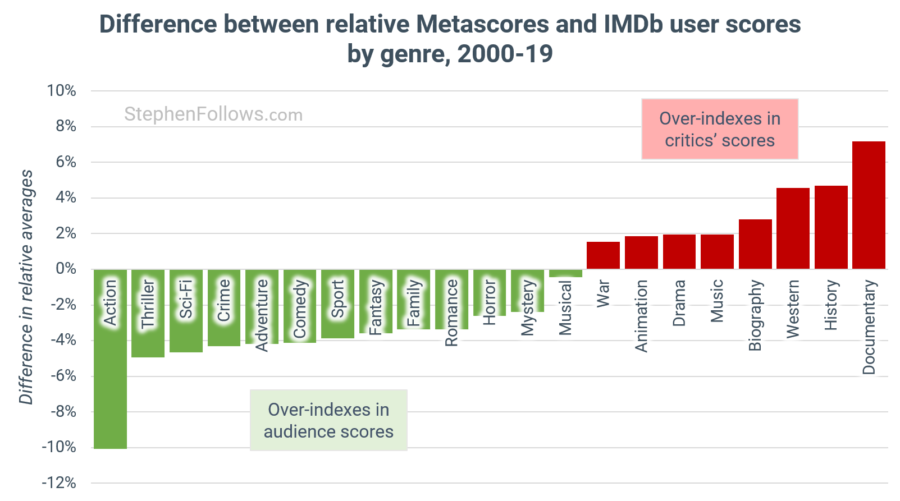
User reviews are retrospective: how much did they actually enjoy watching the movie.
I think there has always been a fundamental disconnect, in that critics think the masses should be watching 'smarter', 'more artistic' or, less flatteringly, more pretentious movies.
The world has become a lot more political over the past couple decades. I wouldn't be surprised if critics are trying to be increasingly prescriptive, using their review to try to change the modern zeitgeist.
I think a very interesting graph would be so see to what extent critics prescriptions are accurately forward-looking to viewer attitudes.
More interesting further research could be:
For movies that came out before 2010 where the user rating diverged from critic rating by more than 10%, are user ratings which were rated after 2015 in the same direction as the critic's divergence? There are certainly movies that I enjoyed as a teenager, but cringe watching today: were critics at the time cringing in the same way, ahead of the masses? Or are critics just in a pretentious bubble that is not predictive of societal evolution?