Dumb question, but is it even feasible to build such a building in a "tornado-proof" way? From how the damage looks, that warehouse must have only been metal walls and roofing instead of solid concrete or bricks...
I’ve been in several buildings designed to withstand tornados. Anything above around typically is only designed to survive and F3 or F4. The ones I’ve seen have a strong outer shell of steel and concrete with some angles to help deflect wind. There’s then an inner shell of steel designed to keep what ever is inside safe. The outer shell will let some debris through but it won’t penetrate the inner concrete and steel shell.
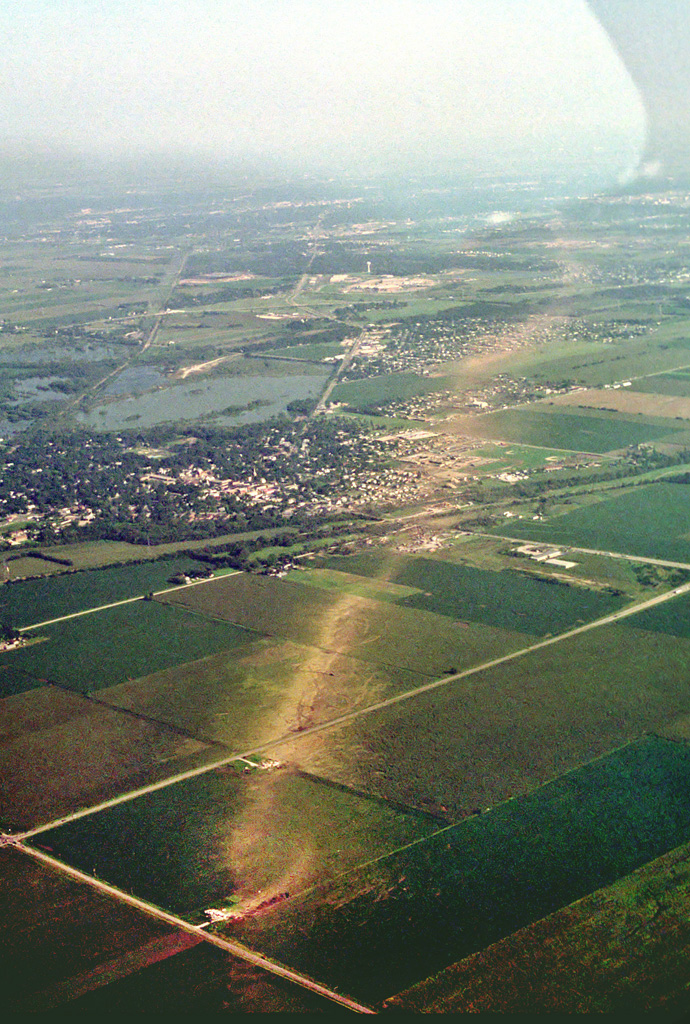
To put it in perspective an F5 (strongest tornado) will leave just dirt behind and all structures, vegetation, and soil will be gone.
Here’s an example of an F5 aftermath in Illinois in the 90s
It's definitely feasible, you basically just end up with something very similar to a military bunker. The structure ends up being mostly underground and the entrance or above ground areas are mostly made of reinforced concrete with heavy steel doors, no windows, etc.
Spent five minutes googling (so now I'm an expert! /s). So much spam on this topic. The most reasonable answer I found so far kindof matches up with your answer:
So first off, to survive the wind speeds of an F-5 tornado wouldn’t be hard to build. This issue is more about price than difficulty. Add extra fasteners, sturdier materials, etc. Once you get the foundation properly anchored and the frame reinforced, the rest is very simple.
The real issue is with the debris. Imagine a tree being tossed into the house. Even IF you built the walls to withstand it, which would be insane in a residential structure, you still have doors, windows, etc. Unless you build underground, or spent 5x more for a tiny house, it would be near impossible.
Your best bet is to not build in the middle of a tornado-prone area.
Financially, no it is not feasible. In the parts of the US where tornadoes are common, any particular spot is hit by a tornado on average once every 2,500 years. Of those tornadoes, 80% of them will be EF0 or EF1 intensity. An EF1 tornado will cause some roof damage and break windows but it won't tear the roof completely off or collapse walls.
So it doesn't really make sense to spend money for something that happens once every few thousand years and is typically pretty minor when it happens. Especially given that it is usually completely predictable when it happens. Tornadoes don't suddenly appear out of a blue sky. There were warnings for the last few days that storms capable of producing tornadoes were likely for the areas that were hit last night. When the storms were going on, the TV networks interrupted programming and had the weather forecasters tell where the storms were and where they were headed next. Tornado sirens would have been going off long before the tornadoes hit. People would be getting texts on their phones warning them to take cover.
If you're in a well-built structure, you're going to be fine in most tornadoes. Even for EF2 or EF3, you would most likely be OK even in a house without a basement if you took shelter in an interior closet on the ground floor. If you're in a mobile home, you're toast. For an EF4, you have a decent chance if you are in an interior room in a basement. So for the vast majority of tornadoes, which are already rare, there isn't much reason so spend money to protect property when there is already a way to protect lives.
For EF5 tornadoes, it would be challenging to build anything other than an underground bunker to withstand them. They are incredibly rare, Wikipedia says 59 in the US since 1950. An EF5 tornado doesn't just level a house, it rips it from the foundation, sends it flying through the air and shatters it into a million pieces. Here's what an EF5 tornado does to a house: https://www.spc.noaa.gov/faq/tornado/f5.htm. It can rip the asphalt from a roadway and send it flying through the air. If you're in a building in the path of an EF5 tornado, you are probably best off following the advice my redneck step dad gave me when I was a kid for what to do in the case of a nuclear attack. He said to head down to the basement to an interior hallway, crouch down on the floor, tuck my head down between my knees as far as I could, and kiss my ass goodbye.
Some types of tornado proof homes are not the big square concrete type, like shown in the sibling comment article, but dome homes made out of concrete. The obvious issues are that most furniture doesn’t fit well, wall hangings don’t work correctly, and putting in interior walls is wasteful, while modifying anything for electric or water is quite difficult without careful planning.
I'd guess those exterior walls are 6-12" thick poured concrete, similar to this[1]. You can see in the 6th picture almost all of the missing wall is still there and intact, it's just lying flat on the ground. In the 12th picture you can see how thick they are compared to car wheels nearby.
You either need very thick castle kinds of walls or to sink underground and essentially build a big hobbit hole kind of construction where wind hits a gentle slope instead of a flat wall.
A building designed to take an 80 mph wind is just a lot different than one to take a 250mph wind. One is basically guaranteed and the other an extreme rarity.
Both at once would be quite a shitshow. Soil liquefaction floats your tornado shelter right out of the ground, then the tornado smashes it. I can't imagine what it would take to survive both at once. Thankfully both at once would be extremely unlikely.