Foiled! I’m in New Zealand at present and it was still yesterday even here when you posted. WST = UTC+13, NZST = UTC+12, and New Zealand doesn’t move to NZDT (UTC+13) until this Sunday at 2am—unless they choose to scrap daylight savings time with even less notice than Samoa.
That amount of letters, numbers and date math is thankfully illegal this early in my time zone.
But speaking of the anti-meridian, if one were at a pole, how is the date determined? Is tomorrow always a few steps away? Is there a non-calendar measure of days that applies to the whole planet at the same time? Is the number of days best described as the distance of the Earth from an arbitrary and invisible part of space representing New Years? Is that part of space best described by the “25,772-year axial precession of the earth?” [0]
Because of the Amundsen-Scott base at the South Pole, and how it is supplied, local time at the South Pole is New Zealand time. The North Pole has no local time since there's no human presence there.
Air traffic generally uses UTC for all purposes, and if there's no clear local time, it's highly likely that UTC will be chosen. Wikipedia's page on Air France 447 (which crashed in the Atlantic Ocean on route from Brazil to France) exclusively uses UTC for its crash timeline notes, while its page on MH17 uses local (Ukraine) of its shootdown and for MH370 uses Malaysian Time for its timeline.
Given that Alert is the northernmost continuous human settlement, I'd imagine that any search-and-rescue effort for an extreme polar crash would be coordinated out of there. Alert's timezone is (US/Canada) Eastern Time.
However, this is a trick question. To get an extreme polar flight, you're looking at something like LA-Dubai. No one on that flight would be bringing enough winter clothing to survive a crash at the North Pole, and so everyone would be dead of frostbite or hypothermia if not killed by the impact itself, and thus there are no survivors.
It was not long ago that a 747 crossing the pole had all four engines die at the same moment. After losing tens of thousands of feet of altitude, they got the engines started again.
Rolls Royce (or was it GE?) figured out what exact combination of intake speed, pressure, humidity, temperature, and history caused the failure, and prevented it on subsequent flights. It had been considered (!), but they thought it would never be encountered on any real flight. The engines restarted because, at lower altitude, conditions were different enough.
The pilots found the event distressing. It is possible most passengers didn't notice.
If you’re not familiar with it, I was riffing on a popular riddle: “if a plane crashes precisely on the border of two countries, where do you bury the survivors?”
It was first brought in in Port Arthur, Ontario, 48 degrees north. It sort of works in London, 51 degrees. So around there I guess though I still don't like it much as a Londoner.
I live at 44 degrees and DST during summers does make evenings after work more enjoyable but if the same UTC offset was held through winter, I'd be waking kids to school in pitch dark and the extra afternoon sunlight hour will be during work days anyway.
The reason people like DST nowadays is quite different from the alleged reasons it has been set up. All people I asked claim that it's all about making the best use of their free time (and few think about the problem of dark mornings on the winter and thus many jump to the conclusion that DST should be abolished but by keeping the summer time of course)
Yeah I'm a bit in the all year DST crowd. I'd rather have sun at 4pm than at 8am in the winter as in the morning I'd generally either be snoozing or commuting by something motorized where the dark doesn't matter much.
Several Pacific island nations adopted DST so they could be the first into the year 2000 for tourist purposes. As a result, some countries are only in DST for a month or two out of the year.
Are you anti winter time or anti summer time though? I am anti the clocks going back in winter and making it even darker in the evenings, but some people want to scrap summer time so the evenings are darker all year round!
Others can fight about what we call “5pm”, but for the love of everything holy, just stop moving the clocks. I’ll happily ally with whichever side (“anti-winter” or “anti-summer”) that appears most likely to deliver a political victory that ends the madness.
The biologically optimal time moves around. People wake near sunrise. DST keeps sunrise at a more consistent time at the expense of moving sunset around.
I found it surprisingly difficult to find data. Not just data for or data against, but any data at all. What little I found organized by month seems to accurately show the percentage of the month typically on vacation (so people sleep later on average in August than September, or they sleep a lot later in Dec than in Oct due to holidays, at least in the north hemisphere).
I theorized that regardless of DST people would wake up later from June thru Nov (DST starts in Nov where I live). Unfortunately the graph shows the opposite trend of people tending to wake up on average almost 4 minutes earlier in Oct than in Sept. Or in spring our DST ends in March, so I expected people to wake up earlier in May than in April, but its the other way around by five minutes.
I'd theorize if required wake up times strictly followed solar elevation, then something like a graph of car accidents vs time of day would vary greatly by month, but it doesn't seem to in what little data I could find. "Most dangerous time to drive" graphs seem to imply evening rush hour is a little more than twice as dangerous as morning rush hour so that would seem to imply morning wakefullness problems are statistically insignificant.
(Edited to note: I'm not insisting you're wrong, but I am insisting I can't find much of any data on the topic, maybe you are right but nobody knows for certain...)
If school times are going to shuffle around, then ther parents' schedules will also shuffle around. Then we have to shuffle schedules for a big chunk of economy every 6 months. How can we optimize that process? Oh wait, let's just move the time around. Aha - now everyone is synchronized automatically.
The point I was trying to make is that choosing an optimum should be centered around the education of the world's children. Standard business hours are really a case of "well, we've always done it this way so why should we change," rather than "this the best thing for the everyone involved."
I think we are moving towards that somewhat, with companies becoming more flexible with working hours/locations in the past year and a half.
According to timeanddate.com, the latest sunrise in Durness (NW Scotland, on the mainland) is at 09:09, at the end of December, but "civil twilight" is then at 08:16, so if school starts at 09:00 a lot of people can presumably travel to school with at least some natural light. On the other hand, if they were using UTC+1 it would be civil twilight from 09:16 and sunrise at 10:09, which would be sort of horrible, surely, because then you really would be travelling at night?
The shortest day in Durness lasts 6 hours 18 minutes. In England typical school hours are 09:00-15:00. If those are the school hours in Scotland, and you're dealing with not much more than 6 hours of sunlight in the winter, then I would have thought that a good time for local noon would be around 12:00 rather than around 13:00.
So I hope that a lot of Scots will join me in asking for UTC+0 all year rather than UTC+1 all year!
For all of you who work in tech jobs with somewhat flexible hours, I'll let you in on a secret: There's nothing stopping you from doing that now. I banished the time change from my life and get up at the same physiological time all year. Half the year I do 8 to 4 and the other half I do 9 to 5. It's wonderful and I implore you all to try it!
My preference is that we just stay on standard time permanently -- when it's noon, the sun should be at (or near, given time zones) the highest point it's going to get that day.
But I think getting rid of the time change is a bigger deal, and I'll accept daylight savings time as the permanent one if that will help us to more quickly end the time change.
Gotta keep the evening lighter, especially now more people aren't traveling early mornings as much - which I always found a weird argument, not like you need the sunlight to be able to get somewhere. Most people (I would bet) want to finish work and be able to do things after.
At my latitude (northern part of the US), the changing clock doesn't affect that. It only affects whether they'll be traveling in the dark in the morning or evening. And, during the depths of winter, they'll be traveling in the dark both ways in any case.
As someone who grew up in Michigan the "both ways" claim seemed odd and upon checking unless "nothern part of the US" includes Alaska/the arctic circle (which seems a bit unfair) that doesn't seem true.
The shortest day for the absolute northernmost point in the continental US has sunrise just before 8:00 am and sunset just after 4:30 pm. With most schools starting at 7:30 and ending at 2:30 it works out for one way adjustment or not. I remember trying to get kids in extracurriculars heading home by sunset was actually a goal of scheduling but obviously that's not always possible particularly during in season due to the extra travel time prior to the game.
My basic take is that I'm mostly in the keep standard time ("winter time" in your parlance) camp. I want the sun up earlier to be able to run/bike in the morning, and I also like noon being somewhat close to where the sun crosses the meridian.
What I think really makes the most sense is just global time - UTC everywhere. Yes, I've seen the args against it and I think it would all be a lot more adaptable.
Either way, just stop it with moving the clocks. Not only is it a major PITA for everyone, studies have shown that it actually causes increases in road and work accidents. And, whatever rationale for energy savings has now been reversed, since air conditioning drives energy use far more than lighting. Just Stop It.
Note on the origin, from what I've read, one of the most likely origins is Ben Franklin's joke about the French, that they'd change the time system laws to save candle wax. I haven't read anything that substantially proves or refutes that, and I think we've honored Ben's joke enough already.
> What I think really makes the most sense is just global time - UTC everywhere. Yes, I've seen the args against it and I think it would all be a lot more adaptable.
So more than half of the planet has "midnight" (i.e. the change of the calendar date because it's 00:00 UTC) happening during waking hours and each solar day is being split into two calendar days? No thank you.
Like the sibling comment, I'm against moving clocks around. I used to ease my way into it by not changing clocks until keeping track of old time and new time got to be a hassle. Now-a-days my org does DR activation a few days before and reactivates when the time changes so I'm kind of resetting sleep that Sunday anyway.
As a South Australian I like that both our times are offensive so we can just split the difference and finally get an on the hour timezone like everywhere should be.
Anywhere else and I'm pro summer time all the time.
Anti DST for me. To the point that I'd rather just keep jumping back and forth rather than go permanent DST. Waking up and living your first hour in darkness ain't healthy.
Surely schedules would adjust, right? In northern latitudes I commonly see different summer hours for shops for instance, it's about time middle latitudes adopt this simple strategy instead of abrupt time changes.
Adjusting schedules is exactly what switching clocks around does. For example, you can't adjust school schedules and keep kids from walking to school in the dark without also changing work and daycare schedules, which means coffee shops have to change schedule, etc.
Switching clocks changes the schedule only by one hour, in a one-size-fits-all fashion. Even at 30deg north, summer and winter sunrises are multiple hours apart. This is why summer and winter schedules for businesses are multiple hours apart in far northern areas. Somehow enough coordination is managed organically.
I share your position on DST, but wouldn’t treat tropical nations as recommended guidance on DST issues in non-tropical parts of the world. There’s less variance (read: not zero, just substantially less) in their daytime hours than there is in ours.
Once a friend in China asked me about the time difference. She was highly amused when I followed up the response (15-16 hours) with the comment 中国就是美国的未来 ["China is the future of America"].
China, which spans 5 hours of "natural time" all operates on Beijing time. In Xinjiang it is dark very late into the morning, and light often well into the wee hours. That is the least of their problems just now.
Well, no, the morning begins around sunrise just like everywhere else. For example, today morning in Ürümqi began around 8 am. In contrast, morning in Beijing began around 6 am.
But this is a joke about the international date line, not a comment on whether you can redefine the difference between night and day by adjusting what your clock says.
> DST was implemented in 2010 by the previous Government of Samoa to give more time after work to tend to their plantations, promote public health, and save fuel. Instead, it “[...] defeated its own goals by being used by people to socialise more,” according to the Samoa Observer.
Maybe I am lacking context here, but that seems a bit mean on the part of the Samoan government. Is extra socializing such a bad thing?
My observations from reading this comment thread, are that Time is a construct created by jewellers to sell more watches. :)
Also, we should switch to UTC globally. My 22:00 is your 22:00 and their 22:00. For me it's my bedtime, for you it's lunchtime, and for them it's breakfast. People should adjust their daily activities around the daylight hours they have, and let time be less of a controlling force in their lives.
We live in a globalised world, especially in business. So with the whole world on UTC, everyone knows when the meeting starts, when the delivery arrives, and when the end of the year starts and finishes.
And if that fails, we should just attach rockets at the poles and push/pull the planet back upright to get rid of the problem altogether.
Careful – this would also entail midnight UTC happening during the waking hours of quite a lot of people (everybody not living near wherever your new meridian ends up). If you keep the calendar date coupled with UTC, this consequently means that the calendar date changes during the waking hours, which I suspect will end up terribly confusing – for almost everybody, the natural term of reference will still remain the solar day, and so having one solar day split across two calendar days isn't exactly intuitive.
Plus anything that currently is only specified at the granularity of days would need to start being specified with exact starting/ending hours, because otherwise you'd end up with strange things like public holidays starting and ending at 11 o'clock solar time, because that's where midnight UTC happens to lie at your location. Or of course you could make a local law that anything that's specified at the granularity of a day or coarser is presumed to happen at a certain UTC time which corresponds to a more sensible value for midnight based on the local solar time, which means basically reintroducing time zones through the back door…
If you did UTC for coordination you would still have access to solar time. You could have the real thing that changes every day. Then if you wanted to start work half an hour after sunrise at the place of work then you would just do that based on whatever that worked out to in UTC. All the advantages of DST but better. No sudden discontinuities. No time zones required.
I can't tell if its a joke post or not, but UTC is a terrible idea. If I'm calling Italy from the US, I won't know if I'm calling during business hours. With regular time, I know that 9am their timezone is roughly when they start working, and 5pm their time is roughly when they finish work. With UTC, I would have no context.
Instead of making it easier, it would make it much much harder to do global business.
I'd support UTC everywhere. Context matters in any case, so it wouldn't necessarily make things easier for meetings, and you'd have to adjust to the fact that "noon" might be at "5pm" (17:00) UTC and midnight at 5am.
Your example is a bad one. People still need to schedule around other people's schedules, like other meetings, lunch breaks, or whatever. But generally you know that people are in the office approximately between 9 and 5. Individual results may vary but that's really really obvious.
The idea that UTC is superior and just looking up everyone's offsets is ridiculous especially when dealing with multiple timezones. Regular time gives CONTEXT about things like daylight, which are appropriate business hours, when do people go to sleep, when do people wake up, when is approximately dinner time, when kids approximately get off school, etc. I can ask Siri for Moscow's current time and Tokyo's current time and get all that context instantly. You don't with UTC at all. Everyone knows it's 5:55pm UTC but I have no context as to what that means for them. You can't just share offsets because you won't know the context.
> Regular time gives CONTEXT about things like daylight
That's the thing I'm discussing here. You are mostly right, but I wanted to point out that depending on a range of factors, local time can be offset by ~3 hours compared to the sun (depending on latitude and longitude), with office times sometimes following suit.
DST is even worse if we consider that some businesses have different opening times during winter and summer.
Anyway, UTC might be impractical to use in everyday life, or it might not. But please give the time as UTC when scheduling a meeting or event across time zones, especially across countries. This is even worse when someone posts something on the internet: "livestream begins at <random time>". You're lucky if a timezone is posted at all sometimes, but I'd have to look up what will be my local time if something like "PST" is given, while I always know my offset to UTC.
Humans measure time by measuring the sun's relative position to their standpoint on the earth -- If the sun is above my head, it is daytime and I will do all sorts of activities. And if the sun is below the horizon then it is night time and I will go to bed. A 24h clock rotation system is designed to measure the progress of a "day".
Getting rid of timezone conversion makes it difficult for human brain to understand the relative time of day in other locations on the earth.
Knowing that it is 22:00 UTC on the other side of the globe doesn't mean much to me. But if it is 12PM local time there, then I immediately get a basic idea that it is roughly the lunch time.
Knowing it's "roughly lunch time" on the other side of the globe doesn't mean much to me, knowing "I'm available from 22:00-1:00" or "let's try to arrive at 23:00" does. If I'm particularly interested in where the sun is there at that time that's when I should need to look it up, not every single time we try to reference times between 2 locations for the off chance I actually care about the sun's position.
I may have a bias here in that I already do meeting scheduling in UTC due to the geographic dispersion of the folks I work with and amount of cross tz travel we do (well, not as much of that as of late but hopefully soon again).
Brazil got rid of Daylight Savings Time two years ago. Initially I was against the idea.. Well now I love it. Feels more natural do deal with increase and decrease of sunrise and sunset as seasons change.
The DST does not save energy (at least in Brazil). It was abolished based on a lot of studies that showed that (and that it brought quite a lot of harm), and the talks about reestablishing it because of energy saving are nothing but stupid.
Oh, and both ANEEL and the ONS already made quite public and definitive statements that DST won't save any energy this year.
It affects business with other South American countries.
International trade exerts outsized influence on politics, just because of the greater overlap between the international trade class and the national political class.
From the countries in a temperate zone that have the same timezone as the main Brazilian one only Paraguay has DST. Losing sync with Argentina and Uruguay is quite a high price to play to keep sync with Paraguay.
For every other country, our DST is just some weirdness that they have to adapt to for no reason.
Thanks, I thought Argentina was less enlightened than they are. It is odd that Paraguay does it, because the "reduce energy" myth means little there: they export surplus hydro power.
When DST was abolished here in Tunisia circa 1999, software using deprecated timezone was not updated and we suffered from bugs and glitches for the next five years
I’m really glad to live in one of the states in nearby Australia that doesn’t have DST.
I feel like people should just be encouraged to have a bit of flexibility to shift their hours how they want. In a lot of professional jobs, that’s basically the case, and a lot of ‘blue collar’ work happens much earlier anyway already (tradies etc. usually start at 6:30 or 7:00am as it is and knock off around 3pm. Plenty of cafes open at 6:00am to 7:00 am too because people are up cycling, jogging, etc. before it gets too hot. The swimming pool I go to to swim laps has different summer and winter hours. None of them need daylight savings to do any of that!
I just don’t get the obsession with changing the clock. It just makes things inconvenient…
There must be real advantages to being able to buy two-year-old cars that Japanese people are obliged to give up. (In Japan they also drive on the wrong side.)
I have personally been involved in fallout from last-minute changes to DST in
* Jordan
* Russia
* Armenia
* Turkey
Morocco suspends DST during Ramadan. Because legally you cannot predict the start and end of Ramadan (it's determined by direct observation) this is quite the challenge to handle.
For people wondering why Morocco has DST (which isn’t that useful for countries relatively close to the equator?), it seems Morocco chose to permanently become UTC+1 in 2018, with the exception of Ramadan, when it’s UTC.
So it’s not really DST in the summer months as done in Europe.
Although the Moroccan approach makes for an interesting technical challenge!
    # From Paul Eggert (2020-05-31):
    # For now, guess that in the future Morocco will fall back at 03:00
    # the last Sunday before Ramadan, and spring forward at 02:00 the
    # first Sunday after two days after Ramadan.  To implement this,
    # transition dates and times for 2019 through 2087 were determined by
    # running the following program under GNU Emacs 26.3.  (This algorithm
    # also produces the correct transition dates for 2016 through 2018,
    # though the times differ due to Morocco's time zone change in 2018.)
    # (let ((islamic-year 1440))
    #   (require 'cal-islam)
    #   (while (< islamic-year 1511)
    #     (let ((a (calendar-islamic-to-absolute (list 9 1 islamic-year)))
    #           (b (+ 2 (calendar-islamic-to-absolute (list 10 1 islamic-year))))
    #           (sunday 0))
    #       (while (/= sunday (mod (setq a (1- a)) 7)))
    #       (while (/= sunday (mod b 7))
    #         (setq b (1+ b)))
    #       (setq a (calendar-gregorian-from-absolute a))
    #       (setq b (calendar-gregorian-from-absolute b))
    #       (insert
    #        (format
    #         (concat "Rule\tMorocco\t%d\tonly\t-\t%s\t%2d\t 3:00\t-1:00\t-\n"
    #                 "Rule\tMorocco\t%d\tonly\t-\t%s\t%2d\t 2:00\t0\t-\n")
    #         (car (cdr (cdr a))) (calendar-month-name (car a) t) (car (cdr a))
    #         (car (cdr (cdr b))) (calendar-month-name (car b) t) (car (cdr b)))))
    #     (setq islamic-year (+ 1 islamic-year))))
I was sortof idly wondering the other day if anyone had "done" holiday calendar calculations in an easy library yet, or if emacs was still the best source.
This argues emacs calendar is the gold standard implementation.
-I shared an office while in uni with a -in his own words- selectively devout muslim.
He moved way up north after graduation, and I, being an inquisitive fellow, asked him how he coped with Ramadan when it occurred during the summer months (when midnight sun was a thing).
The reply was reassuringly pragmatic. -'Oh, I just follow the fast in Mecca, much simpler than for my brethren south of the Arctic Circle.'
Although officially the month starts when an official sees the new moon, I wonder to what extent they predict in advance when the moon is likely to be visible and then, in order to avoid unnecessary disruption, they make sure that that is indeed when they see it.
> The OIC says religious scholars will have access to accurate pictures of the shape of the Moon instead of having to rely on naked-eye sightings which have in the past created discrepancies between Muslim countries or mistakes.
> "Hopefully the satellite will stop the problems associated with lunar sightings," spokesman Ahmed Imigene says.
> "The satellite will have a fixed camera on board that will take highly detailed pictures of the Moon and beam them back to earth," says Professor Mervat Awad, the centre's director.
> Dr Ali Juma, chief of the 15-member panel from Saudi Arabia, Egypt, the United Arab Emirates and Bahrain which decided on the contract for the satellite, says it will solve many problems related to crescent sighting.
Though... not all countries use that technology. I'm not sure if its still in use as that was 15 years ago.
> Since the new moon is not in the same state at the same time globally, the beginning and ending dates of Ramadan depend on what lunar sightings are received in each respective location. As a result, Ramadan dates vary in different countries, but usually only by a day.
However before software vendors can release zoneinfo updates, someone needs to inform the maintainers of tzdata, and they need to make a release. At least in this case someone appears to have done that already.
This does cause problems though. Any software that makes dates in the future (calendar software, billing systems) runs into issues if the future date changes.
And that triggered another unrelated problem because there has been a controversial change to merge several timezones that are alike since 1970 (the current tzdb has been inconsistent about them) and the Samoan change has triggered the next release (2021b) so the debate has to be somehow settled before that release.
Unfortunately the IANA tzdb is less reliable than most developers would probably assume.
A few years ago I was using moment-timezone for a web app and noticed it was displaying time wrong for Chinese users. Looking into the issue, I found out that the packaged tzdb version somehow thought China Standard Time was observing DST, which was a brief experiment scrapped decades ago. Digging into tzdb source, I felt like being thrown into an old style wiki page where people argue with each other back and force over the years, leaving all the historical arguments directly in comments in the source code. At times people just go with incomplete information and somewhat questionable sources, which might get corrected a decade later. You can check for yourself: https://data.iana.org/time-zones/tzdb-2021a/asia
(Btw, I can't really pinpoint the problematic version I encountered years ago now.)
Washington state passed a a law to follow daylight savings time year round but it's contingent on changes to federal law that requires states to observe DST changes or use standard time all year.
I've emailed all my representatives asking for action on this without any response.
I've also emailed the president, our governor, and and secretary of transportation asking to move Washington to Mountain Standard Time because it is equivalent to Pacific Daylight Time and doesn't require changes to federal law.
I would like to know your motivation. We shouldn't all change our clocks so that the sun is overhead at 1:00 unless there's a good reason. I suggest that if you like the sun to be up for more of your waking day, that the best solution is for you to wake up an hour earlier, and go to bed an hour earlier. It is exactly equivalent, except for the numbers that show up on your watch...which you could just set forward on your own if the numbers are the thing you're looking for.
The "good reason" is that considering 12am the "middle of the day" only makes sense if the typical sleeping window was 8pm to 4am (making midnight the "middle of the night").
And following standard time year round is allowed. Changing from Pacific to Mountain requires a request from the state governor or legislature to the secretary of transportation.
If we aren't going to change the clocks in Washington, permanent PST is better than permanent PDT.
1. Work and school starting times are usually in a narrower band of time than work and school ending times, which means you tend to have more traffic density in the mornings.
2. Road conditions tend to be worse in the morning than in the evening. It tends to be colder in the morning meaning it is more likely to have ice or fog.
When you are in the part of the year where there is not enough daylight to have both the morning and evening commute times covered by daylight, for the above reasons you are better off favoring morning daylight, because morning combines the worst traffic with the worst road conditions.
In the UK at least I don't really see the argument for DST. All it seems to do is fuck up my already precarious sleep cycle in exchange for what seems to be some farmers productivity (but they only make up 0.1% of the population roughly)
UK farmer here. We're often cited as justification for BST vs GMT, but it's complete nonsense. We don't care! In fact, the discontinuity is a nuisance to us in many of the same ways as it is to city people.
Time-dependent natural processes don't reconfigure themselves when some administrative body decides to shuffle the names of various times of day. If my cows want breakfast at 6am and you shift the clocks forward, they'll start shouting for Food Man(tm) at 5am instead.
Ah, I was on HN before I was a full-time farmer, and I still work on various free software stuff. After we sold the startup I co-founded to a large acquirer, I took on a Shropshire farm where I've been building a calf-rearing and beef enterprise.
The one thing I did that I'd recommend to anyone who wants to move into running a farm business: spend as much time as you can working for other farmers before you start. You'll have fun, learn loads, find your strengths and weaknesses, etc.
The great thing is, if you are able to juggle tech stuff and farm work, each feels a bit like time-off from the other because they're so different.
> The one thing I did that I'd recommend to anyone who wants to move into running a farm business: spend as much time as you can working for other farmers before you start.
At the very least watch Jeremy Clarkson (of Top Gear fame) make a fool of himself:
Sorry, I don't I'm afraid. I have plenty of stories of my complete incompetence to relate, but I find it so much harder to motivate myself to write that kind of thing in the evenings than to tinker with software projects.
The “farmers need it” reasoning is a fallacy. A farmer is going to operate on when the sun comes up so they can see what they are doing. If sunrise is called 5am or 6am it is irrelevant to them performing their work.
It's not irrelevant to them (and anybody else who uses or wakes to daylight) coordinating with the rest of society, though. Which is the function of a standardized time. It didn't exist up until railroads were popular; before that each town set its own time based on solar noon.
It's not just farmers. It was done away with in the UK for 3 years back in the late 60s and people hated it.
There are 2 options, either going with summer time permanently which seems the most sensible approach in theory and what they did with the British Summer time experiment. The problem is that although having longer evenings in winter sounds good in theory it means that it's dark until 10am in the depths of winter and roads are icier when people are making their morning commute.
The other option is to keep standard time, but that will mean losing the late evenings in summer and the sun rising even earlier which would be a loss.
I don't see what the big issue people have with it is. It makes perfect sense for northern/southern latitudes and essentially all my clocks adjust themselves automatically.
> It was done away with in the UK for 2 years back in the late 60s and people hated it.
Some people hated it, mostly Scots. In the south of England it was popular (I was there).
Now I live in Norway rather further north than most of the UK and guess what we really don't find it difficult to go to work in the dark and nor do children find it hard to get safely to school (that last was the Scottish argument against permanent summer time).
As soon as you shift a big part of society, like kids going to school, much of the rest of society needs to shift to stay in sync. Congrats. You’ve just reimplemented a time shift but more chaotically.
I used to be in camp DST year round. Now I don’t really care because I mostly get up when I want which varies from day to day.
Is it a big part of society though? I would have though children walking to school is fairly independent to the rest of society that needed time-milestones.
Would we assume parents are walking their children to school, hence need to start work later? If that's the case, why does it matter how dark it is?
Most parents of young children are at least seeing them onto school busses if not dropping them off at school themselves themselves. Childcare has to similarly be synced up.
Personally I don’t care much these days but many do.
"It won't last brothers and sisters are natural enemies.
Like English men and Scots or Welshmen and Scots or Japanese and Scots or Scots and other Scots. Darn Scots they ruined Scotland."
Also, we don't pick the time we start or finish work based on what the clock says, although the weather definitely has quite a lot of input!
The main effect of BST vs GMT on farm life is the unexpected one hour jump in the times of day that non-farm stuff happens, e.g. deliveries, times you can phone business, when the vet closes, etc.
I personally find odd historical "traditions" quite romantic and usually dislike movements to update them. For example, I dislike American-English spellings or selling milk in litres for this reason. I guess find the historic reason behind these traditional ways of doing things interesting enough to keep them even though I acknowledge they make little sense today.
However, daylight savings is one of those things I find to be genuinely inconvenient and although from a purely sentimental perspective I would be sad to see it go, I do agree with scraping it.
It's not completely relevant and probably somewhat common knowledge, but historically many (most?) cities and towns had their own time based on solar time before standardised time zones were introduced. In my city there is an old corn exchange building with two minute hands, one for our old city time and another for the actual GMT time we use today. In the past people would use these central clocks to set their own timepieces, but you can imagine how much of a nightmare this was trains were introduced and suddenly people wanted to travel between cities but there was no universal time. So in comparison to adopting standard time, this seems like quite a minor change.
I'm really glad that my employer is flexible about the time I start working. That way, whenever the clocks are set to/from DST, I just start work an hour earlier or later and my sleep remains unaffected.
I like to sow chaos and confusion anytime anyone asks if we're gaining or losing an hour with "it's spring back, fall forward!" while grinning like an idiot.
Here, during the winter, daylight starts between 6:23 and 7:25 in the morning. In the summer, it's between 5:47 and 7:21 am. That's with DST. Without it, full daylight would come as early as 4:47 am.
For them, winter daylight start between 6:28 and 7:51 am. Summer daylight starts between 5:26 and 7:26 am with DST. Otherwise, it would be as early as 4:26 am.
So basically, the more north you are, the more summer daylight comes very early in the morning. Given that humans are diurnal animals, and given that a lot of jobs depend on daylight (e.g., agriculture, construction), and given that we use a social definition of time to regulate a lot of coordinated economic activity, the question is: do we adjust the schedules or the clocks?
Certainly when DST was invented, adjusting the clocks was the only practical option. If we have too many light hours in the morning and too few in the evening, let's just swap the clocks by an hour. There aren't many clocks and you get everybody to do it at once, so no communication is necessary.
These days maybe you could replace it with seasonal hours set by every business on as they see fit, but that's an awful lot of schedule-adjusting and hours-checking that needs to happen to know if you can pick up coffee on your way to work. So personally, I'm for staying with DST.
> So basically, the more north you are, the more summer daylight comes very early in the morning.
That is half the picture. The more north you are the later in the evening sunlight lasts. I grew up near Minneapolis - in winter there is nothing you can do to get daylight both before and after school hours, and when close to the equinox it is hard to even hit one if you sun during recess as well (one hour after school starts or one hour before it ends).
Daylight savings time is useless in the north because there isn't enough daylight in winter to do anything useful with no matter what you do. In summer it is pointless as there is far more daylight than you need and so you have to learn to sleep with the sun up.
I grew up at a similar latitude, and I disagree. That one can't perfectly solve the problem through a clock shift doesn't mean that there are no benefits to the clock shift.
States can opt out of DST (as Hawaii and Arizona do). However, several states want to go to "permanent DST", which requires Congressional approval that has not yet come.
There's a couple of states that have opted out. I'm gonna agree that it's just an issue that not enough people care about to do anything about. Sort of like the penny or metric system
Neither Arizona (with the exception of the Navajo Nation) nor Hawaii observe daylight savings time. Additionally, none of the territories do either (including American Samoa)
These two states are examples of states where it is "easy" to do your own thing. Arizona and Hawaii's metro areas do not bleed over into nearby states.
It'd be tough for New York, for example, to abolish DST without New Jersey and Connecticut doing the same, you'd have people crossing time zones part of the year in their daily commute. Then, it would be hard for New Jersey to do it without Pennsylvania (where many New Jerseyans commute to) also following suit. Likewise in New England, where Boston is the center of the universe, all of New England is best off being in sync, you don't want commuters from New Hampshire and Rhode Island to cross time zones to get to their jobs in MA.
Where I am at right now its DST and sun up is 7am and sundown is around 7pm. Without DST it would be 6am to 6pm. I think the average person gets more use of the sun from 6pm-7pm than they do at 6-7am. A decent chunk of the population is sleeping until 7am and virtually nobody is sleeping from 6-7pm.
That doesn't really support switching away from DST in the winter. So I'd rather stay on DST all the time. But if its between never DST and DST half the year, I pick half the year.
All you’re arguing for is that business hours could/should be variable between summer and winter. Don’t you realize there is no need to change the clock setting to solve your problem?
Looking at the comments this reminds me of a frustrated spin system. No way to make everybody happy.
We could just select 10 possible solutions (precise local noon, UTC for everybody, forever-summer, forever-winter, DST, DST in temperate/polar regions only, smooth sigmoid-like DST transition, etc...) and rotate between them every few weeks.
anyone working with a people located in different regions knows how counterproductive daylight savings is. I've come to that it is inevitable that daylight savings will be eliminated, and the only thing keeping it around is the name implies that legislators have some supreme power over the sun. if we all agreed to cal it "useless time adjustment" i think it would go away quicker.
i do think that we should eliminate different time zones entirely. there isn't a sundial industry that we need to keep afloat. it would be simple and better for people interacting across wide longitudinal gaps. as a first step, i would suggest the united states selecting a single representative timezone, to make the adjustment simple, then just force the rest of the world to follow suit, using climate change as a reason or some such. we can also declare the new proper timezone as metric, to satisfy the europeans.
Time zones are a political compromise. They don’t make sense logically, but they make a lot of sense when you realize they are decided by politicians.
All of timekeeping is based on a long tradition of political compromise. Coordinated universal time is named UTC because british and french couldn’t agree on CUT vs TUC. We have a 7 day week instead of an 8 day week for political reasons in roman times, and for similar reasons the length of the month isn’t the 28.5 days that you would expect for the timekeeping unit based on the lunar cycle. September is the 9th month instead of the seventh (as its name would imply) because adding january and february to the calendar made roman conquest more convenient. A day is divided into two times twelve hours of each sixty minutes because this made sense for the way ancient egyptians and greeks transacted business (duodecimal system is easy to calculate on your hands). Even the fact that it is 2021 has to do with the previous year one falling out of favor for political reasons and getting moved to approximately (but due to poor calculations not quite) the year jesus was born.
Can we just go to one timezone already? We can keep some kind of work hours standardization if we like, perhaps based on current timezones or adjusted for coordinates, but holy moly does this waste so much time.
Day to day, it's still much more convenient having a day definition that is roughly aligned with your waking hours, so that the change of calendar date happens when you're asleep or otherwise don't really care about it.
Solar time (even if quantized to a limited number of time zones) roughly achieves that, a single global time zone on the other hand clearly fails at that task (except for the privileged minority living near wherever the meridian ends up).
There is no point, because going to one timezone does not change the fact that (1) we live on the surface of a roughly spherical rotating planet orbiting a single star, and (2) we like to sleep at night and work/play in the daytime.
If we went to a single timezones we'd just have to introduce something else to deal with the fact that different places on the planet are at different places in their day/night cycles whenever we need to compare times between places at different longitudes. That something else would generally be needed whenever dealing with the kind fo question for which we now need timezones, and so you haven't really gained anything.
Is somebody aware about technical impacts of this kind of change ? I mean, it must break tons of softwares that need to be updated no ? Or I'm just too pessimistic
And Brazil, while facing the risk of blackouts due to dry weather (most power is generated from hydro), is considering adopting DST again in 2022. It was abolished by the extreme-right government in 2019.
Do you have a source backing the statement that daylight savings time improves energy conservation?
I've used to live there and I know that lots of low income workers have to get out really early to commute from their satellite cities towards hubs like Sao Paulo. Talking about people who leave home around 3 to 4 AM. What are the physical and mental health consequences to this people?
Frankly, the savings are so small as to be basically indistinguishable from statistical noise.
It was basically the only good measure this government ever took. Taking it back would be as stupid as I'd expect from them, though (just like the talks about changing the plugs back to the old standard)
I've rarely heard a weaker argument. We have DST, because where I live, it would be light by 3:30 in mid summer. With DST, that's an hour later, and there's a bit more light in the evening. That's a net positive. If every region had to pick optimal time zone, you'd have at least twice the current number of TZs.
Are you sure? "Net" means the benefits minus the drawbacks. I'm very far from convinced that the benefits you cite are larger than the drawbacks (increased fatalities, etc.)
"The first real experiments with daylight saving time began during World War I. On April 30, 1916, Germany and Austria implemented a one-hour clock shift as a way of conserving electricity needed for the war effort. The United Kingdom and several other European nations adopted daylight saving shortly thereafter, and the United States followed suit in 1918."
Imagine one cycle of a sine wave. Now approximate that sine wave using a step function.
The sine wave represents the variation in sunrise or sunset time throughout the year. (I don't think it is quite a sine wave, but close enough). The step function represents the offset from standard time of your clock.
The closer you are to the equator, the smaller the amplitude of the sine wave.
A permanent standard time system is saying "we should approximate the sine wave with a constant".
A permanent DST system is saying the same thing, except with a different constant.
A standard/DST switch-twice-a-year system is saying that we should use a step function that has one value for part of the year and a different value for the rest of the year.
The more steps you use the better you can approximate the sine wave (and since human circadian rhythms sync to sunrise, aligning our schedules to the sine waves is good for us biologically).
But the more steps you use the more hassle it is to deal with the times when the step function changes (you get a short disruption of your sleep schedule and the hassle of changing your clocks--although nowadays most clocks can change themselves).
Thus...you have a tradeoff to make. So far, we've only done one-valued and two-valued step functions.
An interesting possibility is to go to a much larger number of steps, such as 12 or 52 or even 365. With a large number of steps, the change from step to step would be small so no sleep schedule disruptions. With most clocks nowadays having processors they should be able to handle this.
The main problem with this is that it would effectively be getting rid of the 86400 second day. 9:00 one day would not be exactly 86400 seconds from 9:00 the next day. Every time you crossed a step there would be a deviation.
You've got places like Kabul in Afghanistan where the timezone is 1/2 hour off the normal hourly zone (UTC +4:30). You've got countries that want to be aligned with their neighbors for commerce so normal timezone boundaries have exceptions.
I know, I've developed with timezone logic for international settings, I've even dealt with international tax logic which is far worse. However timezones, although they are geographical, are also social and political constructs, hence why all of China is under one timezone (China Standard Time) even though it spans 5 geographical time zones. Daylight savings time is also a political invention (there is no such thing as a 23-hr day existing, yet it exists in Daylight Savings Time, which again makes coding assumptions weird if you really need precise timezone logic which I ended up needing, take that with the fact that only certain countries implement DST and you will have a great time coding for international times). I'm suggesting removing the political timezones (those times were added for productivity and workers or legacy reasons, but really we no longer work on farms and factories all the time now) from timezone logic and go by geographical timezones so we don't have to estimate timezones and time by grabbing your current city and then comparing it a list of cities and then figure out the timezone that way.
Instead of moving the clock an hour forward in summer, we should move it back an hour, at least here in northern Europe. Call it Moonlight Saving Time.
In summer the days get very long and with rising temperatures it's just not comfortable outside until later in the evening. At night, it takes a while for things to cool down and be comfortable enough to sleep. DST makes the problem worse by moving the clock forward.
Or we can just stop doing social engineering and let people deal with natural order of things. These debates always make me upset on the hubris of people that think they know what is better for other people.
That's an argument for getting rid of clocks altogether, as clock time is a social fiction. Our modern notion of global time wasn't invented until railroads and long-distance communications made it necessary.
Before that people relied on local solar time, where noon is whenever the sun is highest at the town hall. That's also socially constructed, just for a smaller social unit.
The only natural order of things for individuals is daylight where one is. In which case, one doesn't really need a clock at all, just the various natural markers like twilight, sunrise, and noon.
Of course, the whole notion of individualism is a relatively recent modern invention. Naturally humans are eusocial primates who live in close groups. So if you're after truly natural, "morning" is when your troop leaders get up and "evening" is when they start to bed down, and it's a thumping for you if you're noisy at the wrong time.
Alternatively, we could admit that modern society exists and isn't going away and work together come up with some useful global definition of social time that works reasonably well for all concerned.
That only works until you have to synchronize time with someone else. If you can afford a private jet with pilots that live inside it at all times in case you want to go, then no problem. For the rest of us we depend on larger airplanes that take a few hundred people at a time (and are a lot more environmentally friendly). Likewise for trains. Or classes in school.
I'm not sure what to make of this comment. It sounds contrary in tone, but it seems like we both agree "modern society exists and isn't going away" and that we must "come up with some useful global definition of social time".
So, questions over gender roles are pushing society towards gender-neutral bathrooms (aka individual stalls).
Maybe questions over work-times should push society over better sound-proofing in living habitats, and permanent (i.e. at all times) noise limits in residential zones?
Indeed, in Hawaii, at 20 degrees north, the sun rises at 6am and sets at 6pm with little variation from summer to winter (there is no daylight saving; what would be the point?). A lot of people work 7am to 3pm to leave a couple of hours of sunlight to go surfing after work. I never personally did that schedule, but it made a lot of sense to me.
I strongly disagree. In Stockholm the sun rises at about 03:30 and sets at around 22:00 in the summer, using DST (UTC+2). If we were to use normal time (UTC+1) in the summer, it would instead be 02:30 (worthless added light for almost everyone) and 21:00, meaning most people would lose an hour of daylight, and one of the best things about living so far north.
If we instead switch to UTC+2 all year, the sun would rise at 09:45 instead of 08:45, and set at 15:50 instead of 14:50 in December. So it would still rise after most people had gone to work (starting at 08:00 is the norm), but it would set closer to when most people leave work.
I hear the argument that we should just use UTC+1 year round since that's when the sun is highest at 12:00, and if you want more light you should just wake up earlier. But speaking for myself, I don't want to go to bed one hour earlier to wake up 03:00 and invite people over for a barbecue. The early morning light is wasted light due to sleep, and the evening light is much more valuable, so it's not an even trade. Personally I don't care when the sun is highest anyway. For me, the day starts when I wake up, and I wake up so I can get to work on time. Everything after work and before sleep is free time, and I want to maximize that since a contiguous time block lets me do stuff I can't do if I had to split it before and after work.
> meaning most people would lose an hour of daylight, and one of the best things about living so far north.
I disagree completely. I’m not that far north (the Netherlands) but in the middle of summer it usually too hot to be outside until after sunset. You’d lose a useless hour of daylight and gain an hour of comfortable twilight/nighttime.
That's western Europe, not northern Europe[0]. You're welcome up north to enjoy our long comfortable summer evenings.
You're further west than Sweden, but the same timezone (CET), so you're already offset compared to the sun. Sweden is pretty spot on where UTC+1 follows the sun time[1], but as I already mentioned, I think modern people's schedules should be more important than when the sun is at its highest. I think UTC+1 would be good for you, UTC+2 would suit us better, and then countries in central and southern Europe could come to some agreement where to draw the line to avoid time zone enclaves.
If it's 30+° C I understand wanting to let it cool down, but I'd be damned if I live through these long dark winters and then have the long bright summer evenings taken from me.
My two cents.. DST will not change when and how the sun rises and sets.
You should really start thinking about +1 hour all year. As you said if you want more light you should just wake up earlier... but that's your point of view.. hence all the fuss about DST, it makes only one portion of the population happy.
> DST will not change when and how the sun rises and sets.
But it does change when people work and when stores and restaurants etc are open. If you're in complete control of your schedule you can just wake up earlier, but unfortunately most of us aren't.
If I want to go on an evening hike, am I supposed to do most of it in the evening, stay the night in the woods, do the last hour in the morning, and then go to work? If I am eating dinner with friends in the garden, should they leave when it gets dark and come back to pick it up again tomorrow morning before one of them have to get on a train? Who benefits from having several hours of daylight while they're asleep?
> with rising temperatures it's just not comfortable outside until later in the evening.
This is inherently personal. I actually like the warmer evenings, and long evenings make socializing outside so much better. If the sun went down at 20:00 in the midst of summer, we'd loose that. There are very few to no days where I still find it too hot when I go to sleep.
Instead, we should stop trying to decide what's best for others, both by moving the clock forward and backward, and just use the closest full-hour approximation to solar time.
> long evenings make socializing outside so much better.
I agree, which is why would should move the clock backwards.
Right now, it’s impossible to be outside comfortably before 20:00 at the earliest. Having to get up early the next day means you can have 3, maybe 4 hours of socializing outside. Barely enough to have a decent BBQ.
If we moved the clock backwards you could be outside from around 18:00, so you’d have 5-6 hours of outdoor socializing time.
> we should stop trying to decide what's best for others, both by moving the clock forward and backward, and just use the closest full-hour approximation to solar time.
That’s fine and dandy, but my employer still expects me to be in the office at 9
> Having to get up early the next day means you can have 3, maybe 4 hours of socializing outside
I'm not sure I understand - moving the clock back means you would get off work "sooner", but you would also have to arrive at work in the morning "earlier". So it shouldn't make any difference to the hours of sleep you get.
> it’s impossible to be outside comfortably before 20:00 at the earliest
> If we moved the clock backwards you could be outside from around 18:00
> my employer still expects me to be in the office at 9
I find these times confusing, b/c you don't state whether they are times under the new, DST-adjusted measure, or the previous scheme. I'd assume if your employer has a fixed 9AM start time, then it would have a fixed end-time too, and thus it wouldn't make sense to me how you would be able to get outside (for 6PM vs 8PM) any earlier.
> it wouldn't make sense to me how you would be able to get outside (for 6PM vs 8PM) any earlier.
I would be able to get outside earlier because due to the changed clock the sun is down earlier and it’s not too hot to be outside at an earlier time. You need to wait until the sun is down because in direct sunlight you burn alive. Even if you wear sunscreen (which is icky and gross) it’s super uncomfortable in direct sunlight so you really can’t be outside for more than a few minutes at a time.
> Right now, it’s impossible to be outside comfortably before 20:00 at the earliest.
That's true for you. I don't experience that at all, there hasn't been any day this year where I found being outside uncomfortable at 18:00. To the contrary actually, there have been quite some days where it was fine at 18:00 but no longer comfortable at 22:00. We didn't have a particularly warm summer this year, but even in previous years there were very few days where I found it uncomfortably hot outside around dinner time. And I live in .nl, so it's not colder here than in northern Europe.
> That’s fine and dandy, but my employer still expects me to be in the office at 9
Maybe we should fix that problem, instead of just shifting it to another group by changing the clock.
The whole world should go on UTC only. We should redefine noon to the time when the local sun is most directly overhead. Let places adjust their schedule to the local day/night schedule as they see fit.
Passing sixth grade should require demonstrating a way to find the local noon on a day when there is at least 6 hours of sun and 6 hours of dark using only basic tools. If the demonstration is off because of magnetic north vs true north, the student is required to tell the examiner that fact, but no correction is required. The 6 hours sun/dark is for those who live in areas where there is less since midnight sun makes this weird.
I'll settled for no DST, but I have to work with people all over the world and it is a pain to discuss times.
It worked exactly the way you've described until the advent of the industrial revolution and the trains. That's when all of England moved to single time, and other countries soon followed.
Assuming you're past sixth grade, please answer the following question: the train leaves point A at noon sharp, and takes 3 hours to reach point B. What time will the train arrive at point B?
Answer: you just have a bigger time zone table, like https://www.netburner.com/wp-content/uploads/2020/02/Compara..., where you can see that A (which perhaps stands for Albany, N.Y.) is 14 minutes ahead of Washington D.C., and B (which is perhaps Baltimore, Md.) is 2 minutes ahead, so this rather fast train will arrive at 2:48pm (12:00 noon + 3 hours − 14 minutes + 2 minutes).
It’s really no different from the coarse-grained time zone system, just more complicated because you have much bigger tables.
(I’m pretty sure I’ve seen a picture of a railway’s time zone table from before the 1883 change to coarser time zones, sorted by station, with most deltas being one or two minutes, but I can’t find it now.)
This also depends on the day, since "noon to noon" is no longer 24 hours 0 minutes 0 seconds. So these tables aren't just "much bigger", they are also changing daily. We would have to either 1. redefine what a "day" is, or 2. redefine what a "second" is — and that's on a daily basis.
Suggesting the whole population starts doing these calculations every time they need to figure out things like "can I take the noon train and still be there on time for my meeting at 3:15 pm" or "my boss asked me to call him at 9am his time, what local time should I place the call?" is completely pointless.
I was assuming we were reverting to how things were two hundred years ago (when a day was of 24 hours of fixed duration and noon was correlated with solar noon, though the precise function I know not), not two thousand (when solar day and solar night were divided into 12 variable hours). If you were really aiming to have noon be solar noon each day… yeah, much misery would ensue.
I wasn't aiming for anything but GP seemingly was:
> We should redefine noon to the time when the local sun is most directly overhead.
The local sun is "most directly overhead" at a different time each day at any place (maybe with the exception of Arctic circles when it's not up at all).
> For me noon becomes 6:43 pm (or something like that)
Interesting. At my place, the 23rd of September started at 00:00 and will end at 23:59. When did that date start at your place?
Also, that Sunday (September 26th) when I'm supposed to get my day off work — is that the day where it's Saturday a.m. and Sunday p.m, or is it the day when it's Sunday a.m. and Monday p.m.? I'm confused.
Only sort of. In general each town had their own time keeper, and clock. Some would adjust their clocks to sun noon more often than others, and some were stricter about doing it. So you could never be sure that the next town west had noon later than this town (though in practice mechanical clocks were so bad that you couldn't measure it)
Also in some area time was set by sunset not local noon. (Jewish cares about when the sunsets - I suspect others as well)
It's only for days of the week. The time is still the local time.
Since it's very important in Judaism to not do any work on Shabbat (the Jewish day of rest), there are two distinct Shabbat's in Israel. One is "religious" Shabbat (translated to English as "Shabbat") which starts at sunset on Friday and ends after sunset on Saturday, lasting about 25 hours. The other is "civic" Shabbat (translated to English as "Saturday"), which starts (as everywhere) after 23:59 Friday and ends at 00:00 when Sunday comes.
So when you invite a friend over on "Shabbat evening" there's an ambiguity: it's unclear whether that relates to Friday evening (the evening of "Shabbat") or Saturday evening (the evening of, ahem, "Saturday"). To resolve that ambiguity, modern Hebrew has a distinct term for "the evening after Shabbat that comes on Saturday evening".
I want to call my Uncle Steve in Melbourne. What are the working hours there? Google tells me it is currently 7:00 to 15:00 there. It's probably best not to call right now.
Using the current system:
I want to call my Uncle Steve in Melbourne. When are the working hours there? It's 8:00 to 16:00, same as it is here, of course! Same as it is in New York, Bangalore and Hawaii, at the South Pole and on the Moon.
> I want to call my Uncle Steve in Melbourne. When are the working hours there? It's 8:00 to 16:00, same as it is here, of course!
Of course not. If everyone uses UTC, Melbourne wouldn't start they working hours at 8 UTC, neither would you (unless you are in a place where 12pmUTC is sun-noon). So you would need to either ask him his hours, or convert anyways
I also work with people around the world, and it’s very easy for me to understand that 4 AM means it’s the middle of the night for them. However, I don’t think that I would have a good concept of when day or night is if we were all on the same time zone.
This is a terrible idea, because it solves practically nothing. Great, we can all agree on when "1pm" is, but now tell me: is that outside of working hours in India? When is their lunch hour? Do I just have to memorize this?
Timezones aren't fun, but at least we all agree that we work 9am-5pm, wherever you are.
EDIT: The 9am-5pm example is just to point out that everyone has a rough understanding of e.g., when 6pm is regardless of location. "Don't call someone at 3am."
Always worked with people outside my timezone, and always worked well. During a time, most folk were Central Time, so we always talked CT when chatting on slack.
And when actually scheduling on google calendar, it shows you the actual working hours of each one, so you don't even have to know what time is it there. Just book it somewhere that's not greyed-out
Yes exactly! Now suppose timezones aren't a thing, and "5pm" is fixed. How do you coordinate? Is 1pm right around lunchtime, or is it in the middle of the night for them? You'll end up converting between "their 5pm" and "my 5pm", which is just timezones again but worse.
Different people around the world have different working and eating hours so we have that discussion no matter what. I know people who eat lunch at 2pm and supper at 9pm. My kids get lunch at 10:30am in school.
I feel like you're missing the point... Nobody eats lunch at literally the same time, but 2pm for me is not the middle of the night for you. Those are two completely different times of day. In the current system, because we both have a common understanding of when 2pm is, it is easier for us to communicate.
The alternative you are proposing doesn't solve anything: I still have to convert from "my 2pm" to "your 2pm". I still need a lookup table, but now the actual time itself gives me no information. It's a downgrade.
Here's a question for you: in your system how do you communicate what "time of day" it is at your location? When you arrive in a new timezone, how do you know how much to adjust your schedule by?
Your missing the point as well. Different people are on different schedules. My dad used to work third shift - I couldn't call him at 2pm because he would be asleep.
Most people are up at 2pm, but there are enough exceptions that you shouldn't assume it is a safe time to call for non-emergencies.
I honestly can't believe this discussion is happening again.
It feels like I've read identical arguments every time (though I now believe that DST feelings are primarily determined by latitude rather than anything else).
Yes, they do. When you say 6pm, everyone has an understanding of roughly when that is. Oops, it's early morning in India. How do you keep track of these translations? You'll just end up reinventing timezones again with extra steps.
See edit in original post. The point is that we all know when 9am is regardless of location. For those that work in office settings (which is a massive group of people), yes, 9am-5pm tends to be the rule. The reason we can do that is because 9am is more or less the same "time" everywhere.
If you don't have timezones, times cease to have any meaning. 1pm where? In New York? Great, that's after lunch. In India? Oh no, that's late at night.
You keep on defining things in terms of cultural artefacts that are simply not consistent even in one area, let alone worldwide. A 9–5 work day, a meal called “lunch” that concluded by 1pm—well, I seldom eat lunch before 2pm (and 5pm is not uncommon), and I know people who don’t have any meal that would match the description or schedule of “lunch”.
9–5, 9–6, 8–4, 7–3, 11—7, these are all common in different places, and outliers with far less overlap—perhaps even none—are common. And that’s just for office sorts of work; count other types of work and especially asynchronous remote work and the disparities get far more extreme. I know full-timers that will be working from 6am until before 3pm, and others that will be working from 6pm until 3am. And latitudes and seasons affect things drastically too.
Look, time zones give you some hints, but they’re really pretty weak hints.
I disagree, timezones give you some pretty strong hints. I know for a fact that 1pm in India is in the middle of the day. I don't have to do a translation and realize "wait, that's actually equivalent to my 10:30pm". Those two are diametrically opposite.
And see what I just did there, that translation? It's timezones all over again! We have timezones because we realized that no matter what we do, we're going to want to convert back into a time that we understand. It's easier for everyone to have a common understanding of 1pm, rather than maintaining mental lookup tables of "1pm in NYC is mid-dayish" vs "1pm in India is midnight-ish". That's not maintainable.
1pm in India doesn't give you any useful information about when the local culture sets work hour. I work with people in India, and often get IMs from them and when I look at their time I wonder why they are still working at 1am. Some off the teams over there need to work with Americans enough that they have adjusted their work hours to meet ours, while others have not. Thus I need to ask each team what a reasonable time for a meeting is no matter what.
Now you're fixated on work etiquette! The advantage of timezones is that we have a common vocabulary to talk about periods of the day. It's not about saying "aha! Everyone is free at 1pm!", it's about being able to agree on "1pm is just after noon."
If you take that away, we literally have no common understanding of time. "It's 3am for me." When is that? Is that late? Is that early? Without timezones, I have absolutely no clue without location information.
Or use Swatch Internet time. Essentially a metric clock, divided by 1000, with the meridian in Biel, Switzerland. @248 is 248 divisions past midnight at the meridian, but still 248 worldwide. No more conversions needed.
A tall pole that casts a shadow and notes of the time made to correspond to markers placed on the ground at the end of the shadow are all that is needed, no need for a compass.
Of course it doesn't work very well here on days like today when the sun is behind heavy clouds.
I used to work with people all over the world; discussing time was usually not a problem unless US-ians were involved because very often they didn't know their UTC offset so giving them a UTC time for a meeting wasn't useful. :-)
There are several different ways to solve the problem, some use a compass, some do not. I want to accept any that will work so long as the error is reasonable.
I was confused also but I think what is being said here is that "noon" is de-coupled from "12:00" and becomes relative to the local position of the sun. So if you are at UTC-4 today your "noon" would happen at at 8:00 and if you were at UTC+2 your "noon" would happen at 14:00.
Honestly I had a hard time even figuring that much out. Time is hard.
Perfect! Then we could just ask people their local noon offset. You don't want it to be too granular, so your city or town holding an event at 1:00PM is not equal to 1:05 for your offset, let's round it to an hour per offset. To make these easy to identify, we could agree on noon offset names and then take these into account when you are coordinating with the person with a different noon offset than your own.
I call it "The Internationally Mandated Earthly-Zoned Offset from Noon-Epoch System" or TIMEZONES for short and I think it's really gonna catch on.
You beat me to the joke by 29 minutes and have an even more clever name!
Of course, until the coming of the railroads, it hardly mattered that Peoria's noon was 6 minutes after Chicago's, to pick an example. Now that disparity just won't do.


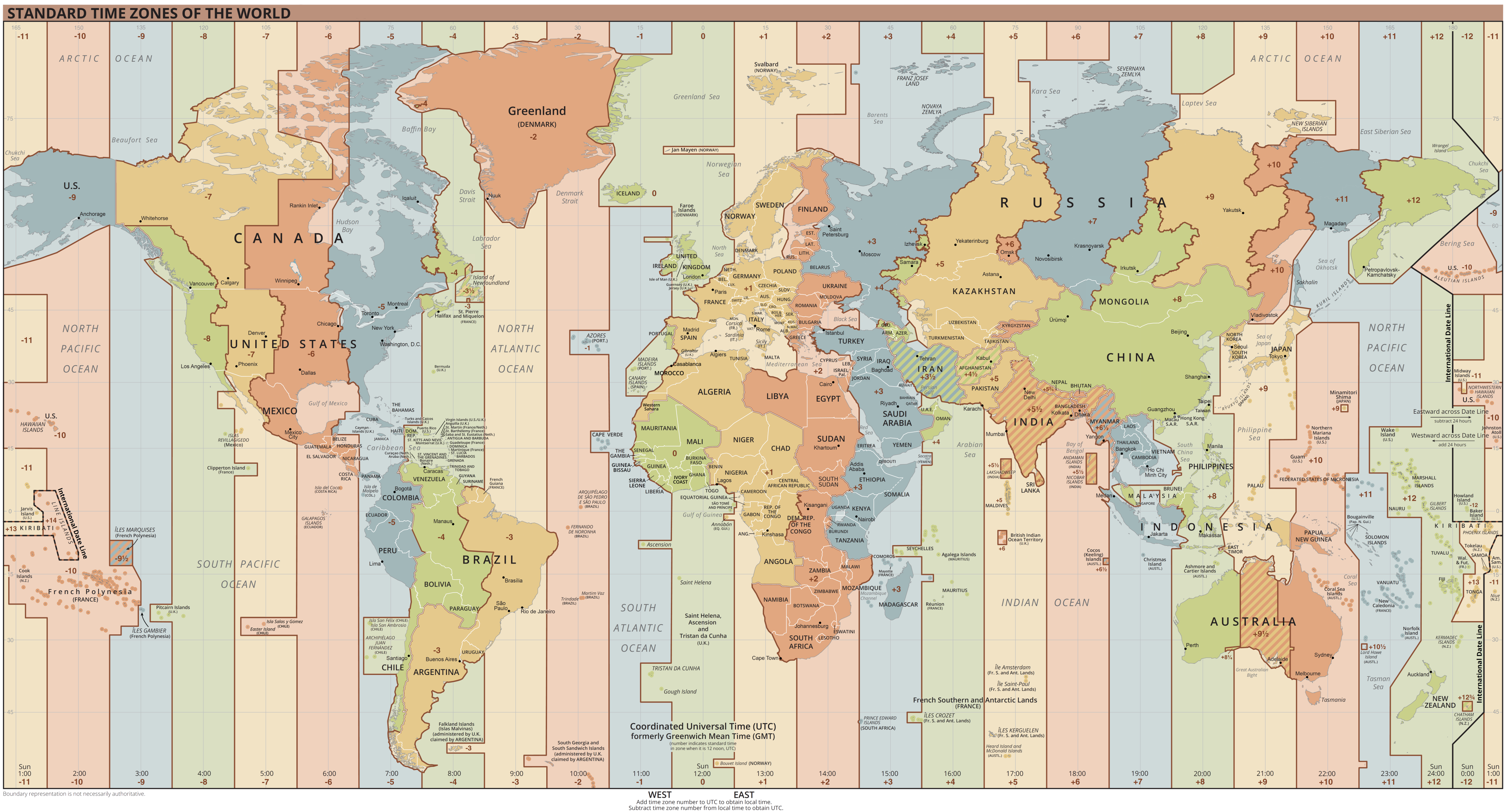

https://time.is/Samoa