What makes you believe temperature isn't accellerating? CO2 in the atmosphere won't go away on its own for hundreds of years, and trapping more and more heat will have exponential effects leading to chaotic climate instability. CO2 is not declining, even in the pandemic year it is still rising sharply way beyond extreme levels for tens of thousands of years: https://www.co2levels.org/
CO2 concentration will mix with other gases, so the dynamic is different. It is still concerning even though the numbers work differently than temperatures. CO2 accumulates over longer time, so appear smoother also.
"If this trend continues, by the end of the next century atmospheric CO2 would approach 900 ppm—just below levels during the Paleocene thermal extinction 54 million years ago."
That's my point. It won't continue. Nothing grows to infinity. CO2 levels are rising due to an increase in emissions year-over-year. This increase is guaranteed to stop on its own. We don't know what happens if emissions stabilize at current levels. Perhaps CO2 concentration will continue to rise for a while, perhaps it will stabilize rather quickly. Absent any other factors, the long term trend is always for CO2 levels to (slowly) sink.
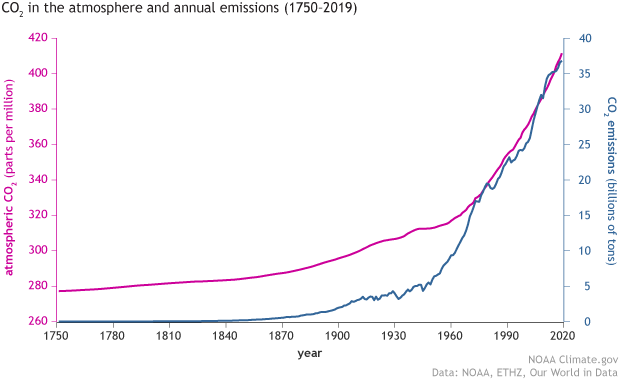
If I naively extend the following correlation, just going from 420 to 520 would require adding another 30 Gt of CO2 of annual emissions (almost doubling current levels):
Same problem, you're name-dropping an extinction event which has, at best, a speculative relation to climate change in general and CO2 levels in particular. Certainly you will find such events where changes in CO2 coincide with extinction, but you will also find events where they don't.
> Lots of countries are looking to go from 1950's economy to modern standards, many live in rural areas that develop etc.
That is true and I'm not ruling it out, but that then begs the question what difference (if any) the comparably small population of already developed countries could make by curbing their emissions.
> Why do you believe CO2 tends to drop?
The cycles of the past million years. After every sudden peak, CO2 levels drop... until the next peak.
> The accumulated CO2 don't follow emission drops in the graph.
For one, there have been no sustained drops in emissions. Secondly, these graphs have different smoothing functions applied to them. Still, they do track each other pretty closely. Around the time of WW2, you see several years of constant CO2 levels, despite increasing cumulative emissions.
> Humanity is driving faster downhill without any brakes.
That's the mental image you like to use. I like to use this one:
Sequestration, basically. All of those fossil fuels we burn today have at one point not returned into the atmosphere. An increase in CO2 also leads to an increase in vegetation. Ocean acidification is a concern that I can't dismiss, but that's true of many concerns and I can't cater to them all.
> Those CO2 peaks mark descents into Ice Ages and cataclysmic events during millions of years.
I was referring to the interglacial cycles, these are not cataclysmic per se.
As for the descent into an ice age, according to the interglacial cycle, we were right on schedule for that. Perhaps our ancestors will thank us for averting it?


Please see David Attenborough's "A life on our planet" (Netflix) what exactly may happen and what to do before it's too late: https://www.youtube.com/watch?v=KglanVLBVrc