The first few citations are circular, they link to articles about the book being discussed or the authors of that book.
Where are they getting the “80% of new households ... will be these one to two person households” stat from? No citation, of course, because it’s not true. I won’t be surprised to see that used in future articles and linked back to this interview, however.
The anti-homeownership propaganda seems to be growing with articles trying to tell us “you don’t want to own a home!”. If an ounce of research was conducted it would be clear how many people want out of cities and into homes.
My wife and I are going into the third season of trying to buy a house (SoCal). Every half decent home sells in its first weekend and, in our experience (6 offers), for all cash and over ask. This is the norm in many other areas from what I’ve read.
To me, the real story is “Millennials want to buy homes and start families but the older generations aren’t moving out of the suburbs fast enough”.
"The anti-homeownership propaganda seems to be growing"
I see this a lot in UK articles too, berating people for wanting a boring detached house and a garden somewhere quiet, when they could live in a shoebox in the city. It seems to be a bit of anti-middle-classism, mixed with environmental concerns and a love of central planning. Some of the same thinking that lead to brutalism here, IMHO.
I’d love it if some of the people downvoting your comment would explain why. For me, it really resonates.
I think a major driver of anti-single-family-home advocacy is simply that the kind of people who become urban planners are the kind of people who personally love the crush of the city and the close proximity of their fellow man. It is also fueled by the interests of developers and, to a lesser extent, social justice advocates.
At least some it has aspects in common with other collective action problems. (See many of the current discussions around remote work.) There's a perception, somewhat warranted, that if they can't persuade other people to adopt their preferences, it's going to be harder for they themselves to live in a world where teams are colocated, cities ban cars, there's more mixed use zoning, or whatever. And the arguments perhaps work better if they're framed in terms of productivity, environmental impact, etc. as opposed to "I like it this way better."
Housing and transportation seems to have two local maxima: car dependent or high density. A walkable high density area with apartments and mass transit. Or free roads, free parking, and sprawl that reinforce each other. If you try to bring a car to a dense area you become frustrated with traffic congestion and expensive parking and insurance. Likewise if you try to maintain an urban lifestyle in most of America you will be braving long waits for a bus and pedestrian hostile layouts.
As usual in this type of threads, I don't quite understand what Americans mean by 'walkability'.
When I was in high-school, I spent 2 weeks in the USA, on Long Island. I could walk for an hour and not walk across a pedestrian. There were often no sidewalk (when there were, I wasn't sure I could use them, as to my foreign eyes, being detached from the road, they where running though properties :-D ), but what's the problem with that? There was almost zero traffic, since the areas are low-density residential; much less than on my country roads. I could reach the ocean, I could reach playgrounds/playfields, I could reach one street with shops, I could reach... the high-school. No transit was needed. But I was alone in the streets/on the roads. I didn't understand why the older kid (16?) of the house was already driving a big car to go to high-school...
When I look at Google Maps, a huge proportion of those suburbs areas seem to be within a mile of a either a shop street or a supermarket, and often some playfield too (we don't have that many over here). The grid pattern makes access easier. So I am puzzled. It seems very 'walkable' to me. Of course accessing those supermarkets by foot or cycle ranges from unpleasant to maddening because access was generally only planned for cars. But that's much more easily fixable than redesigning the whole zones.
Now if you work 15 miles away, that's something else, but does this come into 'walkability' concept? No density is going to fix that: even in a big dense city, your job, or your next job (and even more your partner's!) is almost always going to end up on the other end of the city after some time. Walkability cannot help there, so I reckon jobs location shouldn't weight on the concept much.
I lived abroad in a pretty US-sprawl-like place. A huge majority of detached houses, a few rowhouses, a handful of short flats buildings, with supermarkets in place of the town centre. Basically no small shops, but a few bars between the supermarkets. I was living on one side of the town, and I was walking (winter) or cycling (summer) everyday to my workplace on the other side of the town, 2 rivers and 1.5 miles away. I would shop on the way back home. Easy, simple, practical. No transit is needed. For me it is walkable. But it seems it isn't, for many people I read here, because they would declare similar areas in the US as non-walkable.
I now live in a municipality, where density is 8 inhabitants / km² (20-25 inhabitants / sq mile). But most people live within half-a-mile of the village centre. It has enough small shops for your daily or weekly needs; if you wish, there's a bigger shop/small supermarket in the next village, 2 miles away. There's a guy who is over 80 years old and who lives at the farthest point in the municipality, 1 mile away. He comes shopping almost everyday, by foot, on the road that passes in front of my house. So for him I guess it is walkable. But what if we ask all the 40-something who live 4 times closer, but who prefer to take their car, and drive 2 times 10 miles to go a big supermarket. They'll swear they need their car, for those countrysides are not walkable! Heck, my neighbour works in the centre, that is one quarter miles away (5 mn walk, 1 mn bicycle) and takes her car to go to work.
It's not well-defined. To many people, it has a pretty high bar. For them, it means you can walk to most of the shops you need, restaurants, public transit options, etc. in a comfortable way. And, yes, it often assumes there's a multitude of jobs that can be accessed without a car because the need to own a car--tends to make it more difficult to live in a walkable neighborhood.
> There's a perception, somewhat warranted, that if they can't persuade other people to adopt their preferences, it's going to be harder
Sometimes it is true. Imagine you wish something like the Spanish town model: a very dense centre, and nothing else than the centre, so wherever you are in the town, you just walk/cycle/drive less than a mile and you are in the fields, the hills, or other forms of 'nature'. Density located in a single point would also enable easy and efficient point-to-point public transit between similar towns, by the way.
Anyway, you can't have this if you take the French route and allow suburban sprawl. It will spread 5 miles around in all (free) directions. Then it doesn't matter if you densify the centre (following the mantra "density is good and efficient" which we hear all the time here), people living in the centre (and most of the suburb) will not have access to 'nature' unless they use a car.
(What actually happens in terms of densification in France is generally worse, because densification of the sprawl is not made in the US style with huge buildings in a very dense, punctual, centre, but it is made along some axes or in some areas here and there. You end up with some average density everywhere, while the infrastructure hasn't followed. And cannot follow, because the density itself is spread, instead of being in a single point easily served. The elected from those areas say they want to combat sprawl, but they make it worse for everyone this way.)
On the other hand, I agree that cities, or urbanism in general, shouldn't be designed for what I call the 14-28, like it is often asked on this site. Or at least it should be the only goal and it shouldn't be the goal everywhere. What I mean by 14-28 is people who are in a great demand of interactions, who want to meet people, a lot of people (of course it depends on individuals, I just arbitrarily peeked those figures). It has always been like that, teens and young adults have always wanted to leave and discover the world, to multiply experiences, good and bad ones, and are attracted by the city lights. That's something we must acknowledge, and we'd better provide an environment for that.
BUT that must not be the end of all things. When people get a bit older and become parents, most of them
tone down and wish to be in less hectic areas, that's just a fact we can observe, even if it doesn't match our own ideal. And that's like it until their death, you can find a few people who will move to a city for their retirement but most who move will move the other way. Same for kids: until a certain age, they are satisfied with the presence of their parents, schools, and a handful of neighbouring kids, they have no need or desire of a large and dense city.
So most of their life, people don't care for having a big concentration of people where they live, and on the contrary favour a bit more space and a bit more quietness. Urbanism shouldn't blindly optimise for the former (density).
Upvoting this comment while it's still visible... which it won't be for long. I too am a little saddened by what feels to me like a classist anti-suburb attitude here on HN. Maybe I'm just oversensitive. But I grew up not rich and not safe. Am very, very happy that I can own a few acres 2 miles away from a Costco and 13 miles from the (currently dormant) opera.
I didn't make a value judgement on those reasons, or at least that wasn't my intention, though I can see why someone might take it that way.
I think the environmental concerns that feed into it are often quite valid, spreading endless suburbs across places like the UK is not a great idea. But I don't think criticising those who aspire to have more space is a good outcome.
The tone of the comment is very whiny. There’s this sense of the poster feeling threatened by other people’s preferences. An article discussing how a lot of young people prefer cities is somehow “berating” them. It’s a small-minded and insecure attitude. I know we are not supposed to discuss downvotes on this forum, but that is why people are downvoting it.
I'm not threatened by anyone's preferences, if you want to live in a city that's great - I live in the centre of a small city (300k people?) right now. I wasn't specifically talking about the linked article either, I have seen a lot of articles in recent years in the UK taking an anti-suburban line.
What I'm drawing attention to is that the bien pensant class in the UK seem to have started to tell us it's wrong to want the life that people have aspired to before. And that this is something we saw some decades before with brutalism, pushing people into spaces that designers and architects wanted them, not places they wanted to be themselves. There seems to be a desire amongst some architects and planners to push people towards their ideals of higher density housing, in particular, trading out much in the way of private space to much more social living.
Not everyone wants that. It's not wrong to want to live in smaller urban spaces with that trade-off, but it's not wrong not to buy into it either.
It's also an under-discussed part of the YIMBY movement. Wanting a boring detached house and a garden somewhere quiet is generally categorized as NIMBY in these discussions in my town. I grew up somewhere quiet and residential with trees and sky and space, and I liked that. It has a ton of jobs nearby, so it's gotten crazy expensive. But if you don't want to bulldoze the single-family homes and build high-density, you're the problem. Doubly so if you are lucky enough to afford said home.
I sincerely hope remote work takes off so the geographic network effects of all the jobs being in the same place are less important. It would make low density much more viable for those of us who want to see the sky and maybe a tree every once in a while.
People preferring detached houses is fine. Just take off the subsidies and let the market choose the mix between suburban houses and high density housing.
It is literally illegal to build apartments in many areas of the United States. That's because of local zoning laws limiting how many residential units are allowed per acre, minimum parking requirements, height restrictions, setback requirements, etc. The US government intervened in the mortgage market to make low interest 30 year loans broadly available (if a homeowner defaults and the foreclosure sale is not enough to cover the loan balance Fannie Mae & Freddie Mac are the investors holding the bag). Toll-free highways make commutes from suburbs to downtown possible.
> People preferring detached houses is fine. Just take off the subsidies and let the market choose the mix between suburban houses and high density housing.
Exactly. If someone wishes to own a detached single-unit residence, fine. I'd prefer they didn't but that's not my decision to make for an individual.
The problem comes when people want to control what's built within a quarter or half or full mile of the residence they own. (And, no, before someone comes at me with this specious reasoning, there's a huge difference between "build a nuclear power plant next to a daycare" and "different types of housing near each other.")
As a matter of public policy, I will always advocate that we do the environmental and financially efficient thing of building closer-in and closer-together. (We gotta add in some standards for noise transmission, too.) But preserving a specific type of housing in a specific location in amber forever is not reasonable and should not be continued.
I wouldn't be surprised if what contributed to this message is the same emergent corporatist message that individualism /career progression is what really matters in life. Not that there is some conspiracy, but that media always tends to push whatever narrative requires people to give away the most money (or stay in debt working as wage labor).
The Enlightened Liberals Who Will Save Us From Ourselves cannot tolerate the unwashed masses living independently without big government and high taxes. This is why rural dwellers are cast in the media as knuckle dragging racists
Interesting take. You realize that suburban living is subsidized by urban living[1]? The suburbs don't generate enough economic activity to be self-sustaining.
Unironically this. If I stay in my big city my projected outcome is nothing but poverty in old age. Once a man stops caring about partying and getting laid the freedom to own something substantial and build on it is the new sirens call.
> The anti-homeownership propaganda seems to be growing
I don't read this like that at all. It seems much more a reflection of exactly the difficulty you're describing: lots and lots of people like you want to find big suburban family homes but are priced out, and the suburbs are (awkwardly and somewhat unfairly) infilling to accomodate more modest and denser neighborhoods to house them.
The unfortunate truth is that "The Suburbs", as you and many people imagine, simply don't scale. So the actual neighborhoods we're building in the urban periphery are having to change. Recognizing that fact isn't "propaganda".
It is not just a commentary on what's happening, as you describe in your first sentence. There's also a distinct assertion on what must happen going forward, to the opinion of the speakers.
Suburbs don't scale. Yet, cities don't scale either. This is why people get priced out or want to move out and most cities have been low growth modes for years.
I find it interesting that recognizing that the path of least resistance (suburbs) may be slowly and haphazardly changing (true), is ccheered by all academics.
Yet I don't see any expert opinion about about having cities be more receptive to change to accommodate growth....
Sure sounds like a NIMBY from academics about their cities, no?
Cities do scale though, they have scaled for thousands of years and will continue to scale. The history of human life has seen the median human living in a denser and denser living situation. People are priced out of US cities because the current cohort of property owners wants to treat cities like suburbs (slow growth, restrictions) not cities. Look at any major US city excluding NYC and the vast majority of land in the city is zoned for single family homes.
Cities do scale, but the low-density "Suburb City" that describes large parts of the US doesn't scale feasibly because the property tax / sales tax per square foot of property is insufficient to cover the city infrastructure to maintain it. The answer, unfortunately, is more growth, in an almost ponzi-scheme like fashion; new property tax revenue covers the cost of replacing roads and sewers from much older districts of the city and so forth.
You can see this in how cities tend to go full blight very quickly after the jig is up (e.g. Detroit, probably the largest example, but many midwest rust belt towns too).
I live in a "semi-rural" part of a European country between two major cities and I'm surprised at how immaculate the arterial road is that I live on, between the cities (kind of a "country road" that parallels the highway). Where I lived in the US before, similar roads were full of wheel-eating potholes. But then again, property prices here are through the roof because the government heavily regulates growth, so that's where they get the revenue.
> There's also a distinct assertion on what must happen going forward, to the opinion of the speakers.
I just went back and re-read the article. And... no, I don't see that at all. The tenor of the thing is almost 100% empirical, describing change without advocating for it. (To be fair this is largely a "book review" kind of thing and I haven't read the book itself.)
Politics really has infused everything now. Is it really not possible for you to read a straightforward description of urban growth patterns without seeing a... I dunno, I guess agenda-driven plot against your way of life? You do realize you can't vote your way back to unrestricted suburban growth, right? There just isn't the space for it.
Is it possible that there's a possibility that in fact, your assumptions could be wrong ? For an article that is 100% empirical as you say, i hardly see any citations, like user theNJR OP said.
Take for example my "way of life". How would you react if i told you that I am a resident of a major urban center of +2M people ? And I have lived in such a city all my life ,including my formative years ?
IMO a lot of the “propaganda” are people/planners just being realistic about your options. There’s not enough in it for most communities to build the new or cheaper suburbs you feel entitled to or legislate kicking older generations out of their homes by overturning Prop13 or whatnot.
Even when the olds do die out, you’re not going to get some discount. Newport Beach is never going to be Detroit.
I mean, you sort of prove the point: Right now you're trying to find a suburban home in SoCal. There are suburbs everywhere, and most of those places are far cheaper than SoCal. Likely with better schools, no bidding wars, and possibly even better "suburban" amenities. So why are you looking in SoCal and not those other places?
The urban core the suburb is tethered to matters more to buyers than they're willing to admit directly.
I consider it often but can’t find a suitable replacement. Having grown up in rural Maine I’ll spare you the other excuses and acknowledge that I just love the weather here.
> Where are they getting the “80% of new households ... will be these one to two person households” stat from? No citation, of course, because it’s not true.
Do you have a source to cite for your claim that it's not true?
This source supports the claim that "something like 80%" of newly formed households will consist of only one or two persons, at least for the period 2018 through 2028.
(Also, it seems odd to suggest that the reason a person didn't provide a citation for a statistic mentioned in the context of an interview is because the statistic isn't true.)
The link you provided does not in fact back up that claim. It shows a demand for 15.1m new homes, with 8.4m of those being one or two person. That’s barely over half - nowhere near 80%.
In fact it does. The projected 15.1M new homes needed is not the same number as the projected number of new households, for reasons the text explains clearly.
It projects 12.1M new households, 8.4M of them either one-person households or married couples with no children (which presumably means a two-person household, although I suppose it's possible some of those might have a third person living with them, e.g., an elderly parent). Only 1.6M of new households (married with children) are obviously more than two persons. The remaining households are 0.6M unmarried with children, which could be two or more persons, and 1.5M unmarried living with other adults, which could also mean two or more persons. It's not impossible to get somewhere close to 80% from that.
At any rate, the comment I responded to asserted that the expert in this field said something obviously untrue, yet offered no evidence except his own personal experience shopping for a suburban home in one particular American city, as if that proves anything at all.
"This source supports the claim that "something like 80%" of newly formed households will consist of only one or two persons, at least for the period 2018 through 2028."
It kinda makes sense that newly formed households will consist of one or two people. Does it mention how long they are expected to stay that way?
I lived in a condo for many years. Mostly worked pretty well, except when the one set of neighbors had a...sanitation...problem and we all got a rat infestation. (Ever seen what happens when rats knaw through the sewer drain stack? It's hilarious.) Or when the DJ-in-training moved in and we got to listen to his music until 3am.
I too have noticed a trend of anti-homeownership propaganda. Here's what I can't figure out. Why does "anti-homeownership propaganda" exist at all? Who has something to gain from it?
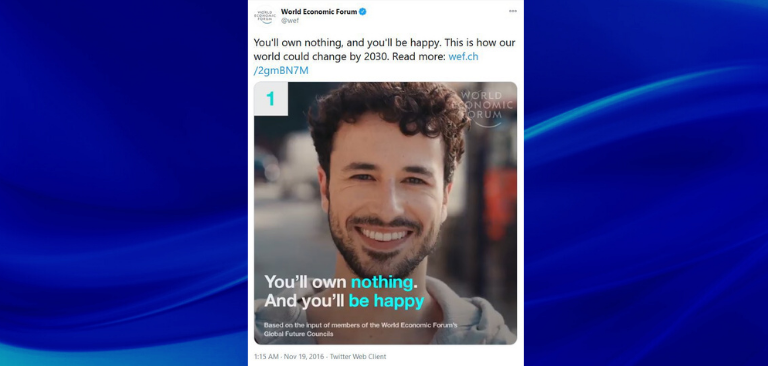
I don't know but it reminds me of the pro eating bugs propaganda, and this recent "You'll own nothing. And you'll be happy"[1] ad from the World Economic Forum. They're trying to get the plebs to not want their own homes or possessions.
I get no use out of the vast majority of objects in my house on a day-to-day basis. I know people in my community need objects that I have. I know people in my community have objects that I need. If they/I had those objects when they/I needed them, the entire community is more productive and "worth more."
If you have ever lent tools to anyone you will quickly realize why this kind of utopian sharing doesn't work. Most people have terrible standards for caring for or maintaining things even if they are their own things, much less someone else's. Thus the stigma against lending or borrowing tools in the trades.
I think we've been sold the suburbanized, car-and-home-ownership-centric, "American Dream" for so long, that other options have been actively neglected if not sabotaged.
* Stability is poor. You can lock in a 30-year fixed rate mortgage with a predictable payment (effectively hedging against inflation), but there's little to no recourse against landlords doubling your rent next year or refusing to renew your lease.
* Fully pedestrianized, live-work development is still a scattershot novelty, often requiring heroic efforts to get zoning and incentives set up, but the 1000-hectare, 900 houses and 4 golf courses, 700 km of roads that curley-Q and cul-de-sac, master-planned community, has been raised to an art form.
* Attempts to support public transit are not just forgotten, but aggressively fought, in part because buses/light rail/subways are considered services for undesirable groups.
* The whole urban-renter situation tends to be treated either as a "well, it's just poor/minority/etc." as a subconscious motivation to allow stagnation, or handwaved as a transient situation for the "successful professionals" -- they'll eventually move out to a McMansion so it doesn't matter that their experience is lousy for a few years while they save a down payment.
Unless the wealthy/successful/influential embrace this lifestyle, there will be limited momentum to improve it for anyone else.
I wonder if you (and OP) are conflating "anti-homeownership propaganda" (perhaps some exists) with anti-single family housing zoning "propaganda"? I follow land use topics pretty closely and I'm not sure I've seen any movement I would describe as "anti-homeownership" so I'm wondering if this is a perspective i'm just not familiar with.
Both can be problems. The lack of housing just big enough for a single, maybe couple, with an occasional guest (friend/etc) that later becomes the first baby's room. The lack of overall social stability to promote relationships.
In more modern terms, also the lack of a home office for each working adult; because society still hasn't digested the possibility of remote-mostly working and how that can be a good thing, rather than the hell many are facing during this pandemic.
My guess from most of my 20s and 30s living in big cities- when you live in a tiny apartment almost anything you do from food, entertainment, exercise, transportation is a repeated consumption expense since you don't have space to actually own anything, repair anything, wash anything or buy in bulk. Now that I live in a suburb I give away way less money just to exist.
Presumably if one owned many homes and rented them out they might benefit from increased renting demand. Though the resale value of the house might also go down with less people buying so Idk if it balances out. My perception from London is that resale prices continues to go up even if most people rent but Idk if that's accurate or generalizable.
People who are struggling to pay rent. American public policy favors homeowners over renters. Suburbs were popularized with government intervention (toll free highways and government backed mortgages). We could choose to relax overly restrictive zoning and change tax laws to throw city dwellers a bone.
Starting with Millennials and Gen Z, you've got 2 generations for whom homeownership is fast becoming a pipe dream without at least one of the following: very high paying job, inheritance or other help from parents, moving to a very low cost of living area (which the hurts job prospects).
Anti-homeownership propaganda appeals to them. Why wouldn't they look for upsides in their situation?


The first few citations are circular, they link to articles about the book being discussed or the authors of that book.
Where are they getting the “80% of new households ... will be these one to two person households” stat from? No citation, of course, because it’s not true. I won’t be surprised to see that used in future articles and linked back to this interview, however.
The anti-homeownership propaganda seems to be growing with articles trying to tell us “you don’t want to own a home!”. If an ounce of research was conducted it would be clear how many people want out of cities and into homes.
My wife and I are going into the third season of trying to buy a house (SoCal). Every half decent home sells in its first weekend and, in our experience (6 offers), for all cash and over ask. This is the norm in many other areas from what I’ve read.
To me, the real story is “Millennials want to buy homes and start families but the older generations aren’t moving out of the suburbs fast enough”.