The inflation that did actually happen was in equities, startup valuations, risk-adjusted debt (interest rates are far lower than the underlying risk would be without QE), fine art, yachts, healthcare, college tuition, etc. None of these are in the CPI because they aren't consumer staples.
You're looking in the wrong place. QE doesn't go to families, so it doesn't increase the cost of milk, apples, or eggs. It went to the wealthiest banks and corporations, and wouldya look at that -- asset prices are inflated, "startups" have absurd valuations, and the wealth gap is larger than ever before.
The inflation is there, clear as day. You're just not looking in the right place and you think you're so smart because of it.
Your claim that Fed policy somehow doesn't have an impact on aggregate demand because it goes "to the wealthiest banks and corporations" is laughable for anyone with an elementary understanding of economics.
We're not seeing inflation because there would have been a huge AD collapse and deflation in the absence of Fed action.
THIS, so much this ... for years people said bottom-up stimulus plans would inevitably cause inflation. Injecting the money on top changes little, now it's just trickle-down inflation.
(and if this doesn't hold, I would love to understand why)
yep, also plenty of inflation to see at the grocery store. the 'family size' of cereal is actually the 'baby' size of a few years ago. that's how they can maintain the same price over time.
It's really easy to hand wave away all the inflation when you change the formula. They have so many "soft" factors they use and completely subjective ones that the reported inflation is in no way matched real world inflation. They only changed the way it was calculated because the national deficit was getting out of control. GDP is, simply, growth - inflation. If you can make inflation look lower you can make GDP look higher.
Because there's no indication of inflation let alone hyperinflation in any economic data or a 'currency crisis' whatever that means.
In fact a sharp decline in demand seems to have outweighed reduction in supply leading to if anything, deflation. (which is in line with data as inflation has slowed to about 0.3%, down a percent from last year).
Given how large the service sector is in particular in the US, and how strongly it is affected by social distancing measures, disinflationary preasures are very likely to persist for a while.
Sure, but the US economy doesn't just run on food. In that particular sector the price increases make inuitive sense, as consumption is expected to stay mostly steady while supply chains have been heavily impacted.
Inflation is measured, for very obvious reasons, by looking at the general price level of goods and services in the economy, not just any given sector.
I agree that there's little sign of unusually high general inflation, but you said "there's no indication of inflation let alone hyperinflation in any economic data", and the sudden rise in food prices is definitely an indication of inflation. You may want to coach/moderate your statements a little more in the future.
No, I don't need to do that to be honest. A 2% increase in food prices while the general price levels fall is not an indication of inflation unless someone redefines inflation and cherry picks data to advance their cause. (In this case the annual doomsday prediction about inflation, which is normal on HN with its substantial contingent of people who rant about fiat money).
Timescales matter; a 2% increase in food prices over a year would be an indication of normal inflation; a 2% increase over a month indicates above-average food price inflation. In either case, the evidence of inflation in one area does not mean there is generally high inflation, it just means one thing is increasing in price.
You can call it cherry-picking, but any presentation of data in this format will be guilty of that, so it's not a particularly damning indictment.
As I said before, I don't agree with the previous version of the other post, but I think you're being a bit broad.
I saw a chart about what hyperinflation in the Weimar Republic did the average family budget. The price of food skyrocketed and the price of just about everything else struggled to keep up. Before food/rent/fuel/other was each 30,30,30,10 percent of the budget. At the end food was 90% of the budget. Rent at 0.2% was a rounding error.
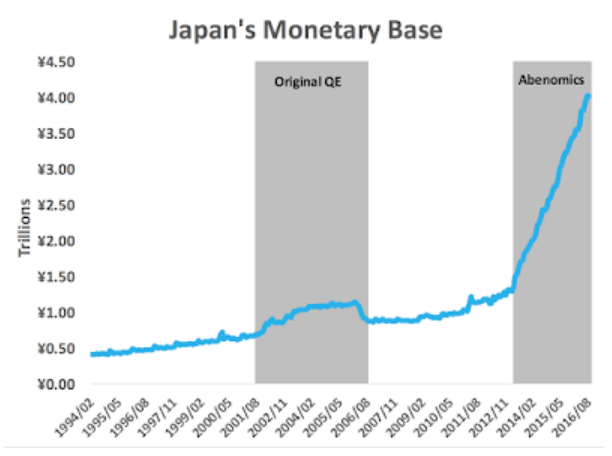
Probably someone who actually looked into what QE actually does--it's more deflationary than inflationary. Look at Japan--they've been doing forms of QE for decades. These Fed printing money, inflation trolls are almost never right even though they've been screaming about it for decades.
Trolls? Sounds like YOU need to understand what QE is. From Wikipedia...
"Quantitative easing (QE) is a monetary policy whereby a central bank buys government bonds or other financial assets in order to inject money into the economy to expand economic activity."
Sounds pretty inflationary to me. Especially when they buy up illiquid mark to fantasy assets that nobody wants and unloads them on the taxpayer to foot the bill while their buddies get a wad of cash to redeploy, into the stock market as it turns out. How is that not inflationary exactly? Oh, the destruction of those bad assets? Yeah I suppose but the socialization of that across America hides that and what's left is pumped up asset prices that cause the average American to have to work even harder to save up to buy and get worse returns because the fed's buddies got in first and drove prices higher.
Have you happened to look at the price of assets since 2008 vs. the actual recovery of the economy? Have you seen that S&P earnings were flat to down for the past 4 years going into this crisis? Yet what's happened to stocks? That's right they've tripled since 2009. Go look at any piece of real estate now almost anywhere vs. 10-20 years go and tell me there's been no inflation.
I realize it's different everywhere but the idea that we've had "low inflation" over the last 10 years is completely laughable because the calculation removes the highest cost items. The fed has effectively destroyed any price discovery on any assets. It's taken increasingly larger amounts of QE to goose the fake economy. And now for its encore it has overreacted to save their buddies and decided to lower rates to zero and tell the world that it will never let assets fall. How in the world is that not inflationary when you're flooding the market with free money and enabling those at the top to buy up assets and run up prices?
Every single person that works to earn USD and saves USD should be livid and rioting in the streets for the theft that's been, and continues to occur.
Also, your example of Japan isn't apples to apples. The US has the world's reserve currency and can print as much of it as it wants, Japan does not. Japan is a nation of savers so getting them to spend is harder than a US citizen.
We may have short term deflation and that's what the fed is scared of but make no mistake about it what they've done is inflationary as they will well overshoot whatever deflationary impact any failures have. Hell, they've made it clear that's what they're gonna do.
"Essentially, the mechanism of QE is that the Federal Reserve and other central banks are buying government bonds - but not directly from the Treasury Department. They’re buying government bonds from banks and paying for them with central bank reserves.
Crucially, these cash reserves are held by the central bank and pay an interest rate just as the treasury bonds did. In a sense the Federal Reserve swapped ten year treasury bonds with hypothetical Federal Reserve Bonds. That’s why you can see a graph of the money supply that shows a massive increase, and yet inflation has not spiked. The money never entered the economy - it is being held in a vault at the central bank (or more realistically is just a number in a spreadsheet). In practical terms it was an asset swap, not a true increase in the money supply."
> The money never entered the economy - it is being held in a vault at the central bank (or more realistically is just a number in a spreadsheet)
This is just incoherent. The money does enter the economy because now the banks can lend out money without their cash reserves dipping too low.
The reason that inflation is not spiking is because of the actual reason that the Fed reserve felt that it was necessary to engage in QE in the first place - huge amounts of deflationary pressure. Without the QE, we would be seeing deflation right now.
>Japan’s QE has been about four times that of the U.S. For the U.S. to do what Japan has done, the Fed would have to QUADRUPLE down and print $12 trillion in addition to the $4 trillion it has already printed.
>Try proposing that after the last round of QE finally fails.
>But even if the Fed tried to print a fraction of that, it still wouldn’t result in hyperinflation.
>Europe has printed almost twice as much as what we have, when compared to GDP, and it has very low inflation and lower growth than the U.S. That’s because our workforce and demographics are flattening, but not declining, as is the trend in Europe and Japan.
There are so many issues with this comment, it's hard to pin point any exact one.
You're right that it's idiotic to describe QE as "deflationary" (don't know where they go that idea) but QE is neither inflationary nor deflationary as either description would be reasoning from a price change [0].
> The fed has effectively destroyed any price discovery on any assets
Don't see why this would be the case - price discovery is relative.
All this talk about rioting in the streets - inflation is projected to go down in the next few years, which should help the average American saver. If there is any place for outrage, it's over the Fed not acting forcefully enough!
As it stands now, the Feds policy stance is contractionary, just as what followed 2008.
And yet you didn't manage to find a single one to point out and inform me of where I'm misguided, only a condescending response. Address any one of my claims about asset prices and the fed's actions distorting price discovery, please. I'd rather be wrong and realize that I'll be just fine not panic buying assets while free money is distributed and stocks rip to infinity, ignoring any and all fundamentals.
Tell me how I'm wrong about housing prices in the last ten years doubling and tripling in some areas. Tell me again how my USD are just fine and buying the same amount of goods and services they did 10 years ago, because I contend their buying power has been effectively halved by the moral hazard presented by the fed and Congress not allowing failures to happen. They're doing the exact same thing right now. How will this end? Deflation? I used to think so but not anymore. JPow even said himself that he has unlimited power to print money. They'll sooner destroy the currency than allow a deflationary depression to take hold.
Again, please, educate me as to what my "many issues" are with any of what I've said.
One is that overall inflation does not make price discovery problematic, because price discovery is a mechanism based on the relative pricing between things.
Two is that inflation is projected to dip below historical levels, so claims of a great inflationary spike that should be met by riots are not at all backed by empirical evidence.
You're not really engaging in good faith, so I'm not going to continue this chain.
Why don’t you google it instead of calling me an idiot. It’s not even slightly controversial, so all you jumping on this attack just reveal your actual ignorance on the subject. QE has led to deflation in Japan, not inflation.
> It’s not even slightly controversial, so all you jumping on this attack just reveal your actual ignorance on the subject.
It's not even slightly controversial that QE causes deflation? That's just laughable, honestly. Look, mainstream economists disagree with you [0].
QE usually occurs in the context of a real shock that induces deflationary pressure, but the fact that QE and deflation sometimes co-occur is correlation, not causation.
Your source does not say that QE was deflationary in Japan - just that in the context of a real economic shock to Japan's economy, the central bank's stance was contractionary. Indeed, they argue that more QE would have combatted the deflation.
You read all 22 pages already? Bullshit. First pages mentions deflation... if tripling their money supply did nott lead to hyperinflation what will? Page two:
>market peaked in the JulySeptember quarter of 1991. Those peaks were followed by steep declines in asset prices, culminating in contractions of real GDP in several quarters of 1992 and 1993 and deflation as measured by the CPI from July 199
My point was to find a right wing source that should be agreeing with you, but is agreeing with what I said. Or you can google it, there are a number of sources. Here’s another I linked above: https://www.economyandmarkets.com/economy/central-banks/japa...
It’s obvious you’re wasting my time tho. Read it or don’t, I don’t care but you’re clearly wrong and we both know it.
> if tripling their money supply did t lead to hyperinflation what will
If you read your own linked paper, you will see that this is not what occurred - monetary base was substantially increased, sure, but that is not synonymous with money supply and there was no corresponding increase in M2.
To your second link, which is not from a reputable source, your CATO paper directly contradicts claims of "huge" QE. It was actually smaller than the prior effort:
> Throughout his tenure, Shirakawa was a reluctant expansionist, frequently making speeches to the effect that QE alone would never succeed in reviving the Japanese economy. Originally, he had intended that the QE program would be completed by the end of 2011, but with the CPI still falling in November and December 2011, operations were extended through 2012 and 2013. Compared to QE1 in 2001–06, Shirakawa’s QE2 was a much weaker program
Here, again, is the paper you linked saying that QE policies combat deflation:
> For better or worse, the Federal Reserve did not counteract the downturn in money growth in 1931–33, either with security purchases or money creation, and thereby exacerbated the depth of the recession, the level of unemployment, and duration of the deflation.
Just because the paper "mentions deflation" doesn't mean that QE "causes" deflation - and the paper is pretty clear that this is not the case. Japan's QE was ineffective, sure, (for a variety of reasons) but in the absence of QE the deflation would have been worse.
Also, I will note that right wing sources are exactly who I would not expect to agree with me. They are hawkish on QE.
Where did I say anything about scale? You're moving the goalposts and arguing about a tangent.
>Also, I will note that right wing sources are exactly who I would not expect to agree with me. They are hawkish on QE.
Right wingers are the ones most likely to argue QE leads to inflation--see Ron Paul. This conversation is a waste of my time. You're basically saying "I'm an expert, I know more than you" which is an appeal to authority, and I'm just pointing out that based on real world examples that we have, that isn't what happened. Theory and reality are not the same thing. End of discussion for me.
Japan's never tried printing the global reserve currency. Yen was a much smaller local experiment. There's no guarantee that Brazil will continue paying USD for Huawei equipment indefinitely.