The article leaves out some facts. While Fennell’s participation in the attack (at the age of 17) was sufficient to convict him for murder, regardless of who ultimately delivered the killing blow, the jury may not have convicted him for murder (or a judge may have later commuted his sentence) had he testified against the man who directly killed the victim: https://www.newspapers.com/image/?clipping_id=19706704&fcfTo.... He refused to testify even though he provided a statement to the police at the time of his arrest stating who had performed the stabbing.
My beef with articles like this one is not that I think a 17 year old should get life in prison for a stabbing. I think nobody should. Our murder laws produce sentences vastly longer than Europe, where 15-20 years is a typical maximum sentence for murder, and longer sentences are reserved for people who are active threats.
Rather, my problem is the attempt to draw lines between more or less egregious conduct that don’t make any sense. Someone who along with three other young men tries to rob and ends up killing a man is among the most dangerous and culpable of criminals. Such premeditated group violence is the greatest threat to social order. Being 17 or acting as part of a group don’t make you less culpable.
The article directly addresses the idea that "Being 17...doesn't make you less culpable."
"Of just over 200 released, six have faced new charges, but only one has been convicted of a new crime, contempt. That’s less than a 3 percent recidivism rate. “When you’re looking at the percentages of the guys who’ve come back in court, and compare that to our overall, which is around 40 percent, you really know you’ve done a good job,” Johnson said.
That outcome supports a theory the U.S. Supreme Court first advanced in 2005, when it outlawed the death penalty for juveniles. The Court took stock of “evolving standards of decency,” as well as a growing body of neuroscience suggesting kids’ immaturity makes them less culpable than adults. It also emphasized that kids, more than adults, are amenable to change. The low recidivism rates likely also reflect the reality that criminal behavior declines dramatically as people age out of their teens and early 20s."
There are a million things incredibly unwise things I would have been far more likely to do at 17 than 27 now - I imagine this is a trend that will continue to likely progress for me individually, and I also imagine this isn't a phenomenon singular to myself.
The shockingly low recidivism rate seems to empirically support this notion as well, particularly when contrasted with the general recidivism rate. If these juvenile offenders were just as culpable as anyone else when they had committed their life sentence crimes, presumably their recidivism rate should be similar. 40 percent for the general population and 3 percent for this cohort so far suggests otherwise.
>There are a million things incredibly unwise things I would have been far more likely to do at 17 than 27 now
Yes, I too made very stupid choices in my younger days, which could have killed me many times over. I have not however, done things that could have hurt/killed others. That doesn't make me a saint, it just means I understand the value of human life and that I have no right to jeopardize the lives of others.
These 'kids' took it upon themselves to rob a person while armed, and stab him to death. This person, named Joseph Hayes, had his life forfeit for no doing of his own, his family and friends having him removed from their lives in a most brutal way.
I think the penalty should fit the crime, if you attack and kill someone unprovoked, I don't care if you are 17 years old, or if you were in a group. Your lack of regard for other human life means you should be locked away, both in order to keep people safe from you as well as a strong deterrent. Haywood Fennell is not a victim, the person he and a group of his friends decided to rob and kill is the victim.
>Haywood Fennell is not a victim, the person he and a group of his friends decided to rob and kill is the victim.
"Fennell was the only one convicted in the incident."
An African American 17 year old in 1968 talking to police without a lawyer ... While the crime definitely should have been punished, it sounds kind of questionable whether the justice was served here.
> Rather, my problem is the attempt to draw lines between more or less egregious conduct that don’t make any sense. Someone who along with three other young men tries to rob and ends up killing a man is among the most dangerous and culpable of criminals. Such premeditated group violence is the greatest threat to social order. Being 17 or acting as part of a group don’t make you less culpable.
Welcome to moral systems, like the law. None of them make much sense at all (even though they're necessary), but laws are particularly bad. Laws + governments saving money are a recipe for total disaster.
But mostly the poor and socially weak are victimized so nobody cares. And of course, whether it's a third world dictatorship or a modern "european democracy" as if that's an ideal: the state protects it's own enforcers. Even when they shoot a slowly moving van that refused to stop for border patrol, then refuse to bring a 2 year old they shot that was dying to the hospital for 20 minutes, their parents in chains (totally not to avoid responsibility, not at all), and then when the child went unresponsive, tried to free everyone they arrested (again, this had totally nothing to do with attempting to avoid responsibility) ...
when an offender kills (regardless of intent to kill) in the commission of a [felony], the offender, and also the offender's accomplices or co-conspirators, may be found guilty of murder.
Is this common in western countries, or one of those "only in the US and/or some third world country" things, like the "three-strikes" and the "death penalty" (even for juveniles) laws?
In this case, Mr Fennell watched a man get attacked, did nothing to help the man and even actively participated in the attack, and when the man died, Mr. Fennell protected the presumed killer by refusing to testify. I don't think it's a stretch, ethically or legally, to assign him significant blame for the killing, especially since his refusal to testify deprived his victims of any further justice.
That doesn't mean I agree with the life sentence (I absolutely do not), but twenty-five years doesn't seem wildly disproportionate to me.
Mr. Fennell protected the presumed killer by refusing to testify.
Do you have any evidence for this, or are you assuming that protecting the murderer was Mr. Fennell's motive? Was he offered immunity for his testimony? If not, then he has very good legal reasons, not to mention the Constitutional right, to remain silent.
> are you assuming that protecting the murderer was Mr. Fennell's motive?
Who gives a shit what his motivation was? The legal system sure doesn't. The effect of his refusal to testify was that the killer could not be brought to justice. His participation in the attack and his refusal to cooperate after the man's death makes him morally and legally culpable in that death. This is not controversial in any modern legal jurisdiction that I'm aware of.
> Was he offered immunity for his testimony? If not, then he has very good legal reasons, not to mention the Constitutional right, to remain silent.
You appear to be confusing this issue with our Fifth Amendment indemnity against self-incrimination. Mr. Fennell was not examined as a witness, but rather as a defendant. If you refuse to testify against an accomplice, and you expect to be somehow protected from a charge of accessory-after-the-fact, you're in for a rude surprise.
The felony murder rule comes from British common law. While it’s been abolished in the UK, Canada, and parts of Australia. But civil law jurisdictions have statutory crimes that achieve the same effect. For example, in Germany this crime probably could’ve been prosecuted as “robbery with deadly outcome,” which can carry life imprisonment.
I don't think it's unreasonable to say all participants in a crime that leads to a murder, even if the participant didn't personally kill someone, are equally guilty.
Obviously there is a question of proximity, but under Fennell's (presumably charitable) telling of events, he assaulted a man then returned with a co-conspirator; when the victim attempted to defend himself, Fennell threw a bottle at him and watched as his co-conspirator repeatedly stabbed the victim. Fennell then refused to help identify the co-conspirator.
>I don't think it's unreasonable to say all participants in a crime that leads to a murder, even if the participant didn't personally kill someone, are equally guilty.
I do. A murder verdict requires action, effect, and malice. How can you prove murderous intent if the defendant didn't personally deliver a lethal blow? His actions might not have intended death. We punish different degrees of homicide differently because they presume differing threats to society.
>I don't think it's unreasonable to say all participants in a crime that leads to a murder, even if the participant didn't personally kill someone, are equally guilty.
You don't? To me it sounds like the epitome of legal absurdity.
So, if 3 teenagers decided to steal a car and have a joyride (sure, a stupid and criminal decision, but tons have done it with nobody being hurt), and while trying to do so, the owner comes, and one of the teenagers kills him in the altercation, that means all 3 are "equally guilty"?
There are different felony murder rules in different jurisdictions, so you'll have to be specific about the rule you're taking issue with. In California, the rule applies only to participants in the actual killing, unless the victim was a police officer. In Illinois, any killing that results from the commission of a violent ("forcible") crime is attributable to all the participants of the crime, on the theory that the criminals could have foreseen that their crime would ultimately require them to kill someone, and went ahead and did it anyways. New York has an expansive felony murder rule, but also an affirmative defense that covers the case you described: if you didn't shoot anyone and didn't know your accomplices were armed, you might not be liable.
>There are different felony murder rules in different jurisdictions, so you'll have to be specific about the rule you're taking issue with.
I'm taking issue with the "equally guilty" the grandparent mentioned - so whatever jurisdiction does that.
I didn't start complaining about some specific jurisdiction, but about the general idea (as mentioned in the grandparent comment) that there are laws that deem people in such cases "equally guilty".
In fact, even the "tamer" California example you gave is already what I characterized as an absurdity (as all 3 kids in my example would be "participants in the actual killing", even though only one did the actual killing - and the others might never had done it or had time to prevent it, they just wanted to commit the initial act (e.g. the joyride).
The Illinois example takes it to even further levels of absurdity, if "is attributable to all the participants of the crime" (so e.g. even someone who gave them the details of the car to steal for the joyride, but wasn't even present in the murder. "on the theory that the criminals could have foreseen that their crime would ultimately require them to kill someone" -- is some "butterfly effect" level legal conception for such cases...
Yes. They chose to commit a crime and then an assault while armed. What you're trying to whitewash isn't joyriding, it's carjacking.
Even for the two that didn't pull the trigger, they could easily foresee the actions they participated in killing someone. If they don't like it, people should refrain from participating in carjacking. And if a member of your criminal group is an idiot liable to hurt someone, you should choose not to commit crimes with that person.
But you can see in your example if one of the teenagers holds the man down and another one stabs him that maybe they both killed him, even if only one of them used the knife?
>But you can see in your example if one of the teenagers holds the man down and another one stabs him that maybe they both killed him, even if only one of them used the knife?
Of course, that would be understandable. And I don't think that would need the "joint enterprise" construct to be tried as both being murderers in most legal systems.
The unjust concern is for the people who weren't such active participants in the act of murder (or called for it), but just on the "initial" crime.
Highly dependent upon context, I suppose. If you came forward to break an otherwise improbable or cold case, I could imagine that would warrant consideration.
Of course someone could sing to save their skin, and in doing so lie.
It’s a balance of incentives, I suppose? This is why we have a human system of law, not an algorithm.
This I corollary to the plea bargaining system in the US (make a confession in exchange for a lighter sentence than you'd get if you went to trial) which is illegal and considered a human rights violation in most other countries.
You conveniently glance over a key paragraph as well.
> According to later testimony from one of those officers, Fennell sat with him, and no lawyer, for about an hour that morning before agreeing to make a statement about the night in question. Fennell later testified that the officer told him that if he made a statement, he would not get more than a year in jail. He felt pressured and scared. “Nobody there was my color, nobody my age—all cops,” he said later. “They took advantage of my ignorance, of my family’s ignorance of the legal system.”
Why is this a key paragraph? What the cop told him was bullshit, but that's not illegal.
All I see here is that Mr. Fennell was briefly questioned by police, and gave a statement that appears to have been largely or entirely accurate. It seems he hasn't significantly recanted any of it to this day, except possibly to add some uncertainty to his recollection of a murder weapon.
When he laments that "They took advantage of my ignorance, of my family’s ignorance of the legal system", is he saying that if only he'd lawyered up then maybe he could have beaten the felony murder rap? Even though he plainly admits to assaulting the man and watching while someone else possibly stabbed him to death? We're supposed to be sympathetic to that?
> Being 17 or acting as part of a group don’t make you less culpable.
Yes it does. Boys do strange things, boys in groups do stranger things, like not testifying against each other, especially if they feel society has abandoned them and the world is against them.
Normal societies are set up to deal with that or prevent it.
Sorry, but a 17 year old knows what it means to rob and murder someone and knows the difference between right and wrong. That’s the basic criterion for culpability.
No they don't. Every human being is an effing idiot when it comes to group dynamics and you never know when a simple brawl or mugging turns into murder.
First of all, if we are talking law and regulations: You don't know all of them and they are constantly shifting. And let's not get into the details of local legislation whether you live in a union of 50 or like me 28 states.
Secondly morals, those are learned first through your family then friends, school, maybe a religious community and later on experience as you master your life on your own. Or rather you learn from your mistakes or the mistakes others make.
The Supreme Court was right to disallow life prison for minors and your 18th birthday shouldn't be the hard limit for that.
Are you really trying to claim a 17 year old doesn’t know murder and robbery are illegal, much less wrong?
I’m not saying anyone should necessarily go to prison forever, but any 17 year old of normal to somewhat below normal intelligence knows murder and robbery are both wrong and illegal.
I sometimes think when we're all bitching about how the world is going to hell in a hand basket (which it is, on many dimensions - maybe not in the aggregate as people like Steven Pinker argue, depending on how you "measure" that, but I think it's fair to say we could do much better), typically because of the foolish behavior of one "stupid" group or another, do we maybe underestimate the significance of how differently each of us perceive and conceptualize the world?
>> Being 17 or acting as part of a group don’t make you less culpable.
> Yes it does. Boys do strange things, boys in groups do stranger things, like not testifying against each other, especially if they feel society has abandoned them and the world is against them.
Both of these seem arguably "true" to me.
> Sorry, but a 17 year old knows what it means to rob and murder someone and knows the difference between right and wrong. That’s the basic criterion for culpability.
This seems arguably "true" as well. But then, what does the word "knows" mean in this context, precisely? For example, we all "know" we should be kind to others, and clean up our acts in general, but when your life falls apart as a consequence of not acting in the way you know you should have, does "know" have the same meaning as it did before? We use the same word for both situations, but is the meaning the same?
> especially if they feel society has abandoned them and the world is against them
There are all sorts of complications in life that we kind of just take for granted because our mind processes them subconsciously. If society has "abandoned" people, and they subsequently use that as a parameter ("excuse") during (conscious + subconscious) judgement of what to do in certain future situations, whose fault is that, and why? Shall we deal with reality as it "should" be, or as it is?
Another example is laws. Should we follow the law? Well of course. But then, are all laws just? Are all people equally/fairly impacted by our vast collection of laws? Are all laws enforced fairly? Are all people equally able to defend themselves? Should these and other questions have any bearing on how we organize our societies and planet, or how we judge others when they've "clearly" gone astray?
The world is an infinitely complex place, and each individual is infinitely complex in their own right. Different people, or even the same person, will often react in completely opposite ways under seemingly identical inputs. We all can clearly see this sort of thing when we're discussing the phenomenon in a philosophical context, but how well do we remember it when we're dealing with an incident in the heat of the moment?
How should people behave? How, precisely, do we even determine what is right and wrong, under various circumstances? Sure, we can write all sorts of complex legal regulations, but how do we know they're right? What does that word even mean in this context? Is everything a matter of fact, or are some things matters of opinion?
I believe until we start to get serious widespread appreciation of these complexities (which are rapidly grower larger every day in our hyper-connected and globalized world), and start to put as much effort into studying and mastering the soft sciences as we've done with the hard, we will continue to stumble around like overconfident but naive children until the complexity we've built (while spending no time learning how to wield it wisely) starts to collapse upon us.
> You see, I have had in my life a number of pleasant experiences. One of the earliest ones was when I was a kid I invented a problem for myself, the sum of the powers of the integers, and in trying to get the formula for it I developed a certain set of numbers, the formula for which I couldn’t get, and I discovered later that those were known as the Bernoulli numbers and discovered in 1739. So I was up to 1739 when I was about 14 you see. And then a little later I discovered something that I’d find out I just may have invented a thing which we now call operator calculus. That was invented in 1890-something. Gradually I was inventing things that came later and later.
> But the moment when I began to realize that I was now working on something new was when I read about quantum electrodynamics at the time and I read a book, and I learned about it. For example, I read Dirac’s book, and he had these problems that nobody knew how to solve that were described there. I couldn’t understand the book very well because I really wasn’t up to it. But there in the last paragraph at the end of the book it said, “Some new ideas are here needed.” And so there I was. Some new ideas were needed? OK! So I started to think of new ideas.
Hundreds of thousands of scientists and technical people have been thinking (and collaborating) really hard for centuries, and marvel at what they've built! Do we have anything remotely comparable in the social sciences, which is arguably a much harder problem space? Where would we even look for new ideas?
I think at least part of the answer lies within the ideas of people who are often considered the oddballs of society. I like this video of Terence McKenna interpreting Plato's ideas:
> How can you tell one theory from another, and is science better than religion and this and that? After a lot of arm waving it should be conceded that the final call is aesthetic. That, because we are monkeys, because we are so far from God, we cannot set knowing the truth as the standard for choosing among the models we can produce. We must set our aesthetic compass towards the more true. What Wittgenstein called the true enough. And then the question is well how do you how do you recognize that? Well, this is a rich field of human study called philosophy of science, or theory, epistemology, and ontology. How do we know what is real?
> But Plato, who all the rest of philosophy is a footnote upon, Plato said that the key lay in the concepts the good, the true and the beautiful. The good, what is it? Tricky, tricky, tricky... The true, what is it? Trickier, even trickier... The beautiful, what is it? Easy to discern! The beautiful is easy to discern. You are going to be condemned to live out the consequences of your taste, really, really, and if you have no taste, you know, God help you! Because you are you are self condemned to an appalling nightmare. You won't be getting it, all the subtle stuff will go by you, while your head is filled with Kant, nonsense, foolishness. So again, the the metaphor of the dream and of making choices based on beauty and beauty is downloaded into the human cultural milieu largely through dreams. So that's the way to set the compass, not toward truth, not toward the good, not because these aren't fine things, but because they're so slippery.....but toward beauty, and with that in place, to my mind, life hope follows as a natural consequence.
Spiritual jibber jabber and woo woo as a result of excessive drug consumption? Sure, at least somewhat. But what if it is also simultaneously true, at least to some degree, but as a result of mankind's hubris (also a powerful drug), no one bothers to take a serious look into it? It would be kind of cosmically hilarious if the answer was right in front of us, but we were too stubborn to look.
In recent news, gangs of youths have attacked people and killed some.
Sad to say, but locking these people up until they're old may be the best answer. (Maybe the death penalty would be better?) The wrong thing to do is to turn them loose back into society when they have a decent chance of hurting someone else.
I would agree more if this didn’t sound like a ‘boys will be boys’ defence.
If you want to fix society you also have to leave that kind of belief in the past.
In this case, the guy is also black. The article avoids the racial aspect and focusses on other circumstances, but American society has never been favourable to black folk.
It's a biological fact that's recognized in our having a separate system for juvenile and adult defendants. We can't leave it behind, it would be cruel and unusual.
That’s more like kids being kids. Boys will be boys is a heavier loaded version and is often used by parents and adults to excuse bad behaviour (or bad parenting).
> His $830 a month included a few hundred in Supplemental Security, but he mostly relied on close to $600 in Social Security spousal benefits, thanks to Bernadette’s years in the workforce. He said he’s offered to refund her a portion of that, but she declined.
It's generous of him to offer to give her part of his spousal benefits, but the word "refund" makes me wonder if there is some confusion over how spousal benefits work. They aren't taken from the other spouse; their benefit remains unchanged.
A somewhat simplified explanation: if one spouse (or ex-spouse in some cases) is receiving more than twice the Social Security benefit of the other, the one with a smaller benefit gets theirs "topped off" to be half of the other's benefit.
It this case Bernadette may be receiving $1660/month in benefits. Haywood's benefit of several hundred dollars is increased to half of that, or $830. Bernadette still gets her full $1660.
There are various requirements and conditions that may change this amount; I'm assuming both spouses are of full retirement age.
Anyone receiving or about to receive Social Security benefits where one spouse earned significantly more than the other would do well to look into this.
>Imprisoned for decades for a crime he committed as a juvenile
So, for a single, first time, first degree murder, Pennsylvania gives "a mandatory life sentence without the possibility of parole, including for juveniles"?
What kind of medieval backwater has such laws?
And how is that working out for them? [1]
Compared to e.g. countries which have much smaller sentences for the same type of crimes (especially for juveniles), in much more humane prisons, and achieve much lower crime rates...
For comparison, the guy who methodically mass shoot and killed 77 people in Norway, only got 21 years in prison (and in a vastly more humane prison, more like a Motel 8 than the hell-holes in the US, at that). Perhaps that's another extreme, and I'd be OK if he went in for life, but the Pennsylvania extreme is medieval, inhumane, and depraved too. Too much Old-Testament inspired morals...
The Norway example is misleading for people who are primarily familiar with US sentencing. Twenty one years is the maximum sentence one can be given initially, but it can be extended five years at a time at the end of the sentence. There are no limits on the number of five year extensions, so a twenty one year sentence can effectively be a life sentence.
It's basically equivalent to a US sentence of life in prison with the possibility of parole after 21 years, though the default is that you're released after 21 years, as opposed to the US default of you continuing to stay in prison unless you can convince a parole board to release you.
Recent changes means the new max is 30, with a possible mandatory 20 years served. The 5 year indefinite extension remains (but as far as I understand extensions are not intended as punishment - rather as a way to protect society in the face of a real risk of the prisoner committing new, serious crimes on release).
As I recall there is some newfangled stuff about "terrorism" on the books - but the change was apparently mostly motivated by the NOKAS-robbers possibly being released earlier under the new "forvaring" (containment?) system than under the previous 21 year "life sentencing". (they'd be given a max of 10 year mandatory imprisonment even with a 21 year sentence).
Yes, but it will also be far more common to be actually released at the default (or close). Heck, "real" life sentences in the US are handed out as peanuts...
Also no death penalty.
Plus much much nicer prison terms (very human hotel-like prisons, permission to study, no solitary crap as punishment, very low recidivism rates, prisoners can take leaves -like "vacations" and come back, etc).
If the system in Norway releases based on someone being a continued threat to society, which is the case if I understand it correctly, the government will probably have to make an argument to that effect, and it strikes me as very possible they might lose that argument at some point.
For the Norway example, that offender is being held in solitary confinement in very harsh conditions, and it's very likely his sentence will be extended indefinitely. It's not a good example of a more human criminal justice outcome, considering how harmful we know the effects of solitary confinement to be on mental health of those held.
I can’t tell if your post was being sarcastic or sincere.
It’s a first degree murder. Putting him away for life is what he deserves and others (law-abiding free citizens) should not have to bear the risk that he would commit more extreme crimes given the extreme nature of the crime here. That’s not medieval or inhumane, it’s appropriate and common sense.
The relation you imply between laws, sentencing, and crime rates between different locations and demographics is not causal and doesn’t account for various other factors, and is therefore irrelevant.
>It’s a first degree murder. Putting him away for life is what he deserves and others (law-abiding free citizens) should not have to bear the risk that he would commit more extreme crimes given the extreme nature of the crime here
Well, not all cultures on Earth, especially western ones, share the above revenge-motivated old-testament-style viewpoint on the law. Perhaps that's why they manage to have less crime, less recidivism, less mass shootings, and far lower murder rates, with far-far lower incarceration rates and no death penalty.
In the end, a society gets what they deserve, and those revengeful reap what they sow. Like those clinging to guns for "protection", and dying from gun crime (or from their own gun-owning family members).
>The relation you imply between laws, sentencing, and crime rates between different locations and demographics is not causal and doesn’t account for various other factors, and is therefore irrelevant.
Well, it's not the only factor, but it's a telling part of the belief systems, structures, and overall culture a society operates. It's not just lost in the noise of other factors, as it's irrelevant. Culturally, and in terms of recidivism etc, it's very relevant (like the long history of racism inspired incarceration is). Besides, the proof in the pudding is in the eating.
As they say, "so, how does that work out for you"?
> In the end, a society gets what they deserve, and those revengeful reap what they sow.
I bet you apply this very selectively.
> Like those clinging to guns for "protection", and dying from gun crime (or from their own gun-owning family members).
You would not want mandatory monitoring collars, sacrificing privacy to massively reduce the homicide rate, would you? We are willing to bear substantial risks to preserve our rights - I would argue it comes from an intuitive understanding of how dangerous it is to be powerless. So why not apply that same logic to gun rights?
There is more to the question than 'Would fewer people die' - after all, if that is all you consider, then monitoring collars would get an unreserved 'Yes!'.
This same logic could get that kid a milder sentence - give him a punishment more just considering his age and role in the crime (subjective, I know I know), despite the risk to "law-abiding free citizens" that he kills again.
If you're not willing to risk death, your own and that of others, to protect your rights, then you will have none.
> In the end, a society gets what they deserve, and those revengeful reap what they sow. Like those clinging to guns for "protection", and dying from gun crime (or from their own gun-owning family members).
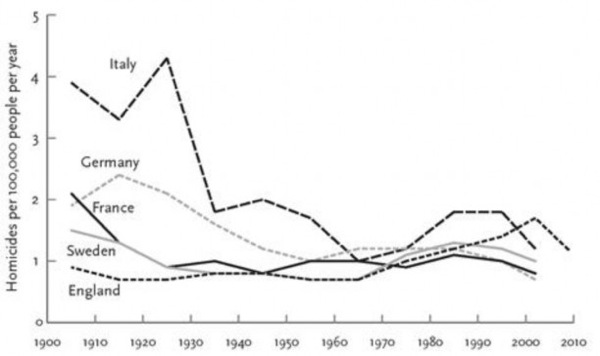
During the 20th century the US homicide rate fluctuated from 5-10 per 100,000. In Germany, France, Sweden, and England, it was below 2.5 the entire century.
Focus on France and the UK (since Germany and Italy were unstable states during part of that time). In France, the first gun laws date to 1938. By that time, France’s homicide rate was about 1 per 100k, about what it is today. The first UK gun laws started in 1920. The UK murder rate has gone up since that time. (Handguns, which are responsible for most US gun homicides, weren’t banned in England until 1997.)
How did gun control cause low homicide rates in those countries when homicide rates were already very low (at current levels or even lower) before gun control? That’s an “umbrellas cause rain” argument.
Likewise, the death penalty wasn’t eliminated in the UK until the 1950s. Criminal justice reform in Europe generally happened in the 1960s and 1970s.
How did criminal justice reform cause European homicide rates to be lower when they were already very low?
The idea that gun control and lenient criminal laws caused lower homicide rates in Europe contradicts all the available data. The only supportable conclusion is the opposite: that Americans remain resistant to lenient criminal justice laws or disarmament because America is a much more violent society.
It was much worse in the past -- and even before the abolishment of the death penalty the drop are related to a more lenient system (e.g. check France during Les Miserables times, or England and Dickensian conditions), plus increased prosperity of course.
Now go to the "Global long run perspective" and click to add United States. Historically worse than Europe (measurements start from 1900 but not so complete then).
I don’t see how that helps your argument. Gun control and leniency on criminal issues are a 20th century reform in Europe. England imposed the death penalty for pickpocketing until 1808. And prior to 1920, you could buy guns at the store with cash in the UK. Gun control didn’t exist in France until 1938. Yet the homicide rate of the UK was lower than it is today, and 1/7 of what it was in the US at the time. By 1800, it was basically at modern levels, at a time when 220 different crimes carried the death penalty, including theft or forgery. How can leniency on criminal issues be responsible for low homicide rates that were low before they were implemented?
>And prior to 1920, you could buy guns at the store with cash in the UK. Gun control didn’t exist in France until 1938. Yet the homicide rate of the UK was lower than it is today
According to the graph it wasn't. It was 0.8 and higher between 1900 and 1960, 0.7 in 1962, had a rise in the 70s and 80s, and is historically smaller than 1900-1960 today at 0.5 (since 2012 or so) while still not having the death penalty.
Which chart are you looking at? The fifth chart in the page shows the homicide rate of England at under 1 per 100k in 1900, and over that from 1990-2010. World Bank data says 1 per 100k in 2017, and there has been a spike in the UK last couple of years. 0.5 in this decade is almost certainly incorrect.
If your point now is that the murder rate didn’t go up after getting rid of the death penalty, that’s probably true, but a different argument than you made previously. (We should keep the death penalty because some people deserve to be executed for their crimes. But death penalty versus life in prison probably doesn’t serve as a deterrent effect that would lower the homicide rate. It’s a moral rather than utilitarian policy.)
Europe had much lower homicide rates before criminal justice reforms. Arguably, the causation runs the other way. Europeans were willing to have more lenient sentences because homicides were less of a pervasive problem.
>Right. Homicide rate in the UK went up significantly after hangings were abolished
Only slowly (following a trend that was there before 1964 - heck, 1053 with the death penalty is higher than 1965 to 1968 without it), then had a sudden jump around mid-90s and a peak in 2002 (35 to 40 years after the abolishment for that to be a factor).
Note also, as the article itself notes, that the measurements were diluted, for example after 1972 "the crimes of murder, manslaughter and infanticide" where lumped into homicides, and that before 1998 they counted multiple murder cases as a single homicide incident.
On top of that, the rate is low enough to be diluted by cases like "58 Chinese nationals who suffocated in a lorry en route into the UK" in 2001, "173 victims of Dr Harold Shipman" in 2013, "52 victims of the 7 July London bombings" in 2006, and so on.
Even with such over-reporting, meanwhile, the whole time, the rate was so far below the US (who had the death penalty the whole time) even at its peak, that it hardly makes the case:
You are assuming that having killed once he is more likely to kill again. Depending on the person this may not be true. A psychopath will likely kill again and so should be locked for good. OTOH someone who was not a psychopath and took this chance to rethink his life choices might be about as harmless as the next guy.
Before you say "we can't tell one form the other" let me say this: we cannot tell if we never look. Northern European countries have gathered a lot of expertise in this area, the least we can do is look at it, then maybe look to expend our own understanding of psychology.
Someone else in this equation didn't get to think their life choices, maybe for no fault of their own, because they're dead.
So, how long should you be in for a murder? 30 years? 20? 10? 5? If punishment really got nothing to do with it at all, and the perpetrator is really, really ashamed from just the trial and conviction, why not let them go after that?
>People die all the time, it's a tragedy. But I would not want the laws of my society to be built on the idea of revenge.
Why have punishments for breaking the law at all ? According to you it's built on the idea of 'revenge', right ?
OR maybe it is good for society if people who murder someone are locked away so that they can't kill someone else, AND maybe it's a good thing that people who have no qualms of killing someone at the very least find the idea of spending a large if not their whole life behind bars a strong deterrent.
But hey, 'people die all the time, so let's just forgive those who take the life of someone else, we don't want to come across as a vengeful society'.
I am happy I don't live in your society, it sounds like a paradise for sociopaths.
I was asking what's the motive for the punishment. Is it to revenge the victim or is it to prevent future victims. I'm not advocating for no punishment at all. The parent was asking what's enough (30,15,10,5 years?). I'd choose a number of years sufficient to deter effectively.
Sociopaths are another matter entirely. It's not a question of deterance or revenge anymore. We may be forced to lock them away indefinitely.
But i see it's getting political and words are turned in my mouth. have a nice day
Every seemingly irrational law or socioeconomic convention that you may find in the US can ultimately be tied causally to the bleeding of contempt for people of color into the design process. It short circuits our logical faculties and results in policy that is as cruel as possible, limited only by the extent to which it is perceived that such policy may affect white Americans and the mandate that said policies be at least nominally race-neutral (though this is only a recent development, itself only predicated on the obvious and embarrassing effects its absence has had on our economic well-being, both internally and globally).
I understand that HN's demographic is likely to be skeptical of this, but I submit as proof the changes to these laws and conventions that happen when they begin to effect white communities. The most infamous of late is, of course, the War on Drugs and the response following the onset of the crack and opioid epidemics, respectively. Cruelty, in the name of deterrence, was 100% the name of the game, until the face of the crisis changed, and suddenly compassion was a more efficacious strategy.
Likewise, gun control is now a serious topic, where for much of the past two decades it was not, even for the left. This change is due mostly to an increased perception of susceptibility to gun violence, which was largely isolated to the black community for years.
I don't understand how these people are supposed to re-integrate.
You commit a crime...cool, we are going to send you to a boarding school for criminals, where you are subjected to a ton of violent behaviour, that is heavily structured and limiting on your freedom...and in twenty years (or whatever), you are going to come out and be expected to be like everyone else...okay...
It would be interesting to ask how the behaviour of those who work in these institutions is effected by this environment...if this is the case then it is clearly non-rational to believe that people in that environment 24/7 are going to be fine after they come out.
(I don't have a solution to this either...just a chimp throwing peanuts from the gallery).
Okay, as they used to say on slashdot when I frequented it (and maybe they still say it), "I know I'll be downvoted for this ...". But I'll say it anyway:
Mr Fennell was a good candidate for parole. I'm not opposed to parole for him. He didn't need to be in jail any longer.
But ...
Why oh why can 5 un-elected people be allowed to decide that his incarceration was "cruel and unusual punishment". As one of the dissenters on the court noted, mandatory life sentences "could not plausibly be described" as unusual when a majority of states endorse them.
Giving the Supreme Court the power to do this is IMO very bad. People simply love love love it when the result is something they agree with, but what about all the other decisions?
Brazil has a big crime problem, a huge murder rate.
There are people who simply aren't fit to be in society. There are people who get out of prison after their 5 years of good behavior, and immediately a week later are raping someone again. Why do the victims have less value than the violent murderer/rapist criminals?
It is simply shocking to me you think it's ok for murderers to be out of jail if they have a job.
What do you propose to do about this, besides blaming Bolsonaro - btw the criminals already all have guns, it's only the lawful citizens who have a hard time getting them. There's a reason everyone in brazil has to hide behind electric fences, security systems, etc.
If you read your second reference, you will find that it states that the decline in homicides is not due to Bolsonaro (it started before he got into office) - in fact, it states that certain types of murder have had increased rates.



My beef with articles like this one is not that I think a 17 year old should get life in prison for a stabbing. I think nobody should. Our murder laws produce sentences vastly longer than Europe, where 15-20 years is a typical maximum sentence for murder, and longer sentences are reserved for people who are active threats.
Rather, my problem is the attempt to draw lines between more or less egregious conduct that don’t make any sense. Someone who along with three other young men tries to rob and ends up killing a man is among the most dangerous and culpable of criminals. Such premeditated group violence is the greatest threat to social order. Being 17 or acting as part of a group don’t make you less culpable.