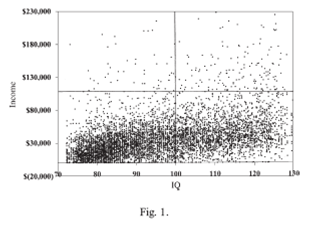
Oh, this is an easy one. When people say a child is talented they mean he or she is a good learner. But a talented adult is a good do-er. High potential people who fail to make an impact are stuck in child-mode, because that is what they were always praised for.
> Or they realised that praise is meaningless and 'making an impact' is overrated.
indeed, by success people usually mean make lots of money, is this the definition of success to a High IQ person? maybe, but perhaps it means why can't I solve Fermats last theorem or something they think is important.
Or put it this way - smart people will only solve the problems smart people see as problems.
> Or put it this way - smart people will only solve the problems smart people see as problems.
Or I would say 'as interesting' and we know it can be hard to find intersections of interesting and well paying.
The habit I formed was enjoying using creative connections. Unfortunately there's lots of reasonably well paying posts for repeating yourself and it's easy to be complacent in your career and have hobbies instead.
Leaving aside company founders who hit it big, the people I know who are the most successful (i.e., as employees), don't seem to be of above-average IQ, and many of them have poor written communication (i.e., spelling, grammar, etc).
What makes them successful is that they are good at interacting with other people, and they can communicate quickly and assertively and see to it that important things get done.
Such people tend to work in customer-facing roles, such as sales, client-relations/customer-success, but they could also be in internal roles like marketing or management (including engineering management).
But contrary to stereotype, the ones I've seen be effective are not insincere charmers/schmoozers, nor bullies. They are just fast-thinking and fast-acting and able to work their way through organisational barriers and ensure things get done in order to satisfy their customer or meet the business's requirements.
On the other hand, I've observed that a lot of people who may be of above-average IQ are less comfortable with social interaction, and less able to engage in the kind of fast, confident communication you need to do well in an organisational context.
It's not always the case of course - plenty of highly intelligent people are great communicators, and these people can do the best of all.
But where a person of "high intelligence" does not achieve great success, low confidence/assertiveness/effectiveness at interpersonal interaction is likely to be a significant factor.
An advantage less smart people have over more smart people is that they get genuinely more impressed over others achievements. This means that they have a much easier time giving genuine compliments which is one of the most important parts when forming relationships.
Either that or the ability to tell white lies with a straight face is negatively correlated with intelligence.
Or maybe there are just different kinds of “smart”, and that it’s possible to be effective and successful in admirable ways even if you’re not exceptionally great at completing IQ-test puzzles.
The kinds of people I described in my first comment have all seemed as smart, honest and respectable as anyone else I’ve known.
The communication range is a great point, one I've never considered before. It's the reason I enjoy the comments on HN so much: for once, a good deal of the discussion is in my communication range, and the rest is above it, pushing me higher, rather than encouraging me to sink below.
I think this is one reason alcoholism is so common among high IQ people, including several of my relatives who are very social. They socialize but they always drink beforehand. The drink lowers the effective IQ, bringing them into a much wider communication range. I had the same experience just the other day.
Of course. I said one of the reasons, not the only reason. I just wish I could connect with more people without drinking. There are a few people I can do that with, but they're few and far between.
I tried giving all my friends psychedelics, but most of them preferred the beer. I'll have to keep looking.
mdma is the most common (and thus somewhat well researched), but there are quite a few, though barely any of them legal (or rather: not yet illegal in the case of most "research chemicals", RC for short).
Except presumably everyone else at the party is also drinking alcohol. Are you saying people with low IQ can drink alcohol and be unaffected, or that people with high IQ are lightweights?
Assuming that at some point people pass out (equivalent IQ=0), there will always be a moment when the effective IQ of any two people will match, no matter the initial IQ.
A quick search on "communication range" returns as first result a post [1] calling it a myth.
"Hollingworth was writing specifically about leadership, and in childen, but Towers extrapolates the point to claim that any kind of ‘genuine’ communication is impossible across a 30 IQ point gap"
Intelligence is orthogonal to financial ambition and work ethic.
There's no particular reason why someone with a high IQ would (e.g.) want to build a startup or any other kind of business, or would necessarily have a talent for corporate politics.
It's just as likely someone with a high IQ would consider corporate culture pointless - even stupid.
High intelligence people often seek other goals, such as the relatively complete freedom of time while having their needs met.
You only get so many years... How many of them are you going to spend doing something that you care about rather than some "means to an end" task?
To many smart people, real agency is the only currency worth persuing... And you only need a trivially achievable amount of money well spent to achieve relative freedom.
So many zero marginal cost things can provide 10-100k a year, and if you are willing to travel, 10k is more than enough to free up 100 percent of your time.
Projects you may wish to work on might require additional funding, but for anything worth doing, it is usually easy to find people willing to throw money at it IME. There's more money looking for good ideas than ideas looking for money, especially as interest rates begin to go negative.
This post seems based on some questionable assumptions. IQ is not the ultimate metric of intelligence and may at best measure only one facet of intelligence.
On a related note, I recommend David Robson’s book The Intelligence Trap.
I tend to be a critic of IQ and (non-applied) psychology in general, but there must be something of value here.
I've experienced something similar to what is described here, and I know many others who experience it too. The highly intelligent people I've known who are also high achievers tend to have an exceptional work ethic, and yes many (but not all!) come from relatively privileged backgrounds.
Communication problems may in some cases be linked to autism spectrum disorders, but in other cases highly intelligent people are actually exceptional communicators.
However, I would agree with those who point out that intelligence is manifold and encompasses far more than the narrow logical puzzles found in IQ tests. Some people who are not even remotely 'book smart' seem to possess acute intelligence of another kind.
Disclosure: Yes, I read Nassim Nicholas Taleb (who is pretty popular here I think).
> The trick is to find your own tribe. It took me forty years to find mine. The group of people where you really can feel yourself belonging, where you can be one of all. Only then will you succeed.
That was a spot on answer. But this last bit was the best, mainly because it universal. We all - high IQ on down - need others to be more successful.
If the question is about why some of them are not, then the answer would be the same as for everyone else: coincidence of other factors. And even with them in mind high IQ means higher averages, e.g. bottom 95% income at the higher IQ on average is higher than bottom 95% income at the average IQ.
Anyone can learn to communicate in a simpler way, otherwise nobody would be able to train a dog. However doing so in most communications is not only tiring, but also has some pernicious psychological effects.
The problem is not about using simple words (which I totally support, BTW), but the speed and complexity of grasping new concepts. Having to decompose, simplify and slowly explain each element of a concept, vs. just saying the thing once and the other person building on it. One is tedious and makes you think everyone is an idiot, the other is an actual conversation.
It's not just having to use simple words, but also simple concepts, simple topics, etc.
The real problem is that talking this way is exhausting. As if someone told you that e.g. you are not allowed to use words containing the letter "m". It is certainly possible, but it requires constant attention to something other than the idea you are trying to convey.
Talking this way feels quite different from talking to someone who uses the same style as you.
I would say that it all boils to "topic relevance". What is relevant enough to foment communication is too divergent in different IQ levels. That brings miscomunication and specially boredom.
You can't be that smart, if you don't figure out how to bridge the "communication range". Showing that IQ is a much too narrow measurement of puzzle solving ability, not related to being smart in real world situations.
You are conflating definitions, specifically making the mistake that IQ=smart. Tabooing "IQ" and "smart" [1], we can say:
Her hypothesis is that people who have some quantified ability to solve math/logic/verbal problems, find it universally easy to communicate with people with similar ability for solving such problems, assuming you control for other factors like quantified communication ability or quantified emotional intelligence etc.
Put this way, there is no obvious internal contradiction in her hypothesis, whatever the empirical support for it might be.
I can't imagine how boasting about superiority working out in well in the end. There has to be an Aesop's Fable short story for this.
Bragging about being smarter is a standing invitation to receive passive aggressive behavior from others. People will unfairly try to find flaws, and who can blame them? They're acting innately better than their peers - while at the same time not being wise enough to be humble / modest.
I also worry it ends up having a person with potential ending up hiding behind a cryptic / abstract facade, afraid of failing when not being an instant prodigy at a new skill. Don't we will have to work our way up and build a track record of some sort?
What does being intelligent mean anyway?
Ultimately, if someone wanted to be recognized as smart, wouldn't at least some "normal IQ people?" have to understand and appreciate the value of something they synthesized/made?
This isn't about boasting, nor it's about "wanted to be recognized as smart". You can be as humble as you honestly can, up to the point of avoiding showing achievements to other people for fear of their reactions (and believe me, I know this very well. You learn to behave like that quite fast), and yet the communication problems will persist. It's difficult not to become a misfit, to feel like you are fundamentally different to the people around you. The article mentions that your arguments won't convince "average" people, and neither do theirs convince us; this is also something I also feel deeply.
I guess I can't complain much; at least I got a good job. For a very modest definition of success I could even consider myself "successful".
Most people that you meet are so concerned about what you think about them that they'll barely spend a thought on what they think about you. So if you get bad reactions to showing your achievements, the problem might be that the other person feels like you are diminishing them in comparison.
From my experience, the trick is to always focus on the emotional side of things. If you say that you feel super happy because project X worked out as planned, the other person can easily relate to that by telling you about their project Y that worked out well.
You might not understand (or care about) the details of each other's achievement, but the emotions why you enjoy talking about it should be pretty much universal.
it’s just a bit funny that you included the parenthetical about your own experience, which mostly just serves to make sure you are also labeled as “very smart”. your whole
point could be made in general without signaling this to the reader. :)
I know :). I actually hesitated, because of that. To be honest I ended writting and sending it just because this is Hacker News and such things are much better received here. In Reddit, for example, I wouldn't have bothered.
Also, I'm not "very smart". I have a high IQ, which might be correlated but it's a different thing. EDIT: I strongly believe that a high IQ means, above all, a fundamentally different way of thinking. Which might make you smart, and which is the main cause of the communication problems.
-The most important quality to succeeds is the ability to perform in high stakes, inter-personal, coopetitive, status-seeking, small world games (politics).
-One of the most powerful tools to achieve results for an individual (and for a group ) is through the mastering of abstractions.
Puzzle:
-There seems to be a negative correlation between the willingness to engage in political games and the willingness to engage with abstractions despite the advantages both procure. (see the "Nerds" essay by Paul Graham [0]).
Funny hypothesis:
-Politics is the most dynamic, reflexive games there is. Abstraction handling requires (whether consciously or not ) to substract oneself from the world. Those two activities tend to exclude each other, or to consume a lot of energy when both running at full speed.
( they are polar opposite in 2x2 quadrant of [static,dynamic]x[contemplative,reflexive] )
-The silver linings is so much value can be created from mastering abstractions, that a small change in the conditions
of the political field (by improving one's attention to it, or by limiting artificially the field like in a elite school)
is enough to tip the balance.
There seems to be a certain amount of “Autistic Spectrum Disorder” mixed in with this. I imagine there are a few papers published with this comparison in mind.
This was my feeling too.. I suspect there's enough overlap between those people who are interested in completing IQ tests, and those on the spectrum to create the same effect mentioned by the author.
I found their comment about small talk particularly reflects this; My experience is that I can't engage in it with strangers as it feels like forced dumb chat, with the end result that a lot of people I casually interact with end up treating me like I'm mentally retarded.
Not applying intelligence on real-world aspects that will make you successful is very much non-intelligent.
Likewise, not being able to effectively communicate with a variety of people shows a lack of analysis, learning, etc.
IOW, people feeling in the situation that their "IQ" is unfairly treated should level up, by broadening their conception of intelligence and also applying it in more contexts.
Maybe success lies in being able to achieve your goals and realise your visions. If you decide to drop out and herd sheep, are you a good shepherd, or the laughing stock of the herding world?
I suspect this answer is missing an underlying point - high IQ is correlated with high ego. I find that there are wicked smart people in this world, who have also managed to overcome their own egos, and who get along well with anybody. They don't feel that there are topics that are beneath them, or that people are lesser beings because they like TV shows. They might not like the same things, but they accept people's differences.
The way I explain it to my kids is that your intelligence is just like the color of your hair. You are born with it. You can take actions to change it, to some extent. But there is zero reason to judge anybody for it. People are who they are.
Fully agree. I've met many high-IQ people who treat normal humans with a sort of "I'm better than you" disdain. And, obviously, being too arrogant will make communication difficult.
IQ tests measure specific abilities but not all abilities.
As for the definition of success, that depends on the individual.
For example, to be successful in academia correlates reasonably well with IQ. However, success in sales far less so. Many successful artists also have high IQ due to their spatial and creativity traits, however that doesn't mean that they'll attain high levels of profit from their art. Programmers often have high IQ, but that doesn't guarantee executive suite jobs with their high salaries and lots of perks.
> People with over 152 are effectively 'The Excluded', routinely finding their thoughts to be unconvincing in the public discourse and in productive environments. If placed in a leadership position, they will not succeed.
> The trick is to find your own tribe. It took me forty years to find mine. The group of people where you really can feel yourself belonging, where you can be one of all. Only then will you succeed.
Even if IQ tests measure something useful - and I'm skeptical of that - intelligence itself is far down on the list of traits needed for success.
Ambition. Confidence. Charisma.
There are probably others but the successful people I've known have those - and it's hard to tell (certainly harder then the IQ test implies) but I don't think those people were particularly smart.
I believe we focus too much on the individuals, successful people are successful because of the products they helped create.
Instead of analyzing the traits of successful people, we can devise and create frameworks which would help direct our efforts in an efficient manner to produce real value.
A common weakness (and one I sometimes share) is looking for exciting, new, and intellectually stimulating things to do, when seemingly boring, repetitive and hard work is actually called for.
A common example: startup founders who'd prefer to build new features (or worse, explore new tech stacks!) instead of the boring work of sales and marketing.
Absolutely. High intelligence and the thirst for novelty and stimulation that often comes with it can make it hard to focus on anything for very long. It also makes people lazy. You learn as a kid that you can achieve a lot with minimal or no effort, so you develop terrible work habits (or none at all). Bright kids who are brought up with a very strong work ethic are far more likely to be high achievers or at least successful at their chosen vocation. This work ethic is often a cultural thing...
Here's another question for you: without reference to IQ or academic achievement, what qualities would you associate with intelligence, or perceive as indicators of intelligence? Have you ever had a hard time figuring out if someone is really bright or not?
> Have you ever had a hard time figuring out if someone is really bright or not?
How do you define bright?
Assuming bright to mean able to achieve post-grad honors:
I feel like you could easily distinguish if someone is bright or not within a few minutes of chatting.
I think that regardless of the subject of discussion, there are a number of strong indicators in the way a person speaks. One example is confidence: very rarely have I met a person I'd call intelligent that is also absurdly confident in their beliefs.
I realise my above statement is highly interpretable. What I mean is intelligent people seem to allow for their assumptions to be flawed, and be open to being proven wrong, about stuff that they can be proven wrong on (i.e. belief about a mathematical postulate versus belief in an objective truth such as global warming is real).
If someone is not bright, then when you start discussing a topic that is outside their everyday experience (i.e. not their job, not their hobby), they only have three options: (1) ignorance and indifference "huh?" "I don't know, this seems stupid/boring", (2) repeating a statement they heard from TV or radio, but unable to e.g. explain what that really means, what would be the consequences thereof, and (3) just saying something completely random.
A bright person would be able to admit their lack of knowledge in the topic, but then do some independent thinking, or ask additional questions, or... something.
Usually the rate at which someone learns something is a good indicator. For a child that could be the rules of chess. For an adult it could be how long it takes to understand the parameters of a well designed job interview question.
My life was in shambles mainly because of ADHD. Once I found drugs that helped a bit I managed to start programming and it turned out I am very good at it. Even though it's still daily struggle to put even 2-3 hours of work it's enough to make mid 6 figures after taxes. I am very lucky to be that talented. I often feel I don't really deserve it as others work harder and will never find that much success.
If anyone of you is always told how intelligent you are but struggle in school and work I encourage you to get tested for various conditions. Diagnosis and meds can change your life even if it doesn't cure you.
Just pick one that does not need much research to get properly installed. It’s about learning the concepts, especially in the beginning.
At uni they made us learn two programming languages that have no use in real wold jobs to teach us concepts, one was even a functional one.
Python seems to be easy enough to begin with and useful enough with its libraries and frameworks to be the language for data scientists. That’s a good point to start at.
As are ruby or java or JavaScript.
This is self selecting nonsense with a pile of no true Scotsman and a good dose of mawkishness, very transparently downplaying the work of successful people.
I wouldn’t want to know you, whatever IQ you have.
I feel like this is a complicated topic. Two common reasons spring to mind....
1) Intelligent but interested in things which are not necessarily eat paths to becoming successful according to society i.e. R&D
2) Low emotional intelligence and therein poor social skills. Humans rely heavily on social connections and collaboration to drive value. I’ve often see clever people who think they are better than others but do not have the ability to get on. Some intelligent people think they are extremely logical but their decision making is often emotionally charged.
It's also worth noting that no one in the field of neuroscience (or genetics, for that matter) takes IQ seriously. It's solely an abstract toy for some psychologists to play with.
Real thorough math right there (quotations from your article):
> "[IQ] ends up selecting for exam-takers, paper shufflers, obedient IYIs (intellectuals yet idiots), ill adapted for “real life”."
> "It is at the bottom an immoral measure"
> "If you want to detect how someone fares at a task, say loan sharking, tennis playing, or random matrix theory, make him/her do that task; we don’t need theoretical exams for a real world function by probability-challenged psychologists"
> "Only suckers don’t have that instinct."
This is just a trash article by a bitter science denier. IQ-deniers are for me not much different from anti-vaxxers. Yes, you are free to criticize aspects of the test but there is no denying that people have different thinking speeds, as "immoral" as that fact might be.
Why did he write it up so badly? He could make his arguments so much clearer if he just stated them fully. Maybe this piece was meant for math PhDs, not a general audience. To me, it comes across as an attempt to impress the reader with the semblance of authority and knowledge, not to guide the reader through the reasoning. This style of writing is often used to hide bad reasoning, to gloss over weak arguments or deliberately deceive. He could have done a better job.
He wrote it badly, because his goal is to write something controversial, which will remind people of his existence and hopefully increase the books sales. The target audience are people who are already his fans, and will accept uncritically anything he writes.
It is possible to have a reasonable debate about whether intelligence is real, what exactly it means, and what outcomes it correlates with. This is obviously not the way to do it. This is pure clickbait, pretending to be smart math, because pictures with dots and number, plus textbook screenshots.
Some of the things he says make sense. But he exaggerates their importance, and completely strawmans his opposition. "If you want to detect how someone fares at [X], make him/her do that task; we don’t need theoretical exams" - thank you, Captain Obvious!
I believe it was a twitter thread that he unrolled and mashed up into a medium post. On twitter he's often abrasive and kind of a dick as a character, and the tone carried into this post. He's doubled down about it because his rant seemed to have angered a lot of people among his demographic following, so if you follow him you'll probably find more explanation.
>this piece was meant for math PhDs
Lol it is absolutely not meant for math PhDs. I think anyone with a bachelor degree could follow the math (probably, I don't know much about the university system works in the US).
“no one”? are you sure that absolutely nobody in neuroscience or genetics thinks IQ measures anything at all? maybe you should also clarify what you mean by “takes seriously”.
if nothing else, it measures your ability to take IQ tests, and IQ score has some correlation to “success” in western culture (note i’m not saying “intelligence” anywhere here).
Genetics happens to be my field and...yeah. IQ is just too far removed from an actual mechanistic explanation ("gene X does this which interacts which gene Y whose coding protein triggers a cascade onto receptor Z of the brain which...") and for a geneticist if you haven't got a mechanism you've got nothing. There are far more interesting, solid and construct-valid traits to study.
As for neurosci I'll admit it's second-hand knowledge from my social circle and colleagues, though it could be that I live in a bubble and neuroscientists are secretly terrorized to share their mindbreaking findings on the first component of a PCA.
>if nothing else, it measures your ability to take IQ tests, and IQ score has some correlation to “success” in western culture (note i’m not saying “intelligence” anywhere here).
This is circular, since many of the required tests to be "successful" are similar to IQ tests or "g-loaded" as people like to say. Even then, the correlation is weak beyond very low IQs.
There is a point that is missed here, even if some points seem familiar. Maybe I'm an outlier, but: I turn out to have top half-percentile IQ (as I'm sure many on HN do), which is not the disconnected genius level that the author describes, but still about two standard deviations above the average. I'm only moderately successful career-wise -- a "follower" in the author's words. Excellent grades from education. In professional life, not destitute and getting a decent amount of professional respect, but nothing outside of what you'll expect to find in a decent-sized company. Salary is likewise. No ambitions of being a boss. I can take technical leadership roles temporarily, if it feels like a good fit, and that's great fun. I'll get bored after a while, and it takes a lot of energy & focus to do well.
The biggest reason I can identify for this moderate and not spectacular level of success, is that I just don't care so much about being super successful in my career. I also crucially lack the energy and drive that some of super-successul people the author describes obviously has. Even if I was born in a millionaire family with excellent connections to power and prestige, I doubt I would have been an entrepeneur or a successful academic.
The vast majority of things you'll do in those professions just seem so boring and tedious. Elon Musk's 100 hour workweeks, all year every year, seems like hell. Ditto for most successful entrepeneurs I'm aware of. Even if they lead fascinating, cutting-edge technology development. I'd much rather spend most of my time learning new things, satisfying my curiosity, playing computer games or learning new skills. As well as spending time with the people I love, which means I deliberately choose to not work 50 hours per week in a high-demand software-related job far from home. I'm certain in a different life I could move to California and do much better, but there's so much in my life today I don't want to sacrifice to do that.
I've just never found a subject that interests me enough (money-earning or otherwise) to dedicate my full effort to it. There's certainly something to the author's points of being surrounded by like-minded people, but there's three or four of them near my hometown that I've met through university. We have fun and get along well, but we won't change the world. Maybe that's a waste. My goal in life is to be happy, not earn power and prestige. Sometimes I wish I had the drive and interest to do cutting-edge research and development in a new field, but when I visualize that, it seems like a lifestyle that will require cutting out so much of what I currently love.
It's probably not possible in the human condition to be truly happy, but I'm certain I'd be more unhappy if I spent all my time doing ambitious things that I don't have an innate drive for.
Maybe I could work super hard five years and then retire, but I'll most likely be able to retire early anyway. Anything can happen in those five years. It's not worth the risk.
This resonates with me a lot. All over my life, even when I was still just a student, I've had people telling me that I could do much better and that I could aspire to much more. I invariably looked at their proposal, saw a huge amount of work that I was definitely not willing to put, and I continued my path of having the minimization of stress as one of my main priorities.
I've mentioned this a couple of times here in HN: the real trick is to keep learning outside of your job. Don't count on your job as a source of intellectual satisfaction; if you learn something while on the clock, that's great, but that will come and go. Having a steady source of brain food outside your job gives you much more control and ends up being much more satisfying.
Also, never ever trade sleep hours for work hours. Sleep as much as your body wants, work as much as you are stipulated (i.e. 40h a week and no more), and squeeze as many satisfying activities (learning, in my case) out of the rest of the time. And yes, diversify if you want: this is why I dropped out of a PhD and started new degrees instead.
I guess that this applies to me because I have zero ambitions outside the purely intellectual ones. YMMV. I strongly feel like I would be much more miserable if I were more ambitious, especially taking into account that I've been, for a long time, acutely aware that time is much much more valuable than money.
I'd wager that it would be easy to argue that the majority of people who work super extra hard to become rich and successful have some sort of childhood trauma that they never recovered from.
So maybe the answer is simply that intelligent people can figure out why they feel a yearning for success, and then solve the root issues instead of joining the rat race like everyone else.
As a practical example, some guys work super hard to buy expensive cars to impress the ladies. But if you're a great conversationalist with a witty humor, you can probably skip the car, so you don't have the need for working hard.
There are people who seem to affect the qualities, habits, and quirks of 'highly intelligent' people, yet are probably not particularly brilliant (or even above average) themselves, except perhaps in some social sense. Any thoughts on that? Can you differentiate between the two without reference to IQ? If so, how? Do these people pay the same price for their quirks, and if so, are they better able to compensate? Are they likely to be more successful at whatever they do by appropriating the trappings of intelligence? Think of it as a thought experiment.
I can only speak to the Marine Corps, but there is a pretty structured/meritocratic method for being promoted.
At least for the enlisted ranks, your promotion potential is dependent on a couple of factors: how many people of a particular rank for any given job field are needed, your personal fitness scores, rifle range proficiency, professional military education completion, etc.
There is a certain degree of subjectivity, as you are given what are called "proficiency and conduct" ratings in the earlier ranks. In the mid-later ranks, you are given performance evaluations. Those evaluations are at least partly based off the factors I described above, though.
Interestingly, when you put in for promotion at the mid-later ranks, the people who make the selection are not in your chain of command. You put together a package and the decision is made by a board consisting of third parties.
In the earlier ranks, your performance/ratings is compiled into a score, then each month the Marine Corps issues a total scoring that must be met in order to be promoted.
It is by no means a perfect system, but it seemed mostly fair. It is also incredibly complicated, so I apologize if I did not do the explanation justice.
As someone who did coaching for lonely high-IQ guys, I know firsthand that there are lots of self-absorbed lazy pricks that feel like they deserve to be successful and loved just because they're intelligent. And the advice I hand out is always the same:
This world is run by normal people. Learn the ways that normal people use to express their emotions.
That regularly incites complaints, like the usual platitudes that they just want to be loved for who they are or that true love should just happen by itself. But the simple fact is that many of these intelligent guys feel like it's either too much work to learn about how normal people talk, or they are too arrogant to do it.
Especially when you use a lot of brainpower in one area of your life, it is very tempting to slide into intellectual laziness in other areas of your life. Lowest common denominator slapstick comedy is quite popular with my high-IQ friends. Nobody is super clever all of the time.
Also, I find it fascinating that the article presupposes that high IQ should lead to success, as pure intelligence is mostly just useless. Being rich is obviously helpful to your friends. Having good genes or being athletic is also obviously helpful for many tasks. But for intelligence, the skills that you derive from it are the important part, not the intelligence itself. And if you use your intelligence and your superior learning abilities to learn a useful trade and become a good communicator, you will most likely end up being successful. So this article is similar to asking: "People with strong biceps, why are you still unsuccessful?"
And lastly, I don't buy the concept of a communication range. Most deep connections are made by sharing emotions. There's no reason why your talking partner would need to understand the specifics of your mathematics problem, in order for him/her to be able to relate to you feeling frustrated about it.