Here are my viewing tips, based on my experience in the 1979 eclipse in Oregon.
You can photograph the eclipse, but you will have a much grander experience if you don't try. Photography is just a distraction from the awesome spectacle of the eclipse, including the phenomena that happen on the ground.
There will be plenty of other people taking great photos, so enjoy those after the eclipse. A total eclipse, viewed directly with your own eyes, is truly an experience of a lifetime. No photograph comes close.
Contrary to one or two other comments, eye protection is not necessary during totality and will prevent you from seeing the full beauty of the corona. It is perfectly safe to view the total eclipse with the naked eye, or even with binoculars. Only the partial phases need eye protection (and they definitely do). [1] [2] [3]
In fact, on the hillside we ended up at, something interesting happened. Most of the people wore dark sunglasses and faced away from the sun during the first partial phase, in order to get their eyes a bit acclimated to the dark. The partial eclipse isn't very interesting compared to totality, and the fun stuff at that point is happening on the ground: there are ripples of light dancing on the ground like you see on the bottom of a shallow stream. And you may get to see the shadow rushing toward you at 10,000 miles an hour!
The moment it reached totality, there were shouts of "it's total!" up and down the hill. Everyone took off their sunglasses and looked directly at the total eclipse. Many of us brought binoculars and viewed the corona with them.
The danger is that it is tempting to keep looking at the end of totality, when the string of beads starts to appear at the edge of the moon (where the sun is starting to peek through the moon's valleys), and finally the "diamond ring" where a larger part of the sun appears through the deepest valley. If you bring proper eye protection, switch to it the moment the string of beads appear, and definitely before the diamond ring appears! I recommend doing this after totality and not before, so you don't interfere with your eyes' dark adaptation before totality.
> Except during totality, when the Sun's bright face is completely blocked by the Moon, it is never safe to look directly at the Sun through a telescope or binoculars. During the partial phases of the eclipse, you must secure a special-purpose solar filter over the front of your optics before aiming at the Sun.
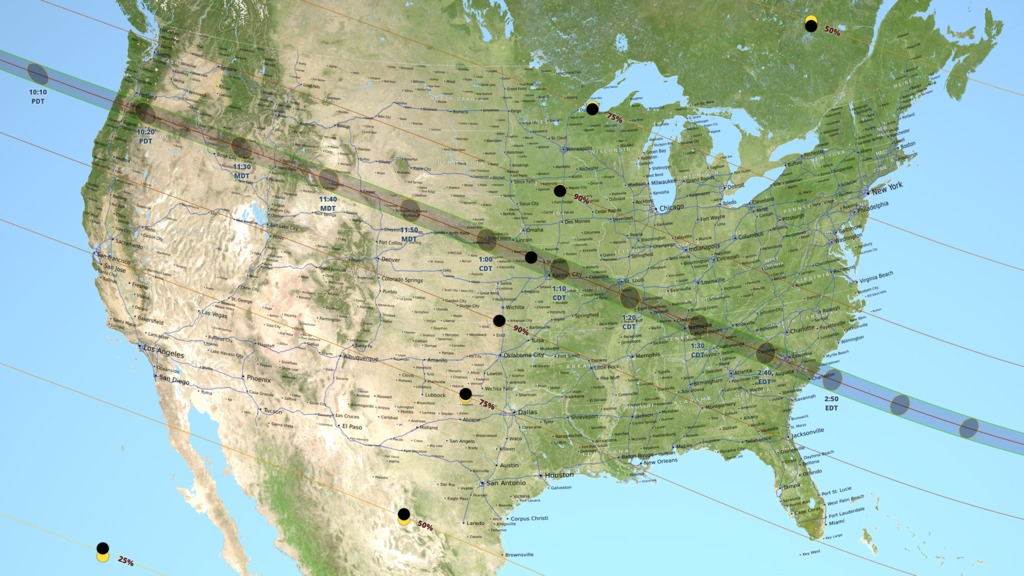
That's a quote from one of the links. Most people will not be in totality. Most people will only be seeing a partial eclipse. The shaded in line from this [1] image is where totality will happen.
Most people watching the eclipse will need some form of eye wear.
Yes, my comment was addressed specifically to those who will be viewing the total eclipse, not the partial eclipse. That's why I emphasized total eclipse and totality.
But thank you for making it more clear that viewing any other kind of eclipse - partial or annular - requires proper eye protection!


You can photograph the eclipse, but you will have a much grander experience if you don't try. Photography is just a distraction from the awesome spectacle of the eclipse, including the phenomena that happen on the ground.
There will be plenty of other people taking great photos, so enjoy those after the eclipse. A total eclipse, viewed directly with your own eyes, is truly an experience of a lifetime. No photograph comes close.
Contrary to one or two other comments, eye protection is not necessary during totality and will prevent you from seeing the full beauty of the corona. It is perfectly safe to view the total eclipse with the naked eye, or even with binoculars. Only the partial phases need eye protection (and they definitely do). [1] [2] [3]
In fact, on the hillside we ended up at, something interesting happened. Most of the people wore dark sunglasses and faced away from the sun during the first partial phase, in order to get their eyes a bit acclimated to the dark. The partial eclipse isn't very interesting compared to totality, and the fun stuff at that point is happening on the ground: there are ripples of light dancing on the ground like you see on the bottom of a shallow stream. And you may get to see the shadow rushing toward you at 10,000 miles an hour!
The moment it reached totality, there were shouts of "it's total!" up and down the hill. Everyone took off their sunglasses and looked directly at the total eclipse. Many of us brought binoculars and viewed the corona with them.
The danger is that it is tempting to keep looking at the end of totality, when the string of beads starts to appear at the edge of the moon (where the sun is starting to peek through the moon's valleys), and finally the "diamond ring" where a larger part of the sun appears through the deepest valley. If you bring proper eye protection, switch to it the moment the string of beads appear, and definitely before the diamond ring appears! I recommend doing this after totality and not before, so you don't interfere with your eyes' dark adaptation before totality.
[1] https://eclipse.gsfc.nasa.gov/SEhelp/safety.html
[2] https://eclipse.aas.org/resources/telescopes-binoculars
[3] http://www.eclipse2017.org/2017/what_you_see.htm