Brutalist architecture is objectively wrong. It's terrible. Building design review boards, take note. It's not back, it died a quick death and we still see its ugly tombstones littering the landscape.
Brutalist concept models must have looked super cool in miniature form though. Blown up to life size? Just a lot of flat, ugly, oppressive, senselessly artless concrete slabs.
Compared to what followed, I think I'd pick brutalism. Downtown buildings in cities that mostly grew up in the 80s and 90s are just boring. When I google brutalist building images, I'm struck by how wildly they vary. I don't love them all. But, they've got real personality and originality. Sure, sometimes it is overblown...big shapes in weird places just for the sake of showing off.
I find architecture that slaps old forms onto new buildings to be...gross. There's a couple of skyscrapers just outside of Houston, for example, with fucking red shingles on it, like it's an adobe house in the desert or or something. So much architecture glues on a bunch of columns, ornamental lintels, fancy molding, etc. When placed on a structure that is huge, particularly one that is much taller than it is wide, they look ridiculous.
I think there are good buildings that were built in almost every era; but, some eras are less ambitious than others. Brutalism was, at least, ambitious. I think there's a reason so much scifi and futurist imaginings feature brutalist architecture. It is an architecture that screams "there are no limits to what we can build!" I think that's pretty cool.
It's all subjective, of course, and we all have our preferences. But, calling it "objectively wrong" seems hard to defend. It is only objectively wrong if it fails to function as a building for people to live or work in. If it leaks, if it falls down, if it is difficult to heat and cool, if it inaccessible to the people who need to use the building. Those are ways to measure architectural wrongness objectively. It's safe to say that some brutalist buildings failed to live up to their purpose, but that's true of many architectural projects. Having the style fall out of fashion, due to a reactionary response to the new and very different, and the buildings fall into disrepair because of it, is not really the fault of the architecture. Old buildings get renovated every 20-30 years, or they stop being relevant. This is true of even iconic buildings like the Empire State building.
Anyway, I quite like brutalist architecture; I don't mean I like it with no discrimination. I still just buildings on their own merit and being in the right style doesn't mean I'll like it, any more than me saying I really love punk rock means I would ever listen to Green Day or Bad Religion. But, there are brutalist buildings that I find beautiful. And, a lot of stuff that followed that I find horrible.
Saying "objectively" is strong language, yes. But I think that if a building fails in its aesthetic, or at least at blending in if it's not going to be aesthetically pleasing, then no matter how functionally fine it is, it's a failure. If all we cared about was function, we'd build ugly boxes everywhere. Oh wait, that's practically brutalism anyways. Every brutalist building I've had the displeasure to walk around or be in has been oppressive, and ugly. The buildings we use shouldn't be oppressive and ugly, because we have to use them. If it was only a piece of art, then I can see the worth in evoking those emotions. But I have to live with the damn thing day in and day out, inside it, not just check it out in a gallery in miniature.
And there is no reason at all to restrict yourself to architecture after brutalism. The Romans figured it out. The architects of the art deco era figured it out. Those ideas are still valid, they still make for beautiful buildings, and we should reuse good ideas because, again, we have to live with the damn things, day in and day out. We can pick and choose what few ideas were good since then and also include them. Prevailing construction techniques might not always allow for it, but we should try.
But some ideas, like brutalist architecture, are a failure, and should never be re-used. I'd rather get a bland design in almost any other style than a brutalist design.
That said, feel free to post some examples of your favourite brutalist architecture, maybe I overlooked something. I'll only be judging them from pictures, which is entirely different than actually seeing the thing in person and having to deal with it; the utter bland enormity and lack of detail gets much reduced when shrunk down to a screen, or student model. But it's something.
You could probably save most brutalist structures by covering them in beautiful murals. Then at least the vast expanses of no detail at all works to your advantage as a convenient canvas. The Bierpinsel in Berlin is not a bad effort in this regard: http://berlin.citysegwaytours.com/blog/wp-content/uploads/20...
You're right, I hate it. It's lazy and bland ("you know what's amazing? gray"). I've even been in a place that has a very similar design. It felt like a dead area to me. Looks like the very definition of soul-crushing. People like blue skies over gray skies for a reason.
With people, being a good person can be more important than looks; with buildings, being well-formed can also outweigh looks. But that, again, is where brutalism tends to fall down: unlike traditional architecture, it tends not to work on the level of the individual human being. It doesn't prioritise the experience of those inhabiting it, but rather the experience of those viewing it (it is, in that respect, 'arch'), nor those who must maintain it for its inhabitants. It's not situated to receive natural light and heat, but rather to receive natural and artificial light to make an interesting play of shadow in photographs. It's not full of little rooms and cubbyholes and shelves, because those wouldn't look as neat in a model. It's not full of decoration and ornament, moulding and waistcoating, glasswork and patterns of colour to delight the eye over decades, in part because those wouldn't show up in the model and in part because its designers simply don't care.
Brutalist architecture is, in the end, a boot stamping on a human face, forever.
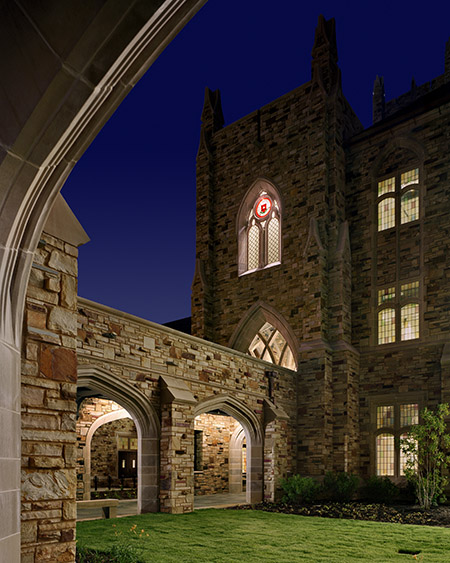
I prefer the former to the latter. I don't dislike the latter. But, I like the brutalist one better than the imitation English style you've linked (I think the one you've linked at least used local stone, which is nice).
You clearly very strongly dislike brutalism, and that's OK. But, you aren't the dictator of what is and isn't in good taste...some people are going to like things you don't like, and you're going to have to accept that.
I wonder how age factors into this question. I'm just over 40, and I suspect I might be a little too old to be part of the next generation that seems to have a revived appreciation for brutalism (but, I like it anyway). But, my parents definitely didn't like it, and from what I can tell there's a generation that's about my age and older that may always have unpleasant feelings about brutalism, while younger folks don't have the same baggage about it.
So, if you don't mind me asking, are you younger than me, or older?
As it happens, I'm very slightly younger than you indicate. So your theory that folks roughly our age dislike it holds. It may be that folks younger than we are don't mind it — but they also don't mind riding bicycles with helmets, which is almost as mad as walking with helmets.
You clearly do not understand what objective means.
Edit: You're using objective for emphasis, in the same way people use the word "literally", when they don't really mean it literally. There is no "objectively" right or wrong when it comes to matters of opinion or taste, they're by definition subjective. I'm shocked I have to spell this out for you.
> You clearly do not understand what objective means.
No, I'm saying that your taste is objectively wrong, 'in the same sense that someone who thinks Steve Buscemi is more handsome than George Clooney is objectively wrong.' He's simply not (which says, of course, nothing about his value as an actor or a man, just about his value as a model).
Tastes can be wrong. Brutalism is wrong; objectively wrong: it denies life and organic beauty (the only beauty that can exist, because we are living creatures). Some things are indeed matters of taste, but others are not. If one writes the number which consists of adding unity to unity as 2 or II or ٢ or २ or ꤂ or 𐒢 doesn't really matter, but if one writes it as PA͉I͓͍͇͜N̵ ̗̻̗p̴̻͙͚͇̳̹ͅa̦i҉̥̫̥͓n̖̭ ̼͕D̻̤̘̮̼̣͜E̴͇̦̟͚͚A̞͇T̴͎̮͔̣͔H̟̻ ̩̥͕̯͙̘D̶̳̞̘͇̠̳̦e̳̥̖̺̯̺s̤̰̬̺t́r̗̼̳u̲͉͎̩̱c̩̬̮̣̫̭͇͟ţ͉̝i̫̝o̗̞̫n̟̘̹̥̖ ̞̝P̪A͓̞͍̭ͅI͚̲̬͙Ṉ̫͉̥ then yes, one is wrong.
You might find Riverside Plaza (aka Cedar Towers) in Minneapolis an interesting bit of colorful Brutalism. It's a collection of apartment towers that use a variety of colored panels alongside the deck doors. They're highly visible, at the intersection of two interstates and across from downtown.
Today, they're populated almost entirely by Somali immigrants, which really makes for a particular Third-World feel that's not visible from photos. Cedar-Riverside is a lively and densely populated neighborhood, and the towers definitely dominate.
I'd say it's both. If you get away from the heights and walk around the base of the buildings, it's totally Brutalism - straight-up shaped concrete, nothing to decorate but the shape itself. It's also remarkably walkable and sociable. It feels like a space rather than an obstacle. (I credit part of this vibe to the Somali community, who are strongly self-policing and don't tolerate dangerous gangs of young men in their space)
You may not appreciate it, and that's a fine opinion to hold. But Brutalist architecture can't be "objectively" wrong, for the same reason that the color red can't be "objectively" wrong.



Brutalist concept models must have looked super cool in miniature form though. Blown up to life size? Just a lot of flat, ugly, oppressive, senselessly artless concrete slabs.