Yes, but if the current young generation of americans is poorer than the preceding generations (a conclusion I think is inescapable at this point), then it is worthwhile considering why.
The world is certainly richer than it was in the 80s. We are vastly more efficient at producing all sorts of goods. So, then, why is the current generation of Americans unable to afford what was available to the middle class previously?
I believe that the answers to this crucial question are obscure and are unlikely to be found in conventional economic and political analysis.
> Yes, but if the current young generation of americans is poorer than the preceding generations (a conclusion I think is inescapable at this point), then it is worthwhile considering why.
The answer is multifaceted, but part of the problem is that some of the major reasons are extremely politically inconvenient. For example, what are the economic consequences of women entering the workforce in large numbers in recent generations? Increased labor supply drives down wages per employee, then more two income families increase price inflation (especially real estate prices). Together they transfer most of the economic value of women working into the hands of employers and existing land owners, when the economic value of the domestic labor it displaced had previously gone primarily to the woman and her family. And people who remain single are extra screwed because they suffer the same wage and price consequences without the second income.
But for cultural and biological reasons when one spouse is a homemaker it will almost always be the wife rather than the husband, so policies that would increase the standard of living by reducing the number of two income families have consequences anathema to the left (fewer women working) and the right (less value captured by employers and land owners). So we don't talk about it.
> Increased labor supply drives down wages per employee
According to conventional economics, quite the opposite: it makes the economy bigger and creates more jobs.
(If growing the workforce increased unemployment, then bigger countries would have high unemployment and population growth would also increase unemployment).
don't forget upto 40% of her output goes to the government in taxes. so even the civil service / employees of the state (who don't care about left or right) prefer both working...
This is very true. We made the choice to have my wife stay home and raise our children rather than go back to work. We're fortunate to be able to do so, but when doing the math and calculating the after-tax income she's bring home, so much of that income would have gone straight to child-care that it was a no-brainier to have her be the caretaker in these early years of their development. The cost of childcare is a very real challenge for the United States.
Ditto here, though we hired a nanny the last 6 months before school-age since a good job opportunity came up for my wife. Now it seems he income just goes to pay taxes.
>I believe that the answers to this crucial question are obscure and are unlikely to be found in conventional economic and political analysis.
I'm astounded by this comment. Are you saying that the obvious answers of asset based inflation caused by our monetary policy does not majorly impact real estate in a way that hurts younger generations and the middle class?
I can't see how. It's basic math.
If assets rise in price and two people are leveraged into assets the same amount, who gets richer, the person with a 100k asset or the person with a 500k asset?
Oh, lovely. No, that's not it. Asset-based inflation is very much the better answer because that's how exponential things play out. Low interest rates stop (mild) inflation from bleeding off asset bubbles, so people do that because there's no risk.
To the extent that Baby Boomers foemented low interest rates and low inflation ( although that's arguable too - the 1980s were not exactly peak Boomer years - see the 1990s for that to really take shape ) you are correct, but it's really just collateral damage. When you make this much more money sitting on land for umpety years until its developed, that's the business culture you'll end up with.
Throw in the effect of 401k plans dragging everybody into the stock market and you get an even fuller picture.
A lot of Boomers are really boned. Like, poor. More than is commonly written about.
ObDisclosure: I am a cusp baby between the Boomers and GenX, early '60s model.
It is a generational wealth transfer. But when boomers die, they're generally leaving that wealth to millenials, aren't they? Except that the boomers also have a lot of debt.
That would depend very much on how the wealth is consumed I would guess. If it is used to finance vacations to Mexico and throw away imported consumer goods, that wealth will be lost. If it was used to build nice cities and finance great art, it would be preserved.
> The world is certainly richer than it was in the 80s
It's debatable. I was in my 20's in the 80's. I was able to buy a 3br/2ba, 1500sq ft. house when I was 26. I had my school loans paid off a couple of years after I graduated - that's not happening for 20-somethings now.
> I believe that the answers to this crucial question are obscure
I don't think they're so obscure. If we are wealthier now, then it's likely that the wealth is in much fewer hands than it was in the 80's and before. Income stagnation. Wealth accumulating in fewer and fewer hands. Back in the 1860's Marx told us this is what happens in Capitalist economies. While you may not agree with his prescription (and I certainly don't agree with most of it) his diagnosis was pretty much spot on.
>It's debatable. I was in my 20's in the 80's. I was able to buy a 3br/2ba, 1500sq ft. house when I was 26. I had my school loans paid off a couple of years after I graduated - that's not happening for 20-somethings now.
No, it's really not debatable the world is richer than in the 80s. Much of that wealth has been accumulating outside the US, though, particularly in India and China.
With interest rates as low as they are you could definitely get into a 1500 sq ft. house by age 26 today. You just can't do it in the places many 26 year olds want to live.
There's no way that 26-year-olds can afford a 1500sf house in those areas because the only jobs available are at Walmart. The places where 26-year-olds can get good-paying jobs are also places where the real estate is much more expensive.
>Where in the country can you not make $15/hr by age 26?
Any town where the only jobs are at Walmart and the feed-and-seed store. Walmart doesn't pay those kinds of wages in rural locations (or probably anywhere else, unless you're a manager).
> Much of that wealth has been accumulating outside the US, though, particularly in India and China.
But from a US perspective we seem to be poorer now.
> With interest rates as low as they are you could definitely get into a 1500 sq ft. house by age 26 today. You just can't do it in the places many 26 year olds want to live.
I bought that house in a place where 26-year-olds want to live (a West Coast city). Interest rate was 10%, but I was able to pay off the mortgage in 9 years. I don't think a lot of 26-year-olds are in that position these days. Too much student loan debt and houses much more expensive as compared to incomes.
We aren't poorer (well we might be a little bit because of the Great Recession), housing just costs a lot more than it used to.
Our parents just didn't get to buy a house for cheap. They also got all the increase in value. We have to buy an expensive house that probably won't increase in value all that much.
Why is housing more expensive? I'm not totally sure, but I suspect it's the effect of stretching suburbia to the limits. When my parents house was built it was the frontier between rural Illinois and the Chicago suburbs. Now it's considered a middle rung suburb. There are suburbs an hour further away from Chicago. But we've hit the limits on what a person can tolerate re:commutes. You just can't commute for over 2 hours each way.
We should be rezoning inner rung suburbs and cities for increased density housing.
Then again telecommuting and/or autonomous cars might destroy all the downsides to commuting.
Probably because land area is zero-sum and population is twice the size it was in the 60s.
Also rent-seeking, foreign investors buying houses with cash, etc.
It's a combination of factors.
> We should be rezoning inner rung suburbs and cities for increased density housing.
Agreed. Most of the suburbs are hideous, inefficient (most houses built before 1973 have marginal to no insulation) and in many places crumbling from age.
Coming from a country where education is free and renting (was) normal it sounds crazy to make so much debt. The 'crazy' is not meant offensive, more like interesting.
Think they will be rich... Wait until the health care and other end of life costs start to add up. Even here in the UK they can be high, if you end up spending time in a 'home' that can quickly eat through savings. So unless there are amazing full life health care and other insurance policies covering these guys then there is ever chance that all that money could go.
This. The entire point of the establishment convincing people to hand over large chunks of their labour for fiat currency is because they are giving you peanuts. You can't cash it in! All these houses "worth" $1MM - who is going to buy them? Demographics are shifting as the boomers die off.
Young Americans are living with their parents instead of saving money rather than living with their parents to save money.
What happens when they have children? Where will their adult children live? In their parents tiny 2 room apartments?
Basically, the full effects of the declining net income of adult Americans is being masked by people living off the accumulated wealth of their parents (both consuming their houses and getting hand-outs). Which implies that there's cliff that the American lifestyle will fall off at some point and then things will be ugly even in comparison to now.
The younger generation is simply not having children at the high rate of previous generations.
Anecodotally, most of my mid 30's friends have either 0 or 1 child, a few that got started earlier have two.
On the other hand, the millions of legal and illegal immigrants, especially from Latin America, are keeping the birth rate up. They do, in fact, many times live in much more crowded conditions. I have met a few Hispanic immigrants in my area as I speak Spanish, and in each case, they lived in single family homes with multiple families / generations.
I think three-generation households have been somewhat common throughout most of history, even in the USA (although admittedly probably not in the sort of high-rise apartment buildings where many people live now).
The US was the only major industrial nation not to be completely devastated in WWI and WWII. They/we benefitted from this enormously throughout the 20th century. It was only a matter of time before things normalized.
I don't think we have free trade (although I would certainly support it!). I think we probably are richer than we were pre-war. We're just not at the peak we were after the war when we had a monopoly on success.
We also profited greatly supplying the wars. We haven't had a "market" like that since then. The US was mostly its own customer during the cold war.
What other major industrial nation was not devastated during either World War? (I guess you can say "Canada" but I'm not sure how "major" or "industrial" they would have been in WWI).
My question is: the standard Ricardian argument for international free trade assumes that as trading partners become more productive, all trading partners benefit. Do you think this is the case? Certainly the original post does, as confirmed in his response.
If that is so, why would other countries becoming better at making things make us poorer?
It's caused by corruption in local governments. Not enough housing is being built; this means that prices rise until enough people are living with their parents or with enough roommates to cover the shortfall. The reason not enough housing is being built is because local governments are preventing it, using zoning. If the restrictions were loosened, rents would fall. If the restrictions were eliminated entirely, they'd fall precipitously.
Its a bit outdated, but the numbers have not radically changed[1] - around 10% of all housing is unoccupied in the US. Sure, its a huge place, and I can imagine few people want to live in Nowhere Nebraska, but that does not change the reality that we have some ~6x more unoccupied houses than homeless, and the vast majority of new construction is the same old unsustainable unaffordable suburban sprawl we have had run rampant with McMansions in this country for the past twenty years.
What we need is not the creation of new houses, but new cities, or the dramatic rebuilding of the old ones. We need high density urban environments with low cost of living built around foot and public transit, no cars, and with mixed use building again, without the zoning hell that currently cripples growth in almost every corner of the US today.
Actual, real-world people vote against high-density urban environments with their feet, and pretty much always have. It's just that in past ages it was only the rich who could afford a country home. That's changed, thanks largely to modern transportation making it possible to work in the city and live in the burbs.
This coffee's claim to fame is that the beans have been eaten (and then excreted) by a cat-like animal called a palm civet.
Now, does that high price mean that most people want to drink this coffee? Nope. Most people would avoid it at all costs. There is a small group of connoisseurs who enjoy this coffee. The price is high because, as small as that group might be, the (tiny) supply is insufficient to satisfy their demand at any lower price.
Similarly, there's a subset of people (mostly, though not exclusively, young, single, and childless) who actually enjoy living in dense urban environments, and will drive up the price accordingly. Those people are not the norm.
"We" is society at large. And half the point of this article is that "young Americans" cannot afford those country homes with long commutes, and thus still live with their parents.
For the current upcoming generation, they do not have the means to afford those homes either. If you want to house them independently they need denser Urban living since modern transportation in the form of personal automobiles is also incredibly expensive.
Society at large has decided that it likes suburbs and McMansions just fine. You don't get to make that decision for other people, just because you use the word "we".
'And half the point of this article is that "young Americans" cannot afford those country homes with long commutes'
Well, then, that's the problem needs to be solved, rather than patching it by forcing people back into the crowded urban environments that they so obviously do not want to live in.
'denser Urban living since modern transportation in the form of personal automobiles is also incredibly expensive.'
1) Why does it need to be dense and urban?
2) No, they aren't. In 1950 a median-priced new car cost about $1,500, somewhat more than half the median annual wage. Today you can get a new Ford Focus for about $17,000, which is... somewhat more than half the $32,140 median annual wage for those over 25.
Also, most families in 1950 had one car, period. Most families now have at least two. That doesn't tend to support your claim that cars have gotten more expensive.
'Society at large has decided that it likes suburbs and McMansions just fine.'
No, the people with the money and land have decided that they like suburbs. I am sure that if a millennial could buy a small patch of land and build a small house on it for cheap, they would.
This is the reason given for why housing costs are high in the bay area, but is not really the reason why housing costs are high, at least in general. Only a small percentage of people actually want to live in shitty apartments in polluted, concrete cities. You can make a million apartments and it is not going to reduce the price of houses where most people actually want to live.
Right. Labor = citizens. Citizens = votes. And as a society, we can decide to tax your productivity to provide for said citizens (Human being quality of life > profits).
I've never seen a more accurate sound (text?) bite for the challenges that today's labour market are facing.
These will only be exasperated further by the onset of automation and robotics in the coming generation(s).
I don't have a doubt that we could easily turn around the benefits of automation and robotics towards favouring the middle and working classes.
My concern though, is that the few that are currently gaining wealth from reduced labour costs in favour of productivity have a stronger grasp on where this wealth goes, than the majority outside of socialist strongholds like Scandinavia and some European states. And that trend will continue.
Surplus labor allows for the devaluing of labor. Japan doesn't have a surplus of labor (IMHO) due to lack of immigration and a quickly aging population.
Japan does have a labor surplus. That's why they have so many public sector make-work jobs doing things that could be automated or performed with fewer people.
Easy. It was harder and less acceptable to use international labor then, there were that many fewer college educated people, and that's 36 years behind the current level of automation technology.
>It was harder and less acceptable to use international labor then
This is very true. I know the big US car unions ended up screwing both the employees and employers, but have you ever wondered what would have happened in the 60's or 70's, had the line manager come over and told his assembly line team that they were going to not only be fired next month, but if they wanted a severance, they'd have to train their replacement recently imported from the third world?
I can guarantee you that there is a good chance this mgmt. team would probably end up dead or severely injured soon afterwards.
Today, the same circumstances elicit, at most, a few angry comments on some online media forum.
They also had a far less connected society where surveillance was /much/ less common and far more easily spotted.
I imagine the reasonable chance that someone snapping figured they could get away with it, particularly in a close knit group that routinely went fishing or hunting together and would say that's exactly where they were at the time something happened; was /much/ higher back then.
Also today everyone knows that someone else will just be hired to do the same thing. Today when some kind of correction does happen it'll either be approved from on high by those seeking to avoid an old-school revolution, or it will be a bloody zerg-rush.
This is a big thing that, oddly, a lot of folks in my cohort (~40s) are unwilling to admit.
You don't have to like unions to admit they benefited workers. In fact, the money spent on the destruction of unions points to it - why bother if they didn't help workers?
The post-WWII bargain, where productivity growth was split, is gone and not coming back. Whether there's a way to give workers a voice again or not is an interesting question.
Of course, if the class differential gets too big, there's always the pitchfork and torch route, which I don't think anyone (OK, most sane people) wants.
> It was harder and less acceptable to use international labor then
Yes, but we have been told that international free trade benefits us all. Do you disagree?
> there were that many fewer college educated people,
Yes, but we have been told that education is the key to our future, and a more educated workforce should be able to produce more and better goods for us all. Do you disagree?
> that's 36 years behind the current level of automation technology.
Yes, but automation was what dragged us out of the stone age and through the industrial revolution. It has, at times, apparently made us vastly richer. Do you disagree?
I don't say all this to be a dick (well, OK, kind of) and I agree to some extent with each of your points, but I think there is a larger issue at the root: debt.
> We have been told that international free trade benefits us all.
If you have 10 jobs paying people $10, and replace them with 50 jobs paying people $1, but keep the prices of the products the same; 10 people now don't have jobs, and 50 people each don't make enough money to buy any products. You've increased productivity 5x and cut costs in half but all of the gains go to shareholders.
> A more educated workforce should be able to produce more and better goods for us all.
Same as above.
> Automation...has, at times, apparently made us vastly richer.
Same as above.
> I think there is a larger issue at the root: debt.
It's the same issue. Debt is just another thing to rent to poor people.
burdensome and protectionism oriented business regulations blocks new entrants and means of doing business. When over a third of jobs require some form of certification, especially in lower paying jobs, it puts an unfair burden on employers and employees. When you can simply get government to regulate away your competition job growth is stifled.
it is always government. from sucking too much money out of the banking industry to make available for business needs to government trying to pick favorites in new industries and distorting the markets. from playing rate games, backing securities, to inducing lending risk by pressuring banks to lend to those they would prefer not too
Even the ACA damaged the ability of those to earn a living by putting in place that infamous twenty hour rule. That wasn't done to benefit working people, that was done to benefit certain types of employers but more it was done to distort unemployment numbers by artificially raising the number of people needed to do that same amount of work each week. This ain't much different than pleads to make college free, keep able bodied people off the job lines.
Sure many of the rich are getting richer but they only do so because those writing the laws are in constant election and reelection cycles. Where they try to write laws prevent you businesses and such putting money into politics but slip in rules that allow PACs to take 350k from one person; provided "wink wink" its not targeted to a specific politician.
tl;dr. Government is the source of the wage stagflation.
To me it seemed like the normal cyclic nature of economics. We had a bubble around 2006-2007, and when it was ready to crash / correct the governments around the worlds threw everything at keeping asset prices high (we have had "emergency" low interest rates here in Europe for ~8 years)now. Great if you are older / richer. Shit if you are under 40.
> (a conclusion I think is inescapable at this point)
It's not obvious to me. Possibly only because I'm uninformed, though, so feel free to point me at any relevant data.
There are a variety of trends which could be happening and which might explain this particular cohabitation-with-one's-parents phenomenon without having to mean that the current young generation has less wealth than its predecessors.
I think it's double-ended - if Mom and Dad bought a 4,000 sq ft monster with a three car garage, why not occupy some of it? I think simply calling it "poorer" is a different thing.
My uncles lived with their Mom until they got married. They are roughly Silent Generation or WWII. Its just The Way It Was. We had a massive housing boom; now it's over.


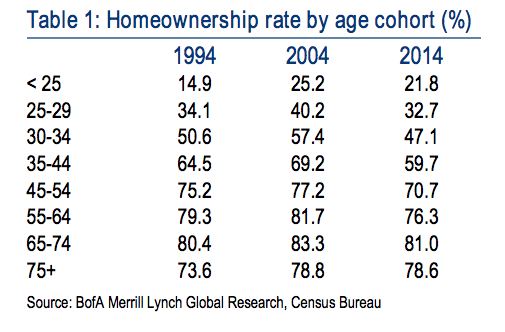


The world is certainly richer than it was in the 80s. We are vastly more efficient at producing all sorts of goods. So, then, why is the current generation of Americans unable to afford what was available to the middle class previously?
I believe that the answers to this crucial question are obscure and are unlikely to be found in conventional economic and political analysis.