I want to believe... But I suspect this will not be a winning approach for most displaced coal miners.
What's interesting to me is that we have many reasonably well-paid trade skills in America: plumbers, carpenters, masons, electricians, landscapers, arborists, mechanics, etc.
Last year I paid $2,000 for a new lawn and another $1,500 to have a dying tree removed. Both took a few hours for two people to complete. It wouldn't surprise me if these guys are making more money than your average programmer. I think we should try and promote these good jobs to both young people in depressed areas, but also to adults looking for a new trade. Not everyone needs to work in a cubical...
And that maintenance is minimized, avoided and cheapened out on as much as possible. You know all those stories of poor people being ticketed for burned out headlights and similar car problems?
I don't know anyone in the tech industry who ever have a burned out headlight on their 2 years old leased car. Maybe it's because they can afford to have it fixed and maybe it's cause they don't own, let alone drive, a junker in the first place.
Since I get downvoted a lot, perhaps a clarification in order: My point is when 2/3 of the high paying jobs in a locale get yanked, the service industry folks that depend on people having income they can use are the first to get screwed. Coal mining is high-paying (compared to median pay, it'd be shit by SF standards...)
And people can rely on friends and family to get them fixed. I bet most HN readers are very familiar with the concept when it comes to computers breaking.
Depressed doesn't mean poor or disadvantaged. In the case of these guys (if it's the ones I'm thinking of) they had a strong middle class area which just doesn't have the same jobs.
As a bonus, if there were more of these guys around their prices would go down a little bit.
In certain parts of American where you have a large amount of immigrants (Texas, California...) you can get a gardener or carpenter much cheaper than say, in the north where the population isn't as high or diverse.
As someone who lives in a small (western) mountain town I think one thing that is often overlooked is that all of those small businesses need at least basic web presence and the founders either need to be tech savey enough to set one up or have someone do it. Even static sites or facebook pages are still somewhat rare where I am.
Its not glamorous or particularly challenging work by HN standards but it is a market for people with pretty basic computer/coding skills.
I think you'd be hard pressed to find a higher per-capita concentration of non-coding 'hackers' than in Appalachia- making do and making things do what they're not supposed to are pretty much the defining regional characteristic. Of course that doesn't necessarily mean they'll be great developers/ software engineers.
Curious what you guys think, I always thought coding is like scribing in the 13th century where a large percentage of population is illiterate and scribers are relegated to imperial quarters to take note of the empire's history and accounting.
However, better education system (programs to teach kids and adults coding) and improved accessibility of writing process from carving on stone tablets to ink on paper (better toolchains and the ubiquity of smartphones and computers) led to mass literacy rates.
Scribers (CRUD web apps written using CGI/Java 1.5) are therefore commoditized and become from emperor's scribes to Bartleby the clerk (CRUD using Rails and Node).
Thus writing becomes less a lucrative profession to literature where you have 1% rockstars authors who rely on marketing and a huge popular following to generate hits (e.g., startup's that rely on the charisma of the "founder myth" to raise money, but have the lifecycle of a reality TV show and the whims of the consumer taste; Friendster to Myspace to Facebook ("Zuckerburg") to Snapchat; Napster to iTunes to Spotify to Tidal ("Jay-Z")).
Now suppose you are the 99% Bartleby the scrivener, what are you to do, other than to say, "I prefer not to..."?
Hello HN.. Atlantan here. Frankly I find this armchair speculation from the west coast a bit comical. Coding as a trade is a thing at this point. Look at the coding bootcamps that function basically as an apprenticeship/trade school. Where does the target audience factor into it? In terms of capital, a) money is everywhere - that's why they call it money and b) the southeast is home to at least three top 20 banks and Atlanta is a huge payments processing hub.
I'd love to see some of the enthusiasm for science and technology that's prevalent along the west coast spread to the south. I always find it interesting when I read an article about San Francisco locals becoming "annoyed" with the huge number of tech workers taking over the city. Where I live (Knoxville), I find that most people are relatively uninterested in discussing technology.
But I think that's changing. Chattanooga was the first city in the US to offer gigabit internet to its residents, and the city is working hard to incentivize tech companies to locate there — for a startup, high-quality internet and cheap office space are hard to pass up. Also, a lot of the region's natural beauty is attractive to programmers who are able to work remotely. Consider a city like Asheville — hardly any tech there, but there is a great little food scene and the city is surrounded by beautiful mountains. Research Triangle Park in Raleigh-Durham has a fair number of tech companies, but that region is still a little too vanilla/corporate/suburban for my liking. I think that's changing as well though.
The biggest problem is that people are always going to locate where there peers are and where the resources are located, and Appalachia currently has very few tech resources. I read recently that 25% of all the world's venture capital is located in the Bay Area. Like-minded people tend to congregate near each other to share and debate ideas. After SF/SV, the biggest tech cities in the US are New York, LA, Seattle, Boston, and Austin. The southern United States still has a long way to go before they acquire a critical mass of people who are interested in technology, and it's difficult to build momentum. I was speaking to my uncle (who has worked at Georgia's department of economic development), and he said that one of the big problems for technological development in Georgia is that companies that are founded there tend to move to California once they become successful. The question is: how do you make it attractive for them to instead stay in Atlanta?
I think one of the 'problems' in viewing the South as a homogeneous whole is that it is so huge and so sparsely populated. Austin, Dallas, and Atlanta (and to an extent, Houston) are pretty tech-y, but they are all so far apart, unlike the Eastern Seaboard, SF-SV, SoCal, or Portland-Seattle. Mid-west has Raleigh-RTP-type pockets of science/tech in Minneapolis and Chicago, otherwise expanse is a problem in Dakotas, Iowa, etc. too. This expanse should be less and less of a problem as telecommuting becomes more prevalent. But geography is still a pretty big challenge to overcome.
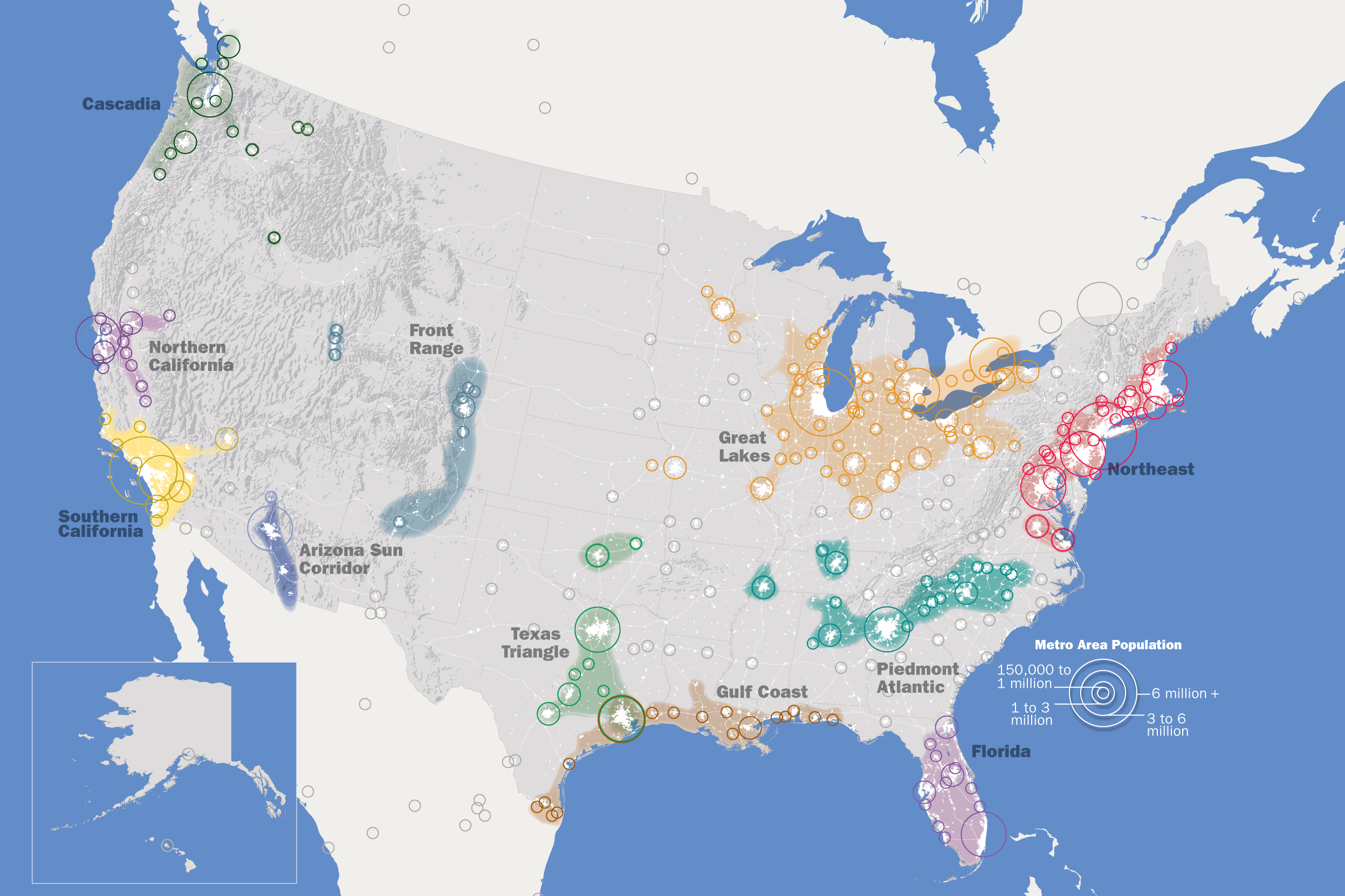
Good point, there are two notable contiguous bands: Atlanta-Greenville-Charlotte-RTP and Florida Atlantic coast. A couple of things to add: in the south, distance between dense counties is large elsewhere- not too many contiguous regions/clusters. Then, there's also the question: is density sufficient to create a tech hub? Density is surely a factor, but far from sufficient.
The map is slightly deceptive when it comes to Virginia; here the cities are independent of the counties that often completely surround them, and so "city or county" is an equivalent-level government. So you see all the darkest-red dots running up the western part of Virginia? If the population in those cities were shared with the surrounding county and the density recalculated, you'd get a lot more of the middle-reds you see in western NC and SC.
So the "Atlanta-Greenville-Charlotte-RTP" band that you see really continues all the way up to DC (where it becomes even denser and turns in to the Northeast Corridor Metroplex).
Quite the contradiction to have a government, both state and local, that is always pontificating pro-business while at the same time suing local municipalities for attempting to provide a superior product (reliable, uncapped, fast internet) to that of a monopolized national corporation.
Outside of Chattanooga, TN lawmakers are quite eager to please Pennsylvania's Comcast at the expense of its citizens. I imagine they (said lawmakers) are all wondering why there isn't a greater startup or tech-centered small business culture while they continue to chain it down while exclaiming how much they support free enterprise.
Just looking at UTK, UTK Hospital, TVA and Oak Ridge...with that amount of engineering / medical / educated talent, East Tennessee should be at a minimum competing with Raleigh-Durham/Charlotte...especially with the Smokies and cost of living, but it feels more like a few companies pulling the rest of the area up a hill with the rest digging in where they are now.
Its not that the cities aren't attractive, its that VCs force their portfolio companies to move to SF/SV, mainly because of the financial interests of the VCs.
There are a lot of companies that would happily locate somewhere else if their funders would let them, and once we get done with this "market correction" it would be neat if the tech industry could get together and agree on a model that doesn't involve making life miserable in the Bay Area for everyone who isn't a software engineer.
A rural coder's initiative wouldn't do much for the racial imbalance, though.
The brain drain away from rural America is pretty alarming. The best and brightest leave for the cities, and they don't often come back. Throw in the burgeoning heroin epidemic, and things are pretty grim.
I know plenty of people that are long-term unemployed. With some the idea of talking about work is deeply upsetting, they just cannot bounce back, pick themselves up, learn a new skill and get set into a new career. To them I should be an example of how it is done - I had to change career a few years ago, and despite being long in the tooth with no formal university education in things like OOP, I was able to learn enough to get a programming gig and move on from there.
I do e-commerce for my sins and I am fortunate enough to always get work. Last time I had to pick up the phone I had 12 interviews lined up by tea time with a couple of those being of the 'start Monday' variety. From this perspective I am aware that, for what I do, there are more jobs than candidates.
Sometimes I watch the news and see some story about unemployment, particularly among the younger entrants into the job market. Normally you have some talking heads in the news article where the government gets blamed for individual circumstances of despair and no opportunity. I then feel bemused, and wonder why the world of work is how it is with companies like my current employers unable to find me a front-end dev for love or money. Sure we would take zero experience for the right candidate, although a few years of experience would be far preferable. I truly doubt we would have more candidates even if there were a million out of work coal miners in a five mile radius, that is what I find odd about this article is that there were '1000 applicants'.
For all of my out-of-work friends I do try and find them some work, even if they are not able to enter the job market properly. I can conjure up some translation work (for those that have a different mother tongue) or some customer service work (that requires no pre-requisite skills). I also offer to train them up in everything I know.
But do these opportunities, even the easiest, baby-step stepping stones get followed up on? No!!! Never!!!
Those of us in the world of work, able to get up in the mornings and able to wear clean clothes doing as we are told working for the man at some desk all day with a convenient pay check just do not 'get it' when it comes to understanding the long term unemployed. To us it seems obvious - learn a new skill, get some experience, put together a portfolio, move to a new area, but many, many people are fundamentally depressed and excluded from the job market. Our advice and gentle nudges falls on deaf ears. We don't understand them and they don't understand us. Articles like this one and every news article ever written on unemployment just has this naive view of things and never touches on the issues of self esteem and confidence that haunt many job seekers.
Awesome. There are a ton of problems that could use software. These guys are used to working for it, and I suspect do not need the problem to be sexy to be worth doing.
On a more basic level, I really value people and when we can open doors for them, the world gets a little better. Worth it. Not all of them will take the steps, nor will all of them enjoy success.
It's not about that. It is all about the ones that do, and the number of doors we have for people to attempt to walk through and improve.
I'm seeing a few people claiming this proves we're in a bubble. That we've reached peak computer science. Why?
Maybe I'm being touchy due to my location[1] but that sounds rather arrogant. This seems to be a more comprehensive training program than 6 week "hacker" schools so many are fond of. The workers were even paid while being trained. Is it because they're hillbillies?
There's a lot of unsexy dev work out there. Not the kind of change the world startup HN is all about but the kind that made the website for your caterer or hairdresser or an "e-commerce" website for some small business.
Bubbles will continue to grow and collapse, but throughout it all, programming will increasingly become a blue collar job. I mean that both in terms of accessibility to the lower classes, and in terms of social status granted once you've made it into the industry.
This news is just one small sliver of that larger picture.
(And for the record, I welcome this. I just hope the workers get their act together and learn the lessons those other workers had to learn the hard way over the past centuries/decades.)
It is more or less correction, if you are JavaScript ninja (as they call now a days), Islands of excellence like SV, Boston etc would be the places to go, but if you want some javascript competent dev work, in stead of off-shore Appalachia can be a good alternative. There was a near-shore movement, where Software development would be done in low COL/rural areas, I think this one is part of that movement.
once I rented a UHaul and it took the young kid like 5 minutes to type my name. He was hunting and pecking. I don't consider programming completely dependent on how fast people can type, but less than 10 words a minute is not employable. For professions that are completely removed from desks I think learning these skills at an adult age would be very challenging...
"I think learning these skills at an adult age would be very challenging"
Anything to backup your thinking? I've seen adult hunt and peckers go to 20-30 wpm in a week or two of using no letter keyboards. That's plenty fast for coding.
If we're not at peak computer science already, we're very close to it. Stories like this almost seem like satire at this point. It will be interesting to see how the companies backing this "learn to code" push fare in the coming months with all the financial turmoil that's brewing.
>If we're not at peak computer science already, we're very close to it.
Is there a 'peak' reading/writing ability? Just because the majority can write doesn't mean they can pump out award winning novels. On top of that, these miners are learning to code, which is to computer science like grammar is to linguistics.
Peak in terms of adoption. Sure they're not experts and are only learning fundamental skills, but it's a bizarre phenomenon nonetheless.
>Is there a 'peak' reading/writing ability?
Arguments like this don't make any sense. Computer science is no more of an essential skill because we use computers than cellular biology is because we're all made of cells. Why aren't we all learning cellular biology? The miners should be learning about how their body works.
First, they are not learning comp science. The article states they are learning to code HTML/PHP/JS.
Second, we do all learn biology....that's fairly standard high school and college curriculum.
Third, I would argue that basic comp science knowledge is becoming essential to professional success just like communication skills are. Individuals who understand systems and communicate in functional and technical domains are in high demand.
Also we all drive cars and use machinery, so we should all learn the principles of mechanical engineering while we're at it. And all of our lives are heavily influenced by the weather, so everyone should learn meteorology. We also all live in homes, so high schools should provide mandatory construction classes.
A human being should be able to change a diaper, plan an invasion, butcher a hog, conn a ship, design a building, write a sonnet, balance accounts, build a wall, set a bone, comfort the dying, take orders, give orders, cooperate, act alone, solve equations, analyze a new problem, pitch manure, program a computer, cook a tasty meal, fight efficiently, die gallantly. Specialization is for insects.
One of the points I see most overlooked in analyses of the software job market is that our opprtunities from our work product are accretive: the demand for our work grows not only as a function of the dollar demand to computerize traditional markets, but also as a function of the new markets created from more powerful and flexible software itself, especially a la carte SaaS offerings, which lower the infrastructure barrier to build new companies, and hardware platforms with friendly developer APIs that create a myriad of untapped opportunities around just what a computer is and can be. In addition, public expectations themselves for what good computer technology should consist of rise ever higher in this feedback loop, and the quality bar isn't getting simpler.
lol peak computer science? comments like this seem like satire at this point... It will be interesting to see what dumb comments try to support this theory.
there are people that break things, and people that dont. I don't ever imagine seeing a world where humans don't try to advance further past any peak you can see now.
A peak you can see now is a local peak. It's not possible to predict a global peak and advance past it but we can always use alternative technologies to achieve the similar goals.
The thing I wonder about is less that, but the fact that if everyone near college age is being steered to "code" we'll be producing less and less actual goods to sell, and what the long term impact of that will look like.
Coding is quickly becoming a cross between 'Factory Work' and a trade skill. The result is going to be a glut of factory worker programmers out of work as things continue to move over seas.
They're being steered that way because there are less actual factory jobs making things in large parts of the country, so that has already happened.


What's interesting to me is that we have many reasonably well-paid trade skills in America: plumbers, carpenters, masons, electricians, landscapers, arborists, mechanics, etc.
Last year I paid $2,000 for a new lawn and another $1,500 to have a dying tree removed. Both took a few hours for two people to complete. It wouldn't surprise me if these guys are making more money than your average programmer. I think we should try and promote these good jobs to both young people in depressed areas, but also to adults looking for a new trade. Not everyone needs to work in a cubical...