Are human rights concerns running cover for more straightforward financial interests here? Norway and Saudi Arabia are both petrostates with large sovereign wealth funds.
Norway's SWF has become increasingly politicized [0] due to the death of the center and the rise of the populist left and right, which is a common issue for any SWF in a Western Democracy. The same thing happened with CalPERS, the Alaska Permanent Fund, Australia's Future Fund, and the Ontario Teacher's Fund as well because these funds are not firewalled off from politicians, thus making them ripe for a populist conversion into ideologically activist funds (this is a both sides problems - as can be seen in California [1] and Florida's [2] case).
A major reason why the gold standard of SWFs are funds like Singapore's Temasek, Japan's GPIF, or South Korea's KIC is because they work hard to remain technocratic in nature and single minded about their goal: provide an economic base for self sufficiency for their citizens should adverse economic crises hit, along with the economic cushion to underwrite social security and welfare programs.
At some point for an SWF, too much "democracy" just becomes a hinderance to the underlying mission, which in Norway's case, building a SWF to support Norwegian state pensions in perpetuity once their oil wealth dries up.
Complaining about "woke/ESG investments" (like in Florida) or stunting about "human rights abuses" (like in CalPERS or Norway's case) doesn't actually shift the needle one way or the other because most other institutional investors (public and private) are much more single-minded about their aims, and a number of funds and LPs have begun to reject investments from politicized SWFs because of the headaches associated with a fund that wasn't supported to be an activist fund dealing with an internal conflict over becoming one or not.
SWFs are a fundamental weapon in a government's economic arsenal, and using them in a non-strategic but politically popular manner leads to you only stealing the future from your kids - as can be seen with the woes the Alaska Permanent Fund now faces due to populist promising of constantly raising the Alaska dividend.
Talking about th "death of the centre" in the context of Norway shows a lack of understanding of Norwegian politics, and even more so of the relatively broad consensus over ethics rules for Norway's wealth fund.
E.g. the recent tightening of rules over investment in Israel saw the centre-left social democrat led government criticised by parties across the political spectrum.
This is common for Norway, where there often is broad, cross-party consensus on these things.
That's not true. Both Japan's and Singapore's fund follow ESG guidelines. Avoiding Israeli investments is no more "woke" than avoiding investing in tobacco companies. It's only "politicized" because you don't agree with their politics.
I'm not complaining about ESG - I think it's an overloaded term that fell prey to populist attacks from the right, as I pointed out in my Florida example.
What I'm saying is the primary goal of a sovereign wealth fund is to invest in developing an economic cushion for it's home country no matter the cost. This is why the GPIF and KIC heavily invested in China and each other despite both counties fighting trade wars amongst themselves. And similar to how Temasek heavily invested in Malaysia in the 1980s-90s despite virulently anti-Singaporean and anti-Chinese sentiment in Malaysia back then.
In all honesty, it's people like you like you who have lead politicans on both the right and the left to realize that turning SWFs into a political football yields electoral wins while ignoring the long-term impact it has.
And this specific case in the article is about Microsoft's investment in KSA which is unrelated to the Israel-Gaza Conflict. And in all honesty, when the far right end up winning in Norway in 2-3 election cycles, they'll do similarly stupid shenanigans with the GPF.
Non-experts do not have to have a say in every single nitty gritty decision. At some point, governance needs to be left to the administrators. And not everything needs to be a moral battle or culture war.
>What I'm saying is the primary goal of a sovereign wealth fund is to invest in developing an economic cushion for it's home country no matter the cost
Primary? Yes. But Norway's fund explicitly and consistently claims that it cares about environment and societal effects of it's investments. Everything else you say follows from this premise, but Norway's fund stubbornly refuses to invest "no matter the cost".
>In all honesty, it's people like you like you who have lead politicans on both the right and the left to realize that turning SWFs into a political football yields electoral wins while ignoring the long-term impact it has.
In all honesty, people like you like you - who believe it's morally OK to support any atrocity as long as it makes money - make the world a progressively worse place by ignoring long-term global impact of those decisions.
> What I'm saying is the primary goal of a sovereign wealth fund is to invest in developing an economic cushion for it's home country no matter the cost.
Obviously there has to be some nuance there. It wouldn't be a good idea for Norway to dump their entire SWF into the Russian economy even if their economic analysis showed that this was the most prudent thing to do with the money.
And national security is absolutely intertwined with the operation of a SWF, but these are very nuanced discussions that cannot be decided willy nilly based on electoral whims.
These are complex and nuanced topics that cannot be resolved via simple populist retorts, which only puts strategy at the backseat at the expense of electoral short-termism.
And this is why examples like Florida's "anti-woke investment" law which lead Florida to miss out on a significant amount of green and renewable investment opportunities that equally red Georgia took advantage of, and California's complete opposite "banning of all greenhouse gas adjacent industries" lead CalPERS to take a significant beating despite similarly progressive funds in Colorado and Oregon continuing to invest in ONG adjacent sectors.
Your reference for #1, The Center Square, is a conservative rag and not a neutral source. Also, the source cited in its article, is from the Reason Foundation, a libertarian advocacy organization. Can you provide an actual source that is not some political advocacy organization? This is no better than if someone used an article from Mother Jones to support the assertion of how awesome CalPERS is. Do better.
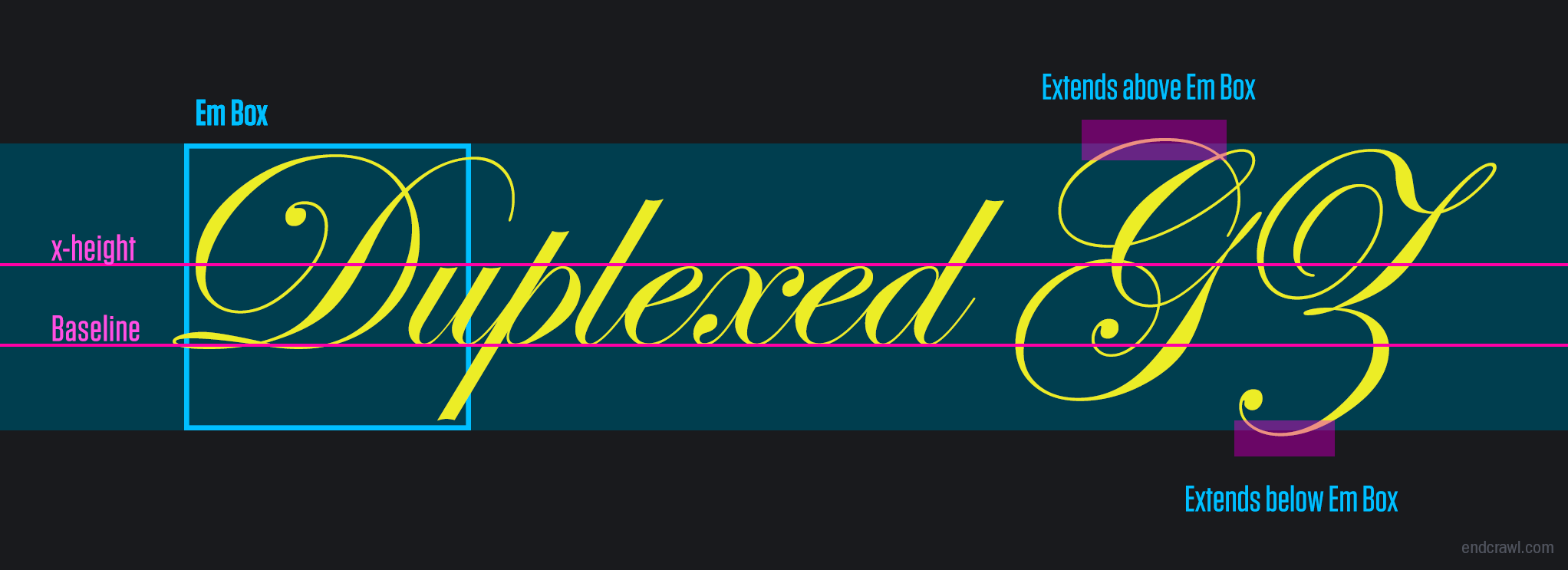
> I believe the bounding box has to fit all the possible ascenders and descenders etc., so the em-height is proportioned within the box to whatever the highest and lowest marks in the typeface are.
I wish it were this simple.
The em square != the bounding box of all glyphs. The em square is defined by the font's ascent & descent vertical metrics, which are set by the font designer.
There are reasons why you might want glyphs to escape the em square. Perhaps you're typesetting English text without accent marks above capitals, and using the bounding box's vertical maximum would introduce too much line space. Or perhaps you're using a decorative font which is designed to escape the em square, and potentially even overlap the em squares of lines above and below, like this: https://alangrow.com/images/blog/script-font-escaping-em-squ...
To make matters worse, and mostly for legacy reasons, there are THREE different sets of ascent & descent metrics in a font file. Which is used depends on your OS and the software rendering the font. But the Webfont Strategy described here is a nice one, because you can use the bounding box (winAscent & winDescent) if you really need to, say because any glyph might be used and you want to avoid em square escape: https://glyphsapp.com/learn/vertical-metrics
This nginx local dev config snippet is one-and-done:
  # Proxy to a backend server based on the hostname.
  if (-d vhosts/$host) {
    proxy_pass http://unix:vhosts/$host/server.sock;
    break;
  }
Your local dev servers must listen on a unix domain socket, and you must drop a symlink to them at eg /var/lib/nginx/vhosts/inclouds.localhost/server.sock.
Not a single command, and you still have to add hostname resolution. But you don't have to programmatically edit config files or restart the proxy to stand up a new dev server!
These are neat. I'm reminded of Claude Mellan's face of Christ from 1649. This also uses a single continuous line, but he was carving the line by hand into steel!
Gleick's "Chaos" got me sent to the principal's office in high school. I went crazy for fractals. Unfortunately all I had at home was an IBM PC XT. Mandelbrot set renderings were agonizingly slow and the CGA palette was too limiting.
Around this time my co-conspirator and I realized the library had 386s that almost no one was using for catalog search. They became our fractal render farm. We'd exit the catalog program, insert a floppy with our latest renderer, kick off a deep zoom, and turn off the monitors to avoid suspicion until we could check back next period. The results were thrilling. What a difference the access to compute made.
You all know the story -- eventually the librarian found us out and reported us for "hacking."
Who was the first person to propose FFTs for faster polynomial multiplication?
Got curious about this recently. I’m not great at citation tracing, but did make it back to this 1995 paper by David Eppstein [0] where he uses it to efficiently solve Subset Sum after an incremental update. Surely Knuth’s TAOCP had it even earlier?
The fact that FFT polynomial multiplication also lets you solve Exact Subset Sum with Repetition in sub-exponential time came as a real shock to me. [1] Crucially, this algo is O(N log N) where N = the maximum element, not N = the set size, so it isn’t a P ≠ NP counterexample or anything.
Pollard [1], Nicholson [2], and Schonhage-Strassen [3] seem to have come up with it independently around the same time, using different approaches. Strassen is said to have discovered the Pollard approach in 1968 but there is no (written) record of it.
It should also be noted that, while it was not exactly the birth of the FFT, Cooley-Tukey's 1965 paper [4] on it was what kickstarted research on FFT and its applications. This was just a few years after that.
> Sure, but how often do you need to touch that config?
More often than I’d like! tmux config has broken backwards compatibility on me multiple times over the years.
This is fine for most software — you upgrade your config once and you’re done. However, the nature of tmux is that I use it on many servers, some old and some new, some with tmux 1.x and some with 2.x. Getting a ~/.tmux.conf from my dotfiles repo that works across both has been papercutty.
Love tmux though & can’t imagine tty life without it — I run it locally as well as on remote machines.
> And on a related note, Lewis Mumford, a philosopher and writer, wrote quite a bit about how clocks were (in his view) the necessary invention for capitalism to flourish.
Szabo also takes this up in his excellent essay "A Measure of Sacrifice":
Fair broadcast and verification of time was thus of fundamental importance to the most common contractual relationship in the new European cities. In agricultural societies, including medieval Europe, serfdom and slavery had provided most of the labor. Most workers in a modern economy earn wages based on a time rate. Along with or following the rise of the time-rate institution – including the contracts themselves, the laws and regulations governing the contracts, and the technology to fairly measure the principal quantity – came the growth of related economic institutions, such as the joint stock company. These institutions enabled a boom in productivity and the spectacular rise of Europe from its darkest ages to the modern era. We will now chart the rise of the clocks and the institutions they supported.
This idea was used to great effect in Matt Might’s “Parsing with Derivatives” paper [0]! And it featured prominently in the Compilers class he taught at the University of Utah.
HTML can be described by a context-free grammar [0], but not by a regular grammar [1]. If a language can be described by a regular grammar, you can parse it with a regular expression -- that's where the "regular" in RegExp comes from!
Derivatives of RegExps don't automatically unlock parsing of context-free grammars, afaik. For that you need recursion. They do however unlock some very elegant parser designs.
Like you, we use pre-signed S3 upload urls. From there we use Transloadit [0] to crop and sanitize and convert and generate thumbnails. Transloadit is basically ImageMagick-as-a-Service. Running ImageMagick yourself on a huge variety of untrusted user input would be terrifying.