No, it’s more like HomeModem ←A→ Exchange1 ←D→ Exchange2 ←A→ ISPModem. The digital parts were all inside the telco’s networks that connect the exchanges to each other.
> Couldn't you send data at megabits per seconds over a mile long copper wire without using modems at all (using just UARTs?).
No. The exchange is sampling the analog signal coming in over your phone line at 8kHz and 8 bits per sample. They just designed modems that sent digital data over that analog link, in a way that would line up exactly with the way the exchange will sample it.
No, you let them off at the nearest station or level crossing. Here in America that would generally be within a block of where the train was supposed to stop anyway. There are a few stations with “underground” tracks that would have to let you off a little further away, but every station has some safe place to do so. It’ll be a place the crew knows about ahead of time as well.
You can do it in any train system designed to be resilient to failures. The Germans have apparently designed a system that incentivizes (or even forces) the conductor (or the dispatchers) to do ridiculous things that waste hours of their customer’s time to fix instead of simple and obvious things that take minutes to fix like just stopping at the next available station.
Around here if the Conductor gets a call from dispatch telling him that a station is unavailable, the dispatcher will already have cleared the train to stop at some logical alternate location. That might mean another train station in the same city or a specific level crossing. It might mean delaying or stopping conflicting traffic. They’ve thought ahead and planned a way to fix the problem _without_ carting passengers an hour out of their way.
Same here. An Amtrak train would just stop at the next convenient road crossing, if there were really something preventing them from stopping at the scheduled station. Most Amtrak stations don't even have staff, or any way to prevent people from coming and going, so this would most likely involve construction on the station platform itself. That’s fairly rare but the last time I took the Zephyr headed east there was exactly that situation. The construction crews had the whole platform blocked off so we boarded at the road crossing a block away.
They can't realistically do this in Germany because the tracks are so much more busy than the US. There would more than likely be a train coming the other direction within the next few minutes, and they cannot guarantee all the people have time to vacate the track area.
Right, but Germany has stations every few miles. Here in America the next station might be hours and hundreds of miles away. Better to stop ¼ mile away instead; people will hardly know the difference. The point is that if for any reason they cannot reach the station then they’ll always stop at the nearest safe place instead. The crew always have an alternate stop.
For really long construction work they’ll actually build an entirely separate train station, like they did in Denver Colorado a few years back. They knew that the construction of the new station downtown would take a few years, so they built a really cheap platform a few miles away on a siding and moved all the arrivals and departures there for the duration.
Yeah, I was on Amtrak in North Dakota somewhere and we got stopped for a couple hours waiting for a plow train. So like half the train got off in the middle of this field to play in the snow while we waited.
The Amtrak people I've met over the years pretty clearly want to do a good job in a system that is stacked against them.
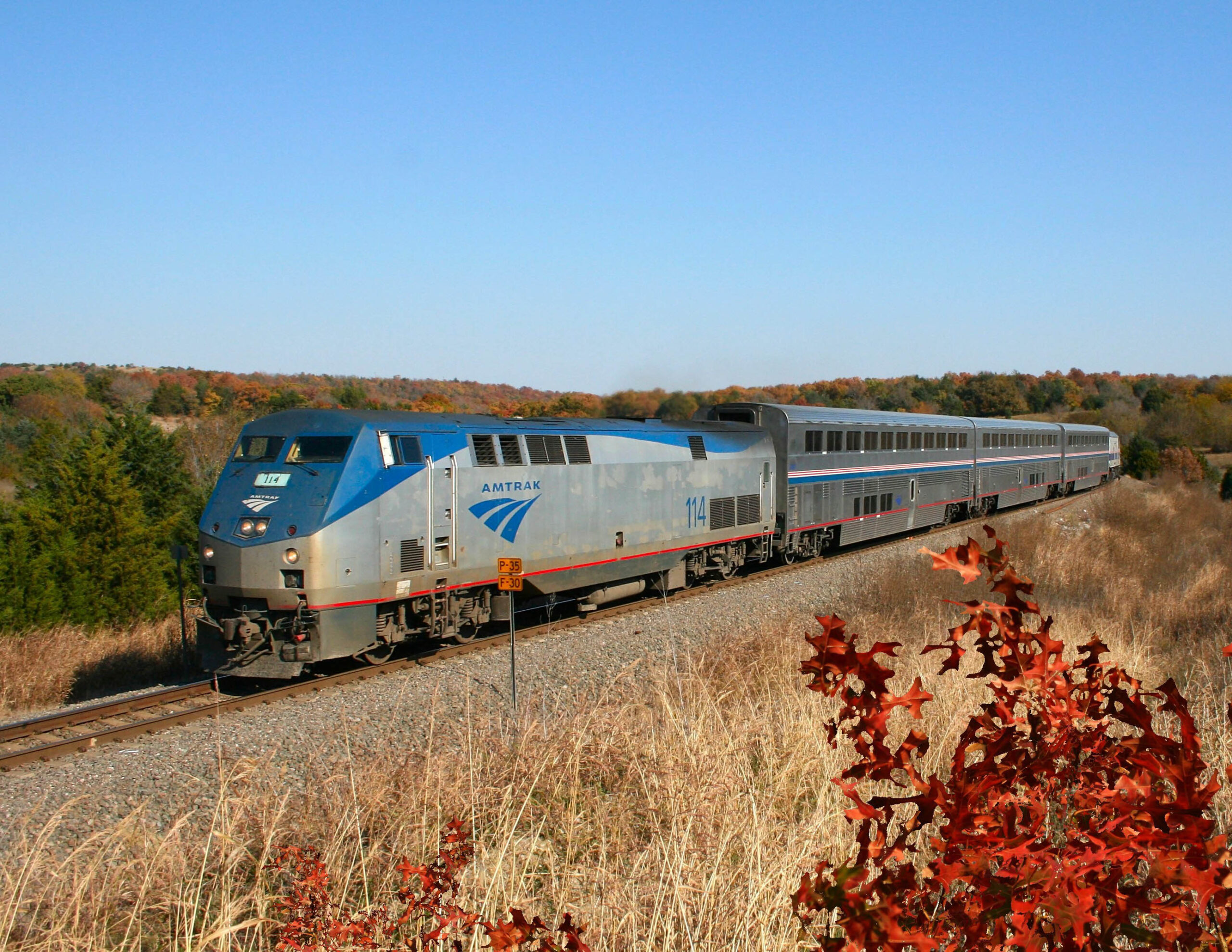
I don't understand ome detail of this story: Amtrak platforms are about 110cm high. That's more than waist high for most people. So how do you let people get on and off at a grade intersection instead of at a platform?
Looks like we both had incomplete information. I didn't know that some trains have their doors really close to the ground and it's actually very inconsistent. I'm getting a clearer picture now.
It is at least consistent within any one Amtrak route. The ones that go through the north east have to go through tunnels that can only accommodate single–level cars, while all the other routes have the double–level cars where the doors are really close to the ground.
I've ridden on Amtrak trains. The door for the passenger compartments is in the middle of the observation cars, the oval on the lower level is the window on the door. You can see 3 of them on the 3 cars. The crew would put out a step at stops which was helpful considering the age of most of the passengers.
Up top are seats and maybe a lounge, below are bedrooms, bathrooms, and storage. There's a spiral staircase to change levels.
The locomotive has steps right outside the wheels with handrails.
It's pretty obvious where the doors are (middle), which have windows. My point, replying to my parent, was that they said Amtrak platforms are at 110cm height. The lowest part of those doors are not at 110cm height, but much lower, almost as if the platform was much much lower than my parent claimed ;)
And yes, trains do exist, which either have doors at two different heights (these don't seem to) or that either automatically fold away so you can get out at ground level via the stairs that are revealed/created by the mechanism or that simply stay up for platform height entry/exit. Used both types. Now, whether or not Amtrak has those in specific parts of the US I can't say.
If your computer fails to sleep, or fails to wake up correctly after sleeping, when running Linux then the problem is almost always the hardware manufacturer’s fault. Many motherboards come with frankly broken ACPI tables that should never have made it out of QA. Remember this (<https://news.ycombinator.com/item?id=45271484>) recent story? This is just the tip of the iceberg. For every well–researched story we have about ACPI problems there are a dozen more that are quietly fixed by Linux kernel developers (who instruct the kernel to simply ignore the broken ACPI tables and write a custom kernel driver to do the work instead) and an unknown but presumably large number that never come to the attention of a kernel developer.
It's not that Linux is "bad" when the hardware is incompatible, it's not "Linux's fault". It's that, at a certain age, I don't want to spend my precious few hours of free time working _on_ my computer, I just want it to work.
(big fan of MacOS, and esp. third-party Mac software, the quality of which simply does not exist on any other platform)
(Also, I have huge affection for Linux. I used Linux exclusively for years personally, and any place I could sneak it into my work environment)
Yea, from the outside looking in it seems so obvious and it’s easy to blame them for overspending. But it’s different when you’re the one who is addicted. Breaking the addiction requires that moment of realization when you finally add up all the real costs and realize how big they are. The only good thing that can be said about Free–to–play games is that adding up the monetary costs is super easy.
If you pay extra for that. Meanwhile _any_ CRT could trade off resolution for refresh rate across a fairly wide range. In fact the standard resolutions for monitors were all just individual points in a larger space of possibilities. They could change aspect ratio as well. This can be quite extreme. Consider the 8088 MPH demo from a few years back (<https://trixter.oldskool.org/2015/04/07/8088-mph-we-break-al...>). See the part near the end with the pictures of 6 of the authors? That video mode only had 100 lines, but scrunched up to make a higher resolution.
Well, we are discussing a CRT TV that was $40k new a life time ago, so perhaps the fact that it costs $599 to get a 480Hz OLED today is not a consideration. To the point though: it is a fallacy to believe that CRTs could arbitrarily shape their resolution. While the input signal could cover a wide range of possible resolutions and refresh rates depending on the bandwidth supported, the existence of apperture grilles or shadow masks imposed a fixed digital reality that limited the maximum possible resolution to much lower values than the typical 4k panels that we have today. The "pixels" didn't become larger on lower resolutions: they just covered more dots on the mask. We can get much better results today with scaling than we ever could on CRTs, as awesome a technology as they were 40 years ago.
Sure, but 99% of that cost was paying for the absurd physical dimensions of that particular television.
> The "pixels" didn't become larger on lower resolutions…
Strictly speaking, the CRT only had discrete lines not pixels. Within a line the color and brightness could change as rapidly or slowly as the signal source desired. It was in fact an analog signal rather than a digital one. This is why pixels in many display modes used by CRTs were rectangular rather than square.
> We can get much better results today with scaling than we ever could on CRTs…
I say it’s the other way around! No ordinary flat–panel display can emulate the rectangular pixels of the most common video modes used on CRTs because they are built with square pixels. You would have to have a display built with just the right size and shape of pixel to do that, and then it wouldn’t be any good for displaying modern video formats.
Seems irrelevant to bring up cost for something that is streamline-priced today, but sure, let's move on.
> Strictly speaking, the CRT only had discrete lines not pixels.
The electron gun moves in an analog fashion, but when it hits the glass surface, it can only go through specific openings [1]. These openings are placed at a specific distance apart [2]. This distance specifies the horizontal, digital, max CRT resolution.
> No ordinary flat–panel display can emulate the rectangular pixels of the most common video modes used on CRTs because they are built with square pixels.
Today's panels have achieved "retina" resolution, which means that the human eye cannot distinguish individual pixels anymore. The rest is just software [3].
AC current paralyzes by alternately contracting and relaxing your muscles, 60 times per second. This tends to lock you in place because the electricity is a higher voltage than your nerves and overrides any command you send every 60th of a second. It could take you several minutes to die, and you will be suffering in pain and terror the whole time as you are unable to let go…
DC current jolts you “across the room“ by contracting your muscles all at once. Of course the exact effect depends on your posture; sometimes it just makes you stand upright or pull your arms in. This tends to disconnect you from the source of the electricity, limiting the damage. Note that if you cannot actually jump all the way across the room then the jolt probably can’t knock you all the way across the room either. If you fall over your head could end up pretty far away from where it started, though, and if you lose consciousness even for a little while then that can affect your perception too. It could certainly throw the screwdriver all the way across the room.
If you pay attention to the special effects that show up in movies and television you’ll soon realize that they simulate shocks by putting the actor in a harness and then pulling on it suddenly. This sudden movement away from the source of the “shock” stops looking very convincing when you notice that the movement starts at their torso rather than in their legs and arms.
I have been electrocuted twice once as a kid (which I don't remember but my parents reminded me) and once as a teenager which I definitely remember. My country's voltage was 240 volts at 50 Hz. I remember screaming uncontrollably as the current flowed through my arm and chest but managed to drop the live wire. The floor was parquet: wood.
I remember putting some keys into an electrical socket when I was quite young. My hand must have bridged live and neutral, so the current only flowed from thumb to forefinger rather than through my chest to my feet. But it was accompanied by a flash of light and an arc that I saw as a forked tongue. I told my mom that it had bitten me :)
Yea, so? Debian goes back 32 or more years, and quilt dates to approximately the same time. It’s probably just a year or two younger than Debian.
At Mozilla some developers used quilt for local development back when the Mozilla Suite source code was kept in a CVS repository. CVS had terrible support for branches. Creating a branch required writing to each individual ,v file on the server (and there was one for every file that had existed in the repository, plus more for the ones that had been deleted). It was so slow that it basically prevented anyone from committing anything for hours while it happened (because otherwise the branch wouldn’t necessarily get a consistent set of versions across the commit), so feature branches were effectively impossible. Instead, some developers used quilt to make stacks of patches that they shared amongst their group when they were working on larger features.
Personally I didn’t really see the benefit back then. I was only just starting my career, fresh out of university, and hadn’t actually worked on any features large enough to require months of work, multiple rounds of review, or even multiple smaller commits that you would rebase and apply fixups to. All I could see back then were the hoops that those guys were jumping through. The hoops were real, but so were the benefits.



> Couldn't you send data at megabits per seconds over a mile long copper wire without using modems at all (using just UARTs?).
No. The exchange is sampling the analog signal coming in over your phone line at 8kHz and 8 bits per sample. They just designed modems that sent digital data over that analog link, in a way that would line up exactly with the way the exchange will sample it.
reply